

Key takeaways from the Polish Economic Illusion analysis
Behind the government's optimistic macroeconomic propaganda lies a starkly different reality for the average Polish citizen. The severe gap between official statistics and daily survival has exposed a deeply fractured labor market and a collapsing standard of living:
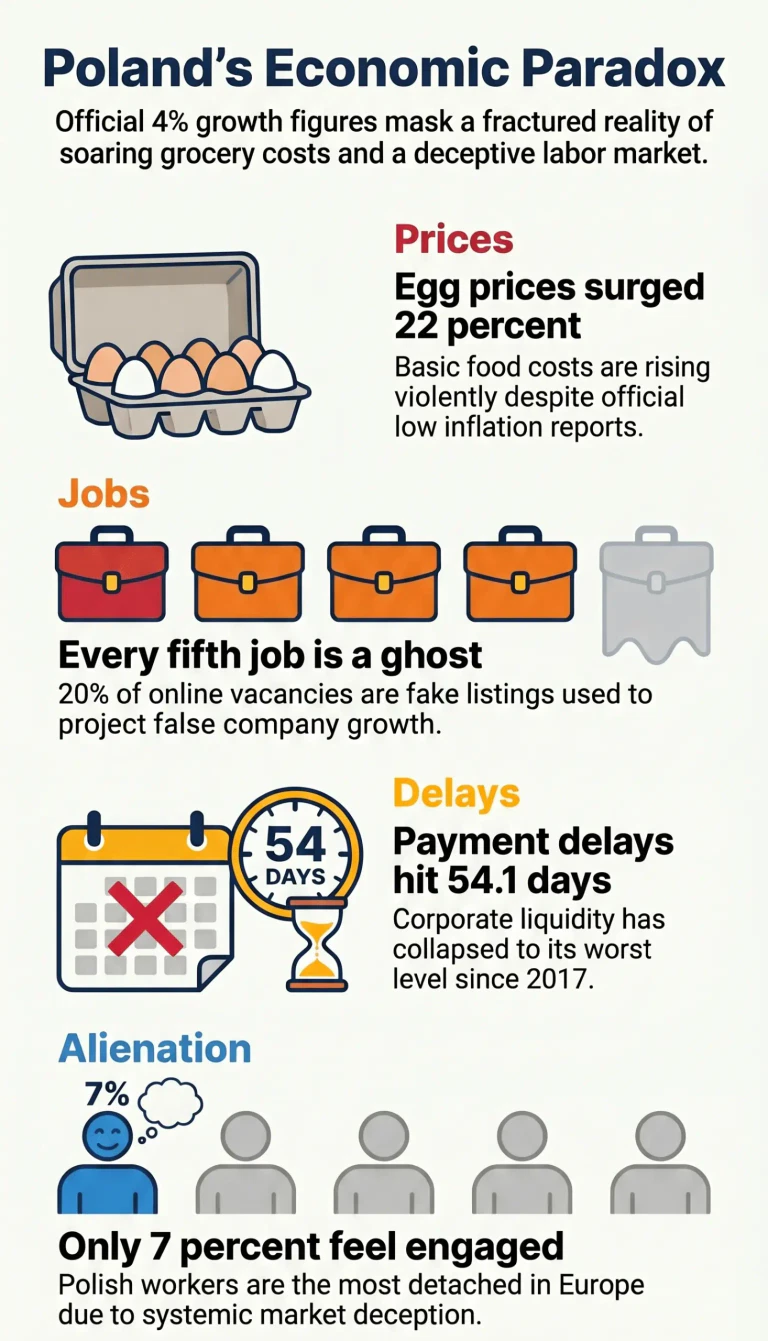
- 1. The macroeconomic facade and cost of living crisis While the state projects 4.0% GDP growth, actual purchasing power is violently collapsing. With basic essentials surging (eggs up 22%) and Warsaw real estate approaching 23,000 PLN per square meter, the disconnect between state propaganda and daily economic survival is breeding deep societal cynicism.
- 2. A predatory and illusionary labor market The employment landscape relies heavily on artificial demand, with one in five online vacancies operating as deceptive "ghost jobs." Candidates endure exhausting, predatory recruitment cycles only to face systemic discrimination—where age, gender, and postal codes strictly dictate career outcomes and block social mobility.
- 3. Corporate illiquidity and the death of engagement Beneath the surface, the business infrastructure is under severe financial stress, evidenced by corporate payment delays stretching to 54.1 days in 2026. This toxic corporate environment has completely alienated the workforce, leaving a mere 7% of Polish employees feeling genuinely engaged in their roles.
The macroeconomic growth disconnect
The state points to the GDP. The worker points to the egg. We are told the Polish economy is a regional powerhouse. Politicians celebrate a trillion-dollar output. Government reports forecast a 3.5% economic growth for 2026. The European Bank for Reconstruction and Development shares this optimism. ING analysts forecast 3.7% growth for the year. The narrative is clear. The state claims dynamic economic development. The numbers look impressive on a spreadsheet.
Reality operates entirely outside the spreadsheet. The construction sector collapsed early in 2026. Output fell by 13.7% in February. Industrial output contracted by 1.5% in January. The state runs a massive general government deficit. The deficit hit 6.8% of GDP in 2025. Public debt will reach 64.9% of GDP by 2026. The debt-to-GDP ratio will climb to 69.2% by 2027.
| Economic Indicator | 2025 Actual | 2026 Forecast | 2027 Forecast |
| GDP Growth (YoY) | 3.2% | 3.5% | 2.8% |
| Inflation (YoY) | 3.4% | 2.9% | 3.7% |
| Government Deficit (% GDP) | -6.8% | -6.3% | -6.1% |
| Public Debt (% GDP) | 59.5% | 64.9% | 69.2% |
Why do we pretend the market is healthy? Growth relies heavily on public investment and EU funds. Private sector investment remains weak. Companies delay projects due to borrowing costs. Global trade friction hurts exports. The state buys debt. The citizen buys groceries. This is the macroeconomic illusion.
Consumers feel the weight of this illusion daily. Inflation fell to 3.4% in 2025, but absolute prices remain high. Energy shocks from the Middle East hit the market. Households save more because they fear the future. Consumption requires disposable income. Real disposable income struggles to keep pace with basic needs.
Creative accounting and global debt
The Polish economy does not exist in a vacuum. The global financial system relies on borrowed time. The global debt reached 348 trillion dollars in 2025. Public and private sectors borrow relentlessly. Analysts describe this as eating the marshmallow today. We ignore the bill coming tomorrow. The global debt burden drags down real productivity.
Technology was supposed to save us. Experts promised artificial intelligence would boost productivity. The data shows the exact opposite. AI increases energy consumption faster than output. Companies deploy technology to look innovative. They do not increase actual efficiency. This creates a facade of progress. Polish companies adopt this mindset eagerly.
Firms post impressive revenue numbers. They hide the collapsing profit margins. DataWalk reported a 118% revenue increase in early 2025. Analysts praised this growth. They ignored the lack of actual profits. This is creative accounting. You focus on top-line growth. You ignore the structural decay underneath. The corporate revenue facade tricks investors.
We see this across the entire economy. US tariffs on China disrupted global trade. Chinese exports shifted to Europe. Poland feels the indirect impact. Weaker demand from Germany hurts Polish factories. The government ignores these macro vulnerabilities. They focus only on the domestic political cycle. They need the numbers to look good.
Measuring wealth in eggs and butter
Let us look at the cost of living. We can measure wealth in official statistics. We can also measure it in eggs. In February 2026, egg prices jumped by 22%. A single egg costs up to 1.28 PLN. Poland is the fourth-largest producer of eggs in the EU. We produced 12.4 billion eggs in 2024. Yet the domestic consumer pays a premium. This is the grocery store reality.
| Food Item | Price Trend (Early 2026) | Market Context |
| Eggs | +7.5% to +22.2% YoY | 1.05 - 1.28 PLN per unit |
| Butter | -30% YoY | Price correction after peak |
| Pork Loin | Price decrease | Oversupply in market |
| Ham | Price increase | Processing costs rising |
| Dill / Parsley | Price increase | Energy costs for greenhouses |
| Data source: Central Statistical Office (GUS) April 2026. |
Some prices dropped. Butter became 30% cheaper. Pork loin prices fell. But ham became more expensive. Even dill and parsley cost more. The cost of a traditional holiday meal fluctuates wildly. Official inflation sits around 3%. The inflation of daily survival feels much higher.
Statistics obscure the daily struggle. The Central Statistical Office publishes average disposable income. In 2024, it reached 3,167 PLN per person. Expenses took 1,878 PLN. Nearly 19% of households survive on less than 2,000 PLN per person. Only 8.6% exceed 6,000 PLN. The income distribution gap widens quietly.
The state ignores the poorest citizens. They highlight the macroeconomic averages. Averages hide extreme outcomes. If one person earns a million, everyone looks rich. The average citizen knows the truth. They count their money at the checkout counter. They skip the ham. They buy the cheaper eggs.
The wage disparity failure
Wages offer little comfort. The national average wage looks great on paper. In March 2024, it reached 8,604 PLN gross. This equals roughly 2,230 USD. But averages distort the truth. The median wage tells the real story. Half of the workforce earns less than 6,549 PLN gross. The gap between the average and the median is nearly 24%. This exposes the wage disparity failure.
| Wage Metric (March 2024) | Gross Amount (PLN) | Equivalent (USD) |
| National Average | 8,604.72 | ~$2,230 |
| National Median | 6,549.22 | ~$1,698 |
| Male Average | 8,885.90 | ~$2,307 |
| Female Average | 8,311.91 | ~$2,158 |
| Minimum Wage (Jul 2024) | 4,300.00 | ~$1,115 |
The minimum wage rose to 4,300 PLN in July 2024. This translates to about 3,261 PLN net. Try paying rent with that. Try buying food. The gender pay gap persists. Men earn a median of 6,770 PLN. Women earn less. Large companies pay more. Small companies pay less.
The minimum wage hike distorts the market. It rose by 17.8% in January 2024. This compresses the wage scale. Experienced workers earn barely more than entry-level staff. This destroys motivation. Productivity stagnates. Companies refuse to grant real raises. They blame the state mandate.
Employment figures mask the rot. Employment in the enterprise sector fell by 0.2% in early 2024. Companies stopped hiring. They run skeleton crews. They squeeze more work from existing staff. The corporate efficiency mandate burns people out. The state claims wages beat inflation. The worker feels poorer every single month.
The housing affordability collapse
Look at the real estate market. The state celebrates dynamic development. The average citizen measures wealth in square meters. Poland has a high homeownership rate. Over 87% of Poles own their homes. This is a historical artifact. It reflects post-communist privatization. It is not a sign of current affordability. A budget of 100,000 USD buys almost nothing today. It buys a tiny studio under 25 square meters. You must look in outer districts like Białołęka. This defines the housing market crisis.
| Warsaw District | Average Price / sqm (PLN) | Market Segment |
| Śródmieście | 23,000 | Premium / Central |
| Secondary Market Average | 18,700 | Established stock |
| Primary Market Average | 17,400 | New developer builds |
| Rembertów | 13,600 | Budget / Outer |
Prices doubled over the past ten years. Nominal gains hit 120%. In Warsaw, the secondary market averages 18,700 PLN per square meter. New developer apartments average 17,400 PLN. Location changes everything. Śródmieście demands 23,000 PLN per square meter. Rembertów asks for 13,600 PLN.
Prices dipped slightly in late 2025. Transaction prices dropped 0.8% on the primary market. The secondary market saw a 0.4% drop. Analysts called this a victory. Bank Pekao noted an improvement in affordability. The average salary buys 11% more space than before. This is cold comfort. You still need years of total salary to afford a basic apartment.
Foreign buyers face hidden costs. The 2% PCC tax on secondary market purchases adds massive fees. A typical Warsaw apartment incurs a 14,000 PLN tax penalty. High mortgage rates freeze the market. Public housing covers less than 6% of the stock. The private ownership monopoly locks young workers out.
The ghost job epidemic
The labor market relies on a core deception. You need a job. The company posts a job. You apply. Nothing happens. This is not an accident. This is a deliberate strategy. In 2025, one in five job postings online were fake. These are ghost jobs. They are kept live with no intent to hire. This is the fictional recruitment economy.
Why do companies do this? The reasons are cynical. Four out of ten companies admit to publishing fake offers. Over 81% of recruiters post offers without intending to hire. Budgets are tight. Managers delay approvals. They keep postings live just to be ready. Job boards reward activity. It is easier to refresh an old post than close it.
| Motivation for Ghost Jobs | Percentage of Managers | Actual Business Purpose |
| Pacify overworked teams | 63% | Signal false hope of incoming help |
| Scare current employees | 62% | Prove staff are easily replaceable |
| Project company growth | 40% | Manipulate optics for investors |
| Build talent pipeline | >33% | Harvest CVs for future use |
Some reasons are purely optical. Over 40% of managers use fake ads to project growth. They want to look successful to investors. Some reasons are manipulative. Nearly 63% of managers use ghost jobs to pacify overworked teams. They signal that help is coming. Help never comes. Another 62% use fake jobs as a scare tactic. They show current employees how easily they can be replaced.
The IT sector is deeply infected. Up to 21% of IT job offers are ghost jobs. Companies harvest resumes. They build talent pipelines for the future. They test market rates without spending money. They test you. They exploit your time. The corporate data extraction treats candidates like free research.
Symbolic violence in corporate recruitment
We see this scam in plain sight elsewhere. Entertainment agencies lure people in shopping malls. They promise lucrative acting roles. They charge 80 PLN for registration. They push 390 PLN photo sessions. People work as extras on film sets. They never get paid.
This literal casting scam mirrors the corporate world. The corporate interview is a performative labor audition. You perform your skills. You do free labor. You get rejected because the role was meant for an internal promotion. Compliance rules force companies to post externally. You never had a chance.
We must apply sociological precision here. Michel Foucault described symbolic violence. It is power exercised without physical force. It relies on manipulation and hidden rules. The modern HR system is pure symbolic violence. The algorithm rejects you. The recruiter ghosts you. You internalize the failure. The corporation maintains absolute dominance.
Karl Marx described the alienation of labor. He argued that capitalism divorces the worker from the product of their work. The worker has no control. Today, alienation occurs before the job even starts. The candidate is alienated from the application process. You submit your data. It becomes a commodity. You have no control over how it is used. The employer extracts value from your application to test the market. You receive nothing.
The hyper-specialized IT trap
Look closely at the technology sector. It is supposedly the crown jewel of the Polish economy. In 2025, IT job postings increased by 44%. Backend roles dominated at 20.1%. Data roles took 12.4%. But the competition is brutal. A frontend role averages 78 resumes per vacancy.
Companies demand extreme specialization. They want High Availability Systems Engineers skilled in Elixir. They want Open RAN engineers for telecom. They want TinyML experts for IoT. They want Bioinformaticians. If you do not fit the exact niche, you are discarded. This defines the hyper-specialized tech market.
The nature of employment shifted completely. Salaries increased mostly for B2B contracts. Permanent employment grows much slower. Why? B2B shifts the tax burden to the worker. It removes labor protections. It is cheaper for the corporation.
Junior developers face a closed door. Demand for junior positions fell by 4%. Companies want seniors. They want technical interim managers who can rescue failing projects. They do not want to train you. They want to consume your existing expertise. The corporate training deficit destroys entry-level careers.
Algorithmic noise and artificial demand
Technology accelerates the deception. Bots and auto-apply tools blast hundreds of resumes in minutes. This creates the illusion of high demand. Recruiters drown in AI-generated CVs. They use AI to filter the noise. The process becomes a battle of machines.
The human candidate loses. Every ghost job chased is a real one missed. Time is wasted. The Wall Street Journal reported ghost jobs account for up to 22% of active listings. A Greenhouse survey found 36% of job seekers applied to unfilled roles. The result is a broken feedback loop. The government uses job openings to measure economic health. The data is compromised. This is a statistical hallucination.
Job postings do not equal jobs. They equal marketing. The Beveridge curve is distorted. Analysts overestimate market health. If leaders assume the market is hot, they make bad fiscal decisions. Ghost jobs warp billion-dollar policies.
The candidate pays the price. Over 61% of candidates get ghosted after an interview. They complete trial tasks. They submit projects. They hear nothing back. Silence breeds cynicism. Three out of five candidates suspect they applied for a fake job. Trust between employer and employee evaporates.
The collapse of workforce engagement
The worker understands the game. They see the ghost jobs. They feel the inflation. They experience the alienation. Their response is entirely rational. They stop caring.
Gallup tracks global employee engagement. The data for Poland is staggering. Only 7% of Polish workers feel engaged at work. Let that sink in. Ninety-three percent of the workforce is detached. This is the lowest engagement rate in Europe. It is tied with Croatia. This represents a workforce motivation crisis.
| Engagement Metric | Poland | Europe Average | Global Average |
| Actively Engaged | 7% | 12% | 23% |
| High Daily Stress | 47% | 39% | 40% |
| Thriving Well-being | 39% | 49% | 34% |
| Looking for New Job | 59% | 57% | 52% |
The cost of this disengagement is massive. Gallup estimates it costs the global economy 10 trillion dollars. This equals 9% of global GDP. Workers do the bare minimum. They are actively disengaged. Why should they care? The company lies in its job ads. The state lies about the economy.
Stress is a constant companion. High daily stress is reported by 47% of Polish workers. Only 39% say their well-being is thriving. Around 12% report feeling daily anger. Only 43% feel they are managing well.
The middle-management squeeze
The crisis hits leadership hardest. Mangers used to be the most loyal employees. Not anymore. Global manager engagement dropped to 22%. This is a nine-point drop since 2022. Gallup calls this the shrinking privilege of management.
Managers are squeezed from both sides. Executives demand higher productivity. Teams demand better conditions. The manager sits in the middle. They must enforce rigid corporate mandates. They must administer the ghost job strategies. They carry the burden of the middle-management squeeze.
Organizations want to implement AI to fix productivity. But technology alone fails. Only 12% of workers think AI changed their work. Nearly 89% of leaders see no productivity boost from AI. AI intensifies work instead of reducing it. Workers fear automation. Among companies using AI, 23% of employees fear losing their jobs.
Max Weber defined the iron cage of rationalization. We see it here perfectly. Management relies on metrics instead of meaning. The system optimizes for short-term KPIs. It destroys long-term human value. The best organizations succeed through human leadership. Engaged managers build engaged teams. But you cannot mandate engagement. Trust requires honesty. Honesty is absent from the modern market.
Structural discrimination and the false meritocracy
The market claims to reward talent. The data exposes this lie. Discrimination dictates outcomes. A Staffly report shows severe biases. Over 54% of respondents cite age as a major barrier. If you are over fifty, you are invisible. This is the structural ageism barrier.
| Discrimination Barrier | Affected Respondents | Specific Impact |
| Age | 54.1% | Excludes candidates over 45 |
| Gender (Female) | 54.0% | Pay gaps and promotion ceilings |
| Gender (General) | 39.1% | Overall sex-based bias |
| Geography (Postal Code) | 30.6% | Small-town candidates rejected |
Gender bias remains entrenched. Nearly 39% of workers experience sex discrimination. For women, this figure jumps to 54%. Even your address works against you. Over 30% say their postal code limits their career. Coming from a small town closes doors in Warsaw.
Leaders preach inclusion. They practice exclusion. They ask for diverse candidates but hire the same profile. They rely on algorithms that replicate human biases. The system filters out anyone who does not fit the template.
This happens while the state complains about demographic collapse. Poland's population shrinks rapidly. The state needs workers. Yet companies discard older workers under the guise of "rejuvenating" teams. They push out loyal employees of twenty years. This is age discrimination wrapped in corporate jargon.
The illusion of transparency and feedback
New laws attempt to fix the market. Since late 2025, companies must publish salary ranges before signing a contract. Candidates demand transparency. Over 62% expect salary ranges directly in the job ad. Ads with visible salaries attract 12% more applicants.
But transparency of the salary means nothing if the job is fake. A ghost job with a clear salary range is still a ghost job. The financial incentive is the main reason people change jobs. Over 54% switch for better pay. But other factors drive turnover. Lack of recognition pushes 35% to leave. Stress breaks 32%. Organizational chaos drives out 31%.
Workers want out. Nearly 59% of Poles believe it is a good time to find a new job. They are looking for an escape. They browse job boards. They send applications. They hit the wall of the algorithmic resume filter.
Out of desperation, candidates lie. The rise of fake CVs is staggering. Candidates inflate skills and invent work histories. HR responds with extreme verification. Laid-off workers feel ashamed. They hide their dismissal. They claim they took a planned sabbatical. The system punishes honesty. The system rewards deception.
The corporate liquidity crunch
Look at how companies treat each other. It mirrors how they treat workers. Payment delays are worsening. The Coface survey shows average payment terms rose to 54.1 days. This is the highest level since 2017.
Discipline is deteriorating. In the metals sector, delays average 64 days. Agri-food hits 61 days. Construction faces 59 days. The number of companies free of overdue payments dropped from 14.6% to 8.5%. Insolvencies hit a record 6,566 cases.
| Sector | Average Payment Delay (Days) | Market Pressure |
| Metals | 64 | High raw material costs |
| Agri-Food | 61 | Inflation and supply chain |
| Construction | 59 | Borrowing costs and weather |
| National Average | 54.1 | Highest since 2017 |
Firms face high interest rates. They face rising labor costs. They face cheap Chinese competition. Chinese imports grew by 11.4%. Polish exports to China fell by 7.5%. This squeezes profit margins. Companies delay payments to survive. This is the corporate liquidity crunch.
When companies cannot pay suppliers, they do not hire. But they still post jobs. They post ghost jobs to look healthy to creditors. The deception serves a financial purpose. They need banks to believe they are expanding.
Energy shocks and systemic fragility
The broader economy remains highly fragile. A single cold month derails the statistics. Severe weather struck early in 2026. Low temperatures froze economic performance. Construction output plummeted in February. It fell by a staggering 13.7%. Industrial output barely rebounded. This exposes our systemic economic fragility.
Then an energy shock hit the market. Military conflict erupted in the Middle East. Energy prices surged instantly. This weighs heavily on consumer confidence. Higher prices constrain household consumption. Solid growth requires a lower savings rate. But afraid people do not spend. They save money because they expect disaster.
The energy transition is a mess. Politicians argue over coal versus nuclear power. The current system relies on unpredictable renewables. Wind power fluctuates wildly. Storage capacity remains hopelessly inadequate. The state plans massive offshore wind farms. But the grid cannot handle the load.
Wage growth stabilized at 6%. This barely matches the central bank target. The National Bank of Poland refuses to cut rates. The policy rate stays at 3.75%. Downside risks mount daily. The state ignores the structural rot.
Demographic collapse and the Poznań metric
The system cannot sustain itself. Demographics guarantee a collision. Poland loses the equivalent of a major city's population every five years. The population drop equals the size of Poznań. The fertility rate remains stagnant. It is the lowest in the Visegrad Group.
The state relies on immigration to plug the holes. We see a surge of foreign students. Students arrive from India, Zimbabwe, and Nigeria. The share of Polish diaspora students shrinks. But immigrants also need housing. Immigrants also face the ghost jobs. Immigrants also buy eggs. The structural flaws do not vanish because the workforce changes.
The education system tries to adapt. The Ministry of Education plans reforms to teach critical thinking. They want to prepare students for technology and AI. They hope to fix the demographic labor deficit. But critical thinking will only make the next generation more cynical. A critical thinker looks at a job board and sees the fraud. A critical thinker looks at the housing market and leaves the country.
The registered employment paradox
The macro data contradicts the micro experience. In late 2025, registered unemployment was 5.7%. Only 887,900 people were registered as unemployed. Eurostat put the figure even lower, at 3.2%. These are historically low numbers.
Yet, the number of actual job offers is shrinking. In July 2025, offers dropped by 9% year-over-year. August saw similar declines. September 2025 brought only 41,100 new offers to labor offices, down from 80,800 the previous year. December saw only 20,800 vacancies. The market is tightening rapidly.
Pracuj.pl boasted 762,000 job offers in 2025. Sales roles dominated at 19%. Physical labor accounted for 17%. IT took 10%. But how many of these were real? If 20% are ghost jobs, then 150,000 of those offers were phantoms. The registered employment paradox hides the truth.
Emile Durkheim described anomie as the breakdown of social norms. When the rules no longer reflect reality, society fractures. The employment statistics are pure anomie. The state claims full employment. The worker sends fifty CVs and gets zero replies. Both things cannot be true simultaneously.
State propaganda and the construction narrative
The government pushes a relentless narrative. They talk about "Polska w budowie". They claim the nation is building the future. They point to new infrastructure. They ignore the absurd costs.
Investments happen because of EU funds, not local genius. Projects suffer endless delays. Costs are double the Western European average. The state extracts taxes to fund this. The proposed digital tax on tech giants might raise 3 billion PLN by 2030. But who pays? The platforms will pass the cost to advertisers. The advertisers will pass it to consumers.
The political class demands optimism. They reject cynicism. They instruct politicians not to complain. They blame delays on bad contractors. But cynicism is the only rational response to manipulated data. When the state says GDP grew 4%, the citizen asks why a studio apartment requires a 30-year mortgage. When the HR department boasts about a dynamic team, the applicant asks why the job posting has been active for eight months. This is the state propaganda disconnect.


