

Key takeaways from the structural collapse analysis
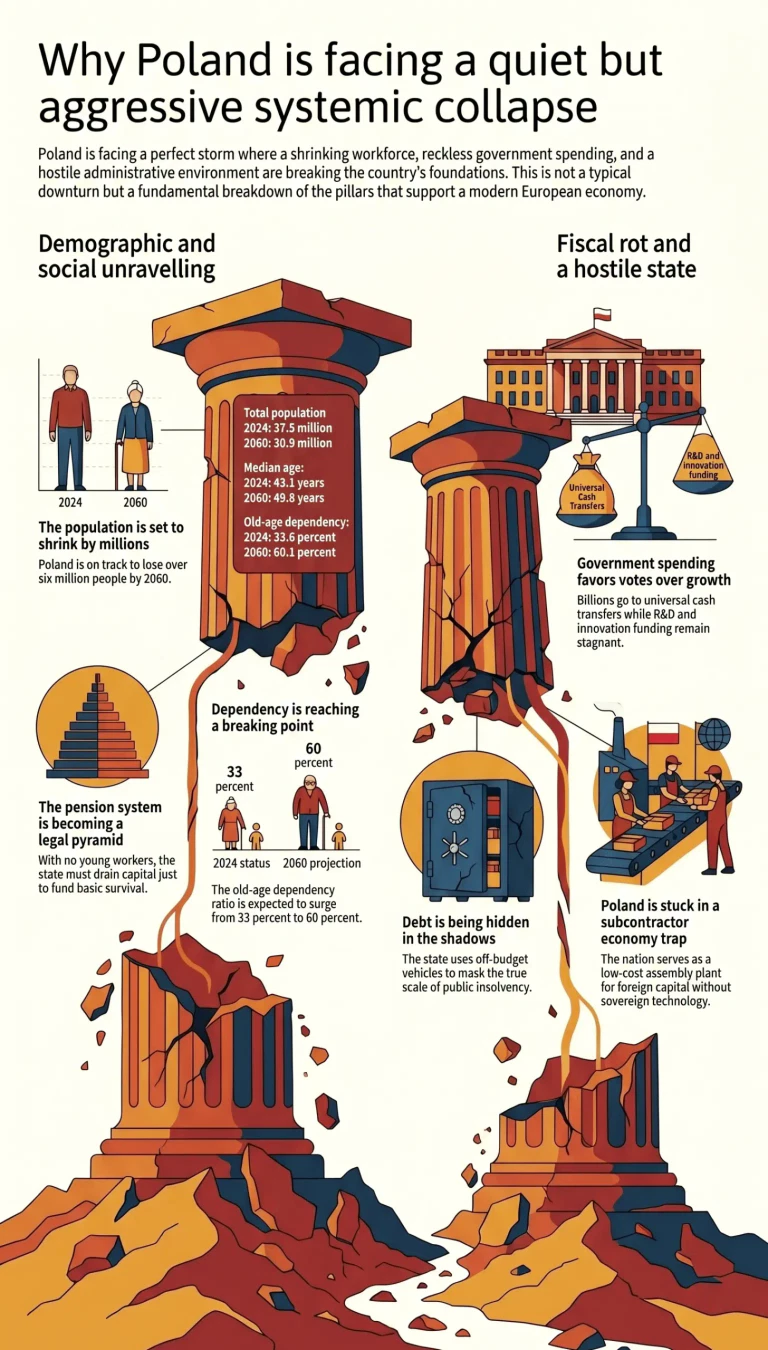
The convergence of an inverted demographic pyramid, reckless fiscal policy, and a hostile administrative apparatus is driving the nation toward functional insolvency and systemic collapse:
- 1. Demographic implosion and pension insolvency A rapidly shrinking workforce and an aging population have mechanically broken the welfare state. The pay-as-you-go pension system is actuarially insolvent, requiring massive central budget transfers that drain capital away from productive investments to fund immediate biological survival needs.
- 2. A hostile state prioritizing consumption over capital The government treats private enterprise with predatory hostility through a volatile, aggressively complex tax code. Instead of funding critical R&D or long-term infrastructure, the state squanders capital on short-term electoral cash transfers, masking the true scale of its debt through opaque, off-budget vehicles.
- 3. The subcontractor economy and elite vacuum Lacking sovereign technological patents, the nation is trapped in a "banana republic" middle-income trap, serving merely as a low-cost assembly plant for foreign capital. This is exacerbated by a clientelist political elite that routinely cancels existential infrastructure projects (like nuclear energy and transit hubs) for petty partisan gains.
The structural integrity of the Polish state is currently undergoing a silent but aggressive disintegration. This is not a temporary cyclical downturn, but a permanent unravelling of the foundational pillars that sustain a modern European economy. The convergence of an unprecedented demographic implosion, rampant fiscal irresponsibility, systemic hostility toward the working class, and a profound vacuum of intellectual elites has set the country on a trajectory toward functional insolvency. Stripped of the illusion provided by European Union subsidies and the historical momentum of post-communist transition, the bare mechanics of the state reveal a deeply broken apparatus.
For decades, political rhetoric has masked the underlying rot with optimistic GDP growth metrics fueled by cheap labor and imported capital. However, the internal mechanisms of the state operate on a fundamentally extractive logic. The administrative framework functions as an extractive institutional machine, prioritizing the immediate political survival of the ruling class over long-term strategic investments. This report dispassionately dissects the mathematical reality of this collapse across four primary dimensions: demography, public finance, state oppression, and the structural reality of a subcontractor economy.
Demographic collapse mathematics
The demographic trajectory of the nation has shifted from a gradual, manageable decline into a phase of violent, structural contraction. Official projections from the national statistical office and European monitoring bodies indicate a devastating population reduction of approximately 6.6 million individuals by the year 2060. This is not merely a statistical anomaly but the obliteration of the domestic consumer base. Births have plummeted to around 252,000 annually, marking a staggering decrease compared to historical replacement levels and yielding a massive natural deficit when contrasted with over 409,000 annual deaths. The resulting population replacement failure guarantees a shrinking domestic market and an entirely unsustainable burden on all existing public services.
Pyramid turning into a coffin
This shrinking base directly triggers an aggressive, unmanageable escalation of the old-age dependency ratio. We are witnessing the total inversion of the demographic pyramid, a structural shift that mechanically destroys the viability of the current welfare state. Projections clearly show this critical dependency ratio surging from 33.6 percent to an overwhelming 54.6 percent by 2050. In practical economic terms, the pool of active, tax-paying labor market participants available to support a single non-working pensioner is dropping at a terrifying velocity. The working age contraction has fallen far below the threshold required to maintain current economic output, let alone fund future growth.
For the first time in the modern history of the nation, individuals over the age of 80 outnumber one-year-olds. This immediate second-order effect of an inverted society dictates a massive, forced reallocation of sovereign capital. A society where the median age approaches 50 years old requires exponential, unavoidable increases in geriatric healthcare and basic maintenance spending. Funds that should theoretically be directed toward infrastructure, military modernization, and technological adaptation are instead consumed by immediate biological survival needs. This structural demographic drag mechanically reduces the nation's capacity for long-term growth, locking the economy into a state of permanent stagnation.
| Year | Projected Population (Millions) | Median Age | Old-Age Dependency Ratio |
| 2024 | 37.5 | 43.1 | 33.6% |
| 2050 | 33.2 | 48.5 | 54.6% |
| 2060 | 30.9 | 49.8 | 60.1% |
| 2070 | 28.5 | 50.2 | 64.0% |
Data from Eurostat and national statistical projections regarding demographic decline.
Breakdown of critical sectors
The real-world manifestation of this mathematical deficit is a catastrophic labor void across both critical public services and private industrial sectors. The national labor market barometer consistently highlights severe, unfillable shortages of physical workers, specialized heavy industry technicians, and essential public servants. Without adequate personnel, entire supply chains, construction timelines, and service delivery networks begin to violently fracture. The industrial capacity constraint forces domestic companies to either abandon expansion plans or physically relocate operations to geographies with more favorable, youthful labor demographics.
The public sector is experiencing an even more acute crisis, particularly within the fragile architectures of healthcare and state education. Recent internal estimates reveal an immediate deficit of up to 25,000 specialist doctors, while the existing medical workforce ages rapidly. The average age of practicing nurses now sits at 53, and specialist physicians average 54 years of age. A similar, echoing vacuum exists in the education sector, where schools struggle desperately to recruit and retain qualified teaching professionals under current wage constraints. This human capital erosion creates a vicious cycle: degraded, understaffed public services drive the remaining young, mobile professionals to emigrate, which further exacerbates the initial staffing shortages.
| Healthcare Profession | Current Average Age | Estimated National Shortage | 2030 Projected Shortage |
| Specialist Physicians | 54 years | 25,000 | 39,000 |
| Registered Nurses | 53 years | Critical | Severe deficit |
| Medical Technicians | 51 years | Moderate | High deficit |
Mathematics of pension insolvency
Analyzed purely through the unforgiving lens of mathematical sustainability, the state social insurance system operates akin to a legalized, state-mandated financial pyramid. The pay-as-you-go architecture of the Social Insurance Institution requires a constant, continuously expanding influx of new contributors at the bottom to fund the liabilities at the top. Because these new demographic cohorts do not physically exist, the system is fundamentally, actuarially insolvent without massive external subsidies. The pension system deficit requires continuous, escalating, multi-billion transfers from the central budget, diverting critical capital away from productive investments into pure, unrecoverable consumption.
Projections indicate that without draconian, politically suicidal reforms, the actual benefit ratio will collapse from 45 percent to a mere 29 percent by 2050. This steep, unavoidable decline dictates that average pensions will rapidly converge toward the statutory minimum, essentially transforming an earnings-related insurance scheme into a flat-rate poverty alleviation program. To artificially maintain current benefit levels and prevent mass elderly poverty, the state would need to increase pension spending by an estimated 6 percentage points of GDP over the coming decades. This actuarial impossibility guarantees that future generations will face exorbitant taxation solely to prevent the outright destitution of the elderly electorate.
Illusion of wealth and capital
For decades, the domestic political establishment has aggressively prioritized short-term transactional economics over genuine, structural capital accumulation. Rather than investing heavily in the foundations of a modern, high-value, patent-generating economy, successive administrations have treated the state budget as a blunt mechanism for securing immediate electoral victories. The transactional political economy relies entirely on immediate cash transfers to specific, high-turnout voting demographics, effectively burning through the nation's financial reserves. This reckless approach creates a superficial, debt-fueled illusion of prosperity while hollowing out the country's long-term economic potential and global competitiveness.
Transactions over investments
The deeply flawed 2025 central budget vividly illustrates this absolute preference for immediate consumption over strategic investment. With a record planned deficit of 271.7 billion PLN, the state continues to blindly allocate astronomical sums to universal, unverified social programs. The flagship child benefit program alone consumes approximately 61.7 billion PLN annually, while the extra 13th and 14th monthly pension payments drain another 31.8 billion PLN from the treasury. These universal cash transfers are distributed without any meaningful income verification or means-testing, meaning scarce public resources frequently flow to affluent households rather than being precisely targeted at economic development.
In stark, terrifying contrast, state expenditures on research, development, and future-oriented technological infrastructure remain critically, chronically deficient. Total business enterprise R&D spending hovers around a mere 1.0 percent of GDP, significantly lagging behind the European Union average of 1.51 percent. While peer nations heavily subsidize innovation, artificial intelligence, and advanced industrial capacity, the local budget is overwhelmingly, disproportionately skewed toward social appeasement. This innovation funding deficit ensures that the economy remains permanently reliant on low-margin manufacturing and imported intellectual property, severely limiting any future domestic productivity gains.
| Budget Category (2025) | Allocated Amount (PLN) | Economic Classification |
| Defense & Military | ~200.0 billion | Security / Consumption |
| 800+ Child Benefit | 61.7 billion | Pure Consumption |
| 13th & 14th Pensions | 31.8 billion | Pure Consumption |
| Science & Higher Ed. | 34.0 billion | Long-term Investment |
| AI Development Fund | ~1.0 billion | Tech Investment |
Concealed debt architecture
The official, publicly debated central government budget represents only a highly curated fraction of the state's true, sprawling financial liabilities. To aggressively circumvent constitutional debt limits and obscure the reality from the electorate, policymakers have systematically shifted hundreds of billions of zlotys into off-budget, opaque special purpose vehicles. Institutions such as the national development bank and various state-managed defense and COVID-era funds issue debt that entirely bypasses standard parliamentary scrutiny. This shadow budget mechanism purposely obfuscates the actual, terrifying scale of public insolvency and shields explosive spending growth from domestic oversight.
When analyzed using the strict European Union general government debt definitions, this accounting discrepancy becomes glaringly, undeniably apparent. The gap between the manipulated domestic debt definition and the broader, accurate EDP metric currently exceeds 12 percentage points of GDP, highlighting the massive, unprecedented scale of off-budget financing. By the end of 2025, the true general government debt ratio is projected to hit 59.8 percent, breaching critical psychological and fiscal thresholds. The escalating debt service costs, driven by a relatively short sovereign maturity profile and elevated interest rates, now consume a rapidly growing share of all state revenues, actively crowding out the remaining fragments of productive public investment.
| Debt Metric | Q3 2024 (PLN Billions) | Q1 2025 (PLN Billions) | Definition Type |
| Domestic Public Debt | 1,373.4 | 1,713.3 | National accounting |
| EDP General Govt Debt | 1,769.5 | 2,123.5 | EU Maastricht standard |
| Hidden Off-Budget Gap | 396.1 | 410.2 | Shadow liabilities |
Squandering the european window
The nation currently exists within a historically unprecedented, totally unrepeatable window of massive European Union wealth transfers. However, rather than utilizing these generational funds to construct a self-sufficient, highly advanced industrial base, the political class is actively choosing to "eat" the capital. Structural funds and recovery grants are frequently dispersed into short-term municipal aesthetics, consumption-stimulating subsidies, or politically connected infrastructure of dubious economic value. This historical capital squandering represents a tragic failure of strategic vision, treating external development funds as a temporary subsidy for domestic political campaigns.
When the current EU budgetary frameworks expire, and the nation inevitably transitions from a net recipient to a net contributor, the artificial floor supporting the economy will collapse. Without a sovereign, highly productive technological sector to replace the influx of European cash, the state will be forced to rapidly extract wealth from an already overburdened domestic population. The impending fiscal cliff will trigger aggressive tax hikes on the shrinking middle class, sparking further social unrest and accelerating the flight of whatever mobile capital remains within the country's borders.
State hostility towards citizens
The fundamental relationship between the state administrative apparatus and the private citizen is defined by deep-seated, systemic institutional distrust. Rather than operating as a transparent facilitator of economic and social activity, the state frequently functions as an adversarial, almost predatory entity. Citizens, independent professionals, and small business owners are routinely treated by default as potential fraudsters requiring constant surveillance, rigid bureaucratic control, and punitive enforcement. This systemic institutional hostility creates an incredibly friction-heavy environment, destroying domestic entrepreneurial spirit and deeply eroding the basic social contract.
Systemic collapse in Bystrzyca
The catastrophic floods of September 2024 provided a devastating, undeniable demonstration of absolute state incompetence and institutional paralysis at every level. When extreme weather struck the southwestern regions, specifically ravaging towns like Bystrzyca Kłodzka and Stronie Śląskie, critical water management infrastructure instantly collapsed, leading to catastrophic, lethal inundation. The disaster was heavily exacerbated by the complete, systemic failure of state-operated early warning systems, leaving thousands of citizens stranded without timely, actionable evacuation directives. This crisis management breakdown exposed the hollow, terrifying reality of the state's protective capabilities, revealing an administration unable to execute the most basic civil defense functions.
In the chaotic aftermath of the destruction, rather than accepting absolute responsibility and swiftly deploying rebuilding assets, state agencies engaged in a pathetic, highly public political deflection campaign. Local municipal leaders and central government authorities traded bitter accusations regarding long-neglected flood risk management plans, deliberately unbuilt retention reservoirs, and the poor, unfunded maintenance of existing century-old dams. The bureaucratic accountability void left deeply traumatized, ruined residents to rely almost entirely on grassroots citizen volunteering and private charity rather than coordinated, effective state relief. This failure is perfectly symptomatic of a state that relentlessly excels at taxation and regulation but completely collapses when required to deliver essential protective services.
Tax instability and brain drain
The domestic tax code stands globally recognized as one of the most volatile, aggressively complex, and burdensome frameworks in the developed economic world. According to the 2025 International Tax Competitiveness Index, the nation ranks a dismal 35th out of 38 OECD countries, reflecting severe, unyielding structural deficiencies. Instead of establishing a clear, predictable fiscal environment that rewards productivity and risk-taking, lawmakers continuously introduce convoluted, contradictory regulations, aggressive retrospective interpretations, and sudden policy reversals. This regulatory instability tax forces domestic businesses to expend enormous, wasteful resources simply on legal compliance, draining capital that should be allocated to expansion, wages, and job creation.
This oppressive, highly unstable fiscal environment actively and ruthlessly drives the most productive, innovative segments of society either into the grey market or completely across national borders. High-earning medical specialists, elite IT professionals, and ambitious entrepreneurs face incredibly steep marginal rates coupled with an aggressive, unforgiving administrative apparatus. As a direct consequence, mass capital flight and intellectual brain drain have become entrenched, undeniable macroeconomic trends. The human capital exodus systematically deprives the economy of its absolute highest intellectual earners, leaving behind a shrinking, exhausted tax base to desperately fund an ever-expanding, insatiable social welfare state.
| OECD Tax Competitiveness Index | Rank (Out of 38) | Score |
| Overall Competitiveness | 35th | 54.7 |
| Corporate Taxes | 35th | Poor |
| Individual Income Taxes | 35th | Poor |
| Consumption Taxes | 35th | Poor |
Criminalization of enterprise
The state's underlying philosophy regarding private enterprise is rooted in a presumption of guilt. Rather than fostering an environment of trust, the revenue administration deploys aggressive audit tactics, arbitrary account freezes, and draconian penalties for minor, unintentional administrative errors. Small and medium-sized enterprises (SMEs) live under the constant, suffocating threat of sudden legislative shifts that can wipe out profit margins overnight. This administrative predatory culture actively discourages the scaling of local businesses, pushing owners to artificially limit their growth to avoid triggering the attention of the state's enforcement machinery.
Furthermore, the labyrinthine nature of the legal system ensures that absolute compliance is virtually impossible, transforming every business owner into a theoretical criminal awaiting prosecution. When the state requires additional funding for its political consumption projects, it frequently turns to the private sector, extracting wealth through surprise levies, solidarity taxes, and aggressive reclassifications of employment contracts. The wealth extraction doctrine fundamentally severs the relationship between hard work and reward, convincing the intellectual and entrepreneurial classes that their own government is the primary obstacle to their success
Elite vacuum and banana republic
In functional, mature democratic systems, political elites possess the intellectual capacity and maturity to forge long-term, cross-party consensus on matters of absolute national security and economic survival. Key, existential sectors such as energy infrastructure, defense procurement, and healthcare modernization typically transcend the standard, petty four-year electoral cycle. However, the domestic political landscape is characterized by a complete, devastating inability to maintain any form of strategic momentum. This institutional discontinuity paradigm ensures that every single transition of democratic power results in the immediate cancellation, delay, or aggressive, politically motivated auditing of the previous administration's flagship initiatives.
Discontinuity of state projects
The highly erratic, deeply politicized handling of massive sovereign infrastructure investments perfectly illustrates this intellectual elite vacuum. Projects of absolute existential importance, such as the planned central transit hub (CPK) and the long-delayed construction of the nation's first commercial nuclear power plants, have been subjected to severe, destructive political turbulence following recent changes in government. Despite desperate, ticking-clock needs for grid decarbonization and base-load energy security, key international nuclear contracts face endless delays, forced renegotiations, and constantly shifting geopolitical timelines. This strategic infrastructure paralysis severely damages international credibility, signals profound unreliability to foreign capital, and leaves the domestic economy highly vulnerable to regional supply chain and energy pricing shocks.
The constant, vindictive resetting of national priorities transforms the state into a highly unpredictable, borderline irrational international partner. Years of meticulous expert analyses, environmental studies, and preparatory engineering work are frequently, casually discarded solely because they bear the political branding of a rival domestic faction. When long-term energy and transport strategies are weaponized for cheap, short-term political theater, the entire macroeconomic structure suffers. The policy reversal culture actively prevents the accumulation of deep domestic engineering expertise, ensuring that the nation must continually, pathetically rely on imported technology and foreign project management to execute basic sovereign functions.
Subcontractor economy reality
Stripped of polite geographic clichés and diplomatic pleasantries, the core structural definition of a "banana republic" centers on an economy heavily dominated by foreign capital, highly reliant on low-value exports, and managed by a deeply clientelist domestic elite. The current economic structure closely, uncomfortably mirrors this exact definition, operating primarily as a vast, low-cost assembly plant for advanced Western European heavy industries. The nation lacks a deep, protected reservoir of sovereign technological patents, original global consumer brands, or high-margin intellectual property. This subcontractor economic model generates superficial, highly vulnerable employment but captures very little actual sovereign wealth, keeping the country firmly, inescapably trapped within the dreaded middle-income demographic.
When global supply chains shift, or when Western corporate headquarters decide to automate or relocate to cheaper Asian or African markets, the domestic assembly lines will be shuttered with zero regard for the local workforce. Because the state has failed to invest in indigenous R&D, it has no sovereign technological champions to fall back on. The technological dependency trap means that the country is essentially renting its economic growth from foreign corporations, trading the cheap, finite labor of its citizens for a temporary, fleeting illusion of modernization that can be revoked at any moment by foreign boards of directors.
Clientelism and systemic rot
Simultaneously, the vast, sprawling state apparatus is treated as an exclusive, highly lucrative repository of political spoils. State-owned enterprises absolutely dominate critical sectors of the economy, yet their executive boards are routinely purged and completely restaffed based on blind political loyalty rather than merit, vision, or commercial acumen. This systemic, normalized cronyism heavily stifles operational efficiency, destroys corporate memory, and actively prevents these massive entities from competing effectively on the brutal global stage. The politicized corporate governance rots the economic system entirely from within, creating a parasitic elite class that extracts massive salaries while delivering zero actual value to the taxpayer.
Ultimately, the definition of a banana republic is not dictated by a tropical climate, but by the presence of highly extractive institutions designed to benefit a narrow political class at the direct expense of the populace. A state that possesses no independent technological thought, where lucrative positions in massive national energy companies are treated merely as post-election political loot, and where true intellectual merytocracy is actively punished, cannot survive long-term. The facade of stability currently holds together only because the nation is still running on the absolute final, evaporating fumes of the cheap, highly motivated labor force from the 1990s. As that demographic advantage finally exhausts itself, the structural rot, the burned capital, and the sheer hostility of the system will inevitably result in a comprehensive, unrecoverable state collapse.


