

Key takeaways from the Bystrzyca Kłodzka incident analysis
The tragic shooting in Bystrzyca Kłodzka exposes the fragile boundary between self-defense and vigilantism. It highlights a profound societal crisis where systemic police failures drive citizens to take the law into their own hands:
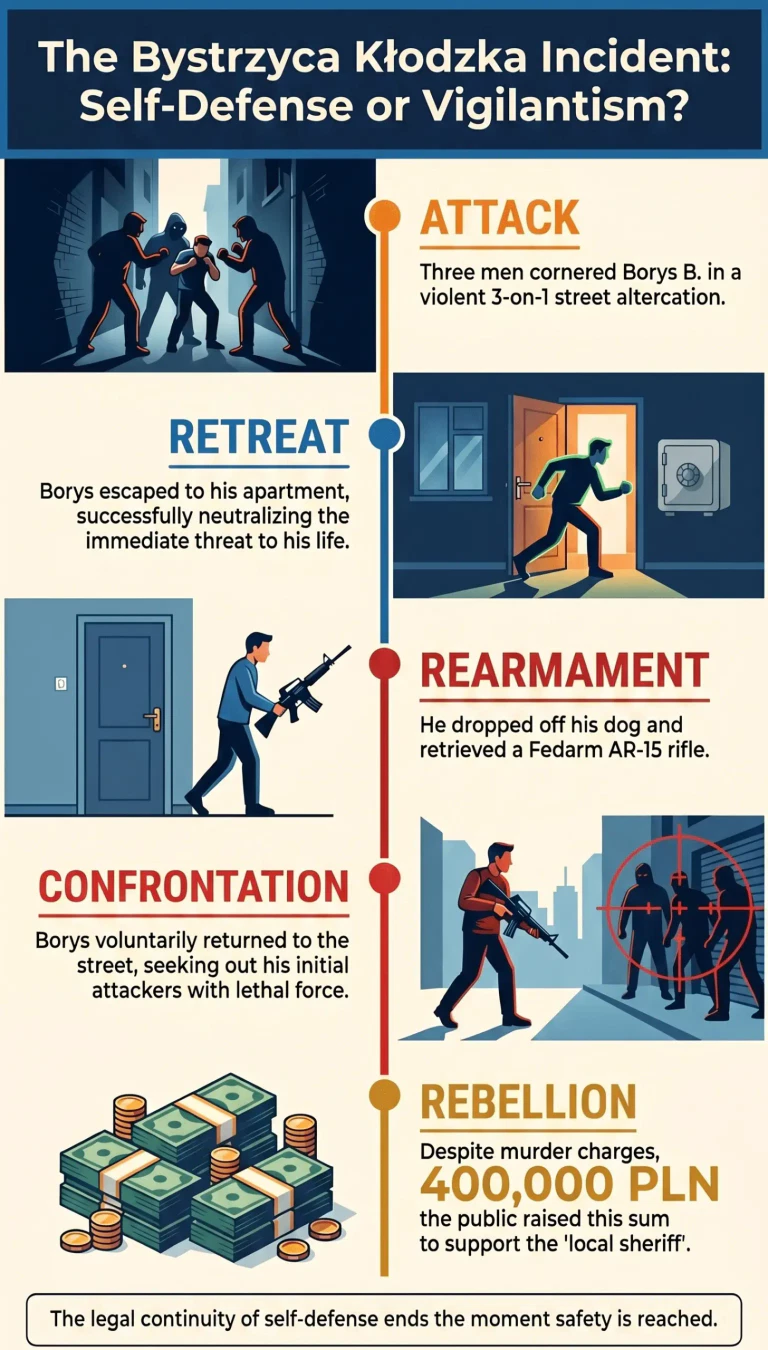
- 1. The fatal transition from self-defense to vigilantism While Borys B. was initially attacked, his decision to retreat to the safety of his apartment, arm himself with an AR-15, and return to the street severed the legal continuity of self-defense. In the eyes of the law, this premeditated rearmament transformed a cornered victim into an active aggressor seeking extrajudicial retribution.
- 2. The state's ruthless defense of its monopoly on violence Terrified of legitimizing street justice, the prosecution immediately levied the maximum charge of intentional murder. The system prioritizes crushing civilian vigilantism to maintain its authority, though the defense may controversially invoke Art. 231b, arguing the shooter acted to protect public order where the police completely failed.
- 3. A massive social rebellion against systemic apathy The public's response—raising nearly 400,000 PLN for the shooter's legal defense—is a damning indictment of local law enforcement. Society views Borys B. not as a murderer, but as a "local sheriff" forced to eradicate a violent gang, revealing a terrifying collapse of trust in the Polish criminal justice system.
The events that unfolded on Friday, April 10, 2026, in the provincial town of Bystrzyca Kłodzka have violently ruptured the conventional understanding of civic duty, exposing the fragile boundary between justified self-preservation and unlawful retribution. A twenty-eight-year-old firearms instructor, identified in court documents as Borys B., shot and killed a twenty-six-year-old man following a severe street altercation. This single act of extreme violence has triggered an unprecedented crisis of confidence in the criminal justice system operating within the country. The community's immediate and overwhelming financial mobilization to defend the shooter reveals a society deeply fractured by the perception of systemic abandonment.
Initially, the situation appeared to the public as a straightforward, albeit tragic, instance of a citizen protecting himself against an overwhelming and lethal threat. The suspect was reportedly confronted by three aggressive individuals, creating a severe tactical disadvantage that typically justifies a robust self-defense response. In the raw environment of a street confrontation, a three-on-one assault inherently carries the risk of grievous bodily harm or death, logically providing the defender with a broad mandate to neutralize the attackers. The public immediately rallied behind the narrative of a solitary victim forced to employ ultimate force against a pack of local tormentors.
However, the reality of the street rarely aligns perfectly with the sterile text of legal statutes read in quiet courtrooms. The ensuing prosecutorial investigation rapidly dismantled this initial assumption, shifting the paradigm from spontaneous self-preservation to a premeditated escalation of hostilities. The absolute monopoly on violence demands that citizens retreat when possible, leaving the administration of justice to sworn law enforcement officers. By stepping outside this mandate, the shooter inadvertently transformed a clear-cut case of personal defense into a profound jurisdictional challenge that the state could not ignore.
The Bystrzyca Kłodzka case serves as a microscopic lens magnifying a macroscopic societal tragedy unfolding across modern neighborhoods. It forces a brutal reevaluation of what citizens are permitted to do when the institutional shield completely fails to protect them from harm. The ensuing public debate is no longer merely about the ballistic trajectory of a rifle round, but about the fundamental trust in institutions. When the apparatus designed to protect society abdicates its responsibility on the street, and a citizen takes up arms to fill that void, the ensuing legal annihilation of that citizen reveals a system operating out of sheer self-preservation.
The anatomy of the tragic incident
The initial classical defense theory
The foundational narrative that initially ignited public sympathy was deceptively simple and culturally resonant. An ordinary citizen, who happened to be a licensed firearms instructor, found himself aggressively cornered by three men in his own residential neighborhood. In the chaotic theater of an urban assault, a numerical disadvantage of this magnitude leaves the victim with microscopic margins for tactical error. The instinctual public reaction categorized the ensuing gunfire as a textbook example of justifiable homicide, viewing it as a desperate measure taken by a man pushed to the absolute brink of survival.
In such highly volatile scenarios, the defender is legally presumed to be reacting to an immediate, unlawful attack against their life, health, or personal property. The legal and moral frameworks of modern democracies generally afford immense latitude to individuals facing multiple coordinated assailants. A three-on-one dynamic introduces a massive asymmetry of force that technically justifies the use of lethal tools to equalize the dangerous situation. The deployment of a defensive weapon in this specific context was widely perceived not as a voluntary choice, but as an inescapable biological imperative to survive a brutal beating.
The immediate aftermath saw the local community fiercely defend the actions of Borys B., painting the deceased twenty-six-year-old and his companions as the true instigators of the tragedy. Eyewitness accounts and localized neighborhood rumors quickly established a stark dichotomy between the law-abiding instructor and the alleged local aggressors. This absolute moral clarity fueled an immediate, visceral defense of the shooter, embedding the concept of citizen intervention deeply into the regional consciousness before the forensic reality could be firmly established by detectives.
The public consciousness naturally gravitates toward narratives featuring a lone defender standing against a pack of aggressors. This archetype taps into deep-seated cultural anxieties regarding safety in public spaces and the vulnerability of the individual. When the initial reports surfaced, they perfectly matched this pre-existing mental framework, allowing the community to instantly absolve the shooter of any moral wrongdoing. The immediate classification of the event as an act of heroic resistance highlights how desperate local populations are for definitive solutions to chronic street harassment.
A sudden turning point in the case
The pristine purity of the defensive narrative completely collapsed under the heavy weight of prosecutorial fact-finding and forensic reconstruction. Investigators meticulously rebuilt the timeline of that Friday evening, revealing a sequence of events that fundamentally altered the optical perception of the crime. Following the initial verbal and physical altercation, Borys B. was not helplessly trapped; he successfully broke contact, retreated to the safety of his apartment, dropped off his dog, and made a conscious decision to arm himself with a Fedarm AR-15 rifle. This deliberate tactical withdrawal severed the immediate continuity of the threat.
By crossing the threshold of his private home, the immediate, pressing danger to his life was effectively and legally neutralized. The critical turning point occurred when he willingly walked back out onto the street, automatic rifle in hand, actively seeking out the men who had confronted him moments prior. This was no longer a desperate fight for survival in a dark alleyway; it was an organized, armed patrol. The introduction of a military-grade platform into a resolved conflict shifted the psychological profile of the encounter from panic-driven evasion to calculated, aggressive confrontation.
Upon encountering the three men for the second time, a fresh altercation inevitably erupted in the neighborhood. The suspect allegedly fired a warning shot before unleashing a rapid series of rounds directed at the group, striking the twenty-six-year-old victim multiple times in the vital areas of the chest and abdomen. The undeniable ballistic evidence of a lethal shot sequence following a deliberate return to the combat zone shattered the legal architecture of the self-defense claim. The state's investigators viewed this subsequent action not as an unfortunate necessity, but as a punitive expedition executed by a severely aggrieved party.
To understand the exact sequence of events that successfully dismantled the initial self-defense claim, the prosecutorial timeline must be examined closely:
| Event Phase | Action taken by Borys B. | Legal Implication |
| Initial Encounter | Verbal and physical scuffle with three men. | Immediate threat is temporarily established. |
| The Retreat | Successfully returns home, leaves the dog inside. | Threat is neutralized; absolute safety is achieved. |
| The Rearmament | Willingly retrieves a Fedarm AR-15 (5.56 mm NATO). | Demonstrates severe premeditation and escalation. |
| The Return | Voluntarily re-enters the hostile street environment. | Negates the legal requirement of continuous fear. |
| The Confrontation | Encounters the men again; fires a warning shot. | Actively initiating a completely new conflict phase. |
| The Conclusion | Fires series of shots; fatal strikes to the torso. | Execution of lethal intent without legal justification. |
Furthermore, the specific circumstances surrounding his eventual arrest provided prosecutors with highly damaging ammunition against the suspect's overall character. When tactical police units arrived at his residence to apprehend him, Borys B. was detained on the building's staircase carrying a significant amount of cash, his passport, and freshly packed personal belongings. This objective evidence of a flight risk profile severely undermined his subsequent claims of innocent victimhood, painting a picture of a man fully aware of the criminal gravity of his actions and actively attempting to evade state justice.
The lethal rearmament decision
The choice of weapon in this incident plays a monumental role in shaping both the legal strategy and the public's perception of the event. Borys B., utilizing his credentials as a firearms instructor, legally possessed a Fedarm AR-15 chambered in 5.56 mm NATO. Retrieving a long gun of this specific caliber from a secure safe requires deliberate mechanical actions that completely belie the concept of blind, unthinking panic. The methodical process of readying an assault rifle platform demonstrates a chilling level of cognitive clarity and lethal intent.
Unlike a concealed handgun, which might be carried routinely for general personal protection, an AR-15 is typically deployed for specific, high-intensity engagements. Walking out of an apartment building with a visibly slung rifle is an undeniable projection of lethal force that escalates the ambient tension of any environment exponentially. The prosecution heavily leverages this specific detail to argue that the suspect was not merely protecting himself, but was actively preparing for a paramilitary engagement on civilian streets.
The ballistics of the 5.56 mm NATO cartridge further complicate the narrative of measured self-defense. This ammunition is specifically designed to cause massive internal cavitation and trauma upon impact, making it devastatingly effective at neutralizing human targets. When the suspect fired multiple rounds into the chest and abdomen of the victim, he employed a level of destructive power that guarantees a high probability of death. The precise targeting of vital biological organs with such high-velocity ammunition strips away any defense attorney's argument that the shots were merely intended to wound or deter.
The fact that the shooter was a certified instructor also works significantly against his legal standing in this context. A trained professional is legally and ethically expected to possess superior emotional regulation and a deeper understanding of the terminal consequences of pulling a trigger. Prosecutors argue that his extensive training should have dictated a strict adherence to de-escalation protocols once he reached the safety of his home. Instead, his specialized knowledge was weaponized to execute a flawless tactical neutralization, transforming his professional background from a shield into a sword.
The doctrine of provoked defense
The psychological and physical transition from a cornered victim to an active hunter carries devastating consequences under modern criminal law. When a person safely escapes a pressing threat only to intentionally rearm and return to the scene, they willingly provoke the subsequent confrontation. From a strict jurisprudential standpoint, Borys B. immediately ceased to be a victim repelling a sudden, unlawful attack. Instead, he mutated into an individual actively seeking a violent armed clash, effectively taking the law into his own hands without state authorization.
This aggressive dynamic engages the complex doctrine of provoked defense, where the instigator of the final violent clash cannot fully claim the protections afforded to an innocent, passive victim. By re-engaging the hostile trio with overwhelming lethal force, the shooter transformed the public street into a personal execution ground. The deliberate firing of multiple rounds, particularly following an initial warning shot, demonstrates a direct operational intent to kill rather than a chaotic, desperate attempt to merely stop an ongoing assault.
The legal system views this specific behavioral pattern as a direct and unforgivable usurpation of its ultimate authority. Vigilantism, regardless of the severity of the prior provocations suffered by the citizen, is treated as a severe societal contagion that threatens the fundamental fabric of public order. The exact moment Borys B. racked the charging handle of his AR-15 and stepped back into the public square, he crossed a dangerous Rubicon from legal self-preservation into the forbidden realm of extrajudicial punishment, a territory the state aggressively guards against civilian intrusion.
Judges and legal scholars frequently debate the precise temporal boundaries of an ongoing assault. However, a deliberate retreat into a locked domicile creates an insurmountable chronological break in the chain of events. The initial aggression by the three men ended the second the apartment door clicked shut. The subsequent shooting must therefore be evaluated as an entirely separate, isolated incident where the firearm owner became the primary aggressor. This legal severing of the timeline is the prosecution's strongest tool in dismantling the self-defense narrative.
Legal minefield of the penal code
The right to err under extreme stress
The sophisticated architecture of Polish criminal law does not demand robotic, mathematical perfection from citizens fighting for their very lives. Article 25 § 3 of the Penal Code explicitly forgives the exceeding of self-defense limits if such an intensive excess is driven by fear or emotional agitation justified by the circumstances of the attack. This provision acts as a vital psychological safety valve, recognizing that a person experiencing paralyzing terror cannot logically calculate the exact quantum of force required to stop a violent aggressor. It strongly protects the imperative of survival in the face of raw, unpredictable violence.
If a terrified defender shoots a fleeing attacker in the back out of blind panic during a continuous, chaotic brawl, the law may mercifully forgive them. The biological reality of adrenaline dumps and sheer terror severely impairs complex cognitive processing and logical executive function. The legislature designed this specific exceeding limits provision precisely to protect innocent people from being incarcerated for making poor tactical decisions while desperately fighting for their breath and their existence.
The legal framework explicitly acknowledges that the human brain operates differently under the immediate threat of death. The concept of proportional force is easy to debate in an academic setting, but practically impossible to measure during a street fight. Therefore, if the psychological trauma of the assault completely overwhelms the defender's rational faculties, the resulting excessive violence is legally excused. This acknowledgment of human biological frailty is one of the most progressive and necessary elements of the modern self-defense statute.
However, the application of this psychological grace period is rigidly bound by strict parameters of time and space. The legal forgiveness extends only as long as the immediate cognitive impairment lasts. Once the acute stressor is removed, the law expects the rapid return of rational thought and legal compliance. Attempting to stretch the umbrella of panic over a prolonged sequence of deliberate actions is a legal impossibility that courts routinely reject with extreme prejudice.
Boundaries of paralyzing fear
The moment Borys B. returned home, secured his dog, and evaluated his personal armory, the acute physiological panic required by the statute theoretically evaporated. The quiet interlude inside his apartment provided an ample opportunity for rational thought, effectively disqualifying him from claiming actions born of a sudden, blinding emotional storm. In the eyes of the law, fetching a heavy rifle and returning to the street is an act of calculated volition, completely incompatible with the defense of paralyzing, unthinking fear.
To successfully invoke Article 25 § 3, the defense must prove a seamless, unbroken continuum of terror. The separation between the first altercation and the second confrontation destroys this necessary continuity. The physical act of packing a passport and gathering a large sum of cash prior to police arrival further demonstrates a highly organized, forward-thinking mindset. A mind capable of planning an international escape is not a mind currently crippled by acute psychological shock.
The prosecution will heavily emphasize the sheer amount of time it takes to unlock a gun safe, load a magazine, chamber a round, and walk back downstairs. Each of these discrete mechanical steps requires fine motor skills that are typically degraded during genuine panic. By successfully completing these complex tasks, the suspect inadvertently provided forensic proof of his own composure. This methodical preparation completely shatters the illusion of spontaneous defensive action, leaving him fully exposed to the harshest interpretations of the penal code.
Systemic asecuration of the law
Faced with a dead body on the pavement and a citizen holding a military-style rifle, the Polish prosecution apparatus inherently relies on a deeply ingrained culture of bureaucratic risk aversion. Rather than conducting a nuanced, immediate assessment of the surrounding contextual factors—such as the aggressive criminal history of the victims or the psychological state of the shooter—investigators default to the heaviest available legal artillery. On April 13, 2026, Borys B. was formally charged under Article 148 § 1 with murder with direct intent, an offense carrying a maximum penalty of life imprisonment. This reflexive deployment of maximum criminal charges serves to immediately neutralize the suspect and placate institutional anxieties.
The District Court in Kłodzko swiftly rubber-stamped a two-month pre-trial detention order. While the suspect's packed bags and passport provided concrete, undeniable grounds for detention to prevent flight , the broader systemic approach remains highly punitive toward any citizen employing lethal force. Prosecutors frequently utilize severe initial charges to secure investigative leverage, preferring to let the appellate courts sort out the legal nuances years later. This creates a devastating legal suppression tactic across society, ensuring that the state maintains absolute dominance over the narrative from day one.
The investigative machinery operates under the assumption that an armed citizen is inherently a rogue element that must be immediately caged. The presumption of innocence is functionally suspended when a firearm is involved in a civilian fatality. By elevating the charge to intentional murder immediately, the prosecution forces the defense into a desperate, uphill battle just to prove basic self-preservation. This prosecutorial overreach is a standard operating procedure designed to insulate the state from accusations of being soft on vigilante violence.
The chilling effect on the public
This institutional hostility toward armed self-defense stems from a bureaucratic terror of accidentally endorsing civilian vigilantism. The state deeply prefers to over-prosecute a potentially justified shooter than risk setting a legal precedent where citizens feel empowered to administer street justice. Consequently, ordinary individuals are mentally paralyzed during critical moments of profound danger, desperately calculating the likelihood of prosecutorial destruction instead of fiercely fighting for their own lives.
The system aggressively secures its own authority, often at the direct expense of the citizen's physical safety. When the public witnesses a man facing life in prison for shooting his attackers, the overarching takeaway is that submitting to a beating is legally safer than fighting back. This generates a profound societal freeze, where the fear of the courtroom supersedes the fear of the criminal. The resulting behavioral paralysis emboldens street gangs, who understand that law-abiding citizens are terrified of utilizing their legal right to self-defense.
The media coverage of the Bystrzyca Kłodzka case dramatically amplifies this chilling effect. As details of the massive charges and immediate incarceration circulate, gun owners across the country silently reevaluate their willingness to intervene in violent situations. The state’s draconian response acts as a highly effective psychological deterrent, effectively disarming the populace through the sheer terror of bureaucratic retaliation. This state-sponsored intimidation ensures that the government retains sole authority over the use of force, even if it means leaving citizens defenseless in the interim.
The hidden legal ace in the sleeve
Despite the prosecution's heavy-handed and uncompromising approach, the Polish Penal Code contains a highly controversial, recently amended mechanism that could theoretically salvage the shooter's perilous legal standing. Article 231b § 1 provides an extraordinary legal shield: a citizen who, in necessary defense, repels an attack while protecting public safety or order, benefits from the exact same legal protection afforded to a sworn public official. This public official protection effectively elevates the armed citizen from a mere civilian to a deputized guardian of the peace during the specific incident.
The implications of this statute, specifically following its recent legislative updates in late 2025 , are incredibly profound for defense attorneys. If the defense team can successfully argue that Borys B. returned to the street not to exact petty personal revenge, but to forcefully pacify a group of aggressive hooligans actively terrorizing the public space, his actions fall under a completely different legal paradigm. An individual acting under the umbrella of public order defense has a significantly broader mandate to employ force to maintain that order, bridging the gap between civilian limitations and law enforcement protocols.
If the three men subsequently attacked him to violently strip him of his weapon while he was attempting to secure the neighborhood, his legal right to discharge the firearm increases exponentially. Disarming a "public official"—which he theoretically becomes under Article 231b—is a severe, life-threatening action that almost always justifies immediate lethal neutralization. This hidden legal maneuver represents the absolute only viable pathway to acquittal, shifting the narrative from a vigilante executing a personal vendetta to a brave citizen desperately attempting to uphold the law where the state had failed.
Below is a comparative analytical breakdown of the legal pathways currently dictating the fate of the suspect:
| Legal Provision | Core Mechanism of the Statute | Application to the Bystrzyca Kłodzka Case |
| Art. 148 § 1 (Murder) | Intentional killing of a human being. | Prosecutor's default stance. Borys B. deliberately returned and fired fatal shots. |
| Art. 25 § 3 (Fear/Panic) | Forgiveness for exceeding self-defense due to terror. | Likely invalid. Returning home for the weapon breaks the continuity of sudden panic. |
| Art. 231b § 1 (Public Order) | Citizen acts as a protected public official. | The defense's strongest argument. Claims the shooter was pacifying a severe public threat. |
| Art. 255 § 2 (Incitement) | Publicly calling for the commission of a crime. | Applied to the 29-year-old seeking revenge against Borys B. |
Public order protection statutes
The legislative intent behind Article 231b was explicitly designed to empower citizens to intervene in situations where public order is severely threatened. Historically, the law was terrified of encouraging vigilantism, but rising instances of unpunished street hooliganism forced a legislative recalibration. By granting citizens the protections of a police officer, the state tacitly admitted that it cannot be everywhere at once. This legislative concession is a fascinating anomaly in an otherwise highly restrictive European legal framework.
However, invoking this statute requires traversing a very narrow and dangerous legal tightrope. The defense must definitively prove that the shooter's primary motivation was the altruistic protection of the neighborhood, rather than the selfish resolution of a personal grievance. If the prosecution can demonstrate that Borys B. was motivated primarily by anger over the initial altercation, the public order defense instantly evaporates. The entire trial will hinge on the forensic dissection of his internal psychological motivations during the few minutes he spent inside his apartment.
Furthermore, the recent November 2025 amendments to the penal code, which took effect on January 2, 2026, removed certain procedural hurdles that previously weakened Article 231b. The repealing of § 2 and the addition of § 3 indicate a legislative trend toward strengthening the rights of those defending public safety. Defense attorneys will undoubtedly leverage this contemporary legislative momentum to argue that punishing Borys B. would directly contradict the parliament's recent desire to empower the civilian protector role.
Social drama and the failing state
Impunity of local street bandits
The sociological earthquake generated by this singular case cannot be fully understood without exhaustively examining the dark, underlying reality of the local environment. Information quickly surfaced across various media platforms suggesting that the victims of the shooting were not innocent bystanders, but local tormentors who routinely terrorized the residential estates of Bystrzyca Kłodzka. The community had reportedly endured a prolonged, agonizing period of intimidation, harassment, and unchecked violence at the hands of these individuals. This chronic exposure to criminal behavior fostered a deep, simmering resentment toward the local criminal element, setting the perfect stage for an inevitable, explosive confrontation.
The true catalyst for this bloody tragedy, however, was the perceived, systemic passivity of local law enforcement. Residents felt utterly abandoned by the police, watching helplessly from behind drawn curtains as the gang operated with functional impunity on their doorsteps. When formal complaints yield absolutely no results, and emergency calls are met with bureaucratic indifference or delayed responses, the invisible social contract begins to rapidly disintegrate. The state's fundamental failure to maintain basic security created a dangerous, expanding vacuum of authority. In this toxic environment of police passivity, the arrival of a well-armed, capable individual willing to aggressively confront the aggressors was viewed by many not as a heinous crime, but as a tragically necessary intervention.
The frustration of the local populace had been boiling for months, if not years. When a community feels that the legal system only protects the criminals, their moral compass realigns to support whoever offers tangible protection. The fact that the twenty-six-year-old victim was widely recognized as a neighborhood menace completely obliterated any public sympathy for his death. Instead of mourning, the community experienced a profound, guilty sense of relief. This stark moral inversion is the most damning indictment of the local police precinct's failure to control its jurisdiction.
The criminal underworld reacts
The criminal underworld's immediate and highly aggressive reaction to the shooting further validated the community's deepest fears regarding the victim's affiliations. Following the arrest of Borys B., a twenty-nine-year-old local man was swiftly apprehended by the Provincial Police Headquarters in Wrocław for publishing a video calling upon "all criminal Poland" and "all hooligans" to exact brutal, bloody revenge on the shooter. During his arrest, tactical police units secured significant quantities of narcotics, and he was subsequently charged with public incitement to commit a crime and drug possession, landing him a mandatory two-month pre-trial detention. This explicit mobilization of the criminal subculture perfectly illustrated the vast, systemic threat that the neighborhood had been living under, casting Borys B.'s extreme actions in a fiercely protective, almost heroic light.
The language used in the revenge video is particularly terrifying and revealing. By invoking the phrase "all criminal Poland," the suspect demonstrated that the local gang felt they belonged to a much larger, untouchable syndicate. They viewed the shooting not just as a loss of a friend, but as a brazen insult to their territorial dominance that required a massive, coordinated retaliation. This organized underworld mobilization proves that the residents were not merely dealing with petty bullies, but with a networked criminal enterprise that felt confident enough to publicly threaten a citizen on social media.
The police response to this video was notably swift, resulting in charges under Article 255 § 2, which carries a penalty of up to five years in prison. However, this rapid law enforcement action only highlighted their previous inaction. Residents bitterly noted that the police could instantly track down and arrest a man making a video, but completely failed to dismantle the gang while they were terrorizing the streets in person. This glaring enforcement hypocrisy further alienated the community, reinforcing their belief that Borys B. was the only entity who actually dealt with the root problem.
Birth of the modern local sheriff
The public response to Borys B.'s harsh incarceration was immediate, staggering in scale, and highly organized. A massive crowdfunding campaign, initiated by Marta Wiewióra on the popular digital platform Zrzutka, was urgently launched to cover his mounting legal fees and secure elite defense counsel. The fundraiser shattered all conservative expectations, rapidly achieving its target and amassing hundreds of thousands of zlotys. With over 8,360 individual donations explicitly recorded, the campaign transcended a mere plea for financial help; it became a massive, quantifiable act of social rebellion against the entire criminal justice system.
The sheer volume of financial support—reportedly cresting around the astonishing figure of 400,000 PLN demonstrates beyond a shadow of a doubt that society stands firmly behind the shooter. They simply do not view him as a cold-blooded murderer with direct intent, but as a modern-day sheriff who was violently forced to do the dirty, traumatic work that the state was too cowardly or incompetent to handle. The organizers transparently promised extreme accountability for every penny spent, assuring the public that "we will account for every penny spent," further cementing the unshakeable legitimacy of their cause. This immense financial mobilization is a damning societal indictment of the state, proving that hundreds of thousands of citizens are remarkably willing to actively fund the defense of a man who killed in the name of street justice.
This phenomenon highlights a terrifying societal shift in modern Poland. When ordinary, law-abiding citizens collectively donate vast sums from their own pockets to defend an act of extrajudicial killing, they are essentially voting with their wallets against the current legal order. The shooter has been rapidly elevated to the exalted status of a folk hero, a tragic, broken figure crushed by a blind bureaucratic machine for simply having the courage to protect his terrified neighbors. The birth of the sheriff narrative reveals a desperate, aching public yearning for tangible safety, even if it explicitly requires stepping over the bleeding, violent boundaries of the penal code.
Anatomy of a massive social rebellion
To fully comprehend the breathtaking scale of this unprecedented societal protest, the underlying metrics of the crowdfunding campaign provide undeniable, hard evidence of the public sentiment. The Zrzutka platform, which boasts a historical total of over 1.6 billion PLN raised across millions of campaigns, provided the perfect digital infrastructure for this legal uprising. The rapid accumulation of funds indicates a highly viral spread of the campaign, fueled by intense emotional resonance and shared anger. The 308 active comments on the platform serve as a raw, unfiltered archive of the public's absolute disgust with the prosecutorial narrative.
| Campaign Metric | Recorded Value / Status | Sociological Indicator |
| Total Individual Donations | 8,360 unique contributions. | Demonstrates massive grassroots mobilization and widespread approval. |
| Total Funds Raised | Hundreds of thousands of PLN. | Indicates deep financial commitment to challenging the state. |
| Public Discussion Threads | 308 active community comments. | Shows high user engagement and profound emotional investment. |
| Platform Trust Level | Transparent accounting promised. | Ensures continuous funding stream without fear of fraud. |
These metrics confirm that the Bystrzyca Kłodzka incident is not a localized anomaly, but a national flashpoint. Citizens from across the country, unconnected to the specific town, contributed funds because they recognized the systemic vulnerability in their own lives. They projected their own profound fears of crime onto the figure of Borys B., funding his defense as a proxy war against their own local inadequacies. This nationalized empathy transforms a local homicide trial into a sweeping referendum on the effectiveness of the Polish police force.
The organizers of the campaign wisely capitalized on this sentiment, framing the collection not merely as legal aid, but as a moral crusade. By positioning Borys B. as a victim of a heavy-handed state apparatus, they tapped into a rich vein of anti-institutional sentiment. The massive influx of capital ensures that the suspect will have access to the absolute best legal minds in the country, guaranteeing a protracted, highly publicized trial that will drag the state's failures into the blinding light of the national media spotlight.
The state monopoly on violence
At the very core of the state's highly aggressive prosecution of Borys B. lies a fundamental, existential terror of losing its absolute control over society. The sociologist Max Weber famously defined the state as a human community that successfully claims the monopoly of the legitimate use of physical force within a given territory. When a citizen retrieves a NATO-caliber assault rifle to unilaterally resolve a neighborhood dispute, that sacred monopoly is directly and violently challenged. The legal system acts to mercilessly crush such individuals, not necessarily out of a pure sense of justice, but out of a panic-driven need to ruthlessly protect its exclusive right to punish.
If the state were to leniently adjudicate the Bystrzyca Kłodzka case, publicly acknowledging the community's relief at the demise of a local bandit, it would effectively, officially legitimize vigilantism. This is a bright red line no modern government can ever afford to cross. Acknowledging that the police utterly failed, and that a citizen was entirely justified in taking lethal action to violently restore order, would inevitably invite sweeping chaos. Therefore, the apparatus deeply prefers to lock away a desperate, highly trained citizen under the most severe charges possible, utilizing the full weight of the penal code to reassert its absolute, unquestionable dominance over the streets.
This rigid dynamic creates a profound, unbridgeable disconnect between the written law and the living society it governs. The system is perfectly optimized to manage routine, post-factum crimes, but it catastrophically short-circuits when violently confronted with an active, armed citizenry doing its job for it. By prioritizing the strict preservation of its monopoly over the genuine, physical safety of its people, the state dangerously alienates the very individuals it is sworn to protect. The relentless pursuit of the institutional status quo tragically transforms the courtroom into a hostile arena where the state blindly defends its bruised ego, rather than seeking the messy, deeply uncomfortable truth of street-level survival.


