
Key takeaways from the Poland small towns analysis
Poland’s smaller towns are often described as dying, but the more precise problem is disconnection. Many places still have buildings, memory and local identity, yet lose the transport, services, jobs and institutional density that make staying feel like a serious life plan:
- 1. A town can survive and still lose its future Decline does not always look like abandonment. A town may still have renovated streets, shops, schools and public buildings, but if young people cannot find work, transport, healthcare, education and alternatives nearby, staying begins to feel like accepting a smaller menu of futures.
- 2. Connection matters more than size The future map of Poland will not be divided simply into cities and villages. It will be divided into connected and disconnected places. A small village near strong transport and labour markets may offer more future than a formal town with weak buses, limited services and few chances to change direction.
- 3. Wałbrzych shows why revitalisation is not enough The Wałbrzych agglomeration shows that post-industrial recovery cannot be reduced to renovated façades, tourist slogans or isolated investments. A region reconnects only when transport, jobs, housing, schools, healthcare, culture and public space begin to work as one living system.
A job that matches their education. A workplace where changing employer is possible without changing region. A hospital within reach. A school for future children that does not feel like a compromise. Dating beyond the people they have known since childhood. A cinema, a gym, a library, a university, a train, a café where nobody cares who they are. A little anonymity. A little choice.
This is not betrayal of the hometown.
It is a search for functional adulthood.
Large cities do not win only because they are glamorous. They win because they offer redundancy. If one job fails, there may be another. If one relationship ends, social life does not collapse. If one doctor is unavailable, there may be alternatives. If one path closes, another may still exist nearby.
Smaller places often cannot offer that density.
That is the hidden advantage of metropolitan life. It is not only higher wages. It is the ability to make mistakes without leaving the map.
A thin local economy punishes mistakes harder. A failed job, a failed relationship, a missed bus, a closed service, a sick parent — each event carries more weight because there are fewer substitutes. This makes life feel fragile even when housing is cheaper.
That is why young people leave places they still love.
They are not always chasing luxury.
They are escaping narrowness.
Cheap housing is not enough
Poland’s housing debate often assumes that cheap housing in smaller places should be an answer to expensive metropolitan life.
It sounds reasonable until one asks what A small town does not die when the last person leaves.
It dies earlier, in a quieter way.
The bus comes less often. The doctor retires and nobody replaces him. The school still stands, but each year has fewer children. The market square is renovated, yet half of the real life has moved to a retail park, a larger city, or the internet. Young people still visit their grandparents, but they no longer imagine their own future there. Houses remain. Streets remain. The church, the cemetery, the municipal office, the old blocks, the main road, the railway station if there is one — all of it may still be present.
And yet something has changed.
The place has not vanished from the map. It has been removed from the future.
This is one of the least understood parts of Poland’s demographic and spatial crisis. Smaller towns and peripheral municipalities are too often described in the language of death: dying towns, dying villages, dying regions. The phrase is dramatic, but not precise enough. Many of these places are not dead. They are inhabited, functional, emotionally important, sometimes beautiful, sometimes recovering, sometimes trying hard to reinvent themselves.
The deeper problem is different.
They are being disconnected.
Disconnected from frequent transport. Disconnected from strong labour markets. Disconnected from healthcare access. Disconnected from higher education. Disconnected from cultural density. Disconnected from the kind of everyday infrastructure that makes staying feel like a serious life plan rather than a sentimental sacrifice.
Poland’s future will not be divided simply into cities and villages.
It will be divided into places connected to opportunity and places left to manage decline with too few tools.
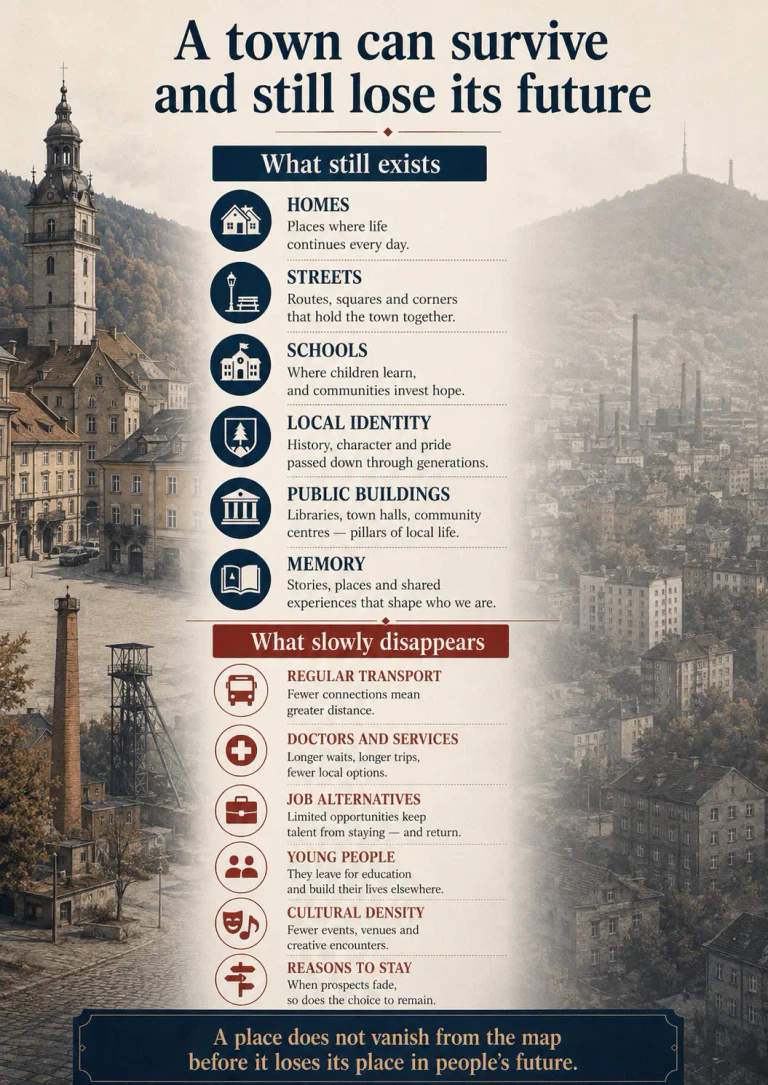
A town can survive and still lose its future
The old image of decline is too visual. Empty windows, collapsing factories, abandoned houses, weeds, silence. Those signs exist, but they are only the final layer. A place can lose its future long before it looks ruined.
It may still have traffic in the morning. It may have a renovated square, a municipal cultural centre, a football club, new streetlights and European Union information boards. It may have people who care deeply about it. It may even have cheap housing compared with Warsaw, Kraków or Wrocław.
But if the local labour market is thin, if the school network is shrinking, if medical services require travel, if public transport is weak, if young adults must leave for education and then cannot find a reason to return, the place becomes structurally fragile.
This is why “small towns are dying” is too crude.
The real question is not whether a town exists.
The real question is whether it still offers enough reasons to build a life there.
That is a harder question, because it cannot be answered by one investment, one road, one renovation, one festival, or one political promise. Life in a place depends on the density of connections. Work, care, transport, education, public services, housing, social trust and the possibility of changing one’s path without leaving the region altogether.
When those connections weaken, staying becomes more expensive than leaving, even if rents and house prices are lower.
The Wałbrzych aglomeration shows the problem clearly
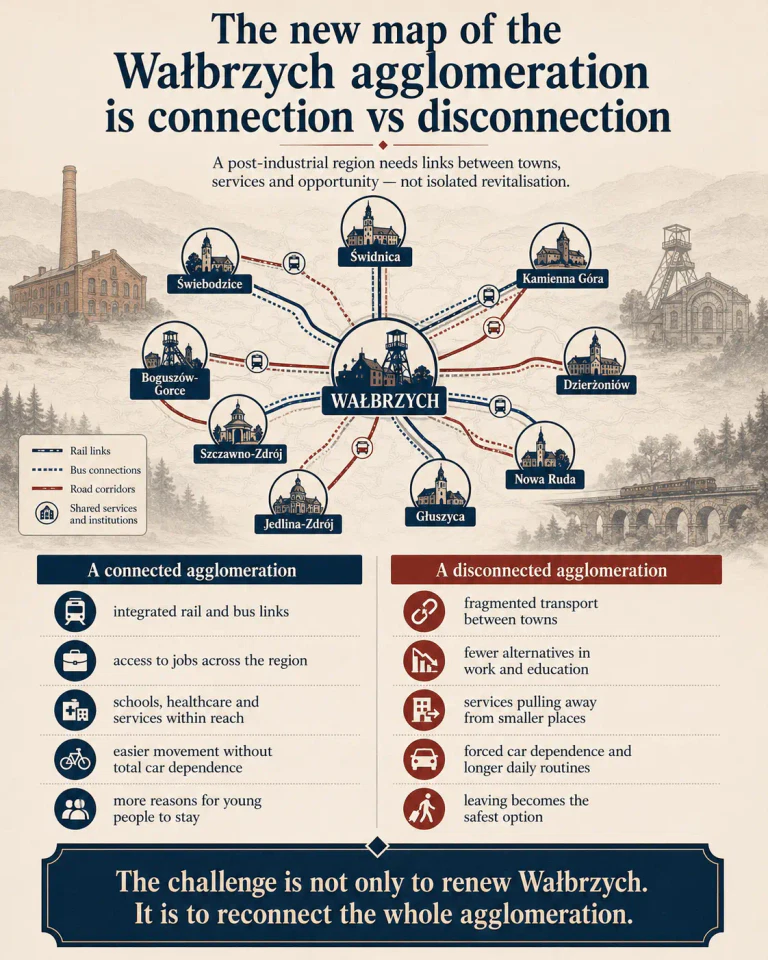
The Wałbrzych agglomeration is a useful example because it is not a simple story of a small isolated town.
It is a region of towns, districts, former industrial places, spa towns, villages, post-mining landscapes, commuting routes, mountain terrain, tourist potential and administrative cooperation. It includes Wałbrzych itself, but the problem is wider than one city. It is a functional area trying to behave like a connected region after decades of economic shock, demographic loss and institutional fragmentation.
Wałbrzych is not an ordinary provincial town. It was a major industrial centre, built around coal, heavy work, dense housing estates and a specific working-class identity. The collapse of mining in the 1990s was not just a sectoral change. It removed the organising force of the local economy. Thousands of jobs disappeared. Social status collapsed for many families. Skills were stranded. Informal survival strategies appeared. The region did not only lose employment; it lost a story about why people belonged there.
That kind of wound does not close simply because time passes.
The city has changed. There are investments, roads, tourism, cultural institutions, better public spaces, revitalisation projects, and attempts to build a greener post-industrial future. Wałbrzych is not a ruin. It is more complicated than that. But the agglomeration still shows what happens when a region has to rebuild connection after losing the industry that once connected everything.
The question is no longer only: how many people live there?
The question is: how many forms of life can still be organised there without constant dependence on leaving, commuting, or escaping?
This is where Wałbrzych becomes more than a local case. It becomes a warning about Poland’s spatial future.
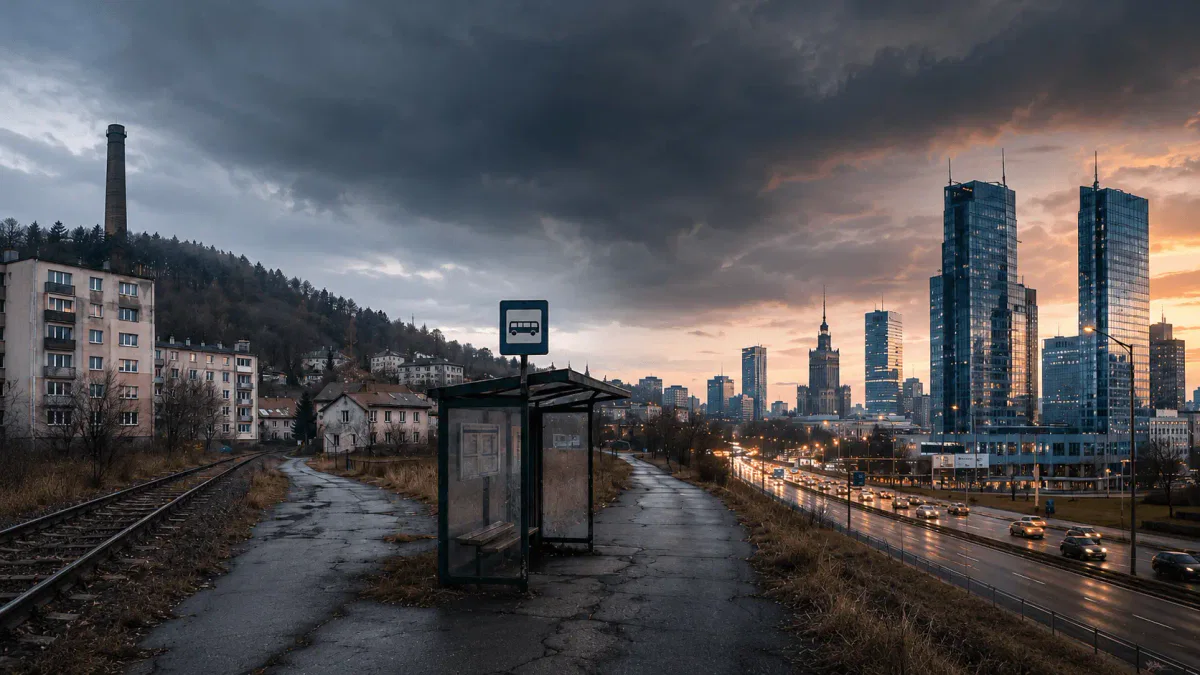
The bus stop as a social border
In large cities, bad transport is an inconvenience. In smaller places, it can become a life sentence.
A weak bus line decides whether a teenager can attend a better school without parental transport. It decides whether an elderly person can reach a clinic. It decides whether a worker can accept a job in the next town. It decides whether someone without a car is an independent adult or a dependent person. It decides whether a young couple can manage childcare, work and appointments without turning every day into logistics.
This is why transport is not only infrastructure.
It is social permission.
If the train is rare, the bus is irregular, and the last connection leaves too early, the place may still be technically inhabited but practically narrowed. The car becomes compulsory. That means the right to live fully depends on income, health, age, family help and the ability to drive.
The result is quiet exclusion.
Older people become trapped. Teenagers become dependent. Young workers become selective about jobs. Parents become chauffeurs. People without cars lose access to the wider region. A place that seems cheap becomes expensive in time, fuel, stress and missed opportunities.
In the Wałbrzych area, the need for integrated public transport is not an abstract planning slogan. It reflects the region’s actual structure: many towns, many settlements, difficult geography, commuting needs, railway potential, bus gaps and the challenge of linking local life to regional opportunity.
A disconnected small town is not always far away.
Sometimes it is only badly connected.
Services leave before people stop needing them
One of the cruel things about spatial decline is that services often withdraw before demand disappears.
People still need doctors. Children still need schools. Elderly residents still need pharmacies, rehabilitation, banks, offices, postal services and local shops. Families still need childcare. Workers still need training. Young people still need places to meet that are not only parking lots, benches or alcohol.
But services follow numbers, money and efficiency.
A shrinking population weakens the argument for keeping institutions. The institution disappears or centralises. Its disappearance makes the place less attractive. That accelerates outmigration. Then the next institution becomes harder to defend.
Decline becomes circular.
This is why small-town policy cannot be reduced to nostalgia. It is not enough to say that people should appreciate slower life, cleaner air, local identity or cheaper housing. Those things matter. But they do not replace a paediatrician, a railway connection, a school, a dentist, a stable job, a cultural offer, or a second employer if the first one fails.
A place can be emotionally rich and institutionally poor.
Young adults notice the difference quickly.
They may love where they came from. They may defend it against mockery. They may still feel shaped by its streets, hills, dialects, buildings, smells and family histories. But love for a place does not automatically make it a viable adult strategy.
At some point, staying begins to feel like accepting a smaller menu of futures.
Young people do not leave only for ambition
There is a lazy explanation of migration from smaller towns: young people leave because they are ambitious, restless or seduced by big-city life.
Sometimes that is true. Often it is too simple.
Many young people leave because they want ordinary ththe cheap home is connected to.
A house in a weak labour market is not the same asset as a flat in a strong one. A cheaper apartment in a town losing services may reduce monthly costs, but it may also reduce access to income growth, career change, childcare options, healthcare and social networks. A family can save money on the mortgage and lose it in commuting, lower wages, stress, car dependence and limited opportunity.
This is the same paradox visible across Poland: empty or cheaper space can coexist with overcrowding and unaffordability elsewhere.
The problem is not the physical absence of dwellings.
The problem is that housing value follows the geography of opportunity.
If a smaller town is disconnected, cheap housing may not save it. It may simply become one more sign of weak demand. People do not refuse small-town housing because they are irrational. They refuse it when the surrounding system cannot support the life they want or need.
This is why revitalisation cannot mean only façades, squares and housing stock.
A place does not become livable because it looks better on a municipal presentation.
It becomes livable when people can organise a future from it.
The new map is connection versus disconnection
The old division between city and countryside is becoming less useful.
Some villages near strong metropolitan areas are not peripheral at all. They are part of a commuting, digital and property system tied to a nearby city. Some formal towns, meanwhile, may be more disconnected than villages located close to transport, jobs and schools.
The decisive line is shifting.
It is no longer simply urban versus rural.
It is connected versus disconnected.
A connected place may be small, but it has transport, broadband, access to labour markets, schools, healthcare, public services and enough people moving through it to keep life open. A disconnected place may have buildings, history and identity, but too few links to opportunity.
This matters because Poland’s demographic decline will not produce one uniform future. It will create different futures in different places. Some smaller towns may become attractive because they are well connected, affordable and close enough to stronger labour markets. Others may keep losing young people even if they are beautiful, cheap and historically important.
Connection will decide which is which.
The Wałbrzych agglomeration shows why this is so difficult. The area is not a single compact city. It is a network that needs to function across municipal borders, old industrial geographies and uneven local capacities. If transport, planning and services remain fragmented, the region risks competing internally for shrinking resources. If it becomes genuinely connected, it can behave less like a set of isolated towns and more like a shared living system.
That difference may decide whether people experience the region as a place to pass through or a place to stay.
Revitalisation is not the same as reconnection
Poland has become familiar with the language of revitalisation.
Renovated squares. EU-funded projects. Thermal modernisation. New roads. Cultural centres. Tourist routes. Restored buildings. Public consultations. Strategy documents. Promotional videos. Better lighting. New pavements. Urban branding.
Some of this matters. It can improve daily life. It can restore dignity to neglected spaces. It can make residents feel that the town has not been abandoned.
But revitalisation can also become cosmetic if it does not reconnect people to opportunity.
A renovated market square does not replace a labour market. A new façade does not replace a bus network. A cultural event does not replace everyday services. A tourist attraction does not automatically create stable local futures for young residents.
The hardest question for smaller towns is not how to look alive.
It is how to remain useful to the lives people are trying to build.
Wałbrzych understands this better than many places because its post-industrial history made cosmetic answers impossible. The city can improve its image, and it has done so in many visible ways, but the deeper challenge is structural: how to turn a difficult geography and a damaged industrial inheritance into a connected regional future.
That means jobs, transport, housing, schools, health services, culture, tourism, public space and environmental repair cannot be treated as separate projects.
They are one problem.
A place reconnects when these systems begin to support one another.
Blind future of small towns
Poland should stop speaking about smaller towns as if their only possible futures are death, nostalgia or rescue from above.
The better question is not whether they are dying.
The better question is what they are still connected to.
A town connected to transport, work, services and regional cooperation can survive demographic pressure better than a town that only has cheaper housing and memory. A village near a strong labour market may have more future than a town with formal urban status but weak access. A post-industrial city may recover if it becomes the centre of a functioning regional network rather than an isolated symbol of decline.
This requires a different imagination of development.
Not every place can become a new Wrocław. Not every town needs a technology park, a tourism slogan or a miracle investor. But many places need something more basic and more difficult: reliable links to the systems that make everyday life possible.
In the end, people do not leave only because places are small.
They leave when smallness becomes isolation.
And they stay when a place, even a modest one, remains connected to a future they can believe in.


