

Key takeaways from the Poland family-law and demography analysis
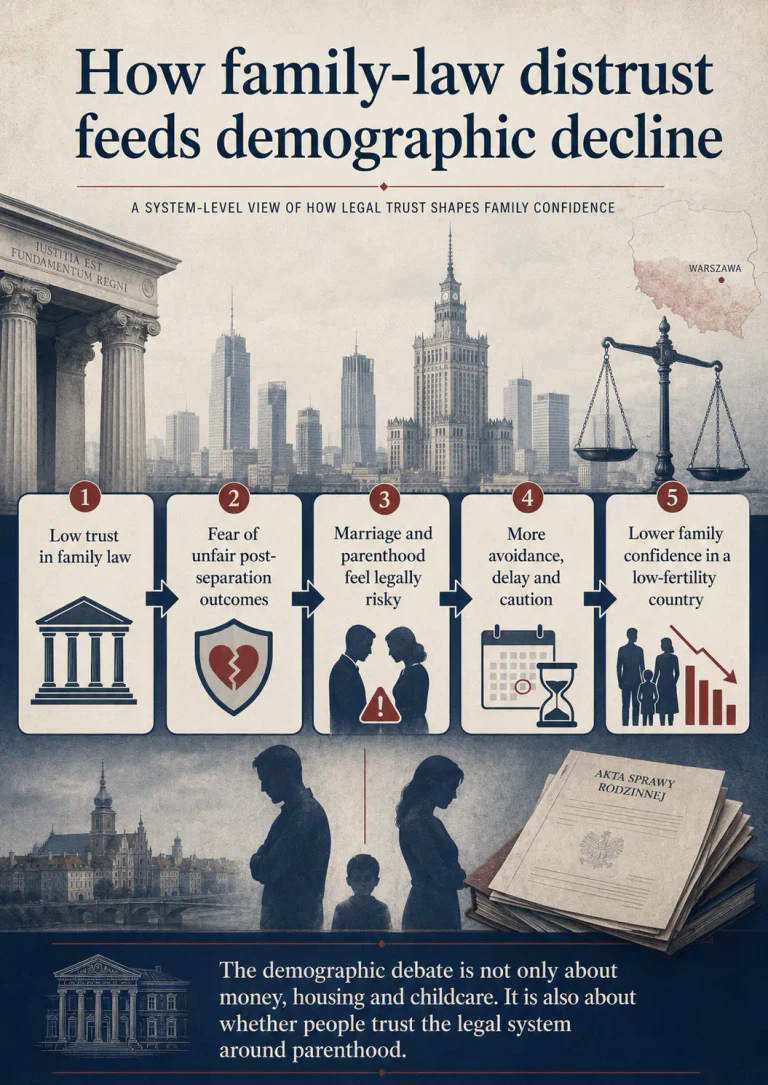
Poland’s demographic crisis is usually explained through money, housing and childcare. But parenthood also depends on legal trust: people need to believe that family law will remain fair when marriage breaks down, paternity is disputed or child-support duties become contested:
- 1. Poland’s demographic crisis is also a trust crisis Fertility is not shaped only by financial incentives. If people believe that parenthood may expose them to unfair courts, rigid paternity rules or unpredictable child-support duties, demographic policy loses credibility. A state cannot rebuild family confidence while ignoring legal fear.
- 2. Paternity law should protect children without protecting fiction The presumption of paternity can give a child legal stability, but it becomes dangerous when a man is required to carry legal and financial responsibility for a child who is not biologically his. If the mother refuses DNA cooperation or the truth emerges years later, the system needs a fast, credible and fair route to correction.
- 3. Fair child support must be tied to fair parenthood Child support is necessary, and unpaid maintenance harms children. But the system also needs legitimacy. When men are treated mainly as payers, when fathers must overprove care, or when legal fatherhood survives despite biological contradiction, family law stops building responsibility and starts producing avoidance.
Poland talks about its demographic crisis mostly through money.
Housing is too expensive. Childcare is too weak. Young people delay adulthood. Women face career penalties after motherhood. Men feel unstable in the labour market. Politicians promise benefits, tax reliefs and new programmes, then wonder why births keep falling.
All of that matters.
But there is another issue, less comfortable and usually pushed outside polite demographic debate: family law can also shape fertility decisions. Not because one statute directly decides whether someone has a child, but because law creates the emotional climate around parenthood. It tells people what will happen if love fails, if a relationship collapses, if paternity is disputed, if the child’s legal status does not match biological reality, or if one parent becomes mainly a payer while the other becomes the default caregiver.
A country cannot ask people to build families while leaving them afraid of the legal consequences of family breakdown.
This is especially visible in Poland, where the demographic problem is already severe. The debate usually treats fertility as a matter of economic incentives. Yet parenthood is not a consumer choice. It is a long-term exposure to law, courts, obligations, uncertainty and institutional trust. When that trust is weak, demographic policy becomes a performance.
The state may pay benefits.
But if people believe the family-law system is unfair, unpredictable or structurally asymmetric, many will still hesitate.
The missing word in Poland’s fertility debate is trust
Low fertility is often described as if it were mainly a problem of insufficient encouragement. Give people more money, more apartments, more nurseries, more flexible work, and they will have more children.
Some of that is true. But it is incomplete.
People do not decide to have children only because the monthly budget looks better. They also ask quieter questions. What happens if the relationship ends? Will I be treated as a parent or as a visitor? Will the court see me as a caregiver or mainly as a source of money? Will the law recognise biological truth quickly, or will it force everyone into a long procedural fiction? If I am wrongly treated as a father, will I have a real way out? If I am the biological father, will I be able to establish my role without waiting for another man to fight a legal presumption?
These questions are rarely part of official demographic language. They are too conflict-heavy. They cut across gender, marriage, divorce, parenting, child support and the symbolic role of motherhood and fatherhood in Polish society.
But they matter because parenthood requires confidence in the future.
If the future looks legally hostile, people retreat. They delay marriage. They avoid formal commitments. They become more cautious about children. They treat family not only as an emotional risk, but as a legal and financial risk that may become impossible to control.
That does not mean family law is the only cause of Poland’s demographic crisis. It is not. But it may be one of the neglected reasons why demographic incentives fail to rebuild confidence.
Paternity by legal fiction
One of the clearest examples is the Polish rule on presumed paternity.
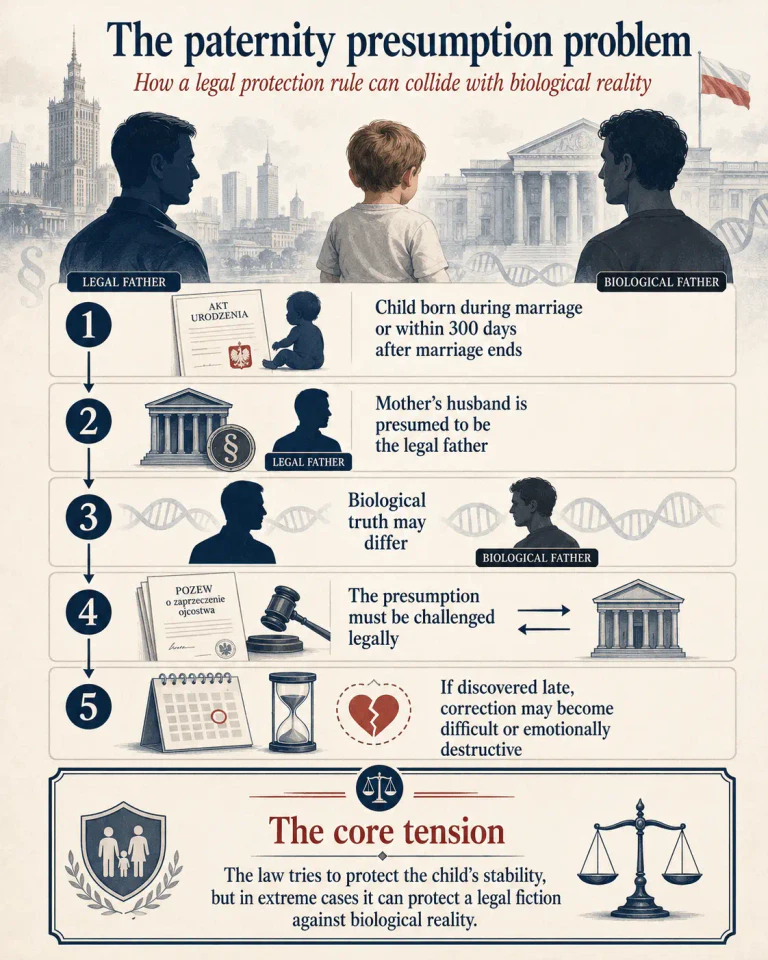
Under Polish family law, if a child is born during a marriage, or within 300 days after the marriage ends or is annulled, the child is presumed to come from the mother’s husband. The rule has an old logic. It was designed to protect the child’s legal status, secure family continuity and prevent children from being left without a legally recognised father.
In a slower, more socially rigid world, that legal fiction had a practical function.
In today’s Poland, it can become a trap.
Divorces can last a long time. Couples may separate emotionally and practically long before the court formally ends the marriage. People enter new relationships. Children are conceived in new family realities while the old marriage still exists on paper or has only recently ended. Then the law may attach fatherhood to the former husband, not to the biological father.
This is not a minor technical inconvenience. It can affect the child’s name, the biological father’s ability to recognise the child, access to information, parental authority, emotional bonds and financial obligations. It can also force adults into litigation even when everyone involved knows the biological truth.
The law says: first defeat the presumption.
Only then can reality be legally reorganised.
That is where the system starts to look absurd. Biology may be clear. The mother may know who the father is. The biological father may want to recognise the child. The presumed father may know he is not the father. Yet the legal machine does not simply update reality. It requires a case.
The state creates a fiction, then charges the family time, stress and money to correct it.
When biology arrives too late
The sharper problem appears when the truth emerges years later.
A man may discover after a long period that a child legally treated as his is not biologically his. In ordinary moral language, this is already devastating. In legal language, the situation becomes even more complicated. Fatherhood is not something one can simply renounce by personal declaration. It must be challenged through proper legal procedures, within time limits, and with the child’s status protected.
The state’s concern for the child is understandable. A child is not responsible for adult betrayal, mistakes or silence. The law cannot treat a child’s identity as a disposable record that changes casually whenever adults change their claims.
But the opposite extreme is also unjust.
If a man is forced to remain the legal father of a child who is not biologically his because the legal route is closed, delayed or dependent on institutional discretion, the system sacrifices one person’s legal identity for administrative stability. That is not a small cost. It means that the civil status of the family can remain detached from truth because the law values finality more than correction.
This is where Poland’s family-law system creates one of its deepest trust problems.
The man is told that fatherhood is a duty.
But when the biological truth contradicts the legal record, he may discover that the duty survives more easily than the truth.
The hidden DNA problem
There is one scenario that deserves more direct attention because it explains why the issue is not only legal, but psychological.
Sometimes a man is treated as the father of a child for years, including through child-support obligations, before he discovers or seriously suspects that the child may not be biologically his. By that time, the case is no longer only about money. It is about identity, betrayal, legal status, emotional attachment, and the disturbing possibility that the state may continue to treat legal fatherhood as more important than biological truth.
This is one of the most corrosive experiences a family-law system can produce.
In theory, the man can seek to challenge paternity. In practice, that path may depend on time limits, evidence, the court’s assessment, and the availability of reliable DNA testing. If the mother refuses cooperation, the situation becomes even more difficult. A court may assess such refusal negatively, but refusal itself does not always resolve the case. The father still has to enter a formal process, carry the emotional burden of litigation, and often fight against a legal status that already treats him as responsible.
That is why some men turn to private or discreet DNA tests.
This detail matters for demographic trust. A system in which men feel pushed toward secret testing is already a system with a credibility problem. It means that official procedures are perceived as too slow, too dependent on the other parent’s cooperation, or too uncertain to answer a question that should be fundamental: am I the biological father of this child?
The issue is not that every suspicion is justified. Many are not. Nor should children be turned into objects of adult conflict. A child has a right to stability, dignity and protection from being dragged through parental revenge.
But the law cannot use the child’s stability as a blanket excuse to ignore biological truth.
When legal fatherhood, biological fatherhood and financial responsibility diverge, the system must offer a route that is fast, credible and procedurally fair. Otherwise, child support may start to look less like a duty flowing from parenthood and more like an obligation imposed by a fiction that the state is unwilling to correct.
This is precisely where family-law distrust becomes demographic. Men who hear such stories do not treat them as rare technical anomalies. They treat them as warnings. They ask whether marriage and fatherhood could expose them to obligations that remain enforceable even if truth arrives too late.
A country struggling with fertility cannot afford that kind of fear.
If Poland wants more people to trust family life, it must also make legal fatherhood trustworthy.
Child support is necessary, but legal fatherhood must be credible
Any serious analysis must be careful here: child support is not a punishment for men. It is supposed to protect the child. Children eat every day. They need housing, clothes, transport, school materials, medical care, care time and emotional stability. A state that treats child support lightly harms children and usually pushes the burden onto the parent who provides everyday care.
In Poland, unpaid child support is a real social problem. Many children and single parents are hurt by parents who avoid responsibility, hide income or treat maintenance as optional.
So the argument cannot be: child support is bad.
The argument is different: child support becomes corrosive when legal responsibility is detached from credible parenthood and fair parenting arrangements.
If a man is the biological and legal father, child support may be justified when the child lives mainly with the other parent. If he avoids payment, the law should respond. But if a man is not the biological father and remains trapped in legal fatherhood because the system is slow, rigid or indifferent to late-discovered truth, then support obligations can start to look less like child protection and more like institutional coercion.
The state cannot build trust by saying: pay first, litigate later, and maybe the truth will matter.
That is not a foundation for family confidence.
The courts question is more complicated than a slogan
Many men in Poland believe that family courts favour women. The perception is strong, and it should not be dismissed as internet bitterness. It comes from lived experiences: fathers who feel reduced to weekend visitors, men who feel that maternal care is treated as natural while paternal care must be proven, and litigants who enter court expecting that the mother is the default centre of the child’s life.
There is a cultural basis for this. Polish family life has long placed mothers at the centre of daily care. Courts do not operate outside society. They inherit assumptions about who knows the child’s routine, who attends school meetings, who takes sick leave, who handles doctors, who buys clothes, who organises homework, and who becomes the “main parent” after separation.
That pattern can disadvantage fathers who were active caregivers but cannot easily translate that care into the language courts trust.
At the same time, a serious article should avoid pretending that the evidence proves a simple anti-male conspiracy. Official data suggest a more complex picture. Fathers apply less often for full or primary parental authority than mothers, and when they do apply, their applications can be successful. That does not automatically mean the system is fair. Low application rates may themselves reflect expectations, costs, social pressure or legal pessimism. But it does mean that the problem cannot be reduced to one sentence.
The better diagnosis is this: Polish family law and family culture still produce asymmetric expectations.
Women are often treated as default caregivers.
Men are often treated as default payers.
Both roles can be oppressive.
For women, the result is unpaid care, career damage and social blame if anything goes wrong with the child. For men, the result is conditional parenthood: a father must prove he is more than a wallet, more than a visitor, more than a biological fact. In the worst cases, he may even have to fight the state to stop being treated as the father of a child who is not his.
This is not a healthy legal culture for a country that wants more families.
Demography is not only about women’s choices
The public debate often frames fertility as a question of what women want. Do women want children? Do women delay motherhood? Do women prioritise careers? Do women trust the state?
These questions matter, but they are incomplete.
Men also make fertility decisions. Men decide whether to marry, whether to have children, whether to formalise relationships, whether to take on long-term commitments. If a growing number of men believe that family law exposes them to unfair risks, demographic policy cannot ignore it.
A state can tell men to be responsible fathers.
But responsibility must come with recognition.
If fatherhood is mostly invoked when money is due, but less strongly protected when care, custody, paternity truth or parental authority are at stake, the system sends a damaging signal. It tells men that their obligations are more stable than their rights.
That perception is demographically dangerous.
Not because men should be freed from responsibility. They should not. But because sustainable responsibility requires legitimacy. People accept duties more easily when they believe the system that imposes them is fair.
A family-law system that is experienced as unfair will not produce more stable families. It will produce avoidance.
The paternity presumption should be redesigned
The presumption of paternity should not be abolished carelessly. Children need legal certainty. A newborn should not be left in legal limbo because adults are in conflict. But Poland’s current model is too rigid for modern family realities.
A better system should distinguish between protection and fiction.
If all parties agree, and if biological paternity can be established safely and reliably, the law should provide a faster route to correcting the child’s civil status. Not every case should require a full conflict-driven court battle. Not every family should be forced to perform legal theatre in front of a judge when reality is undisputed.
The 300-day rule after divorce is especially questionable. It may make sense as a fallback in uncertain cases, but it should not block the biological father from recognition when the marriage was already over in every meaningful sense and the facts are clear.
The law should protect the child from instability.
It should not protect a fiction from reality.
Child support needs standards and symmetry
Poland also needs a more predictable child-support system.
One of the reasons alimentary disputes become so toxic is that parents often experience them as unpredictable. One side believes the amount is too low and does not reflect the real cost of raising a child. The other believes it is too high, disconnected from income, or used as an indirect weapon in parental conflict.
Both problems can exist at the same time.
A better system would make ordinary cases more standardised, more transparent and less dependent on litigation style. It should also connect money with actual parenting arrangements more honestly. If one parent provides most daily care, that must matter. If care is genuinely shared, that should also matter. If a parent hides income, the system should respond. If a parent is wrongly assigned legal fatherhood, the system should correct it quickly.
The aim should not be to help men avoid paying.
The aim should be to make child support feel like a fair contribution to the child, not a gendered weapon in a broken relationship.
What this changes
Poland’s demographic crisis will not be solved by family-law reform alone. No serious person should claim that changing paternity rules or improving family courts will suddenly raise fertility to replacement level.
But the reverse is also true: Poland will not solve its demographic crisis while ignoring the legal fears surrounding parenthood.
Fertility policy is not only about persuading people to have children. It is about convincing them that having children will not expose them to an unfair, unpredictable or humiliating system if the relationship fails.
This requires a wider shift.
Paternity law must become more responsive to biological truth without abandoning the child’s stability. Child support must remain strong against evasion, but fair in cases where legal fatherhood is contested or parenting is genuinely shared. Courts must avoid cultural shortcuts that treat mothers as natural caregivers and fathers as secondary parents. Public debate must stop pretending that men’s distrust of family law is automatically reactionary or irrelevant.
It is possible to defend children, mothers and fathers at the same time.
In fact, a country with Poland’s demographic crisis has no other option.

The danger of inflated numbers and the reality behind them
The paternity issue should not be built on exaggerated statistics. Claims that 10 or 20 percent of men unknowingly raise children who are not biologically theirs circulate widely online, but they are not a safe general-population estimate. The best available research usually points to lower figures, often around 1–4 percent in contemporary Western populations, depending on the sample and method.
That distinction matters.
High non-paternity rates can appear in selected groups, especially where paternity is already disputed or where men seek testing because they have doubts. Those figures cannot be treated as if they describe all fathers. A man who orders a paternity test after a relationship breakdown is not a random father from the general population. The sample is already shaped by suspicion, conflict or uncertainty.
But the lower population estimates do not make the problem irrelevant.
Even if misattributed paternity affects a small minority of families, the consequences can be severe. A man may discover years later that legal fatherhood, biological truth and financial responsibility do not match. A mother may refuse cooperation with DNA testing. A private test may become the only practical way for a man to understand whether his suspicion has any basis before entering a formal legal process.
This is where the trust problem begins.
The demographic importance of paternity law is not based on the claim that most fathers are deceived. It is based on something subtler: the fear that if such a case happens, the legal system may be slow, rigid or too protective of an existing legal fiction. Men do not need to believe that the risk is statistically common for it to shape their perception of marriage, fatherhood and legal exposure.
Good family law should therefore do two things at once. It should reject inflated panic, but it should also offer a credible route when biological truth and legal fatherhood diverge. A rare injustice can still damage trust if people believe the system has no fair way to correct it.
What should happen next
Poland needs a family-law reform that is not built on slogans.
Not “men versus women”.
Not “fathers’ rights” against children.
Not “motherhood” against legal truth.
The country needs a system that treats parenthood as both care and responsibility, both biology and relationship, both money and presence. That means faster paternity correction where the facts are clear, more predictable child-support standards, stronger enforcement against real non-payment, and a court culture that does not quietly assume that one parent is naturally central while the other must prove he belongs.
Demographic decline is not only a matter of how many children people want.
It is also a matter of whether people believe the state will remain fair once children exist.
Right now, Poland has reasons to ask whether that belief is strong enough.


