

Key takeaways from the Poland housing crisis analysis
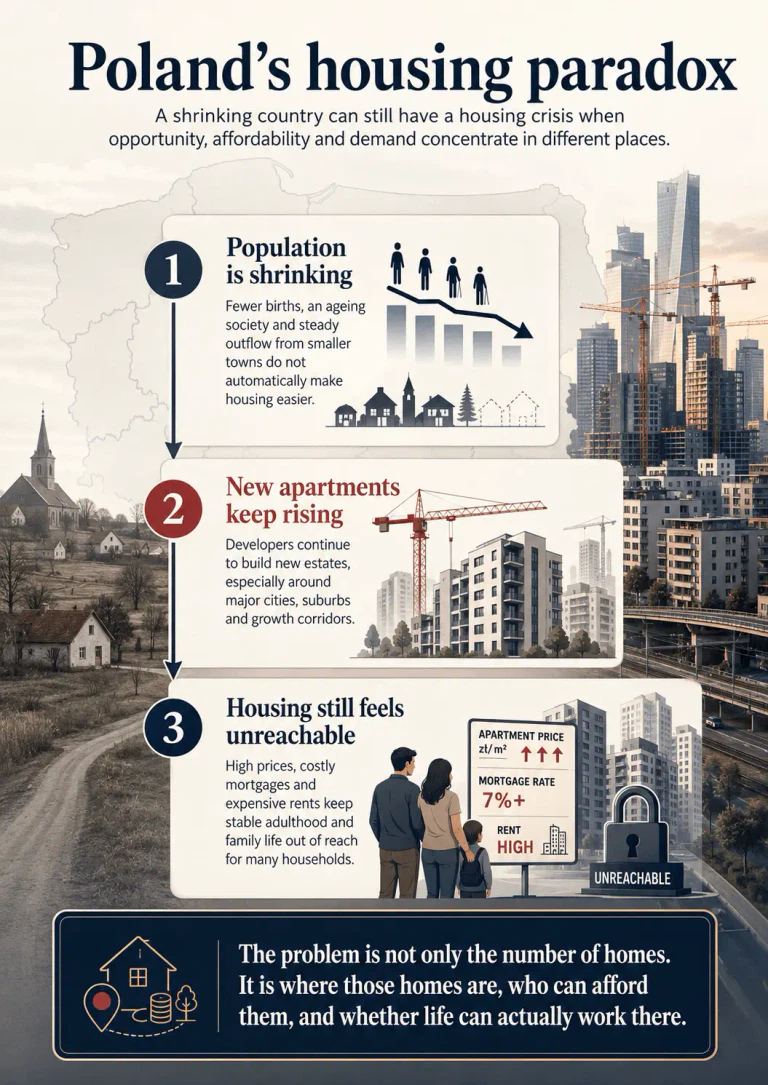
Poland’s housing problem looks contradictory only at first: the population is shrinking, new apartments keep being built, and yet housing still feels unreachable. The deeper issue is not just supply, but the geography of opportunity, affordability and access to places where life still works:
- 1. A shrinking country can still have expensive homes Demographic decline does not automatically lower housing pressure, because demand is not spread evenly across Poland. People move toward cities and regions where jobs, universities, healthcare, transport and social life are concentrated. A flat in a shrinking town and a flat in Warsaw may both count as housing, but they do not offer the same future.
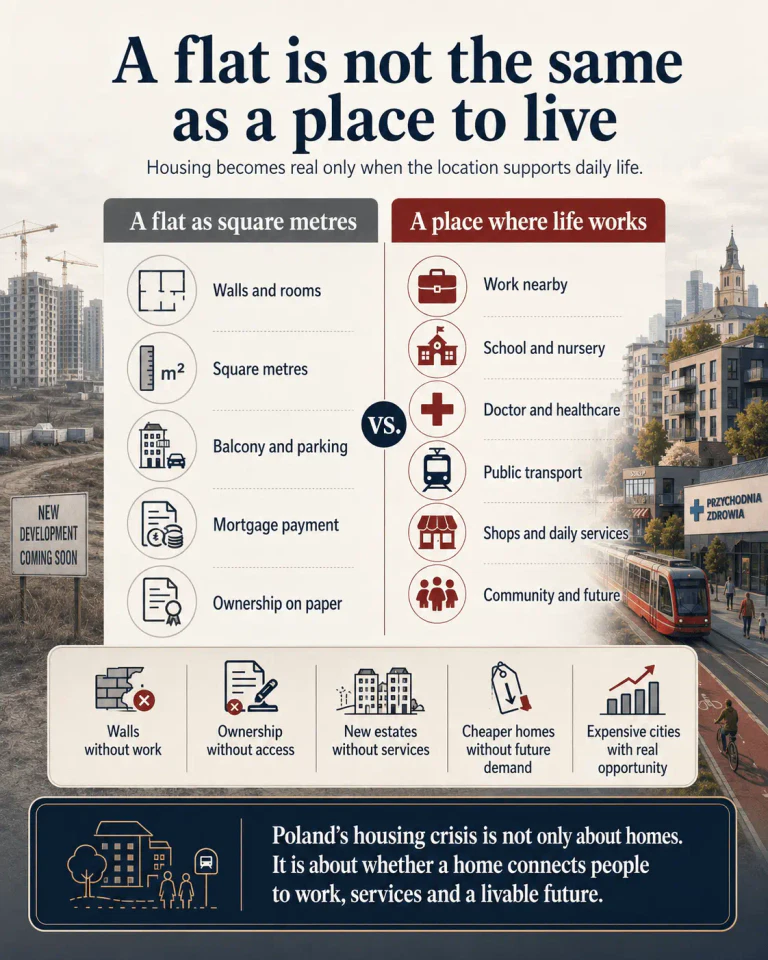
- 2. Poland is building apartments, but not always livable places New estates can add units without solving the real crisis. If housing is built far from transport, schools, doctors, stable work and public life, it gives people walls but not necessarily independence. The market can produce apartments as products while failing to create places where families can actually grow.
- 3. The real shortage is access to adulthood Poland’s housing crisis is felt most sharply at life thresholds: leaving parents, moving in together, having a child or changing cities for work. The problem is not only price per square metre. It is the growing distance between ordinary wages and the kind of home that makes stable adult life possible.
The country is shrinking. Births are low. Natural population growth is negative. New apartment blocks keep rising on the edges of cities, near ring roads, behind shopping centres, on former fields, in districts that did not feel urban fifteen years ago. Cranes have become part of the skyline of Warsaw, Kraków, Wrocław, Gdańsk and Poznań. Smaller cities also keep adding new estates, often marketed with the same language: modern, safe, green, close to everything.
And yet housing still feels impossible.
Young people stay longer with parents. Couples postpone children because they cannot find a flat large enough to make family life workable. Workers from smaller towns look at Warsaw or Kraków salaries and then discover that rent eats the wage premium. Families move to suburbs and accept long commutes because the city itself has become unaffordable. In many local markets, the word “available” means something very different from “accessible”.
This is the core contradiction: Poland is building homes, but not necessarily solving the housing problem.
The reason is that housing demand is not evenly spread across the map. People do not need a dwelling in the abstract. They need a dwelling near work, transport, childcare, healthcare, education, social life and future income. A country can have empty buildings in one place and a brutal shortage in another. It can have a falling population and still have overcrowded homes. It can keep building apartments and still make young adults feel locked out.
Poland’s housing crisis is not only a construction crisis.
It is a geography crisis.
The country is shrinking, but demand is concentrating
The most misleading way to think about housing is to start with the national population number.
If Poland has fewer people, the argument goes, why are apartments still expensive? Shouldn’t demographic decline automatically make housing cheaper? Shouldn’t emptying towns release enough housing stock? Shouldn’t the market correct itself?
Only if people were evenly distributed and indifferent to location.
They are not.
Demographic decline does not hit every place in the same way. Small towns, peripheral regions and ageing municipalities can lose residents while metropolitan labour markets still attract students, professionals, migrants, service workers and young families. A shrinking country can still contain growing pockets of intense demand.
This is why the national housing discussion often feels confused. One side points to new construction and says: we are building. Another side points to prices and says: people still cannot afford to live where they need to live. Both sides are partly right.
Poland does not only need more housing units.
It needs more usable, affordable, well-located housing in the places where life chances are concentrating.
That is much harder than adding buildings to a statistical table.
The apartment can exist and still not solve anything
A flat in a depopulating town is not the same economic object as a flat in Warsaw.
On paper, both are housing. In real life, one may give access to jobs, universities, hospitals, cultural infrastructure, transport and networks. The other may sit in a place where schools are shrinking, buses are rare, doctors are ageing, young people leave, and the local labour market cannot support modern aspirations.
This is the uncomfortable part of the Polish housing debate: the country may have enough physical walls in some places and not enough functional homes in others.
A dwelling is not just square metres. It is a position inside an economic system.
This helps explain why prices can remain high even while new developments appear everywhere. Developers build where demand is financially visible. Investors buy where liquidity is strong. Banks lend against assets in markets they trust. Young professionals move where wages justify risk. International workers and students also concentrate in larger urban regions. The result is circular: the most attractive cities attract more people, which raises housing pressure, which makes them more expensive, which pushes people outward but rarely breaks the dominance of the metropolitan core.
The rest of the country does not disappear overnight.
It hollows out unevenly.
Poland is not becoming one big city, but it is becoming more unequal
It would be too simple to say that everyone will move to Warsaw, Kraków or Wrocław.
That will not happen literally. Remote work, family ties, local ownership, ageing, regional identities and housing costs all prevent a total metropolitan migration. Some people will choose small towns. Some will return. Some will build houses outside cities. Some rural and semi-rural areas near strong labour markets will grow.
But the deeper trend is still clear: opportunity is concentrating.
The future will not be divided between “cities” and “villages” in the old sense. It will be divided between connected places and disconnected places.
A village near a major city, with good roads, schools, broadband and commuting options, may become part of a wider metropolitan system. A small town far from strong labour markets may lose young adults, shops, services and political weight. Some county towns will survive as local centres. Others may become places with buildings but fewer reasons for the young to stay.
This is how demographic decline changes housing.
Not by making every home cheaper.
By separating places with future demand from places with past infrastructure.
The old map of Poland still shows cities, towns and villages. The economic map increasingly shows something harsher: metropolitan gravity zones, commuter belts, ageing peripheries and shrinking service landscapes.
Housing prices follow that map.
Why new supply does not automatically lower prices
In theory, more supply should reduce pressure.
In practice, it depends on what is built, where it is built, who can buy it, how it is financed and whether it matches real household needs.
If developers build small investment flats in high-demand cities, they may increase the number of units without solving the shortage of family-sized homes. If construction happens on the edge of a city without proper transport, it may create housing but also lock residents into car dependency. If new apartments are priced for investors or upper-middle-income buyers, they do not become accessible to average workers. If wages rise more slowly than prices, supply can grow while affordability worsens.
Poland has added many dwellings in recent years. That matters. It has improved quality, reduced some forms of overcrowding and changed the physical landscape of cities. But construction alone cannot fix a market where land, labour, credit, speculation, planning and geography all push in the same direction.
A developer does not build a social policy.
A developer builds a product.
That product enters a market where households compete not only with each other, but also with investors, cash buyers, parents buying for children, landlords, funds, and people trying to protect savings from inflation. Housing becomes both shelter and asset. Once that happens, prices stop reflecting only the number of people who need a place to sleep.
They also reflect the number of people who want a place to store capital.
The empty-building paradox
Poland also has another contradiction: while people struggle with access to affordable housing, many buildings stand empty, underused or functionally abandoned.
Some are old schools. Some are industrial sites. Some are offices, warehouses, service buildings or public assets with unclear futures. They are not always ready to become homes. Conversion can be expensive, legally complicated and technically difficult. But their existence exposes the weakness of a system that treats housing mainly as new construction.
The country keeps building on new land while old structures sit idle.
This is not just an architectural problem. It is a planning problem. A climate problem. A municipal finance problem. A social-housing problem.
Adaptive reuse will not solve everything. An abandoned school in a shrinking village will not suddenly become affordable housing for Warsaw workers. But in some towns and city centres, reuse could matter. It could provide lower-cost housing, protect urban fabric and reduce the need to push development farther outward.
Poland’s housing debate is too often obsessed with whether the market should build more.
The better question is: where should people be able to live, and what existing space is being wasted?
The real shortage is not just apartments, but affordable independence
Housing shortage is usually imagined as a lack of units.
For young adults, it often feels like a lack of independence.
A person may technically have a roof. They may live with parents. They may rent a room. They may share a flat with strangers into their thirties. They may commute from a smaller town because the city is too expensive. They may own a small apartment but be unable to have a child because the next size up is financially unreachable.
This is why overcrowding matters. It shows that the housing problem is not only about homelessness or visible poverty. It also lives inside ordinary households: too many people in too little space, adult children unable to leave, couples without room for family expansion, workers with no privacy, children without adequate conditions for study.
A country can have many homeowners and still have a housing crisis.
Ownership statistics can hide pressure. In Poland, many people own homes because of historical privatisation, inheritance or family transfers. That does not mean the market works well for new households. It may mean the opposite: those already inside the ownership system are protected, while those trying to enter it face prices shaped by scarcity, credit conditions and inherited advantage.
The dividing line becomes generational.
Those who bought earlier watch assets rise.
Those who arrived later watch the ladder move upward.
Metropolisation turns housing into a demographic filter
Housing prices now help decide who can participate in the country’s most dynamic places.
This is not only unfair. It is economically stupid.
If teachers, nurses, young doctors, service workers, junior specialists, cultural workers and small entrepreneurs cannot afford major cities, those cities become socially thinner. They may still look prosperous, but they lose diversity and resilience. A city cannot function only as a showroom for high earners, investors and inherited wealth.
Housing becomes a filter.
It selects who can live near opportunity and who must remain outside it.
In Poland, this filter has demographic consequences. Young people do not form families in spreadsheets. They do it in actual flats, with actual rooms, actual commutes and actual monthly payments. If the housing ladder requires two high incomes, parental support or years of delay, fertility policy loses contact with reality.
A child benefit does not compensate for a missing bedroom.
A slogan about family values does not lower rent.
A new apartment block does not help if the price assumes a household that does not exist.
The future may be emptier and more expensive at the same time
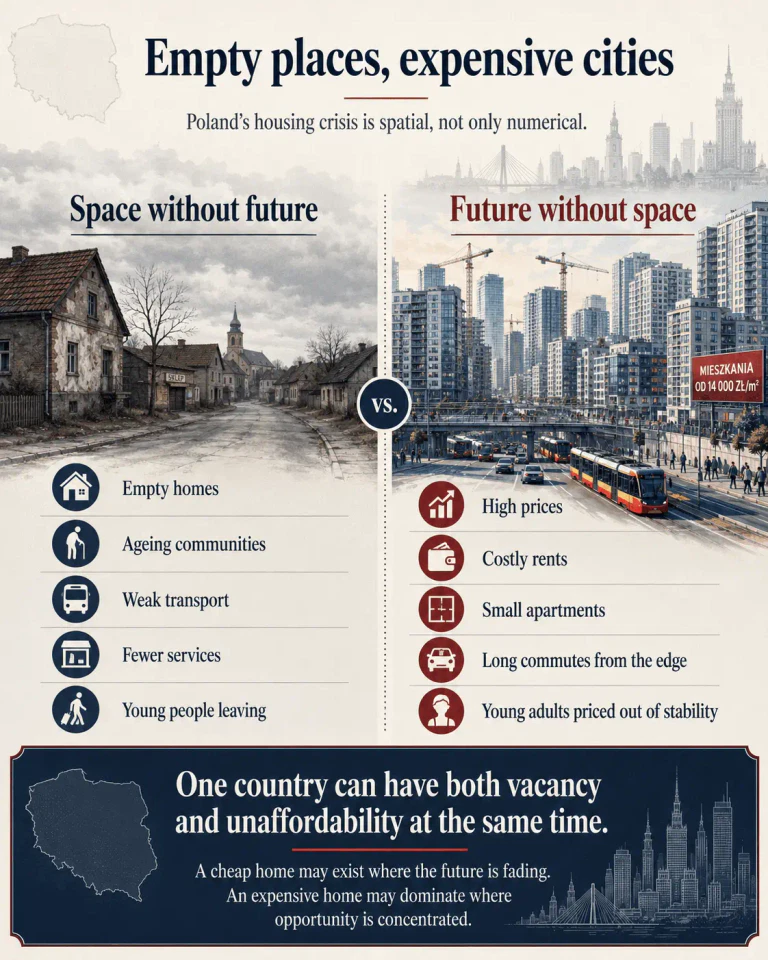
This is the brutal possibility Poland needs to face: some parts of the country may become emptier while the desirable parts become more expensive.
That sounds contradictory only if housing is treated as one national market.
It is not.
Housing is local, and the strongest local markets are connected to labour, infrastructure and status. If Poland’s population declines but economic life concentrates in fewer nodes, pressure on those nodes can remain high. Meanwhile, weaker towns may accumulate empty properties that do not attract new residents because the surrounding opportunity structure has collapsed.
In that future, Poland could have both vacancies and unaffordability.
Both abandoned buildings and overcrowded families.
Both shrinking municipalities and expensive metropolitan flats.
Both demographic decline and housing anxiety.
This is not a market failure in the simple sense. It is a spatial failure. The country is not distributing opportunity, infrastructure and housing capacity in a way that allows people to build stable lives outside a few high-pressure zones.
Change of housing debate
The housing debate in Poland needs to stop asking only whether enough units are being built.
The better question is whether Poland is building the right homes, in the right places, for the right households, within a spatial model that does not condemn smaller towns to slow decline and larger cities to permanent affordability stress.
That requires a different policy imagination.
Planning cannot be treated as paperwork. Transport cannot be separated from housing. Empty public buildings cannot be ignored while municipalities ask for more land consumption. Rental housing cannot remain underdeveloped in a country where mobility increasingly matters. Social and affordable housing cannot be reserved only for the very poorest, while millions fall into the gap between public eligibility and market affordability.
Most of all, Poland needs to admit that demographic decline will not automatically solve the housing crisis.
Fewer people do not mean easier housing if the remaining population is pulled toward fewer places.
A shrinking country can still be an unaffordable country.
And that may be the most important lesson of Poland’s housing paradox.


