

The question for an apartment connected to a heating network is who supplies the difference. Some money comes through customers’ tariffs, some from the company’s capital and some from public support. A grant and a loan distribute the cost differently. Meanwhile, a new source of heat may be added before the old boiler can be retired.
That last point makes the transition more expensive than a simple fuel swap suggests. Residents need dependable heat on the coldest days as well as lower fuel consumption over the year. A system can move away from regular coal burning while still paying to keep conventional equipment available.
A better trading year leaves a large construction bill
The URE’s report on licensed heating businesses in 2025 records gross profit above PLN 2.5 billion. Stabilising coal and gas prices helped, as did lower variable costs and a 6.62% increase in heat sales in a colder year. Coal nevertheless remained the largest fuel in the reported mix, at 52.8%.
These are two different kinds of improvement. Cheaper fuel helps an operator pay its current expenses. Replacing the equipment requires a construction budget, financing and a project that can operate within the existing network. One profitable year gives companies more room to act, but it does not establish that they can finance the national programme from retained earnings.
The Energy Ministry’s June 2026 description of the strategy envisages combinations of heat pumps, electric boilers, storage, waste heat and other local sources. These technologies do different jobs. Storage changes when heat must be produced; recovered heat changes where it comes from. Our earlier account of Finland’s sand battery examines that timing advantage in a particular installation.
Poland therefore has to finance changes to whole operating systems. The useful comparison is the delivered heat, reliability and cost of the proposed combination. The purchase price of one new boiler cannot settle that question.
Backup boilers still need to be maintained
There is a revealing change in URE’s capital-return model for 2026. The model suspends the asset-efficiency adjustment known as EWA for heat generation. URE’s report on its activities in 2025 explains the change in terms of non-renewable assets being used as reserve installations alongside renewable sources and installations recovering waste heat.
The distinction is between how much heat a unit produces and why it remains installed. Equipment that runs infrequently can still have a role in the network’s operating plan. Judging it only by its annual output can miss the service the operator is retaining: another source available when needed.
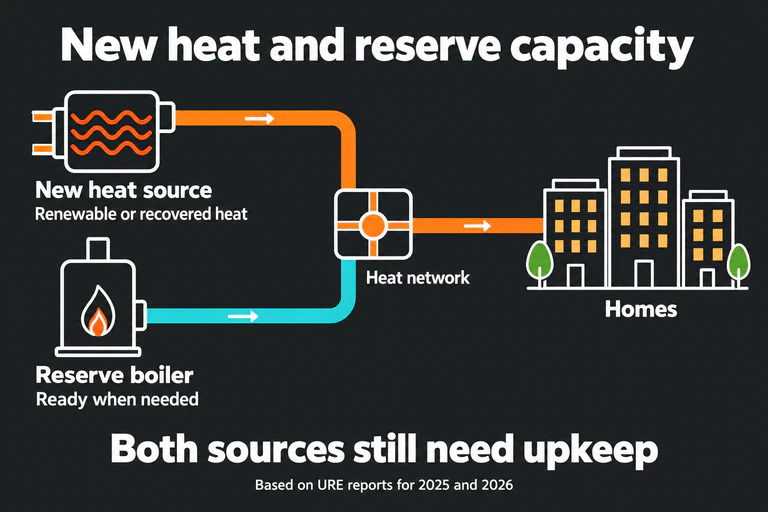
Keeping that option involves maintenance, controls and capital tied up in the existing plant. The regulatory change recognises a practical complication of adding new sources. It does not establish that every old boiler should remain indefinitely. Each operator still needs a credible plan for what its sources will do and which capacity it can eventually retire.
For customers, the relevant question is how the investment changes the operating role of the old equipment. Does the new source displace routine coal burning? Is the existing boiler retained for peaks or reserve? When can it be removed? Those answers determine whether the project is a replacement, an intermediate stage or a permanent addition.
A publicly supported project can still carry debt
Radomsko’s municipal operator provides a concrete example. Its biomass-boiler project description records grant and loan agreements signed with NFOŚiGW on 28 December 2023. The planned 12.5 MW heat source connects into the coal-fired heating plant’s existing system. The work includes pumps, water treatment, fuel handling, flue-gas cleaning and connections; the published planned completion date is 31 December 2026.
This is a project plan, not evidence that the boiler is already delivering its promised output. It shows both the breadth of the work and the mixed financing behind it. Describing the whole package as public funding would leave out a consequential distinction: borrowed money must be repaid.
The structure also appears in NFOŚiGW’s December 2025 loan call for county heating, whose application window ended in January 2026. A loan complemented a grant for the same project, and its amount could not exceed the difference between eligible costs and the grant. The published call illustrates a financing route; it is not an offer still open to applicants.
A grant supplies capital the operator does not have to raise entirely from its own customers or borrowing. A loan provides money earlier, with repayment obligations later. Financing can make a project possible without making its future cost disappear. To understand the pressure on tariffs, a funding announcement needs a breakdown of the grant, debt and operator’s own contribution.
The cost reaches households through a local tariff
A real tariff shows why the unit price of heat cannot describe the whole bill. MPEC-Konin’s notice for the tariff introduced on 1 May 2026 lists a heat price of PLN 52.64 per GJ net. It separately lists a charge for contracted thermal capacity, fixed transmission charges, variable transmission charges and the heat carrier. The notice says the change increases the annualised total delivery cost for customers on the Konin network by 7.41%.
That is a specific network and tariff, rather than an estimate for Poland. It also does not prove that the increase was caused by a particular transition project. It demonstrates the practical reading task: a resident needs to distinguish the cost of heat consumed from the other services being paid for.
URE’s capital-return model puts justified operating costs and a return on the assets into the revenue calculation. The regulator therefore has to consider the money a company needs to operate and invest alongside the cost borne by its customers. Changing the fuel can reduce one expense while financing and maintaining the replacement system creates others.
The long-term demand side adds pressure. Forum Energii’s 2025 analysis identifies renovation of inefficient buildings as essential to reducing fuel use and the expenditure needed on new heating equipment. Better buildings can make the required system smaller. That requires coordination: insulation, contracted capacity and the heating company’s investment plan have to describe the same future demand.
For a household, the documents worth asking about are concrete: the applicable tariff, the building’s contracted heat capacity, the operator’s new-source plan and the grant-and-loan split. They show how much of the transition is being supported from outside the network, what future obligations remain, and whether the equipment being financed fits the heat the buildings will need.


