
Revolutionary transformation of space economics
The global space economy reached an unprecedented $613 billion in 2024, marking a robust 7.8% year-over-year growth that positions space as one of the fastest-expanding sectors in the global economy. This remarkable expansion represents a fundamental shift from government-controlled space programs to a commercial-driven ecosystem where private companies now account for 78% of total space economic activity.
SpaceX leads this transformation with projected revenues of $15.5 billion in 2025, making it financially larger than many national space programs. The company's Starlink satellite constellation, generating $7.7 billion in 2024 alone, has become the largest single revenue source in commercial space. This shift demonstrates how private enterprises have not only entered the space market but fundamentally reshaped its economic dynamics.
The commercial space sector's dominance extends beyond mere financial metrics. SpaceX completed 134 launches in 2024, representing 87% of all U.S. orbital missions and establishing launch frequencies that exceed many entire national space programs. This operational supremacy illustrates how private companies have become the primary drivers of space access and technological innovation.
Ranking the most influential space powers
SpaceX - the undisputed leader
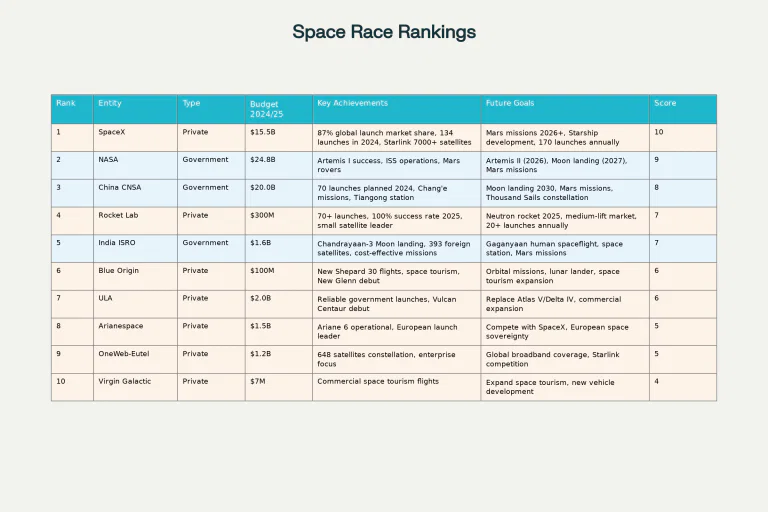
SpaceX maintains overwhelming market dominance across multiple space sectors, achieving what many considered impossible just two decades ago. The company's reusable rocket technology has reduced launch costs by up to 96%, bringing payload delivery prices down from $30,000 to approximately $1,200 per pound. This cost revolution has enabled SpaceX to capture over 66% of NASA's launches and dominate the global commercial launch market.
The company's Starlink constellation represents the largest commercial satellite network in history, with over 7,000 satellites providing internet services to 8.5 million subscribers globally as of September 2025. This network generates approximately 70% of SpaceX's total revenue, demonstrating how satellite internet services have become the primary profit center for modern space companies.
SpaceX's technological achievements extend beyond Earth orbit operations. The company's Starship program completed its 10th test flight in August 2025, demonstrating measurable progress toward heavy-lift capabilities essential for Mars missions. Elon Musk's ambitious timeline calls for five uncrewed Starships to launch toward Mars in 2026, with human missions potentially following by 2029.
NASA - government space leadership under pressure
NASA remains the world's largest space organization by budget, with $24.8 billion allocated for 2025 operations, though this represents a potential decrease from previous funding levels. The agency's Artemis program continues progressing toward returning humans to the Moon, with Artemis II scheduled for April 2026 and the first lunar landing since 1972 planned for mid-2027.
However, NASA faces significant budgetary challenges that could fundamentally alter American space leadership. Proposed budget cuts for 2026 would reduce NASA's funding by 24%, potentially eliminating key science missions and laying off one-third of the agency's workforce. These reductions would particularly impact Earth science programs, with funding dropping by 53%.
The Artemis program's costs continue escalating, with total expenditures from 2012 through 2028 projected to reach $102.5 billion. This enormous investment demonstrates both NASA's commitment to lunar exploration and the financial challenges facing government-funded space programs in an era of commercial competition.
China - emerging superpower with ambitious goals
China's space program has evolved into a formidable force with an estimated annual budget of $20 billion, making it the world's second-largest space economy. The China National Space Administration (CNSA) planned 70 launches for 2024, demonstrating operational capabilities that rival established space powers.
Chinese lunar exploration ambitions center on achieving a crewed Moon landing by 2030, potentially making China only the second nation to accomplish this feat. The country's Chang'e missions have already achieved significant milestones, including successful sample returns from the far side of the Moon.
The "Thousand Sails" constellation represents China's answer to Starlink, with plans to deploy over 15,000 satellites to provide global internet coverage. The first 18 satellites launched in August 2024, marking the beginning of China's challenge to American dominance in satellite internet services.
India - cost-effective space innovation
India's space program demonstrates remarkable efficiency, achieving major milestones with a relatively modest budget of $1.6 billion (13,416 crore rupees) for 2025-26. The Indian Space Research Organisation (ISRO) has established itself as the world's most cost-effective space agency, launching 393 foreign satellites since 2014 and generating significant commercial revenue.
Chandrayaan-3's success in 2023 made India the first nation to successfully land near the Moon's south pole, achieving this milestone at a fraction of the cost typically associated with lunar missions. This achievement demonstrates how innovative engineering approaches can compete with much larger budgets.
The privatization of India's space sector has catalyzed remarkable growth, with space startups increasing from one in 2014 to 328 companies by 2025. The government has allocated a ₹1,000 crore venture capital fund specifically to support space startup development.
Private companies reshaping space access
Blue Origin - Bezos's long-term vision
Blue Origin has finally achieved orbital capability with the January 2025 debut of its New Glenn rocket, ending years of development delays. The New Shepard suborbital program has completed 30 flights, including 10 crewed space tourism missions, generating over $100 million in revenue.
The company's space tourism operations charge $200,000 to $300,000 per passenger for 11-minute suborbital flights that cross the Kármán line. While significantly smaller than SpaceX's operations, Blue Origin's focus on reliability and methodical development has established a foundation for future growth.
New Glenn represents Blue Origin's orbital ambitions, designed to compete with SpaceX's Falcon Heavy for large payload deliveries. The rocket's maiden flight demonstrated the company's transition from suborbital tourism to serious orbital operations.
Rocket Lab - Small satellite specialist
Rocket Lab has emerged as the world's most reliable small satellite launcher, achieving 100% mission success across all 2025 launches and completing over 70 total missions. The company's Electron rocket has become the most frequently launched small orbital rocket globally.
The Neutron rocket development represents Rocket Lab's expansion into medium-lift capabilities, with first launch planned for late 2025. This vehicle will enable the company to compete for larger payloads while maintaining its reputation for reliability and rapid launch cadence.
Rocket Lab's manufacturing investments include a $23.9 million CHIPS Act award to expand semiconductor production capabilities for space applications. The company produces space-grade solar cells that have powered major missions including the James Webb Space Telescope and Mars exploration vehicles.
Virgin Galactic - Space tourism pioneer
Virgin Galactic operates the world's first commercial space tourism service, though with limited financial scale generating just $7 million in annual revenue. The company's spaceplane approach offers a different experience compared to rocket-based competitors, appealing to passengers seeking winged vehicle flights.
The space tourism market itself shows enormous growth potential, projected to expand from $1.3 billion in 2024 to between $5.27 billion and $40.4 billion by the early 2030s, depending on technological developments and cost reductions. This growth will benefit all space tourism operators as the market matures.
European space efforts - Arianespace and sovereignty concerns
European space capabilities center on Arianespace's operations, which achieved just three launches in 2024, highlighting the continent's struggle to maintain competitive launch capabilities. The Ariane 6 rocket's debut in 2024 ended a temporary European dependence on SpaceX for critical missions.
European space sovereignty drives continued investment in independent launch capabilities despite higher costs compared to commercial alternatives. The IRIS2 constellation project represents Europe's attempt to develop independent satellite internet capabilities with 300 planned satellites.
Starlink's market dominance
Starlink operates nearly 7,000 satellites, representing approximately two-thirds of all active satellites and establishing an overwhelming lead in the satellite internet market. The constellation provides service in about 40 countries with speeds ranging from 25-220 Mbps at historically low satellite internet prices.
Starlink's technical advantages include full global coverage, including Arctic and Antarctic regions, through its large constellation size and continuous satellite deployment. The service has become particularly valuable for military and emergency communications, as demonstrated in Ukraine.
OneWeb-Eutelsat - the primary challenger
OneWeb-Eutelsat operates 648 satellites in a higher 1,200-kilometer orbit, providing global coverage with fewer satellites than Starlink. The company focuses primarily on enterprise and government customers rather than consumer markets.
OneWeb's hybrid network approach combines low Earth orbit satellites with geostationary satellites from parent company Eutelsat, potentially offering more robust coverage in polar regions where Starlink has limitations. This positioning creates opportunities in underserved market segments.
Chinese constellation development
China's satellite internet ambitions include multiple competing projects, with the Qianfan constellation planning over 15,000 satellites and Geespace targeting nearly 6,000 satellites. These projects represent China's determination to compete directly with American satellite internet dominance.
Mars exploration timeline
SpaceX's Mars mission plans call for five uncrewed Starships to launch during the 2026 transfer window, with potential human missions beginning in 2029. The timeline envisions rapidly escalating mission scales, reaching 100 Starships by 2031 and eventually 1,000-2,000 ships per Mars transfer opportunity.
NASA's Mars exploration strategy focuses on robotic missions and technology development while maintaining the Artemis lunar program as a stepping stone to Mars. The agency's approach emphasizes scientific exploration and technology demonstration rather than immediate colonization.
China's Mars ambitions include plans for crewed missions by 2033, potentially making it the second nation to send humans to Mars. This timeline positions China as a serious competitor in interplanetary exploration.
Lunar development programs
The Moon has become the primary near-term objective for multiple space powers, with NASA's Artemis program targeting 2027 for the first crewed landing since 1972. The program includes plans for annual lunar missions after Artemis VI, establishing permanent human presence.
China's lunar program aims for crewed landings by 2030 through the Chang'e series of missions, with potential for establishing a lunar research station. This timeline creates direct competition with American lunar exploration efforts.
Commercial lunar opportunities include SpaceX's cargo delivery services beginning in 2028 at $100 million per metric ton, opening the Moon for commercial development. These services will enable private sector lunar activities beyond government programs.
Economic projections and market evolution
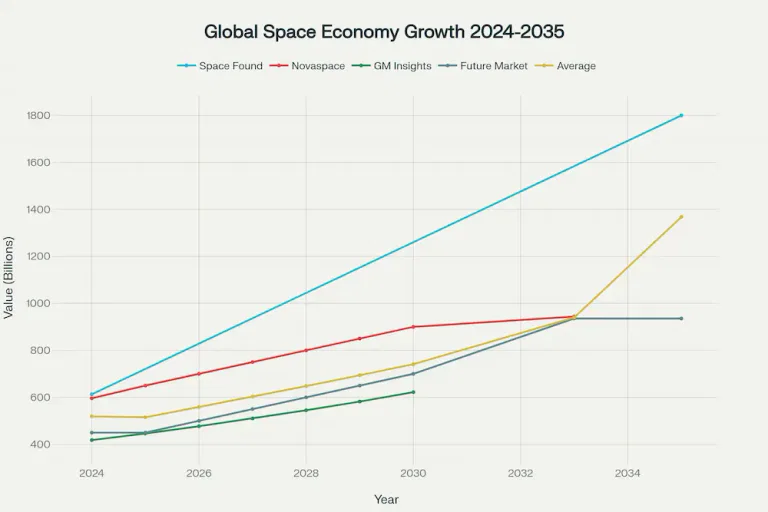
The space economy's growth trajectory shows remarkable acceleration, with projections ranging from $944 billion by 2033 to $1.8 trillion by 2035. This growth spans multiple sectors including satellite services, launch operations, space tourism, and emerging applications like space manufacturing.
Commercial sector dominance will continue expanding, with private companies driving innovation in reusable launch vehicles, satellite constellations, and space tourism. The commercial sector's 78% share of space economy activity demonstrates the fundamental shift from government-led to market-driven space development.
Investment flows show increasing private sector confidence, with space technology startups receiving $2.7 billion in venture capital funding during 2024, surpassing traditional aerospace markets. This investment pattern indicates sustained private sector growth in space applications.
Challenges and competitive dynamics
Launch market competition continues intensifying as new entrants including Firefly, Relativity Space, and Stoke Space prepare to challenge established players. These companies aim to capture market share through innovative manufacturing techniques and specialized capabilities.
Regulatory challenges grow as space activities expand, with concerns about orbital debris, spectrum allocation, and international coordination becoming critical issues. The proliferation of satellite constellations raises questions about sustainable space development.
International cooperation and competition create complex dynamics as nations balance collaborative scientific projects with competitive commercial and military objectives. This tension shapes policy decisions and technology development priorities across all major space powers.
Technological barriers remain significant for Mars missions, lunar development, and space manufacturing, requiring continued innovation and substantial investments. Success in these areas will determine which entities achieve long-term space leadership.


