

That recurring purchase helps explain two familiar frustrations: a long queue for a digital book and a title that remains in the catalogue even though nobody can borrow it. They look similar on a phone, but they can require different spending decisions from the library.
Some ebook licences run out
OverDrive’s lending-model documentation makes an important distinction. One Copy/One User titles allow one borrower at a time and do not expire from the collection. Metered Access titles run out after a specified period, a number of checkouts, or whichever of those limits arrives first. Publishers determine the available models.
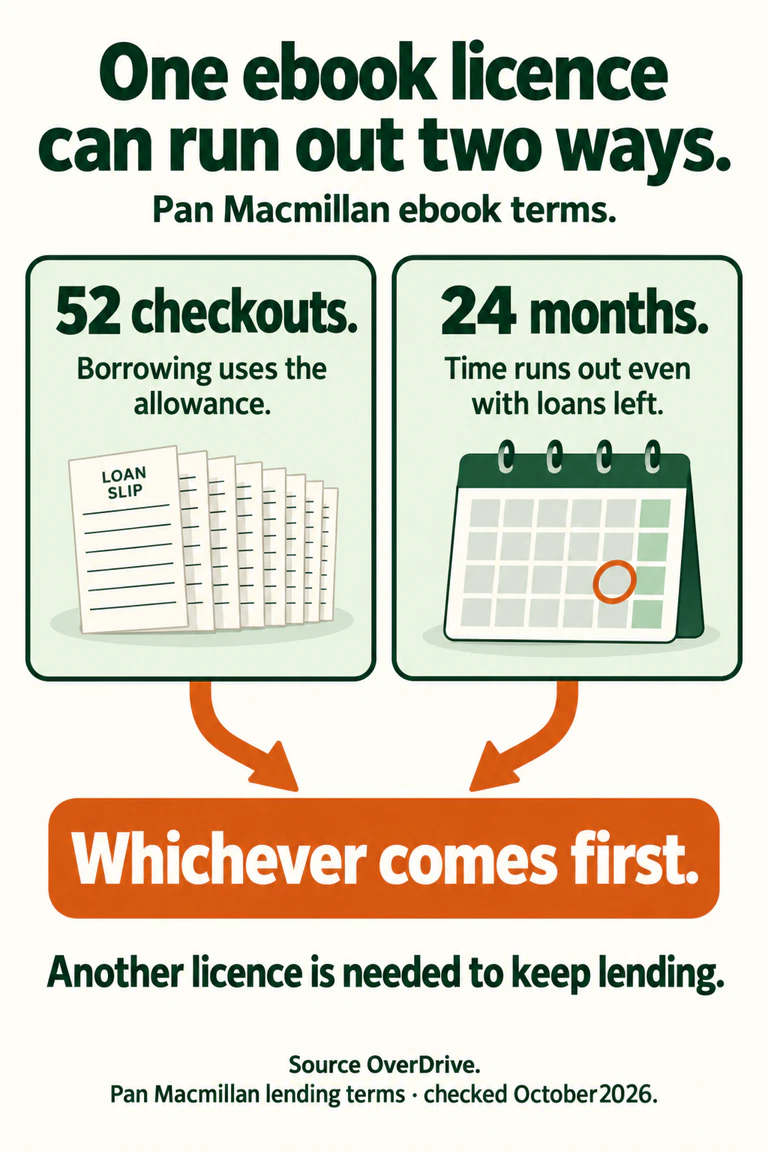
A concrete example appears in the Pan Macmillan terms published by OverDrive. An ebook purchase permits up to 52 sequential checkouts or 24 months of lending, whichever comes first. Those particular limits expressly do not apply to Pan Macmillan audiobooks. They are an example of a contract, not a universal rule for all publishers, formats or countries.
The two limits put pressure on different books. Heavy borrowing can exhaust a checkout allowance. A quieter title can reach its time limit while still having unused checkouts. Popularity therefore creates a replacement expense, while low demand does not necessarily protect a book from disappearing.
For a library with a fixed collection budget, renewing access to an old title competes with adding a new one. Some spending preserves what readers could already borrow rather than enlarging the collection. A catalogue can become more expensive to maintain without becoming broader.
A queue can outlive the right to lend
An ordinary waitlist usually means other people are ahead of you for available lending copies. Libby’s explanation of digital waiting lists says publishers often require each copy to be loaned to one person at a time. Buying more copies can shorten that queue if the library has the budget.
An expired licence presents another problem. Libby’s September 2026 help page explains that “Unknown Wait” can mean a title has expired or been removed. Libraries may leave expired titles visible and use holds to judge whether to buy more copies. If they replenish or restore the title, the hold can start moving normally again.
Waiting longer does not itself replenish that licence. The queue is now also a request for the library to spend money. A book’s presence in a search result tells you that the institution knows about it; it does not guarantee a currently usable lending copy.
Readers cannot see all the information behind that decision. OverDrive says its borrower-facing services do not display the remaining time or checkouts on Metered Access titles. The librarian manages those allowances. Someone who finds the middle volume of a series unavailable may be seeing a collection decision that the interface cannot fully explain.
The cost can change who gets a library card’s benefits
Coquitlam’s December 2025 announcement put the issue in everyday terms. It listed a library ebook price of $85 for Louise Penny’s The Black Wolf, against $21.99 at retail. Its hardcover figures ran in the other direction: $23.60 for the library and $30 at retail. These are the Canadian library’s published prices for that title, not a current universal price list.
The restriction took effect on 1 February 2026. Customers whose account addresses were outside Coquitlam could still receive notices for existing holds but could no longer check out those items; their holds could not be transferred to another system. The notice provides an eligibility route for people who have moved to the city or own property or a business there.
That decision makes a digital collection local in practice. A neighbouring reader’s device can receive the file; their card can no longer borrow it from this service. A restriction can protect the budget while reducing access.
Coquitlam is one case. The wider budget dispute was visible in a May 2026 joint call from North American library organisations. They said digital demand was straining budgets and that a two-year ebook licence often cost $55 or more. Their request was for sustainable licensing that would let libraries keep lending and preserving works. Those figures describe the groups’ case for reform; they do not establish the price or licence of every book.
Publishers and authors have a competing concern. In its September 2026 statement, the Association of American Publishers and the Authors Guild argued that easier digital borrowing can substitute for retail purchases. They cited a study they commissioned and favoured more library funding over state controls on licensing. That is an interested party’s argument, not a settled estimate of what one additional loan does to an author’s income.
The question is how a lending service should pay for books while remaining dependable for readers. A time limit can require spending on the same text even when demand is modest. A checkout limit makes successful borrowing consume the remaining allowance. Neither pattern automatically tells the library whether buying another licence is a better use of money than buying something its readers have never had.
For a stalled hold, the useful question to ask the library is whether it still has a lending copy and plans to replace any expired licences. That gets closer to the decision than asking when another borrower will finish. Returning a book early can help someone in an active queue. It cannot renew an expired contract.


