

Key takeaways from the Competency-Based Hiring analysis
Competency-based hiring is often presented as the end of degree-based recruitment, but the real shift is slower and more complicated. Degrees are losing their monopoly, yet many employers still lack the systems, assessments and cultural habits needed to hire by skills at scale.
- 1. The degree reset is real, but not complete Many employers have removed bachelor’s degree requirements from job postings, especially in roles where practical skills matter more than academic credentials. But removing one line from a job description does not automatically change who gets screened, interviewed or hired.
- 2. Skills-first hiring often stops at the press release A company can claim to hire for skills while its applicant tracking system, recruiters and hiring managers still reward traditional credentials. If the hidden process continues to favor degrees, “degree optional” becomes branding rather than real access.
- 3. The real barrier is hiring infrastructure Most recruitment systems were built around degrees, job titles and résumé keywords, not verified competencies. Without better assessments, updated ATS filters, structured interviews and clear skills frameworks, non-degreed candidates can still disappear before a human ever sees them.
- 4. Public-sector reform may matter more than corporate slogans Some of the most meaningful progress is happening in government hiring, where degree requirements are being removed through formal policy rather than marketing language. Public-sector reforms can force job classifications and recruitment systems to change in ways private employers often avoid.
- 5. Degrees are losing their monopoly, not disappearing Degrees still matter in regulated professions, prestige-driven markets and organizations without reliable skills assessment. The real change is that a degree is no longer the only acceptable proof of employability. Portfolios, certifications, work samples, experience and verified competencies are becoming part of the same hiring conversation.
For decades, the bachelor’s degree functioned as a social password. It did not always prove that someone could perform a specific job, but it opened doors, satisfied recruiters, reassured managers and gave employers a simple filter in a crowded labor market. A degree was not only an educational credential. It was treated as a proxy for discipline, intelligence, social polish and professional potential.
That system is now under pressure.
Employers face labor shortages, rising wage expectations, changing technologies and growing frustration with degree inflation. Millions of workers have practical skills but no four-year degree. At the same time, many graduates carry debt without possessing the precise competencies employers claim to need. The mismatch has become too visible to ignore.
This is why competency-based hiring has become one of the most important recruitment debates of the decade. The idea sounds simple: hire people for what they can do, not only for where they studied. Evaluate skills, portfolios, work samples and practical ability instead of treating a degree as the default gatekeeping mechanism.
The slogan is attractive. The implementation is much harder.
The labor market is not witnessing a clean revolution. It is witnessing a messy transition. Degree requirements are falling in many job postings, but old hiring logic remains embedded in software, interview habits, compensation systems and managerial bias. Many employers have learned to speak the language of skills-first hiring without building the infrastructure needed to practice it.
That gap between promise and reality is where the real story begins.
The degree reset is real, but uneven
The decline of degree requirements is not imaginary. Many employers have removed bachelor’s degree requirements from roles that never truly needed them. Technology firms, banks, manufacturers, state governments and large public institutions have all started questioning whether a four-year degree should remain the automatic entry ticket for middle-skill and even some high-skill roles.
This shift reflects a simple economic truth: many jobs were over-credentialed.
For years, employers asked for degrees because degrees were convenient. They made screening easier. They reduced the number of applicants. They gave hiring managers a familiar benchmark. But convenience is not the same as accuracy. A degree may show that someone completed a long educational process, but it does not necessarily prove they can manage a team, write code, solve customer problems, operate technical systems or analyze data under pressure.
Degree inflation created a strange labor market contradiction. Many job postings demanded college credentials even when large numbers of successful workers in those same roles did not have them. The requirement became less about the job itself and more about filtering the applicant pool.
Competency-based hiring attempts to reverse that logic. Instead of asking, “Does this person have the expected credential?”, it asks, “Can this person demonstrate the competencies required for the work?”
That is a better question. But it requires better tools.
The 0.14 percent problem
The most uncomfortable fact about the skills-first hiring movement is that corporate announcements often overstate actual change.
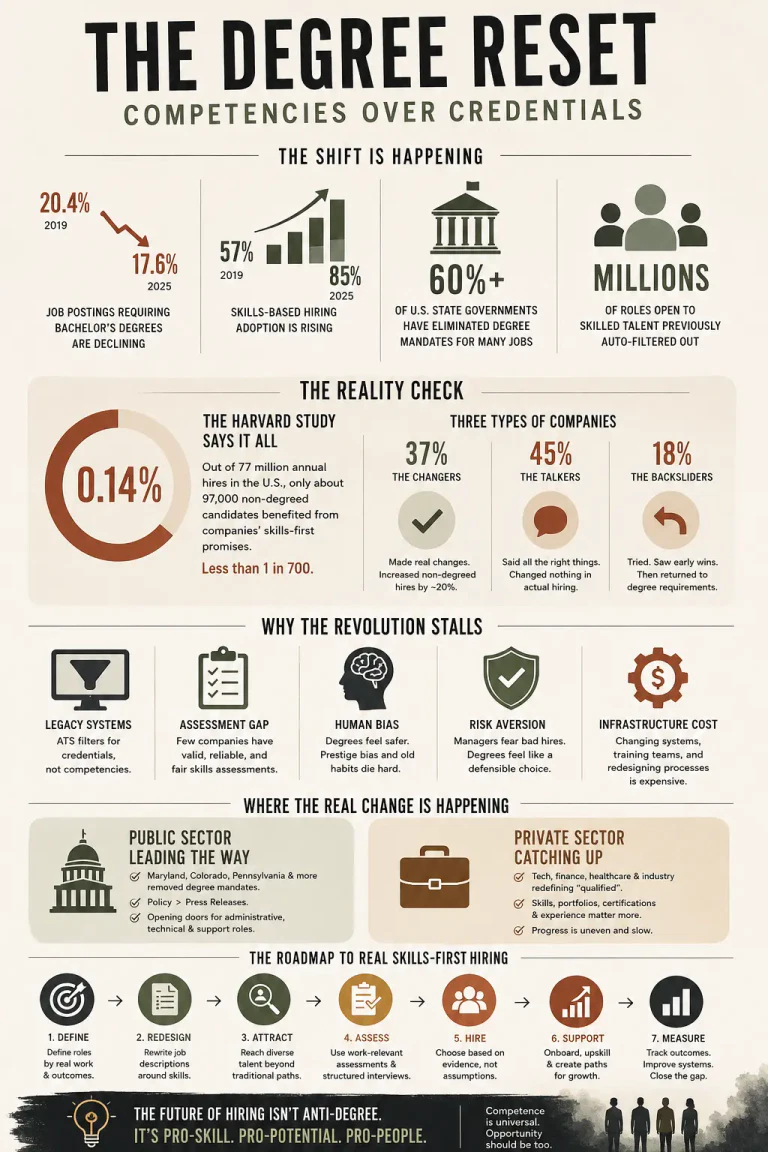
According to the research cited in the source material, only a tiny share of annual hires without degrees appear to benefit directly from companies removing degree requirements. The figure is especially striking because it exposes the difference between a policy statement and a hiring outcome. A company may remove a degree requirement from a job description, but that does not automatically mean non-degreed candidates will be interviewed, evaluated fairly or hired.
This is the central contradiction of the degree reset.
Many employers say they are open to non-traditional candidates. Far fewer can prove that their hiring patterns have changed at scale.
The problem is not only hypocrisy. It is also inertia. Hiring systems are built from many layers: job descriptions, ATS filters, recruiter habits, screening calls, manager preferences, interview rubrics, compensation bands, onboarding systems and promotion pathways. Removing one line from a job posting does not transform the rest of the machine.
A “degree optional” label can become cosmetic if the hidden process still rewards the same old signals.
Why degree inflation happened in the first place
Degree inflation did not appear because every employer suddenly became irrational. It grew because degrees solved a practical problem badly but efficiently.
Employers needed a quick way to reduce uncertainty. Hiring is expensive. Bad hires are costly. Managers often lack the time, skill or tools to evaluate candidates deeply. A degree became a shortcut: not perfect, not always relevant, but easy to recognize.
Over time, this shortcut turned into a default requirement.
Jobs that once required experience began requiring degrees. Jobs that required practical ability began requiring degrees. Jobs where the majority of successful workers had no degree still began listing bachelor’s degrees as preferred or mandatory. The credential became detached from the actual work.
This produced a self-reinforcing cycle:
employers demanded degrees,
workers pursued degrees to stay competitive,
degrees became more common,
employers raised expectations again,
and non-degreed workers were pushed further outside the professional pipeline.
The result was not a more accurate labor market. It was a more expensive and exclusionary one.
Why companies like the idea of skills-first hiring
Skills-first hiring appeals to employers for several reasons.
First, it expands the talent pool. If a company stops filtering out people without degrees, it can consider candidates from community colleges, bootcamps, military backgrounds, apprenticeships, online learning programs, internal training routes and direct work experience.
Either way, if you're betting your career on this trend, don't wait for the system to change. Force your way in through the cracks that already exist.
Second, it can reduce hiring bottlenecks. When roles remain open because the credential requirements are too narrow, dropping unnecessary degree demands can help employers fill positions faster.
Third, it can improve diversity. Degree requirements often exclude people who could not afford university, had caregiving responsibilities, entered the workforce early, came from under-resourced school systems or built skills through nontraditional routes.
Fourth, it aligns better with fast-changing technical work. In fields like software development, cybersecurity, cloud computing, data analytics and AI operations, specific competencies can change faster than university curricula. A portfolio, certification or live assessment may say more about current ability than a diploma earned years earlier.
Finally, it gives companies a reputational benefit. “We hire for skills, not degrees” sounds modern, inclusive and pragmatic.
But that last point is also dangerous. It creates an incentive to advertise skills-first values before the organization has actually changed.
The difference between removing a requirement and changing a system
Removing a degree requirement is only the first step. It is not the reform itself.
A company genuinely practicing competency-based hiring must change how jobs are designed, advertised, screened, assessed and supported after hiring. Otherwise, the degree disappears from the posting but survives everywhere else.
A real skills-first process asks:
- What tasks does this role actually require?
- Which competencies predict success?
- How can candidates demonstrate those competencies?
- Which requirements are essential and which are inherited assumptions?
- Can the ATS recognize alternative credentials?
- Are hiring managers trained to evaluate skills instead of prestige?
- Do interview questions reflect real work?
- Can nontraditional hires succeed after onboarding?
Most organizations have not fully answered these questions.
That is why skills-first hiring remains more developed as an aspiration than as an operational model.
The ATS problem
Applicant tracking systems are one of the biggest barriers to competency-based hiring.
Most ATS platforms were designed around keywords, credentials and linear résumés. They are comfortable with degrees, job titles, employers, dates and familiar certification names. They are less effective at interpreting portfolios, practical projects, informal learning, military experience, self-taught skills or fragmented career paths.
This creates a cruel paradox. A company may publicly welcome non-degreed candidates while its software quietly filters many of them out.
The problem is not only the word “degree.” It is the entire architecture of automated screening. If the system ranks candidates based on traditional markers, then candidates without those markers start at a disadvantage. If résumé parsing cannot interpret project-based evidence, then real ability becomes invisible. If recruiters rely on automated shortlists, many candidates never reach the stage where their skills can be assessed.
Competency-based hiring requires infrastructure that can read competency.
Without that infrastructure, “skills-first” becomes a slogan placed on top of degree-first machinery.
The assessment gap
If employers stop using degrees as a shortcut, they need something better in its place.
That is where many organizations struggle.
Skills must be assessed in a reliable, fair and role-specific way. This is easy to say and difficult to do. A coding role may use technical tasks, GitHub portfolios or pair-programming exercises. A writing role can use samples or editorial tests. An analyst role can use a dataset. A customer support role can use scenario-based simulations. A project management role can use a planning exercise.
But assessments create their own problems.
They must be valid.
They must not be excessively time-consuming.
They must not exploit unpaid labor.
They must be accessible to candidates with different backgrounds.
They must be evaluated consistently.
They must be updated as tools and practices change.
Many companies do not have the expertise to design these assessments. Others rely on generic tests that fail to represent the real job. Some make candidates complete long take-home tasks that feel more like free consulting than hiring evaluation.
A weak degree requirement should not be replaced by a weak skills test.
The point is not to create new barriers. The point is to create better evidence.
What real competency-based hiring looks like
A serious skills-first hiring system begins before the job is posted.
The organization first defines the role in practical terms. Instead of copying an old job description, it identifies the work that actually needs to be done. What does success look like in the first 30, 90 and 180 days? What tools will the person use? What decisions will they make? What problems will they solve? What level of independence is required?
Then the job description is rebuilt around competencies.
A strong job description separates:
- must-have skills,
- trainable skills,
- nice-to-have experience,
- formal credentials required by law or regulation,
- and credentials that were historically preferred but not essential.
Next, the screening process is redesigned. Recruiters and hiring managers need criteria that do not default to educational prestige. Interviewers should ask structured questions connected to real work. Candidates should have a chance to demonstrate ability, not merely describe it.
Finally, onboarding must reflect the diversity of candidate pathways. A non-degreed hire may be highly competent but unfamiliar with corporate language, internal tools or unwritten professional norms. Good onboarding can close those gaps quickly. Poor onboarding can make the company falsely conclude that skills-first hiring “doesn’t work.”
The issue is not whether nontraditional candidates can succeed.
The issue is whether the organization knows how to recognize and support them.
Why the public sector may be ahead
The most meaningful degree-reset reforms may not come from Silicon Valley.
Public-sector reforms in U.S. states such as Maryland, Colorado and Pennsylvania matter because they convert skills-first rhetoric into administrative policy. When a state removes degree requirements from large categories of jobs, the change is not merely a marketing message. It becomes a rule that affects how public roles are classified, posted and filled.
This matters for three reasons.
First, government jobs often include many roles where practical competence, experience and training matter more than a bachelor’s degree.
Second, public institutions face workforce shortages and need wider applicant pools.
Third, state policy can force bureaucratic systems to change in ways that private companies often avoid.
Corporate employers can announce flexibility and still hire the same profiles. Public-sector policy, when implemented properly, can create a stronger accountability mechanism.
That does not mean government hiring is automatically efficient or fair. But in the degree-reset movement, public-sector mandates may be more structurally important than corporate press releases.
Why technology companies get too much credit
Technology companies helped popularize skills-first hiring, but they should not be mistaken for proof that the whole labor market has changed.
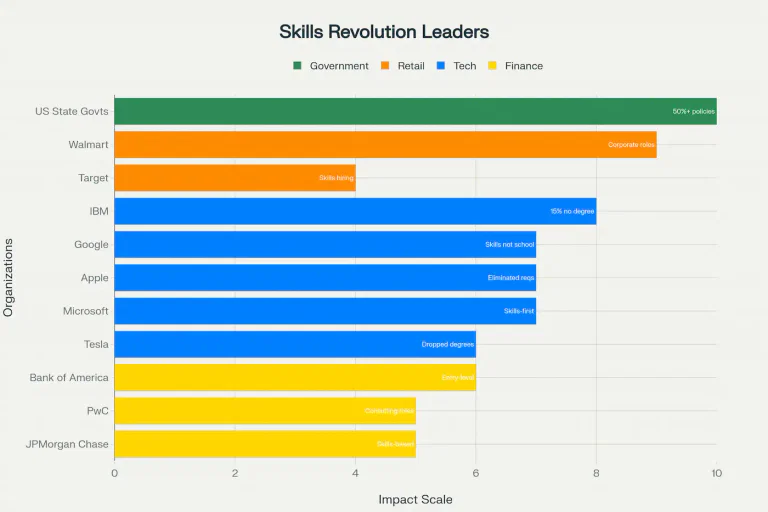
Companies like Google, IBM, Apple and Tesla are often mentioned in this debate because their brands carry symbolic weight. When elite companies say they no longer require degrees for certain roles, it sends a message to the wider market: talent can come from outside traditional university pipelines.
That message matters.
But symbolism is not the same as scale.
Many large technology firms already had pathways for exceptional non-degreed candidates, especially in technical roles where ability can be demonstrated directly. Removing formal degree requirements may make these pathways more visible, but it does not automatically democratize access. Candidates still face intense competition, algorithmic screening, referral advantages, portfolio expectations and cultural bias.
The real test is not whether prestigious companies make announcements.
The real test is whether ordinary employers change ordinary hiring.
The role of alternative credentials
Bootcamps, certificates, apprenticeships, microcredentials and online courses are becoming more important, but they have not yet replaced degrees as universal signals.
Their value depends heavily on context.
A cybersecurity certification may matter in one role and mean little in another. A coding bootcamp may be respected by some employers and ignored by others. A Google or Microsoft certification may carry weight for a specific toolset but not prove broader professional readiness. A portfolio may be powerful if the hiring manager knows how to evaluate it.
The future will likely involve credential pluralism.
Degrees will remain useful in some fields. Licenses will remain mandatory in regulated professions. Certifications will matter in technical ecosystems. Portfolios will matter in creative and digital work. Work samples will matter wherever job performance can be simulated.
The problem is that the labor market does not yet have a shared language for comparing these signals.
A degree is imperfect, but widely understood.
Alternative credentials are often more relevant, but less standardized.
Why hiring managers resist the shift
Technology is only part of the problem. Culture may be harder to change.
Many hiring managers with degrees believe in degrees because their own careers were built around them. Questioning degree requirements can feel like questioning their own legitimacy. If a manager sacrificed time and money to earn a credential, it may be psychologically difficult to accept that another person can be equally capable without one.
There is also status bias. Elite school names create comfort. Familiar career paths reduce perceived risk. Candidates who look like previous successful hires feel safer, even when the evidence is weak.
Hiring is not purely rational. It is full of anxiety. Managers fear making the wrong decision. Degrees provide cover. If a traditionally credentialed hire fails, the choice still looks defensible. If a nontraditional hire fails, the manager may feel more exposed.
That is why skills-first hiring needs institutional protection. Individual hiring managers should not be left alone to take all the perceived risk. The organization must define assessment standards, train evaluators and make nontraditional hiring normal rather than exceptional.
The risk-management illusion
Employers often treat degrees as risk reduction. This is understandable, but misleading.
A degree may reduce uncertainty about some traits: persistence, exposure to formal education, ability to complete long-term assignments, familiarity with academic norms. But it does not reliably prove that someone can do a specific job well.
The risk-management function of degrees is partly symbolic. They make a hiring decision look responsible. They are easy to justify to senior leadership. They create a shared expectation across the professional class.
Competency-based hiring challenges that comfort. It asks employers to replace borrowed trust with direct evidence.
That is a better standard, but it is harder work.
What this means for candidates without degrees
For candidates without degrees, the opportunity is real but uneven.
More doors are open than before. Some employers are genuinely reconsidering requirements. Technical roles, government jobs, support roles, operations, sales, customer success, administration and some digital professions offer stronger pathways than they did a decade ago.
But candidates should not assume the system has become fair.
Many job postings remain performative. Some say “degree not required” while still ranking degree-holders higher. Others invite nontraditional candidates but use screening tools that disadvantage them. Some managers support skills-first hiring in theory but revert to familiar prestige signals when making final decisions.
The best strategy is not to wait for the revolution to complete itself.
A non-degreed candidate should build evidence that bypasses doubt:
- a portfolio,
- documented projects,
- certifications with market recognition,
- case studies,
- references,
- work samples,
- freelance experience,
- apprenticeship records,
- public contributions,
- GitHub repositories,
- writing samples,
- or measurable achievements from previous roles.
The goal is to make competence visible.
In a degree-based system, the credential speaks first.
In a competency-based system, the evidence must.
What this means for employers
For employers, the degree reset is not a charity project. It is a business correction.
Over-credentialing narrows the talent pool, increases time-to-hire, excludes capable workers and often fails to predict performance. Employers that learn to evaluate skills more accurately can access talent their competitors overlook.
But they must treat the shift seriously.
This means auditing job descriptions, identifying unnecessary degree requirements, training hiring managers, redesigning interviews, introducing work-relevant assessments, updating ATS filters, tracking outcomes and comparing performance across candidate pathways.
The key metric should not be how many job postings removed degree requirements.
The key metric should be whether hiring outcomes changed.
If non-degreed candidates are not applying, not advancing, not being interviewed or not being hired, the policy is not working.
Which roles are most likely to change first?
Competency-based hiring will not advance evenly across all professions.
It is most likely to grow quickly in fields where output can be demonstrated directly. Software development, cybersecurity, technical support, data work, design, digital marketing, content production and some operational roles are easier to assess through portfolios, tests and work samples.
It is also likely to grow in public administration and government support roles where degree requirements were historically inflated.
It will move more slowly in fields where credentials are legally required, culturally entrenched or connected to professional licensing. Medicine, law, engineering, accounting, education and regulated financial roles will remain more credential-heavy, although even these sectors may distinguish more carefully between roles that require formal degrees and roles that do not.
The future is not the disappearance of credentials.
It is the end of using one credential as a universal substitute for judgment.
Why “degree irrelevant” is too simple
The phrase “degrees are becoming irrelevant” is powerful, but not entirely accurate.
Degrees are becoming less dominant.
They are becoming less automatic.
They are becoming less defensible as blanket requirements.
They are becoming less useful in roles where direct skill evidence is stronger.
But they are not irrelevant.
Degrees still matter in regulated professions, elite labor markets, corporate leadership pipelines, graduate recruitment, international mobility and organizations that lack better assessment systems. They also still carry social capital. That will not disappear quickly.
The more accurate claim is this:
degrees are losing their monopoly as proof of employability.
That is a major change. But it is not the same as irrelevance.
The next stage of the hiring revolution
The next stage will depend on infrastructure.
If employers build credible systems for verifying skills, the degree reset can become real. If they do not, degree requirements may simply be replaced by vague “experience” requirements, biased interviews or unreliable self-reported skills.
The labor market needs better tools:
- verified skills records,
- role-specific assessments,
- portable competency profiles,
- better ATS parsing,
- standardized alternative credentials,
- structured interviews,
- and internal mobility systems based on demonstrated ability.
Without these tools, hiring will remain trapped between two weak options: over-reliance on degrees or chaotic evaluation of unverified claims.
Competency-based hiring is not anti-education. It is anti-laziness.
It does not say that learning does not matter. It says employers should stop confusing one form of learning with all forms of ability.


