
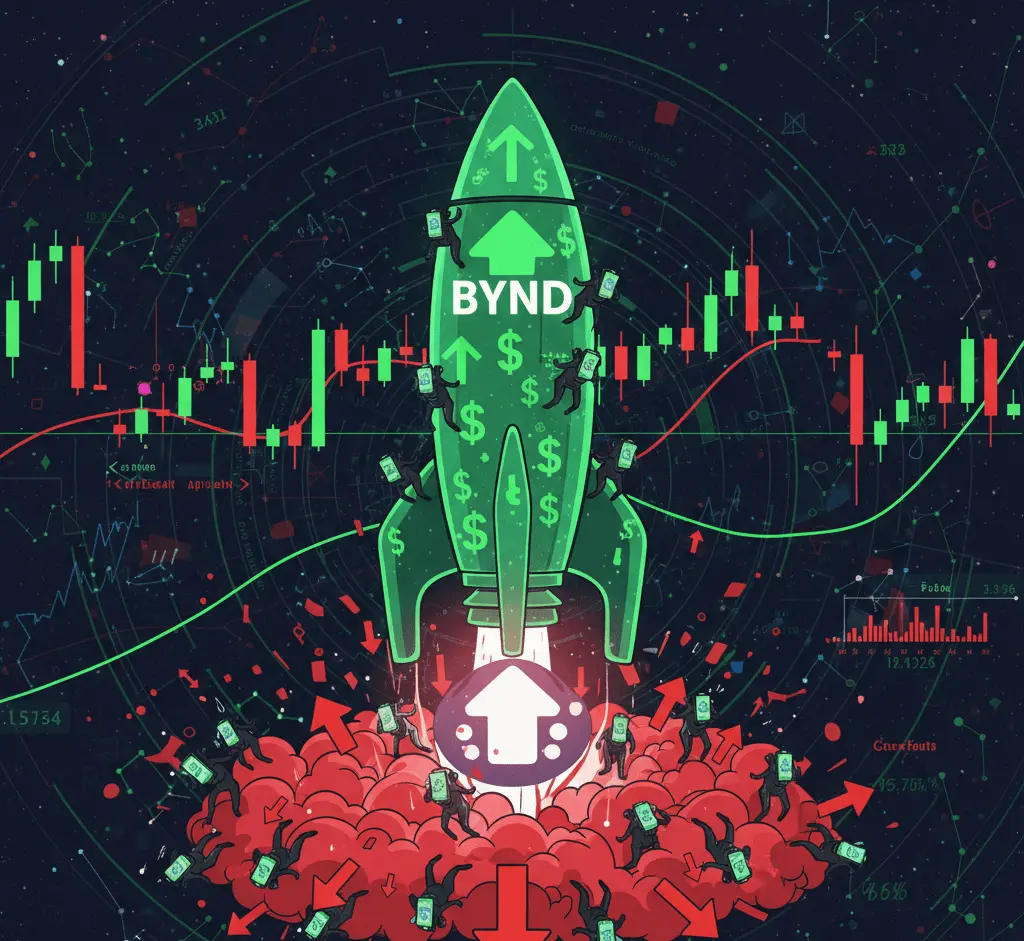
🍔 Key takeaways on Beyond Meat (BYND)
In October 2025, Beyond Meat became the latest casualty of "meme stock" psychology, surging 1,300% before crashing back to reality. Here are the 3 critical factors behind the volatility:
- 1. The "Perfect Storm" Squeeze The massive 1,300% rally was engineered by technical triggers rather than business success. The collision of Roundhill Meme ETF inclusion, a timed Walmart distribution announcement, and extreme short interest (>80%) created a feedback loop that forced shorts to cover, temporarily driving a penny stock to $7.50 despite broken fundamentals.
- 2. The Bondholder Exit Liquidity Retail traders celebrating the squeeze effectively bailed out institutional creditors. Following the debt restructuring, bondholders owned ~88% of the company (316 million shares) with a cost basis near zero. The viral surge provided these creditors with massive liquidity to dump their shares at a profit, leaving retail investors holding the bag as the price collapsed.
- 3. Fundamentals are irrelevant to the narrative The market ignored the fact that Beyond Meat is essentially a "zombie" company. With revenue down 28% and annual losses exceeding $250 million, the business model remains unproven. The Walmart deal, while good for headlines, likely exacerbates margin compression, meaning the company is simply losing money faster on a larger volume of sales.
Beyond Meat was dead. Absolutely cooked.
The plant-based burger company that once traded at $230 per share in 2019 had crashed to 52 cents last Thursday. Penny stock status. Market cap under $80 million. Revenue down 28%. Losses exceeding $250 million annually. The company just finished a brutal debt restructuring that handed bondholders 316 million new shares, diluting existing investors into oblivion.
TD Cowen slapped an 80-cent price target on it with a "Sell" rating. Analysts declared the fake meat bubble had finally burst.
Then the Internet showed up.
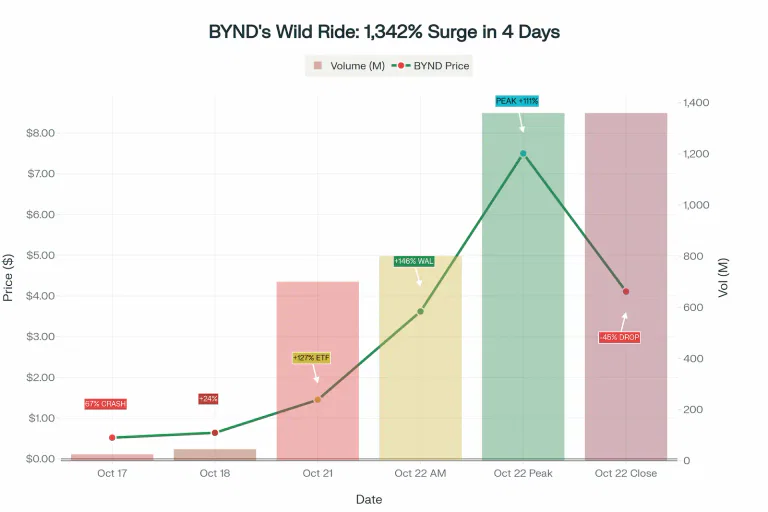
By Monday, BYND was up 127%. Tuesday? Another 146%. Wednesday morning it hit $7.50, up over 1,300% in four trading days. Trading volume exploded from a normal 20 million shares daily to 1.36 billion shares. Retail traders bought $35 million worth of BYND stock on Tuesday alone, the largest single-day retail purchase in the company's history.
The Reddit thread titled "MAKE $BYND GREAT AGAIN" started circulating. Posts claiming "BYND is now officially GME 2.0" went viral. Someone on wallstreetbets bragged about buying 10,000 shares at $7.50.
Then reality arrived with a vengeance.
By Wednesday afternoon, BYND had crashed 45% from its intraday peak. That person who bought at $7.50? Down $7,000 within hours. One Reddit comment captured it perfectly: "You're already down 7k, impressive".
Welcome to the latest meme stock disaster, where emotions trump fundamentals and someone always gets left holding worthless bags.
The three catalysts that triggered the madness
Nobody wakes up one morning and decides to pump a dying plant-based meat company. The BYND surge had three specific triggers that created perfect conditions for speculation.
First, Roundhill Investments added BYND to their Roundhill Meme Stock ETF on Monday.
Yes, that's a real thing. An actual exchange-traded fund dedicated to buying meme stocks. Roundhill had shut down this ETF earlier due to lack of interest, then revived it this month as retail traders returned to speculative plays. The inclusion gave BYND instant credibility as an official meme stock target.
Second, Beyond Meat announced a distribution deal with Walmart on Tuesday. The company's Beyond Burger 6-Pack would hit 2,000+ Walmart stores nationwide. Investors saw this as a potential lifeline for declining retail sales, even though the fundamental business remained broken.
The timing was perfect. Good news dropped right as meme momentum was building, creating narrative justification for speculation that had nothing to do with business fundamentals.
Third, and most critically, BYND had massive short interest. Over 80% of the free float was sold short by October, with some data showing 63% as of September.
That's GameStop and AMC territory. Classic short squeeze setup.
When retail traders spotted the high short interest combined with penny stock pricing and meme ETF inclusion, they smelled blood. Short sellers betting against BYND suddenly faced coordinated buying pressure forcing them to cover positions, which pushed prices higher, which forced more covering, which pushed prices even higher.
The feedback loop fed itself. By Tuesday, short sellers had racked up $50 million in losses. They were getting squeezed hard, and Reddit loved every second of it.
What Reddit was actually saying while this happened
The posts tell the real story better than any analyst report.
"$BYND - The Meat Revolution Begins. From 132K to 1.1M. That's not luck - that's precision," bragged one trader on Twitter, claiming they saw the squeeze coming when "everyone was laughing".
Another post: "$bynd is now officially $gme 2.0. I thought many others were but now based on what I'm seeing if retail band together and unite nothing can stop this from double digits then maybe just maybe into triple digits".
The Reddit wallstreetbets daily discussion thread for October 22 featured this reality check from a moderator: "Those creditors that got 326 million shares of BYND in the debt swap last week? They can rug this back down to $1.00 and still lose nothing".
Someone responded to a post showing a $10,000 BYND purchase at $7.50: "You're already down 7k, impressive".
Another comment captured the absurdity: "You know the economy is in trouble when BYND stock is making a comeback".
The moderators eventually had to step in: "The moderation team recently held a meeting about BYND, and we've decided to permit posts featuring trades exceeding 50k. However, we want to clarify that we won't accept any nonsensical 'hold forever' narratives. The volume of spam from certain groups and clear coordination has become excessive".
Even the most enthusiastic meme stock promoters were warning people. Tom Bruni, head of markets at Stocktwits, noted that "Today's reversal and high short-interest will put it back on meme traders' radars," basically predicting the crash before it happened.
The emotional cycle destroying retail traders
Watch what happens when you let emotions drive investment decisions.
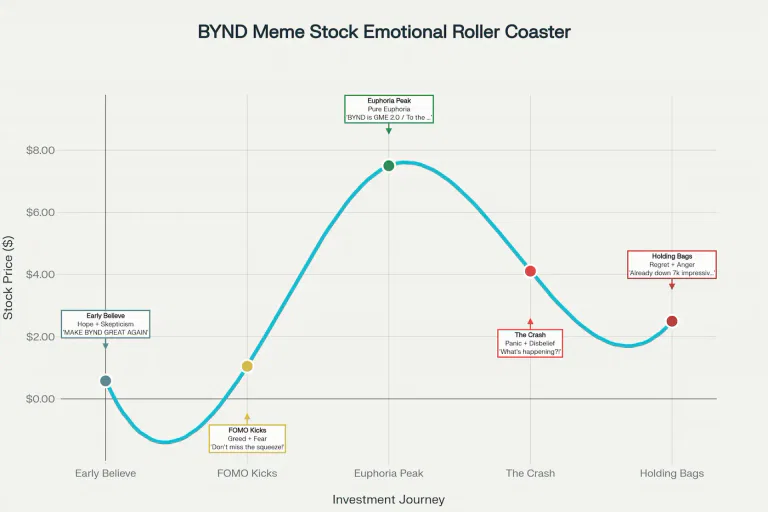
Stage one: Hope. The early believers who bought BYND between 50 cents and 64 cents after the debt deal crash. They saw a potential reversal, a beaten-down stock that might bounce. Some legitimate value investors thought the market overreacted to dilution.
These people had a thesis. Flawed maybe, but rational. If they sold Monday or Tuesday, they made money. Most didn't.
Stage two: FOMO. Fear of missing out kicked in hard once BYND started moving Monday. Retail traders who missed GameStop, who missed AMC, who missed every other meme stock surge saw another chance.
They bought in at $1, $2, $3 thinking they were still early. Social media amplified the pressure. Everyone was talking about BYND. You felt stupid for not being in.
Stage three: Euphoria. By Tuesday and Wednesday morning, BYND bulls were absolutely convinced this was going to $10, $20, maybe higher. The stock was up 600%, 800%, 1,000%. Short sellers were getting destroyed. Retail was winning.
Posts claiming "retail can band together and push this to triple digits" went viral. The Walmart deal provided fundamental justification. The short squeeze was working. Everything felt possible.
That's when smart money started selling.
Stage four: Panic. Wednesday's trading session turned into a bloodbath. BYND opened up 111%, hit $7.50, then crashed.
Within hours it was down 28% from the peak. Then briefly went red for the day entirely before bouncing back slightly. The implied volatility hit 100% IV Rank, the highest level in 52 weeks, with options pricing in potential moves between $2.17 and $9.29.
People who bought the top watched their accounts implode in real-time. The Reddit threads filled with confusion, denial, anger. How could this happen so fast?
Stage five: Bag holding. By Wednesday close, BYND was at $4.11, down 45% from the intraday peak but still up massively from the week's start.
Late buyers were underwater. Those who bought at $5, $6, $7.50 were down 30-50% within hours. The consensus analyst rating remained "Moderate Sell" with no dividend to soften the blow.
And here's the brutal reality nobody wants to admit: those bondholders who got 316 million shares in the debt swap? They can sell everything, crash BYND back to $1, and still break even on their original bond positions.
Someone's getting left holding worthless bags. Probably thousands of someones who bought the hype and believed the squeeze would last forever.
Why the fundamentals never mattered and why that's terrifying
Beyond Meat's actual business is a disaster. Let's be clear about that.
Revenue fell 28% in fiscal 2024 to just $343 million. Net losses exceeded $250 million. Consumer demand for plant-based meat products continues declining, especially in the U.S., their largest market.
The company was drowning in debt until last week's restructuring. They had $1.14 billion in convertible notes against $691.7 million in assets. The debt swap that triggered the initial crash was a survival move, not a strategic win.
After the restructuring, bondholders own approximately 88% of the company. Existing shareholders got diluted into near-irrelevance. The business model remains broken. There's no clear path to profitability.
Walmart adding the Beyond Burger 6-Pack to 2,000 stores sounds good until you realize Walmart probably negotiated brutal wholesale pricing. Beyond Meat's margins are already terrible. More distribution at lower margins doesn't fix anything.
Yet none of this mattered during the squeeze.
Traders weren't buying BYND because they believed in plant-based meat. They weren't analyzing the Walmart deal's financial impact. They were buying because the stock was moving, shorts were covering, and they wanted to get rich quick.
"BYND is behaving like a pure momentum trade," one Wall Street trader told Reuters. "Without earnings visibility or product growth, the risk-reward is extreme".
The options market reflected this perfectly. The put/call ratio crashed to its lowest level of 2025 as calls massively outnumbered puts. Everyone was betting on upside. Nobody was hedging downside. That's a massive red flag signaling speculation has completely detached from reality.
Elizabeth Volk at Barchart warned: "This leaves BYND vulnerable to another sudden shift in investor sentiment - this time on the bearish side - as traders await another catalyst".
The catalyst came Wednesday morning when reality arrived. There is no next chapter for this story. The squeeze is done. Short interest dropped as covering happened. The meme ETF inclusion is priced in. The Walmart deal is known.
What's left? A company losing hundreds of millions annually with declining revenue and no credible turnaround plan, now trading at a market cap over $1.6 billion.
The bigger pattern nobody wants to acknowledge
This isn't new. We've seen this movie before.
GameStop in 2021. AMC in 2021. Countless other meme stocks that surged on social media hype, short squeezes, and retail coordination before crashing back to reality.
What's different this time? Nothing really.
The same Reddit forums. The same "retail vs. hedge funds" narrative. The same short squeeze mechanics. The same euphoric posts claiming "this time is different" followed by the same brutal crashes.
Even Martin Shkreli, the notorious "pharma bro," reportedly shorted BYND this week, basically calling the top. When someone that
controversial is betting against your meme stock, maybe that's a sign.
The pattern is always identical. A heavily shorted stock with a recognizable brand name hits penny stock levels. Retail traders spot the setup. Social media amplifies it. A meme ETF or influencer adds legitimacy. FOMO kicks in. The squeeze works briefly. Late buyers get destroyed.
Speculation becomes self-fulfilling until it isn't. The stock surges on pure momentum disconnected from fundamentals. Then the momentum stops, usually when shorts have covered enough to relieve pressure, and gravity reasserts itself.
Finance Magnates put it perfectly: "Fundamentals are optional when the internet gets hungry".
Who actually made money and who's getting wrecked
Let's be honest about winners and losers here.
Winners: Anyone who bought BYND between 50 cents and $1 and sold above $3. Early believers who caught the initial move and took profits. Professional traders who scalped the volatility. The bondholders who converted debt to equity and can now sell at massive profits.
Big losers: Late FOMO buyers who purchased anywhere above $4. People who bought the peak at $7.50 thinking it was "just the beginning." Retail traders who believed the "hold forever" narrative and refused to sell. Short sellers who covered at $5+ instead of waiting for the inevitable crash.
The moderators on wallstreetbets explicitly warned against coordination and "hold forever" narratives, basically telling people to take profits and run. Most probably didn't listen.
Retail traders bought $35 million worth of BYND on Tuesday alone. That's the day it peaked. Statistically, most of that $35 million is now underwater. Those positions are down 30-60% depending on exact entry timing.
Someone on Reddit captured the sentiment: "As soon as I saw the initial comment claiming 'BYND is going to $10 today,' I was completely convinced that it was the day it would plummet. It's a pattern I've noticed. This has occurred with OPEN and numerous other meme stocks".
The pattern repeats because emotions repeat. Greed makes people buy tops. Fear of missing out makes people chase momentum. Euphoria makes people ignore risk. Panic makes people sell bottoms.
And the really depressing part? This will happen again. Different stock, same story. Because retail traders have short memories and FOMO is a hell of a drug.
What happens next and why it doesn't matter
Beyond Meat's next earnings report comes in November. Analysts will be watching for any Walmart deal impact, though it's too early to show up meaningfully in numbers. The stock will probably continue experiencing high volatility as remaining shorts cover and momentum traders move on.
Options traders expect potential moves between $2.17 and $9.29 through Friday based on implied volatility. That's insane price uncertainty reflecting pure speculation.
Long-term? The company's prospects haven't changed. Revenue is falling. Losses continue. The debt restructuring bought time but didn't fix the underlying problem: consumers aren't buying enough plant-based meat to support the business model.
The consensus rating remains "Moderate Sell" with zero dividend and no clear path to profitability. Analysts aren't suddenly bullish because of a four-day meme stock surge.
Wall Street views BYND as exactly what it is: a broken company that experienced a speculative spike driven by social media hype and short covering, not fundamental improvement.
But here's the thing. None of this matters to the next wave of retail traders who will chase the next meme stock. They'll see BYND's 1,300% surge and think "I want that." They'll ignore the 45% crash that followed. They'll convince themselves they would have sold the top.
Confirmation bias is powerful. People remember the success stories and forget the disasters. They focus on the person who turned $1,000 into $10,000 and ignore the hundreds who turned $10,000 into $3,000.
The bottom line
Emotions destroy investors. That's the lesson here, though probably nobody who needs to learn it actually will.
The people who made money on BYND were the ones who controlled their emotions. Who bought low with a plan and sold when targets hit. Who recognized the setup as pure speculation and treated it accordingly.
The people getting wrecked were the ones who let FOMO, greed, and euphoria drive decisions. Who bought the hype. Who believed social media posts about triple-digit price targets. Who thought this time was different.
It's never different. The mechanics change slightly but the emotional cycle stays identical. Hope, greed, euphoria, panic, regret. Over and over and over.
Someone always gets left holding the bag when speculation detaches from fundamentals. With BYND, that someone is probably thousands of retail traders who bought anywhere above $4 believing the squeeze had more room to run.
Those 316 million shares the bondholders got in the debt swap? They're waiting to dump them at profits that would make early investors weep. When they sell, BYND probably crashes back toward penny stock levels. Because nothing fundamental changed. The company's still dying.
Disclaimer: This article is a personal analysis, not financial advice. Read my full investment philosophy and YMYL Transparency Statement here.


