AI-powered campaign automation
Campaign-level negative keywords implementation
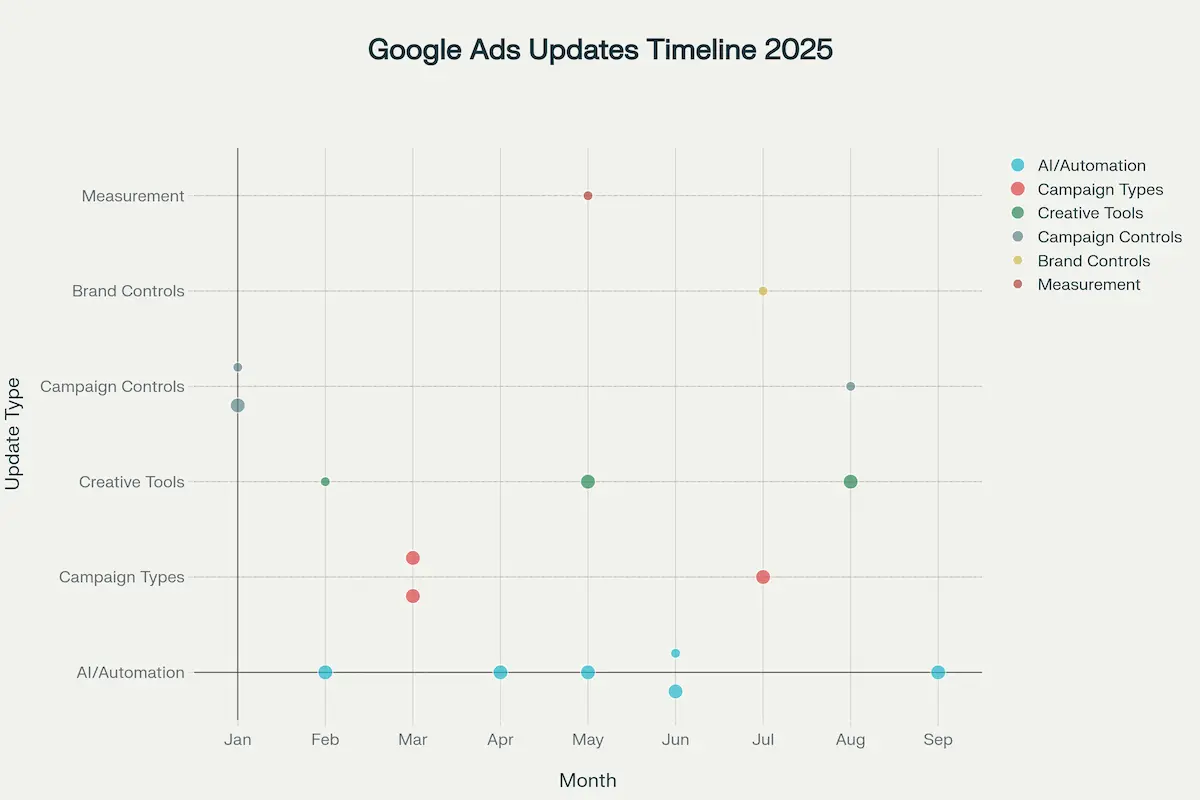
One of the most significant updates came in January 2025 when Google finally introduced campaign-level negative keywords for Performance Max campaigns. This addressed a longstanding frustration among advertisers who previously had to choose between applying negative keywords account-wide or filing special requests with Google representatives.
The implementation allows advertisers to add up to 100 negative keywords directly to individual Performance Max campaigns, providing surgical control over irrelevant traffic without compromising other campaigns. For example, a premium software company can now exclude terms like "free templates" from their Performance Max campaign while preserving the ability to target those terms in other campaigns where they might be relevant.
Enhanced demographic and device controls
Performance Max campaigns gained new demographic exclusions and device targeting capabilities in early 2025. Advertisers can now exclude specific age groups, household income segments, and device types (such as tablets) within Performance Max campaigns. This represents a significant shift from Google's previous approach of limiting these controls in favor of machine learning automation.
AI Max for search campaigns
Google launched AI Max for Search campaigns in April 2025 as a comprehensive AI package that enhances traditional search campaigns. The system operates through three integrated features:
- Search term matching enhancement - activates broad matching capabilities while enabling "keywordless matching" using signals from existing keywords, creative assets, and landing pages to discover more effective search queries.
- Text customization - dynamically adjusts ad headlines and descriptions based on landing pages, existing ads, and keywords to create more relevant advertisements tailored to user search queries.
- Final URL expansion - automatically identifies more relevant landing pages based on user queries and search intent, similar to how Performance Max campaigns operate, with advertisers maintaining control through URL exclusion options.
Early testing showed that AI Max delivers an average 14% increase in conversions overall, with campaigns previously restricted to exact or phrase match keywords seeing up to 27% improvement at the same cost-per-acquisition or return on ad spend. Companies like Cashify reported a 15% increase in conversions while maintaining campaign efficiency.
Video action campaigns unset
Google implemented a definitive timeline for transitioning Video Action Campaigns to Demand Gen campaigns throughout 2025:
- March 2025 - creation of new Video Action Campaigns ceased
- Q2 2025 - automatic migration of existing Video Action Campaigns to Demand Gen
- Current status - all Video Action functionality now integrated into Demand Gen
The transition wasn't merely administrative Google reported that Demand Gen campaigns deliver 58% higher return on ad spend compared to Video Action campaigns. The consolidation provides advertisers with expanded placement options across YouTube, Gmail, Discover, and Display networks within a single campaign structure.
Demand Gen campaign evolution
Demand Gen received significant enhancements throughout 2025, including:
- Vertical 9:16 image ads optimized for YouTube Shorts
- AI-powered video enhancement features for creating short-form content at scale
- Improved ad creation workflows with stakeholder preview sharing for faster creative approval
- Retail-specific features including product feeds and real-time local inventory visibility
Enhanced Channel Controls
Starting in March 2025, advertisers gained more precise control over where their ads appear across YouTube, Discover, and Gmail, including specific targeting options for YouTube Shorts. This addresses the growing need for placement control while maintaining the benefits of automated optimization.
Asset studio launch and capabilities
Google launched Asset Studio in May 2025 as a centralized creative production platform within Google Ads. The tool represents a fundamental shift from Google Ads being merely a media-buying platform to becoming a complete creative production hub.
Core Capabilities Include:
- AI-powered image generation using text prompts for product and lifestyle visuals
- Advanced image editing capabilities including object removal, background swapping, and color adjustments
- Bulk editing functionality for scaling asset updates across multiple campaigns
- Video creation and trimming tools for producing ad-ready content
- AI voiceover generation for video and audio advertisements
The launch of Asset Studio reduces advertisers' reliance on third-party creative tools, making Google Ads a comprehensive solution for both media buying and creative production. Early beta users report significant time savings in creative production workflows, particularly beneficial for Performance Max campaigns that rely heavily on asset variety for optimal performance.
AI-generated creative enhancements
Lifestyle imagery generation
February 2025 brought AI-powered lifestyle imagery generation capabilities, allowing advertisers to create compelling product-in-use visuals using simple text prompts. This addresses the common challenge of producing high-quality lifestyle content at scale without extensive photography resources.
Image-to-video transformation
Google introduced image-to-video capabilities powered by the Veo model, enabling advertisers to transform static product images into engaging video content. This feature significantly reduces the barrier to video advertising for businesses that previously lacked video production capabilities.
Responsive search ads evolution
Google updated Responsive Search Ads in 2025 to provide greater flexibility in how ad components are assembled. The key changes include:
- Single headline display - Google can now show just one headline if predicted to improve performance
- Headlines as sitelinks - up to two unused headlines can appear as clickable links below the main ad
- Dynamic omission - ad components may be excluded entirely if it leads to better engagement
These changes represent a significant shift toward AI-driven ad assembly, where Google's algorithms have increased freedom to arrange advertiser content in ways predicted to maximize performance. Advertisers benefit from getting more value from existing headlines without creating additional content.
Shopping ads and e-commerce integration
Shopping ads began appearing in AI Overviews on desktop in June 2025, following the initial mobile rollout. These product listings are embedded directly within AI-generated summaries for queries with high commercial intent, such as "best running shoes for flat feet" or "eco-friendly garden furniture.
The placement is powered by existing Shopping and Performance Max campaigns without requiring advertiser opt-in, making it accessible to all eligible advertisers immediately. This represents a significant shift in how products are discovered within Google's search ecosystem.
AI mode advertising
Google launched AI Mode with integrated advertising, creating a conversational search interface powered by Gemini. This allows users to engage in multi-step queries with ads appearing contextually within longer conversations, particularly when users are narrowing down purchasing decisions.
Users can now engage in extended conversations about products, asking follow-up questions and refining their intent in real-time, with relevant product ads appearing throughout the conversation flow rather than only at the conclusion.
Brand control and targeting refinements
Google introduced self-serve brand exclusions in December 2024, fully implementing the feature across Performance Max campaigns in early 2025. This replaced the previous system requiring contact with Google representatives or extensive negative keyword lists covering all brand variations and misspellings.
The system automatically excludes all variations, misspellings, translations, and related terms associated with excluded brands. For example, excluding "Louis Vuitton" automatically covers variations like "Louis Vitton," "Luis Vuitton," and the Chinese translation "路易威登."
Starting in May 2025, Google moved brand inclusions and exclusions into the AI Max framework for all new Search campaigns. This change makes AI-powered features the default gateway to core targeting controls, effectively requiring advertisers to embrace automation for full brand targeting functionality.
Measurement and analytics improvements
Google significantly lowered the minimum spend requirement for incrementality testing from $100,000 to just $5,000 in 2025. This democratizes access to advanced measurement tools, allowing smaller advertisers to assess the true impact of their campaigns on customer behavior and brand perception.
The platform now offers improved testing methods across all campaign types with better statistical significance and more accurate attribution modeling. This enables advertisers to make more informed decisions about budget allocation and campaign optimization.
Cross-channel measurement enhancement
Google Analytics received significant upgrades in 2025 to provide improved measurement of the full customer journey and return on investment. The system now offers deeper impression-level data across Google properties and beyond, giving marketers comprehensive insight into campaign performance across touchpoints.
A new centralized Data Manager helps marketers gather, store, and activate first-party data from any source using privacy-first technologies like confidential computing. This addresses the growing need for privacy-compliant data utilization in the post-cookie advertising era.
Google Ads interface for creating responsive search ads with multiple headlines and descriptions for AI-driven optimization
Smart bidding and automation advances
Google introduced Smart Bidding Exploration in 2025 as a toggle setting that allows Search campaigns to capture additional conversions by temporarily relaxing return on ad spend constraints where appropriate. This represents one of the biggest updates to bidding strategies in over a decade.
The feature uses machine learning to analyze various signals and predict conversion likelihoods, enabling campaigns to reach users during research and consideration phases before they enter the traditional sales funnel. This expands reach while maintaining performance targets.
Power pack strategy implementation
Google evolved its campaign strategy recommendations from the "Power Pair" to the "Power Pack" model, combining three AI-enhanced campaign types:
- Performance Max for comprehensive reach across all Google properties
- Demand Gen for visually rich placements across YouTube, Discover, and Gmail
- AI Max for enhanced Search performance with maintained transparency
This integrated approach delivers full-funnel coverage using shared creative assets and audience signals for improved efficiency at scale.
Screenshot of a digital marketing dashboard showing detailed Google Ads performance metrics, including anomalies in impressions and clicks for multiple campaigns over 28 days
Industry response and strategic implications
The 2025 changes represent a fundamental shift toward increased automation, with some industry professionals expressing concerns about reduced manual control. However, Google has simultaneously introduced more transparency features, such as channel-specific reporting within Performance Max campaigns, to address these concerns.
The extensive AI integration requires advertisers to develop new skill sets focused on feeding quality signals to algorithms rather than managing granular settings manually. Successful adaptation involves understanding how to optimize asset variety, audience signals, and conversion data rather than traditional keyword and bid management.