
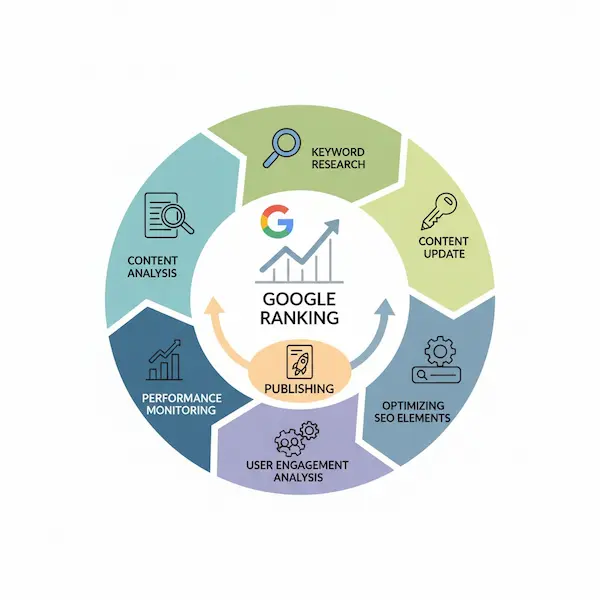
Understanding Google's freshness algorithms
Google's approach to content freshness operates through sophisticated systems designed to serve users the most timely and relevant information. The Query Deserves Freshness (QDF) model lies at the heart of this evaluation, determining when recency should override traditional authority signals in search results.
The QDF algorithm analyzes search patterns to identify queries requiring current information. When sudden spikes in search volume occur alongside increased publishing activity on specific topics, Google temporarily elevates newer content in rankings. This system proves particularly impactful for:
- Breaking news and current events where users expect real-time information
- Recurring events such as annual conferences, seasonal activities, or regulatory updates
- Technology and product reviews where specifications and competitive landscapes evolve rapidly
- Industry trends and market analysis demanding up-to-date data and insights
Research demonstrates that websites quickly publishing content related to trending topics can experience dramatic ranking improvements, sometimes jumping from obscurity to top positions within hours. However, this freshness boost applies selectively—Google maintains different temporal categories for different query types.
The freshness ranking multiplier effect
Content freshness can multiply ranking potential by 3-4x for time-sensitive queries. Recent analysis of over 200 websites across 15 industries reveals that pages updated at least annually gain an average of 4.6 positions compared to stagnant content. This correlation strengthens for more frequent updates, with quarterly refreshes showing even greater benefits.
The mechanism operates through multiple ranking signals working in concert:
- Enhanced crawling frequency - active websites receive more crawl budget allocation from Google's spiders, ensuring faster indexation of new content. Sites producing fresh content see their pages appear in search results up to 76% faster than inactive competitors.
- User engagement improvements - fresh content attracts higher click-through rates from search results and increases time-on-page metrics. Google's algorithms interpret these positive user signals as quality indicators, creating a reinforcement loop that strengthens rankings.
- Authority signal amplification - regular updates demonstrate ongoing expertise and active industry involvement, key components of Google's E-A-T (Expertise, Authoritativeness, Trustworthiness) evaluation framework.
Strategic content refresh methodologies
Effective freshness strategies require systematic approaches that balance frequency with quality. Analysis of high-performing websites reveals that top-ranking articles implement an average of 16 changes per month compared to 10 changes for lower-performing content.
Quality-focused update approaches
Strategic content refreshing extends beyond superficial modifications. High-impact updates include:
- Data integration and statistical updates - incorporating current research findings, market statistics, and industry benchmarks strengthens content authority while maintaining relevance. Pages featuring up-to-date data points show 47% higher click-through rates and 31% longer session durations.
- Content expansion and depth enhancement - adding comprehensive sections covering emerging subtopics, methodologies, or case studies increases topical coverage, now recognized as the primary on-page ranking factor for 2025. Top-performing pages cover approximately 74% of relevant facts and subtopics compared to 50% for underperforming content.
- Technical optimization and user experience improvements - updates addressing Core Web Vitals, mobile responsiveness, and accessibility signal ongoing quality maintenance to both users and search engines.
Content velocity optimization
Publishing frequency termed "content velocity" has emerged as a significant ranking correlator. Websites maintaining weekly publishing schedules show 3.2x better ranking improvements than monthly publishers. However, the most effective approach balances new content creation with systematic updates of existing high-value pages.
Research indicates optimal ratios: for every three new pieces published, one existing piece should receive comprehensive updating. This approach maximizes crawl budget efficiency while demonstrating comprehensive topical authority across content libraries.
Freshness impact on technical SEO performance
Content freshness directly influences Google's technical evaluation mechanisms through several pathways:
- Crawl budget optimization - fresh content signals prompt increased spider activity, with active sites receiving proportionally more crawling resources. This improved discovery rate proves particularly valuable for competitive industries where timing advantages matter significantly.
- Indexation priority signals - Google evaluates publication dates, last-modified tags, content update frequency patterns, and user engagement with fresh content to determine indexation priority. Properly structured sites see new content indexed 76% faster than competitors lacking freshness optimization.
- Entity relationship mapping - Google's algorithm now emphasizes entity relationships and semantic networks over isolated keywords. Consistently updating content around related entities establishes websites as authoritative hubs for topics a primary ranking factor in current algorithmic iterations.
Industry-specific freshness requirements
Different sectors demonstrate varying sensitivities to freshness signals:
- News and current affairs - immediate updates prove essential, with QDF algorithm strongly favoring sites publishing within minutes or hours of breaking developments.
- Technology and software - quarterly updates addressing new features, security patches, and competitive comparisons maintain relevance in rapidly evolving markets.
- Finance and legal - regular updates incorporating regulatory changes, market developments, and compliance requirements satisfy both user needs and algorithmic freshness criteria.
- Healthcare and medical - content refresh cycles must balance currency with accuracy, typically requiring updates when new research emerges or guidelines change.
Measuring freshness strategy effectiveness
Successful freshness strategies require systematic performance monitoring through multiple metrics:
- Ranking position tracking - monitor keyword rankings for freshly updated content over 30-90 day periods to identify improvement patterns.
- Organic traffic analysis - updated pages typically show traffic increases within 60 days if refreshes address genuine user needs and search intent evolution.
- Engagement metric evaluation - time-on-page, bounce rate, and scroll depth improvements indicate successful refresh execution. These behavioral signals reinforce ranking stability.
- Technical performance monitoring - track crawling frequency changes through Google Search Console to verify increased spider activity following content updates.
Advanced freshness optimization techniques
Leading SEO practitioners implement sophisticated approaches maximizing freshness benefits:
Systematic content audit workflows
Quarterly content audits identifying update opportunities through traffic decline analysis, competitive content gaps, and keyword ranking fluctuations enable proactive refresh scheduling. Priority matrices ranking pages by traffic value, ranking position, and update urgency optimize resource allocation.
Automated freshness signals
Technical implementations including proper last-modified headers, structured data markup indicating update timestamps, and XML sitemap optimization accelerate Google's freshness recognition.
User-generated content integration
Encouraging comments, reviews, and community contributions keeps pages dynamically updating, signaling ongoing relevance to search algorithms.
Economic impact of freshness strategies
Investment in systematic content refreshing delivers measurable returns. Websites implementing disciplined update schedules report:
- Average organic traffic increases of 23% over six-month periods
- Visibility improvements exceeding 40% in competitive niches
- Reduced content decay rates maintaining long-term ranking stability
- Enhanced domain authority through consistent expertise demonstration
Companies prioritizing freshness optimization through regular content updates often experience improved brand perception and market positioning, with correlation to increased customer retention and conversion rates.
Future implications for content strategy
As Google's algorithms continue evolving toward entity-based understanding and semantic search, content freshness will likely increase in importance. The integration of AI-powered content evaluation systems means websites must demonstrate ongoing human expertise and current industry knowledge to maintain competitive advantage.
Organizations succeeding in future search landscapes will implement systematic content refresh programs balancing automated efficiency with human expertise validation. The evidence overwhelmingly supports regular, strategic content updating as fundamental to sustainable search visibility and business growth.
Content freshness represents far more than a ranking signal, it embodies a commitment to providing users with valuable, current information while signaling authority and expertise to search engines. Websites embracing systematic freshness strategies position themselves for sustained success in increasingly competitive digital markets.


