Key takeaways from the First-Party and Third-Party Data Integration analysis
Effective advertising data strategy is no longer about collecting as much information as possible. The real advantage comes from combining reliable first-party signals, carefully validated third-party enrichment, privacy-safe infrastructure, and disciplined activation rules:
- 1. The core strategic bottleneck Fragmented customer data, inconsistent identifiers, weak consent propagation, and overreliance on external audience segments prevent advertisers from building a dependable view of customers, prospects, and campaign performance.
- 2. The targeting and measurement consequence When first-party data and third-party data remain disconnected, audience targeting becomes less precise, attribution becomes less reliable, and media budgets are more likely to be wasted on duplicated, low-intent, or already-converted users.
- 3. The business value of integration Combining accurate first-party behavioural data with validated third-party intent, demographic, and market signals improves segmentation, customer journey mapping, predictive analytics, acquisition efficiency, retention activity, and campaign-level decision-making.
- 4. The privacy and architecture correction Sustainable advertising optimization requires consent-aware data governance, robust identity resolution, clean customer profiles, controlled data activation, and privacy-safe collaboration models such as data clean rooms.
- 5. The implementation priority The highest-priority actions are to audit all customer data sources, map consent and permitted uses, standardize identifiers, validate third-party data quality, and activate only those audience segments that can be measured against real business outcomes.
Digital advertising has entered a more demanding phase. Brands can no longer rely on broad targeting, loose attribution models, and unlimited access to user-level signals across the web. Privacy regulations, browser restrictions, platform changes, and growing consumer awareness have changed the rules of data-driven marketing.
In this environment, first-party and third-party data integration is no longer just a technical advantage. It has become a strategic capability. Companies that know how to combine their own customer data with carefully selected external data can build more accurate audiences, improve campaign relevance, strengthen attribution, and reduce waste in media spending.
However, the value of data integration does not come from simply collecting more information. More data can easily become more noise. The real advantage comes from knowing which data is reliable, which data is legally usable, which data improves advertising decisions, and which data should be excluded.
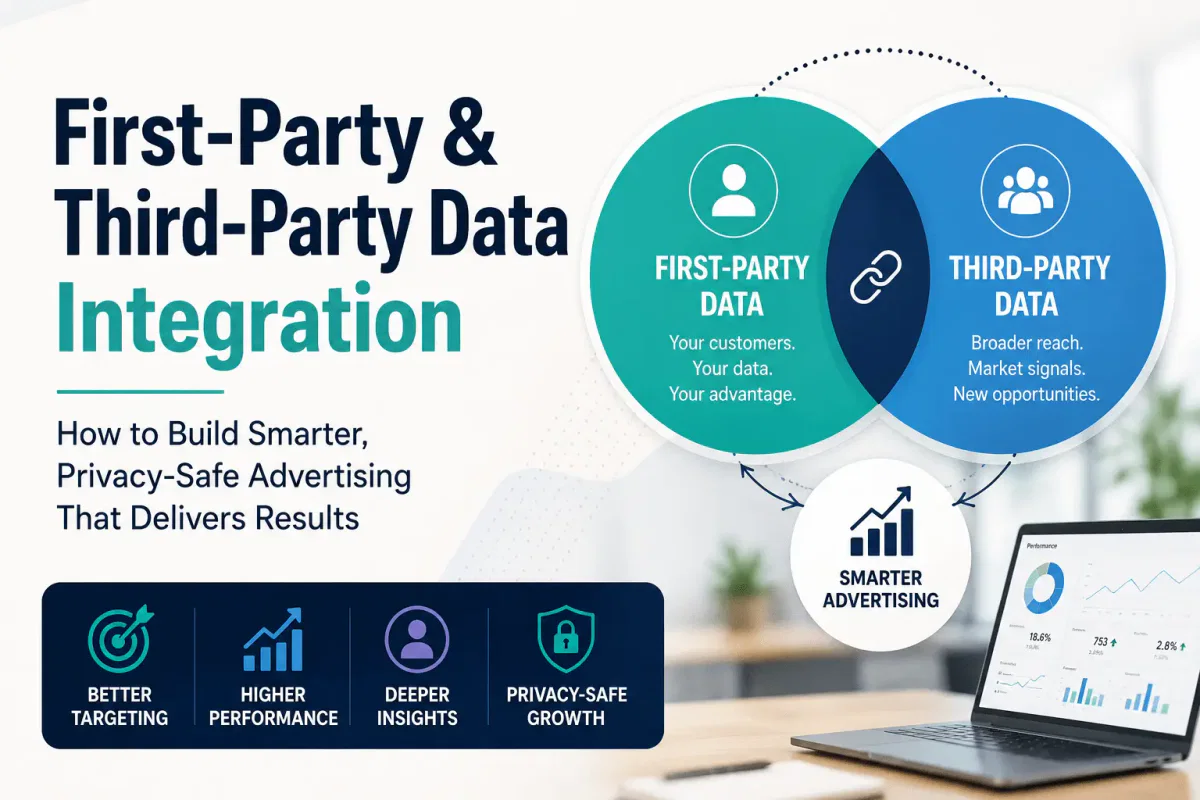
First-party data provides accuracy and context because it comes directly from a company’s own customers and digital touchpoints. Third-party data can add reach, discovery, and broader market signals. When both are integrated properly, advertisers can move beyond fragmented campaign decisions and build a more complete view of customers, prospects, and market behaviour.
The challenge is to do this without creating compliance risks, poor-quality profiles, or intrusive advertising experiences. The future of advertising optimization belongs not to brands that collect the most data, but to those that use data with discipline.
What is first-party data?
First-party data is information collected directly by a company through its own channels. It may come from websites, mobile applications, CRM systems, ecommerce platforms, email campaigns, loyalty programmes, customer support interactions, surveys, offline purchases, webinars, or account registrations.
This type of data includes information such as:
- purchase history;
- product preferences;
- website behaviour;
- email engagement;
- loyalty status;
- customer service records;
- declared interests;
- form submissions;
- abandoned carts;
- subscription activity;
- consent and communication preferences.
The main strength of first-party data is that it is grounded in a direct relationship between the customer and the brand. A company knows where the information came from, how it was collected, and what the user actually did. This makes it more useful than many external data sources, especially when the goal is personalisation, retention, segmentation, or conversion analysis.
For example, an ecommerce company may know that a customer frequently buys premium skincare products, opens educational emails, and usually purchases after reading product comparison pages. These signals are not abstract demographic assumptions. They are behavioural indicators based on real interaction.
That is why first-party data should be the foundation of any modern advertising strategy. It is usually more accurate, more relevant, and easier to connect with business outcomes than data acquired from external providers.
What Is third-party data?
Third-party data is collected, aggregated, or supplied by external organisations. These providers gather information from multiple websites, platforms, publishers, apps, data partnerships, or commercial sources and organise it into audience segments.
Such data may include:
- demographic categories;
- interests;
- lifestyle indicators;
- purchase-intent signals;
- market behaviour;
- location-based patterns;
- professional attributes;
- industry-specific audience segments;
- category affinity;
- competitor interest signals.
The greatest strength of third-party data is scale. A brand may have rich information about existing customers, but very limited insight into people who have never visited its website or purchased its products. External data can help identify new audiences, enrich incomplete customer profiles, and support prospecting campaigns.
At the same time, third-party data should be used with caution. It is often less precise than first-party signals. The original collection method may be unclear. Segment definitions can be too broad. Some categories may sound attractive in a campaign plan but perform poorly when tested against real conversions.
For this reason, third-party data works best as an enrichment layer, not as the core of a marketing strategy. It should extend what a company already knows, not replace direct customer knowledge.
Why first-party and third-party data integration matters
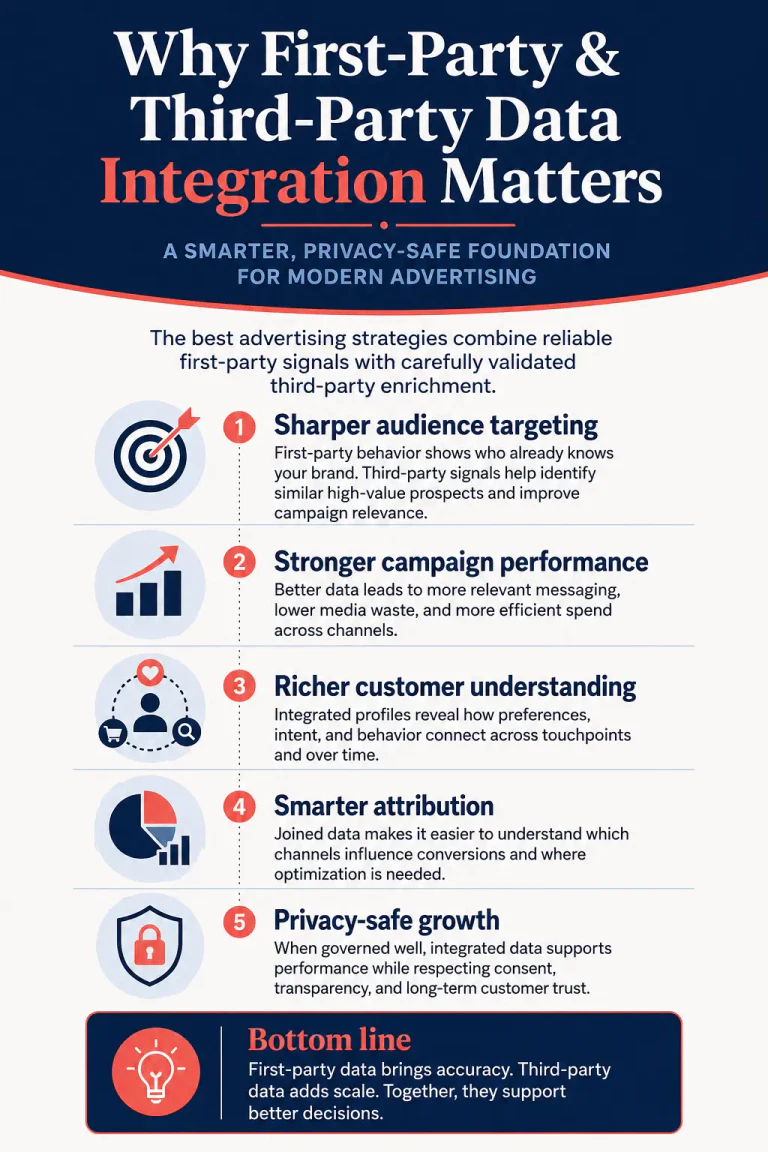
The purpose of first-party and third-party data integration is to improve decisions. It is not about building the largest possible database. It is about creating a clearer, more useful view of customers and prospects.
First-party data answers questions such as:
- Who already interacts with the brand?
- What products do customers buy?
- Which users are loyal, inactive, or at risk of churn?
- Which channels drive real engagement?
- What behaviour appears before conversion?
Third-party data answers different questions:
- Which new audiences may be similar to valuable customers?
- What external interests or intent signals are relevant?
- Which market segments are worth testing?
- Where can the brand reach people outside its owned channels?
- What broader behavioural patterns may explain demand?
When these sources are combined, advertisers can create richer segments, improve audience targeting, build stronger predictive models, and develop more relevant messaging.
A fitness brand, for example, may know from first-party data that a customer buys running shoes twice a year. Third-party data may indicate that the same person is interested in marathon training, sports nutrition, and wearable technology. This combination allows the brand to create more precise campaigns around training plans, recovery products, or race preparation.
The value does not come from one data source alone. It comes from the relationship between them.
The privacy-first advertising background
The digital advertising ecosystem has been reshaped by privacy regulation, browser restrictions, platform policies, and user expectations. Advertisers can no longer assume that cross-site tracking will remain stable or universally available.
The situation around third-party cookies is especially important. Google announced in April 2025 that Chrome would maintain its current approach to third-party cookie choice rather than rolling out a new standalone prompt. Users would continue to manage their preferences through Chrome’s privacy and security settings.
This does not mean that advertisers can safely rely on third-party cookies as they did in the past. Google’s own Privacy Sandbox guidance continues to recommend auditing cookie usage and preparing websites to work whether or not third-party cookies are available.
In practice, the direction remains clear: advertising systems must become less dependent on fragile identifiers. Consent, authentication, contextual signals, server-side measurement, identity resolution, and data clean rooms are becoming more important.
Privacy frameworks are also evolving. IAB Europe’s Transparency and Consent Framework is designed to support the digital advertising ecosystem in communicating user choices and processing purposes. Its v2.3 update introduced additional requirements connected with vendor disclosure and implementation changes.
For advertisers, this means one thing: data integration must be built with privacy from the beginning. Consent, purpose limitation, data minimisation, retention policies, and vendor governance cannot be added later as an afterthought.
Building a strong data foundation
A successful first-party and third-party data integration strategy starts with a clear data foundation. Before connecting systems, marketers should understand what data exists, where it comes from, how reliable it is, and whether it can legally be used for advertising.
A proper data audit should answer several questions:
- What first-party data is currently collected?
- Which systems store customer information?
- What identifiers are available?
- Which consent signals are captured?
- Which external data providers are used?
- How often is data refreshed?
- Which data is used for audience targeting?
- Which data is used for analytics or attribution?
- Which data should no longer be collected?
- Which sources create compliance or quality risks?
This stage is often underestimated. Many organisations begin with technology selection, such as choosing a customer data platform or data warehouse. But technology alone cannot fix unclear data ownership, poor event naming, inconsistent consent logic, or unreliable third-party segments.
The foundation should include four basic elements: data inventory, consent mapping, identifier strategy, and quality assessment.
Without these elements, integration becomes guesswork.
Data collection and ingestion
The first operational layer is data collection. This includes gathering first-party data from owned channels and importing third-party data from external providers.
For first-party data, companies may use:
- website analytics;
- server-side tracking;
- tag management systems;
- CRM integrations;
- ecommerce platforms;
- email marketing tools;
- mobile SDKs;
- loyalty systems;
- customer support platforms;
- offline transaction uploads.
For third-party data, companies may work with data marketplaces, publishers, retail media networks, demand-side platforms, identity providers, or specialised data vendors.
However, ingestion should not be treated as a simple technical pipeline. Each source should be evaluated before it enters the system. The most important criteria include:
- data accuracy;
- match rate;
- source transparency;
- update frequency;
- consent documentation;
- segment definition;
- historical performance;
- permitted use cases;
- vendor compliance;
- commercial value.
Bad data does not become useful just because it enters a clean data warehouse. If a third-party segment is too broad, outdated, or poorly sourced, it may damage campaign performance instead of improving it.
Data storage and management
Once data is collected, it needs to be organised in a structure that supports analysis, activation, and compliance.
Many organisations use a cloud data warehouse such as Snowflake, Google BigQuery, Amazon Redshift, or Azure Synapse. Others combine a data warehouse with a data lake for raw and semi-structured information.
A mature data environment usually separates information into different zones:
- raw data for original files and events;
- staging data for cleaning and validation;
- production data for reporting and activation;
- restricted data for sensitive or regulated information.
This separation makes the system easier to govern. It allows teams to trace where data came from, how it was transformed, and where it was sent. It also reduces the risk of using incomplete or unapproved data in advertising platforms.
At this stage, a customer data platform may also play an important role. A CDP can help unify customer profiles, manage segments, support identity resolution, and activate audiences across channels. However, a CDP should not be treated as a magic solution. It works well only when the underlying data is clean, consent-aware, and strategically organised.
Identity resolution - Connecting the right signals
Identity resolution is one of the most important parts of data integration. It is the process of connecting different identifiers, events, and records that belong to the same customer, household, account, or device.
A user may appear in many systems at once. The same person might be known as:
- an email subscriber;
- a website visitor;
- a CRM contact;
- a loyalty programme member;
- a mobile app user;
- an offline buyer;
- an advertising platform user.
Without identity resolution, these signals remain fragmented. Marketing teams may over-target the same person, miss important behavioural patterns, or fail to understand the customer journey.
There are two main types of matching.
Deterministic matching uses clear identifiers, such as email addresses, customer IDs, login data, phone numbers, or hashed identifiers. It is usually more accurate because the link between records is known.
Probabilistic matching uses patterns, such as device signals, IP information, location, behaviour, or statistical similarity. It can increase reach, but it should be used with clear confidence thresholds. Not every likely match should be treated as a confirmed customer identity.
The goal is not to identify every possible user at any cost. The goal is to create reliable connections that improve marketing decisions while respecting privacy, consent, and security.
Data clean rooms and privacy-safe collaboration
Data clean rooms have become increasingly important in privacy-conscious advertising. They allow companies to compare, analyse, or match data without freely exposing raw customer-level information.
A brand may use a clean room to collaborate with a publisher, retail media network, platform, or strategic partner. Common use cases include:
- audience overlap analysis;
- campaign reach measurement;
- frequency analysis;
- conversion attribution;
- incrementality testing;
- customer list matching;
- aggregated behavioural insights.
For example, a retailer and a consumer goods brand may want to understand whether advertising exposure influenced purchases. A clean room can support this analysis without requiring both parties to exchange full raw datasets.
Still, data clean rooms are not a shortcut around privacy law. They reduce certain risks, but they do not remove the need for lawful data collection, consent management, contractual controls, security safeguards, and output restrictions.
Their real value lies in controlled collaboration. They make data partnerships more practical in a world where unrestricted data sharing is increasingly unacceptable.
Audience targeting and segmentation
One of the strongest use cases for first-party and third-party data integration is improved audience targeting.
First-party signals can identify customers who are active, loyal, high-value, inactive, price-sensitive, or interested in specific product categories. Third-party signals can add external interests, intent indicators, and broader behavioural patterns.
Together, these sources can support more precise segments, such as:
- high-value customers likely to repurchase;
- inactive customers with renewed category interest;
- prospects similar to best customers;
- users showing purchase intent in a specific product category;
- customers likely to respond to premium offers;
- users who should be excluded from acquisition campaigns;
- customers at risk of churn.
Good segmentation is not only about reaching more people. It is also about knowing whom not to target. Suppression lists, frequency controls, and exclusion rules can be just as valuable as prospecting audiences.
For instance, a customer who recently purchased a product should not immediately receive acquisition ads for the same product. A user who repeatedly ignores discount messages may respond better to educational content. A loyal customer may need retention communication rather than aggressive retargeting.
Better audience targeting often means fewer impressions, not more.
Predictive analytics and machine learning
Integrated data can significantly improve predictive analytics. When first-party behaviour is combined with external signals, models can become more sensitive to customer intent, risk, and timing.
Possible applications include:
- churn prediction;
- next-best-offer models;
- customer lifetime value forecasting;
- product recommendation systems;
- propensity-to-buy scoring;
- lead scoring;
- campaign response prediction;
- audience expansion models.
A churn model, for example, may use first-party data such as declining email engagement, fewer website visits, reduced purchase frequency, and negative customer service interactions. Third-party data may add external signals, such as competitor research, category interest, or broader lifestyle changes.
The result can be a more nuanced prediction. Instead of reacting after a customer has already left, the company can intervene earlier with a relevant message, offer, or service experience.
However, machine learning should not become a black box detached from marketing reality. A model is useful only when the team understands what action should follow from the prediction. A churn score, for example, should lead to a retention strategy. A product propensity score should shape offer timing and channel selection.
Data integration is valuable when it changes decisions.
Customer journey mapping
Customer journey mapping becomes more accurate when different data sources are connected. A customer rarely moves through a clean, linear funnel. They may see an ad, visit a website, leave, read reviews, receive an email, compare competitors, return through search, and finally convert.
First-party signals show what happens inside owned environments. Third-party signals may reveal earlier interest, external intent, or media exposure. Together, they create a fuller picture of the path to purchase.
A combined journey view can help marketers identify:
- which touchpoints introduce new users;
- which channels assist conversion;
- where users abandon the journey;
- which messages work at different stages;
- when retargeting becomes wasteful;
- which audiences need education before sales activation;
- which campaigns support retention rather than acquisition.
This improves both media planning and creative strategy. A person in the awareness stage should not receive the same message as someone comparing prices. A loyal customer should not be treated like a cold prospect. A high-intent visitor may need proof, not general brand storytelling.
Effective customer journey mapping makes advertising feel less random.
Attribution and incrementality
Attribution has always been difficult, and privacy changes have made it even more complex. Still, first-party and third-party data integration can improve how advertisers understand performance.
First-party data provides conversion events, purchase history, customer value, and owned-channel interactions. Third-party data may add media exposure, audience context, or market-level signals.
Together, they can support:
- multi-touch attribution;
- media mix modelling;
- incrementality testing;
- holdout experiments;
- geographic testing;
- customer-level performance analysis;
- cross-channel campaign evaluation.
However, attribution should be approached carefully. Many attribution models assign credit without proving causality. A channel may appear valuable because it reaches users who were already likely to convert. Retargeting campaigns are especially vulnerable to this problem.
That is why incrementality matters. Advertisers should ask not only, “Which touchpoint received credit?” but also, “What changed because this campaign existed?”
The most reliable measurement strategies combine attribution models with controlled tests. Integrated data helps make these tests more precise, but it does not remove the need for experimental thinking.
Data governance and consent management
Data governance is the discipline that keeps data integration under control. It defines who can use data, for what purpose, under which conditions, and for how long.
A strong governance framework should include:
- data ownership;
- access permissions;
- consent management;
- data retention rules;
- vendor responsibilities;
- security requirements;
- audit trails;
- data quality monitoring;
- deletion procedures;
- documentation of processing purposes.
Consent is especially important. A user’s preferences should travel with the data. If someone withdraws consent for advertising, that choice must be reflected across relevant systems, not only in the consent banner.
This is where many organisations struggle. Data may be collected in one tool, stored in another, transformed in a warehouse, activated in an advertising platform, and analysed in a reporting system. If consent logic is not propagated across this chain, compliance risk increases.
Good consent management is not only a legal requirement. It is also a trust mechanism. Customers are more likely to share data when the value exchange is clear and their choices are respected.
Measuring data integration performance
Data integration should be measured like any other business investment. The question is not whether the system looks sophisticated. The question is whether it improves outcomes.
Useful technical metrics include:
- match rate;
- data completeness;
- duplicate rate;
- profile accuracy;
- data freshness;
- consent coverage;
- event reliability;
- identity confidence score;
- activation success rate.
Useful business metrics include:
- conversion rate;
- customer acquisition cost;
- return on ad spend;
- average order value;
- retention rate;
- churn reduction;
- customer lifetime value;
- revenue from personalised campaigns;
- incrementality lift.
The most important insight is often not found in a single metric. A campaign may increase click-through rate while attracting low-value customers. Another campaign may generate fewer clicks but produce stronger retention and higher margins.
For this reason, advertising optimization should not be reduced to surface-level engagement. The goal is not more clicks. The goal is better business performance.
Common mistakes in first-party and third-party data integration
Many data integration projects fail because they begin with technology instead of strategy.
One common mistake is treating all data as equally reliable. A confirmed purchase in a CRM and a broad third-party interest segment should not carry the same weight. Data sources need hierarchy.
Another mistake is integrating data without a clear use case. If a dataset does not support segmentation, measurement, personalisation, modelling, or decision-making, it may not be worth collecting.
A third mistake is over-personalisation. Just because a company can use a signal does not mean it should. Ads that feel too specific can damage trust, even if they are technically accurate.
Another problem is weak consent propagation. Privacy choices must follow the data through every system. If consent is captured but not enforced, the organisation creates unnecessary risk.
Finally, many advertisers still rely too heavily on a single identifier, platform, or matching method. This makes the strategy fragile. A resilient system uses several privacy-aware methods rather than depending on one technical mechanism.
Implementation roadmap
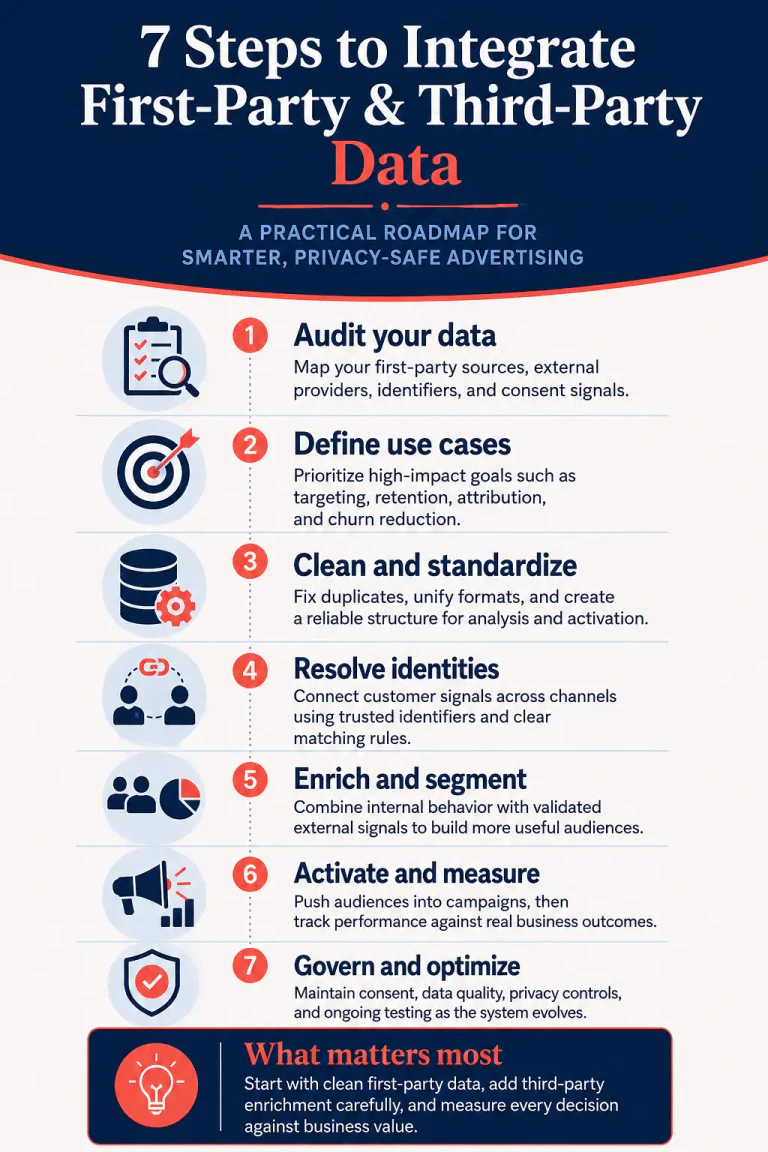
A practical first-party and third-party data integration roadmap can be divided into five stages.
Stage 1. Data audit
The first step is to document existing data sources. This includes owned systems, external providers, identifiers, consent signals, event structures, audience segments, and reporting tools.
The goal is to understand what already exists before buying new technology or adding new vendors.
Stage 2. Use case prioritisation
Not every use case should be implemented at once. The best starting points are usually those with clear business impact and manageable technical complexity.
Examples include:
- improving retargeting exclusions;
- creating high-value customer segments;
- enriching CRM profiles;
- building churn-risk audiences;
- testing lookalike campaigns;
- improving attribution quality.
Stage 3. Governance and consent alignment
Before activation, teams should define permitted uses, retention periods, access rules, vendor responsibilities, and consent logic.
This stage should involve marketing, analytics, IT, legal, privacy, and commercial stakeholders. Data integration is cross-functional by nature.
Stage 4. Technical integration
This stage includes data ingestion, schema standardisation, identity matching, quality checks, segmentation, and platform activation.
It is better to start with a small number of reliable data sources than to connect everything at once. A narrow but accurate integration is more useful than a large but chaotic one.
Stage 5. Testing and scaling
Once the first use cases are live, teams should test performance through A/B tests, holdout groups, campaign comparisons, and incrementality analysis.
Only after the system proves value should it be expanded to additional channels, audiences, models, and partners.
Future-proofing advertising data strategy
The advertising ecosystem will continue to change. Browser policies, platform rules, privacy regulations, and customer expectations will not remain static. A future-proof strategy must therefore be adaptable.
Brands should invest in:
- stronger first-party data collection;
- logged-in customer experiences;
- better preference centres;
- server-side measurement;
- contextual advertising;
- privacy-safe partnerships;
- data clean rooms;
- transparent consent flows;
- reduced dependence on third-party cookies;
- continuous data quality monitoring;
- ethical use of predictive analytics.
Artificial intelligence will increase the value of clean data, but it will also expose the weakness of poor data. Automated systems trained on outdated, inconsistent, or poorly governed information will not produce reliable decisions.
The strongest advertising organisations will not be those with the most tools. They will be those with the clearest data discipline.