

Key takeaways from the Competitor Content Strategy analysis
Systematically analyzing your competitors' content and SEO tactics is vital for identifying market gaps and building a winning digital strategy. The key to outranking opponents lies in leveraging these insights ethically to create superior resources:
- 1. Differentiate between business and SEO competitors Your SEO competitors are not just those who sell the same products, but any website (including blogs or publishers) that ranks for your target keywords. Categorizing them into tiers helps prioritize your analysis and outreach efforts.
- 2. Execute strategic keyword and content gap analyses Using SEO tools to compare your domain against rivals reveals untapped and shared keywords. By evaluating competitors' content depth, formats, and backlink profiles, you can identify "content gaps" and prioritize opportunities that offer a high return on investment.
- 3. Emphasize ethical improvement over imitation The goal of competitive intelligence is not to copy, but to build something better. By maintaining ethical standards, respecting legal boundaries, and focusing on creating uniquely valuable content, you can build sustainable, long-term competitive advantages.
Understanding your competitors' content strategies is essential for building a successful SEO approach in today's competitive digital landscape. By systematically analyzing what works for your competitors, you can identify content gaps, discover new keyword opportunities, and develop strategies to outrank them in search results. This comprehensive analysis involves examining their content types, keyword targeting, backlink profiles, and overall content performance to inform your own strategic decisions
Identifying your true SEO competitors
The first step in competitive content analysis requires understanding that your SEO competitors may differ significantly from your business competitors. Direct competitors offer similar products or services and target the same customer base, while indirect competitors are websites that rank for your target keywords regardless of their business model. For example, if you sell running shoes, Nike and Adidas are direct competitors, but a running blog that ranks for "best running shoes" is an indirect SEO competitor.
To identify your true SEO competitors, conduct manual searches for your primary keywords and note which domains consistently appear in the top 10 results. These are the websites actively competing for your target audience's attention in search engines. Tools like SEMrush's Organic Research and Ahrefs' Site Explorer can automatically identify competitors by analyzing domains that rank for similar keyword sets.
Building your competitor Llist
Create a comprehensive competitor list by categorizing them into three tiers based on their competitive threat level. Tier 1 competitors directly compete for your primary keywords and have similar domain authority. Tier 2 competitors may target some of your keywords but operate in adjacent market segments. Tier 3 competitors include larger brands or industry authorities that occasionally rank for your terms.
Document each competitor's domain, primary business model, content focus areas, and estimated monthly organic traffic. This systematic approach ensures you're analyzing the most relevant competitors and can prioritize your analysis efforts effectively.
Conducting comprehensive content analysis
Begin your content analysis by cataloging the types of content your competitors produce. Examine their blog posts, landing pages, resource pages, tools, videos, podcasts, and downloadable assets. Note the frequency of publication, content length, and format preferences. Some competitors may focus heavily on long-form guides, while others emphasize visual content or interactive tools.
Pay particular attention to their most successful content pieces, which you can identify through tools like BuzzSumo or by examining their highest-traffic pages in SEMrush. Analyze what makes these pieces successful – is it comprehensive coverage, unique data, expert interviews, or superior user experience?
Content quality and structure evaluation
Evaluate the quality and structure of competitor content by examining factors such as depth of coverage, readability, use of visuals, and internal linking strategies. High-performing content typically provides comprehensive coverage of topics, uses clear headings and subheadings, incorporates relevant images or charts, and maintains good readability scores.
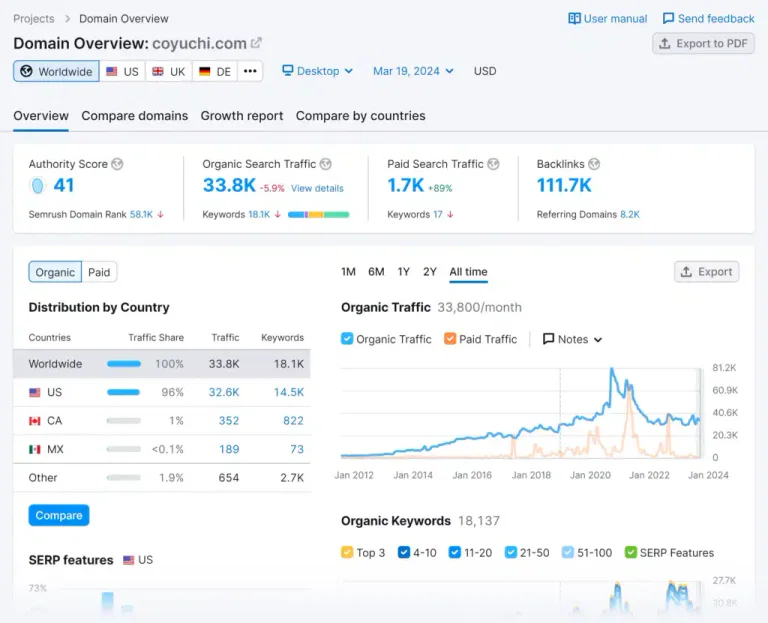
SEO competitor analysis dashboard showing traffic trends, authority scores, and keyword rankings for coyuchi.com
Assess their content from a user experience perspective by considering page load speed, mobile optimization, and overall site navigation. Content that ranks well often provides superior user experience alongside valuable information.
Performing strategic keyword gap analysis
Keyword gap analysis is perhaps the most valuable aspect of competitor content analysis, revealing keywords your competitors rank for that you don't. Use tools like SEMrush's Keyword Gap tool or Ahrefs' Content Gap feature to compare your domain against up to four competitors simultaneously. This analysis reveals untapped keywords, weak keywords where you could improve, and shared keywords where you're already competing.
Focus on keywords with moderate search volume and reasonable competition levels, as these represent the most achievable quick wins. Long-tail keywords often provide the best opportunities, as they typically have lower competition and higher conversion intent.
Understanding search intent and user needs
Analyze the search intent behind your competitors' target keywords to understand what users are actually seeking. Content that ranks well typically matches user intent perfectly, whether that's informational, navigational, commercial, or transactional. Examine the SERP features (featured snippets, People Also Ask, video results) for your target keywords to understand what type of content Google favors.
Analyzing competitor backlink strategies
Understanding your competitors' backlink profiles reveals their link-building strategies and identifies potential opportunities for your own campaigns. Use tools like Ahrefs, Majestic, or Moz to analyze the quality and diversity of their backlinks. Focus on metrics such as domain authority of linking sites, anchor text distribution, link types (editorial vs. directory), and recent link acquisition patterns.
Identify high-authority websites that link to multiple competitors but not to you – these represent prime targets for your own outreach efforts. Look for patterns in their most valuable backlinks, such as industry publications, resource pages, or guest posting opportunities that you might replicate or improve upon.
Link building opportunity identification
Create a systematic approach to identify link building opportunities by filtering competitor backlinks by domain authority (typically 30-70 for achievable targets) and relevance to your industry. Examine the content that attracted these backlinks to understand what type of resources earn editorial links in your space.
Pay special attention to recently acquired backlinks, as these may indicate active link building campaigns or trending topics worth pursuing. Tools like SpyFu can provide historical backlink data to understand long-term link building strategies and campaign timing.
Content gap analysis and opportunity identification
Content gap analysis involves comparing your existing content against competitor offerings to identify missing topics, insufficient coverage areas, and opportunities for improvement. Create a comprehensive content inventory that includes your current pages, their target keywords, content length, and performance metrics. Then map this against your competitors' content to identify clear gaps.
Focus on identifying topical gaps where competitors have comprehensive coverage but you lack content entirely, depth gaps where your content exists but lacks the thoroughness of competitor pieces, and format gaps where competitors use different content formats that perform well.
Prioritizing content opportunities
Not all content gaps are worth pursuing, so establish a prioritization framework based on factors such as search volume, keyword difficulty, business relevance, and resource requirements. High-priority opportunities typically combine decent search volume with achievable competition levels and strong alignment with your business goals.
Consider the content creation effort required for each opportunity. Some gaps might be filled with simple additions to existing content, while others require entirely new, comprehensive resources. Balance quick wins with longer-term strategic content investments to maintain momentum while building authority.
Content creation strategy development
Transform your competitor analysis insights into actionable content strategies by identifying content types and topics that consistently perform well in your industry. If competitors succeed with in-depth guides, case studies, or interactive tools, consider how you might create superior versions that provide additional value.
Develop content that fills identified gaps while maintaining your unique brand voice and perspective. The goal isn't to copy competitors but to learn from their successes and create something better. This might involve providing more current information, additional examples, better visuals, or more comprehensive coverage.
SEO optimization based on competitive analysis
Use competitor analysis to inform your on-page SEO strategy by examining how top-ranking competitors optimize their content. Analyze their title tags, meta descriptions, header structure, internal linking patterns, and keyword usage to identify optimization opportunities for your own content.
Pay attention to technical SEO factors that might give competitors advantages, such as site speed, mobile optimization, schema markup implementation, or site architecture. These technical elements often provide competitive edges that are easier to replicate than creating entirely new content.
Maintaining ethical standards
Competitive analysis must be conducted ethically, using only publicly available information and respecting intellectual property rights. Focus on analyzing public-facing content, published data, and openly available SEO metrics rather than attempting to access proprietary information or misrepresenting yourself to gather intelligence.
Establish clear guidelines for your team about acceptable competitive intelligence gathering methods. This includes avoiding practices like creating fake customer accounts, bribing employees for insider information, or using deceptive methods to access competitor data. Ethical competitive analysis builds long-term success while maintaining professional integrity.
Legal compliance and fair use
Ensure your competitive analysis activities comply with legal requirements and platform terms of service. While analyzing public websites is generally permissible, automated scraping that violates terms of service or accessing private information crosses ethical and potentially legal boundaries.
Use competitive insights to inspire and inform your strategy rather than directly copying competitor content. Create original content that provides unique value while learning from successful competitive approaches. This approach builds sustainable competitive advantages while avoiding copyright issues.
Performance tracking and analysis
Establish metrics to measure the success of your competitive analysis efforts, including organic traffic growth, keyword ranking improvements, and content engagement metrics. Track how content created based on competitive insights performs compared to your existing content and competitor pieces.
Monitor competitor activities ongoing rather than conducting one-time analyses. Set up alerts for competitor content publication, backlink acquisition, and keyword ranking changes to stay informed about their evolving strategies. Tools like SEMrush and Ahrefs offer competitor monitoring features for automated tracking.
Continuous strategy refinement
Competitive content analysis is an ongoing process that requires regular updates and strategy refinement. Schedule quarterly comprehensive competitor reviews to identify new competitors, changing strategies, and emerging opportunities. Market dynamics shift rapidly in digital marketing, making continuous monitoring essential for maintaining competitive advantages.
Use performance data to refine your competitive analysis approach over time. If certain types of competitive insights consistently lead to successful content, prioritize those analysis methods. Similarly, discontinue analysis activities that don't translate into actionable improvements or measurable results.


