
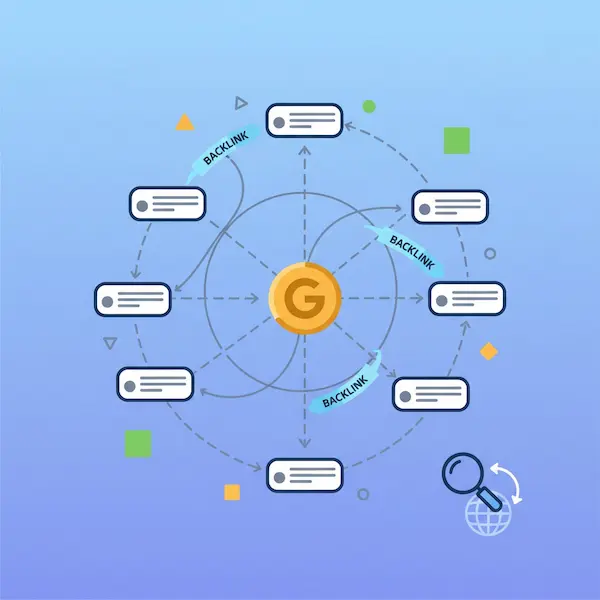
Key takeaways from the Search Visibility and Backlink analysis
Building search authority is a highly expensive and mathematically complex operation. To avoid destroying capital, organizations must strictly manage acquisition costs, control algorithmic risks, and prioritize architectural stability over vanity metrics:
- 1. The financial burden of centralized acquisition The cost of acquiring durable search visibility is severe, with premium editorial placements exceeding $2,000. As intermediary platforms centralize the market and replace direct outreach, the operational burden heavily shifts toward rigorous publisher vetting and strict financial modeling.
- 2. Algorithmic risk and anchor text control Uncontrolled anchor text distribution poses a terminal risk to organic revenue. Preventing algorithmic discounting requires database level pattern analysis to avoid the dangerous overrepresentation of commercial exact match phrases.
- 3. Link decay and architectural capital destruction Backlink authority naturally degrades over time, making link reclamation mathematically more profitable than new acquisition. Furthermore, acquiring expensive links to orphaned or poorly routed pages destroys capital if it fails to translate into actual commercial pipeline growth.
The prevailing baseline assumption surrounding offsite search optimization frequently obscures the rigid economic realities of acquiring durable external authority. Professional SEO practitioners operate within a highly structured, capital-intensive workflow that bears little resemblance to the simplified concept of earning natural citations. Link building is an industrial process of capital allocation, requiring exact calculations of labor, placement fees, and anticipated revenue efficiency.
This article describes the economics and operational mechanics of link acquisition as they exist in the market. It should not be read as a recommendation to violate search engine guidelines. Paid, sponsored, affiliate, or advertising-based links should be properly qualified with rel="sponsored" or rel="nofollow". The strategic question is not how to hide commercial relationships, but how to build a search visibility system that can survive technical audits, editorial review, algorithmic changes, and commercial scrutiny.
Recent industry surveys suggest that the perceived cost of a high-quality backlink remains substantial. One recent pricing analysis reported that SEO professionals were willing to pay an average of $508.95 for a single high-quality backlink. This figure should be treated as a market signal rather than a universal benchmark: actual acquisition costs vary according to niche competitiveness, publisher quality, editorial standards, geographic market, content requirements, and whether the campaign relies on direct outreach, digital PR, marketplace procurement, or agency execution.
The labor economics of direct outreach explain these escalating costs. Executing a successful direct acquisition campaign frequently demands the distribution of over one thousand personalized emails simply to secure ten to fifteen qualified placements. With response rates hovering consistently between one and three percent, the rejection rate inherently exceeds ninety percent. This structural inefficiency forces operators to rely on volume approaches, which in turn degrades the quality of outreach and increases the probability of domain blacklisting by email service providers.
A high rejection rate is not a failure of copywriting; it is the natural byproduct of saturated publisher inboxes. Target publications receive hundreds of automated requests daily, leading to immediate deletion of templated pitches. Successful direct outreach now requires deep target segmentation and the presentation of a value proposition that extends beyond an exchange of capital for a hyperlink. Time zone disparities in international campaigns further compound the friction, extending project timelines and delaying the recognition of acquired authority. The math is rigid. An organization either pays directly in placement fees, or it pays indirectly through the mounting labor costs of an inefficient outreach pipeline.
Link velocity should be interpreted in context rather than reduced to a fixed numerical threshold. A sudden spike in links from legitimate press coverage, product launches, research reports, or viral brand mentions may be entirely natural. A similar spike from unrelated, low-quality, commercially anchored domains is a different risk category. Professional operators therefore monitor not only the number of new links, but also their source diversity, topical relevance, anchor distribution, publication timing, and relationship to real marketing events. The objective is not to imitate a natural pattern mechanically, but to avoid building a backlink profile whose growth can only be explained by manipulation.
Intermediary platforms and the economics of escrow
Platforms such as WhitePress and Linkhouse have altered the mechanics of publisher discovery, placement ordering, and campaign monitoring. WhitePress positions itself as a global link building and content publication platform with advanced filtering, publication guarantees, and daily monitoring. Its current communication highlights a 36-month guarantee for selected publications and daily checks designed to detect whether the article or link disappears. Linkhouse similarly presents itself as a platform for planning, managing, and monitoring content marketing and link building campaigns, connecting advertisers with publishers and helping publishers monetize their sites.
The primary advantage of these platforms is not operational efficiency, but transaction enforcement. In direct outreach, non-delivery is a constant operational hazard. A publisher may accept payment, place the link temporarily, and remove it three weeks later, leaving the SEO operator with a financial loss and zero search impact. Publishers might also covertly apply rel=sponsored attributes to the placement when a standard dofollow link was negotiated.
Intermediary platforms neutralize this risk through escrow systems. They function as a market policeman, holding funds until the placement is verified against the exact specifications of the order. If a publisher fails to deliver, the platform refunds credits to the buyer's account, entirely bypassing lengthy dispute resolution processes. Furthermore, platforms execute post-publication monitoring. WhitePress continues checking link integrity for up to one year after placement, addressing issues like unauthorized link removal or modified attributes.
To control inventory quality, these platforms require publishers to undergo verification processes, including the submission of Google Analytics screenshots to validate traffic claims. This creates transparency and prevents the masking of zero-traffic domains behind inflated third-party metrics. Platform-based acquisition frequently carries a higher per-unit cost than direct outreach, but when factoring in the labor savings, the elimination of non-delivery risk, and the mitigation of communication friction, the total cost of acquisition proves significantly more efficient.
Publisher qualification and referring domain entropy
Access to tens of thousands of publishers does not equal access to useful placements. The democratization of link purchasing requires rigorous internal qualification standards to prevent the acquisition of toxic inventory. Companies routinely buy links from sites that publish casino reviews, SaaS listicles, and dental implant guest posts in the same week. This is usually presented internally as authority building.
To filter platform inventory or direct outreach targets, operators must evaluate publishers against strict mechanical thresholds. A common operational failure is relying exclusively on third-party scores like Domain Rating (DR), Domain Authority (DA), or Authority Score (AS). Search engines do not use these metrics. They are highly susceptible to manipulation through private networks and expired domain redirects. A high-DR website that links out indiscriminately to thousands of unrelated commercial domains provides less authority than a topically strict, low-DR industry publication.
When auditing a prospective publisher, the ratio of referring domains to total backlinks offers immediate insight into the site's editorial standards. A low ratio, such as one to three links per referring domain, suggests natural editorial citations or highly selective guest posting. A medium ratio of four to ten links per domain indicates standard resource pages or deeper author relationships. A high ratio, exceeding twenty links per domain, typically indicates automated site-wide footer links, sidebar widgets, or sponsored network placements. Google's algorithmic systems are highly adept at identifying and discounting these structural patterns.
Topical relevance remains the primary governor of link equity transfer. High relevance involves links from websites operating strictly within the same industry or topic area. Medium relevance allows for links from adjacent commercial sectors or broad business publications. Low relevance indicates placements on generalist news aggregators or entirely unrelated niche blogs. High-relevance profiles signal earned authority; low-relevance profiles signal poorly disguised capital deployment.
The evaluation process must be systematized. Operators frequently utilize weighted scoring models to strip emotion and sales narratives out of the publisher selection process.
-- Example weighted publisher scoring implementation
=IF(AND(Spam_Score<5, Traffic>1000),
   (Traffic_Volume * Topical_Relevance_Score) / SUM(Traffic_Volume),
   "Exclude_from_Pipeline")
| Offsite condition | Search consequence | Business cost |
| Links from weakly relevant publishers | Low authority confidence | Placement spend without durable ranking support |
| Sitewide footer or widget link patterns | Algorithmic discounting | Reporting inflation with zero organic yield |
| High total backlink to referring domain ratio | Classification as a link farm | Exposure to manual review and ranking suppression |
| Verification via unauthenticated metrics | Traffic overestimation | Inflated customer acquisition costs |
Technical detection of private blog networks
The most severe risk in offsite operations is the acquisition of links from Private Blog Networks. PBNs usually consist of repurposed expired domains whose historical authority metrics are used to sell placements rather than serve a real audience. The commercial danger is straightforward: these links may temporarily inflate reporting metrics while exposing the target domain to future discounting, manual review, or broader trust loss.
The proper operational response is not to learn how such networks hide, but to audit whether a prospective publisher behaves like a legitimate editorial asset. A publisher should demonstrate visible audience demand, topical consistency, transparent editorial standards, stable indexation, credible authorship, organic traffic patterns, and a link profile that does not appear to exist primarily for selling outbound authority.
Risk signals include repeated publication of unrelated sponsored topics, thin or generic AI-generated content, aggressive outbound linking to commercial pages, irrelevant anchors, weak brand presence, no genuine readership signals, and sudden changes in topical direction after domain expiration or ownership transfer. Technical signals may also matter, especially when multiple sites share unusually similar infrastructure, design, templates, authorship patterns, publishing cadence, or outbound linking behavior.
A responsible backlink audit should classify such domains as high-risk unless there is clear evidence of editorial legitimacy. The goal is not to prove that every weak publisher is a PBN. The goal is to avoid paying for links whose only measurable function is to manipulate third-party authority metrics. In a mature SEO program, suspicious publishers should be excluded before acquisition, not cleaned up after they have already entered the backlink profile.
Anchor text concentration and semantic risk analysis in BigQuery
Beyond publisher quality, the most critical variable in risk management is anchor text concentration. The anchor text teaches search engines how to categorize the destination page. Historically, operators manipulated this classification by building thousands of links using exact-match commercial keywords. Today, an overabundance of keyword-rich anchors acts as a definitive spam signal, triggering algorithmic filters designed to suppress manipulated profiles.
A natural backlink profile is highly entropic. It contains a vast array of naked URLs, brand mentions, generic phrases, and fragmented sentence strings. When commercial anchors are overrepresented across weak publishers, the campaign teaches the backlink profile to look engineered. That does not create durable authority. It creates reporting artifacts that survive until someone competent opens the export.
Because search engines do not publish safe percentages for anchor text distribution, anchor thresholds should be treated as internal risk bands rather than universal algorithmic rules. In practice, many SEO teams flag exact-match commercial anchors once they begin to dominate the profile or appear repeatedly across weakly relevant publishers. A healthy profile usually contains a large share of branded anchors, naked URLs, generic references, partial-match phrases, and naturally fragmented sentence anchors. The more commercial and repetitive the anchor text becomes, the more important it is to evaluate publisher quality, topical relevance, destination page intent, and historical acquisition patterns together.
Monitoring this concentration across tens of thousands of historical backlinks requires transitioning from standard spreadsheet filtering to robust database querying. SQL, specifically implemented in environments like Google BigQuery, allows search authority analysts to segment backlink audit exports accurately, applying text analyzers to detect over-optimization.
BigQuery offers specialized text analysis functions such as TEXT_ANALYZE and SEARCH, which extract data from unstructured anchor text. When configuring the database, analysts select from three primary text analyzers. NO_OP_ANALYZER extracts the input as a single exact term without applying any normalization. LOG_ANALYZER, the default option, extracts input text as tokens when a delimiter is encountered, discards the delimiters, and converts uppercase letters to lowercase.
For aggressive spam pattern detection, the PATTERN_ANALYZER is the most effective. This analyzer extracts tokens matching a specified re2 regular expression. By default, it utilizes \b\w{2,}\b to match non-Unicode words containing at least two characters. It finds the first substring matching the pattern from the left, extracts it as a token, removes the preceding text, and repeats the process until the string is empty.
Analysts can further refine the extraction using token filters. The mode setting determines normalization: NONE leaves terms untouched, LOWER forces ASCII lowercase, and UNICODE_LOWER maps cases according to the Unicode Character Database without language-specific constraints. For advanced international backlink profiles, ICU_NORMALIZE applies deep normalization using modes such as NFC, NFKC, NFD, or NFKD. An array_of_stop_words can also be deployed to strip generic terms like "click" or "here" from the risk calculation.
|
1 2 3 4 5 6 7 8 9 10 11 12 13 14 15 16 17 18 19 20 21 22 23 24 25 26 27 28 29 30 31 32 33 34 35 36 37 38 39 40 41 42 43 44 45 46 47 48 49 50 51 52 53 54 55 56 57 58 59 60 |
WITH tokenized_anchors AS ( SELECT source_url, target_url, term AS anchor_token FROM `seo_data_warehouse.historical_backlink_export`, UNNEST(TEXT_ANALYZE( anchor_text, analyzer => 'PATTERN_ANALYZER', analyzer_options => ''' { "patterns": ["[A-Za-z0-9]{2,}"], "token_filters": [ { "normalizer": { "mode": "LOWER" } }, { "stop_words": ["click", "here", "read", "more", "website", "link"] } ] } ''' )) AS term ), anchor_distribution AS ( SELECT anchor_token, COUNT(*) AS placement_frequency, SUM(COUNT(*)) OVER () AS total_analyzed_links FROM tokenized_anchors GROUP BY anchor_token ), scored_anchors AS ( SELECT anchor_token, placement_frequency, total_analyzed_links, ROUND((placement_frequency / total_analyzed_links) * 100, 2) AS concentration_percentage FROM anchor_distribution ) SELECT anchor_token, placement_frequency, total_analyzed_links, concentration_percentage FROM scored_anchors WHERE concentration_percentage > 5.0 ORDER BY concentration_percentage DESC; |
This infrastructure allows teams to track the exact token frequency of commercial root words hidden within long-tail anchors. It moves the evaluation of link equity out of generic third-party dashboard gauges and into verifiable semantic analysis. If the token extraction reveals that a highly specific keyword variant controls ten percent of the anchor distribution, outreach teams must be immediately instructed to utilize only branded or generic anchors until the ratio dilutes to safe levels.
| Text Analyzer | Primary function | Anchor text analysis application |
| NO_OP_ANALYZER | Extracts input as a single term without normalization | Identifying exact full-string match anchors precisely as coded |
| LOG_ANALYZER | Breaks input on delimiters and applies lowercase formatting | Aggregating fragmented or slightly punctuated anchor text |
| PATTERN_ANALYZER | Extracts terms matching re2 regular expressions | Filtering specific commercial root words from long-tail anchors |
AI-assisted data analysis and large language model integration
The complexity of querying massive backlink datasets has been significantly reduced by the integration of large language models directly into data warehousing environments. Google BigQuery has introduced "Comments to SQL," an AI-powered feature that bridges the gap between natural human language and structured SQL syntax.
This feature allows analysts to embed natural language expressions directly within their queries using comment syntax, which the system then translates into executable code. For example, an analyst can write SELECT /* average domain rating, total backlinks */ FROM /* competitor link gap data */ WHERE /* topical relevance is high */ GROUP BY /* publisher category */. The AI analyzes the surrounding schema context to interpret the intent and generates the complex multi-table joins and window functions required to execute the analysis.
Furthermore, BigQuery allows operators to create remote models that represent hosted Vertex AI large language models. By establishing an external connection to Vertex AI and executing a CREATE OR REPLACE MODEL statement, SEO teams can apply the ML.GENERATE_TEXT function directly to their database records. This enables automated categorization of thousands of publisher URLs or the summarization of extracted anchor text patterns without exporting the data to external tools. The prompt parameter temperature controls the randomness of the model's response, while max_output_tokens limits the response length, ensuring the output remains structured for subsequent database operations.
Link decay, entropy, and the mathematics of reclamation
Acquiring a link does not guarantee permanent authority. The web is highly volatile, and link decay operates as a continuous drag on search performance. A backlink audit is fundamentally a health check, evaluating the precise state of external routing at a specific moment in time. The data regarding link rot is severe. Ahrefs’ link rot study found that at least 66.5% of links pointing to the sampled websites had rotted over a nine-year period, while additional links were affected by temporary errors or other SEO-specific issues.
When businesses invest heavily in placement fees, losing a link is a direct destruction of capital. Link reclamation is the operational countermeasure. It is the structured process of identifying and recovering lost or broken backlinks to regain missing equity. Given that cold outreach conversion rates average around 8.5 percent under optimal conditions, reclaiming a link that the brand has already earned is statistically three times more effective than acquiring a new one. Reclaiming links restores lost value, retains historical referral traffic, and protects the domain's authority baseline.
Links disappear for four primary technical reasons. First, the author or publisher manually removes the link from the linking page. Second, the linking page itself is deleted, returning a 404 error. Third, the linking page is 301 redirected to a new destination that does not include the original external link. Finally, the linking page is tagged with a noindex directive, keeping the page live but instructing search engines to strip its authority from the index.
The operational workflow for reclamation requires merging crawler data with historical backlink exports. Analysts utilize tools like Ahrefs Site Explorer, navigating to the Backlinks report and applying the "Lost" filter. It is crucial to further filter this list to display only "Dofollow" backlinks, as recovering a lost nofollow link yields minimal authority return. The analyst categorizes the loss by status code to determine the outreach strategy.
If the link was removed manually or the page was deleted, the outreach team contacts the publisher to politely inquire about the removal. The email must be highly personalized, concise, and provide the correct replacement URL. Supplying the webmaster with an updated resource or suggesting a substitute link saves them editorial labor and increases the probability of reinstatement. If no response is received, operators typically deploy a single gentle follow-up sequence after one to two weeks.
If the target page on the brand's own website was deleted or the URL structure changed, causing the external link to point to a 404 error, the solution is entirely internal. The operator must run a crawler like Screaming Frog, navigate to the "Response Codes" tab, filter for 404 errors, and map those broken internal URLs against the referring domains. The operator then executes a 301 redirect, mapping the dead URL to the most topically relevant live commercial page to preserve the inbound link equity.
Link reclamation is strictly separate from unlinked brand mention recovery. Link reclamation recovers equity that was previously established and routed. Unlinked mention recovery targets plain-text brand citations that never contained a hyperlink, attempting to negotiate the conversion of text into a crawlable anchor. Tools like BuzzSumo or Mention track these brand mentions online, allowing outreach teams to request proper attribution. Additionally, reverse image search engines like Google Images or TinEye can locate proprietary graphics or charts used without permission, creating leverage to request a backlink as attribution.
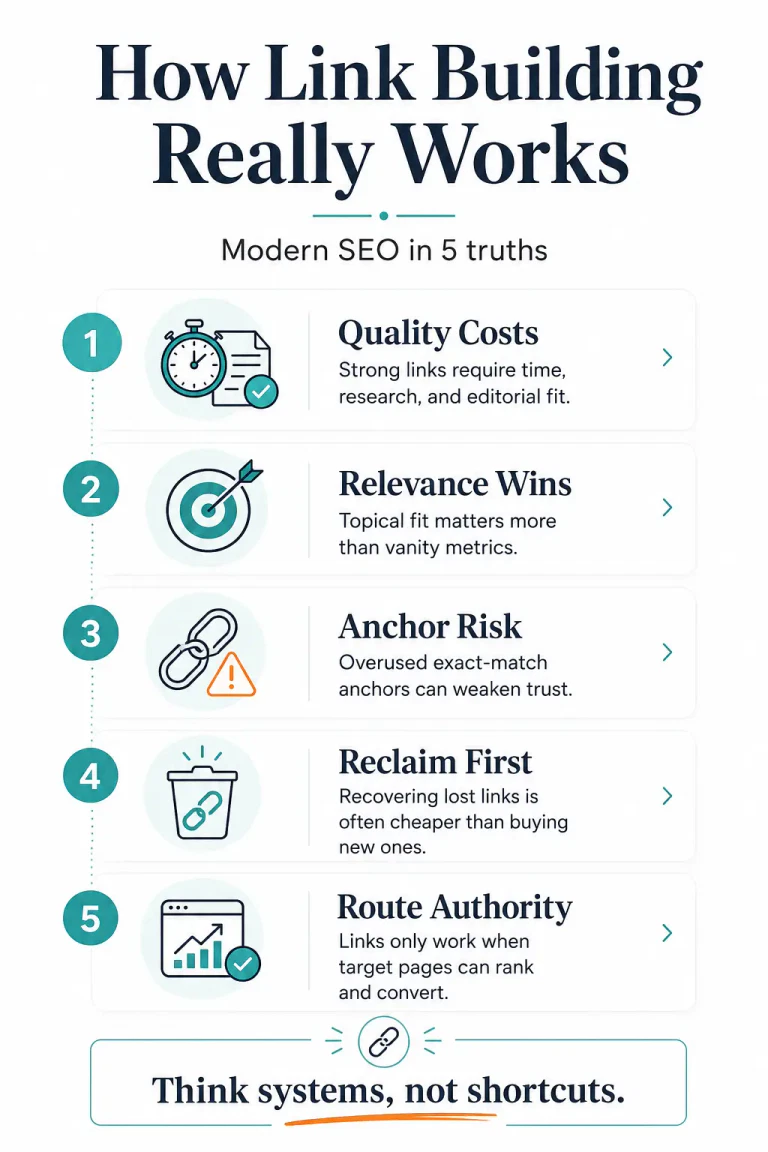
Toxicity remediation and disavow discipline
When backlink profile entropy results in a heavy concentration of toxic links, operators must intervene to prevent algorithmic suppression. Identifying the toxic components requires isolating the specific markers of negative SEO or historical manipulation.
A backlink audit report systematically evaluates every external link pointing to a domain. Toxic links frequently originate from de-indexed domains, link farms, or spammy directories possessing excessively high spam scores. Geographic and topical mismatch is a primary indicator; for instance, a local business operating in Boston receiving thousands of links from irrelevant.xyz or.top Country Code Top-Level Domains (ccTLDs) signals clear manipulation. Furthermore, links utilizing spammy anchor text related to pharmaceuticals or gambling represent a major red flag for negative SEO attacks.
The Google Disavow Tool should be treated as an exceptional remediation mechanism rather than a routine cleanup instrument. It is most defensible when a site has received a manual action related to unnatural links, or when there is clear evidence of severe, manipulative, and uncontrollable backlink contamination. Routine disavowal based only on third-party toxicity scores can destroy useful equity if legitimate domains are misclassified as harmful. A disavow file should therefore be built from verified evidence: source quality, topical mismatch, anchor spam, de-indexation signals, historical manipulation, and clear footprint anomalies.
The process demands precision. The analyst exports the link data from Google Search Console, which provides up to 100,000 recent links, and cross-references it against third-party indexes like Ahrefs or Semrush to ensure comprehensive coverage and deduplication. The data is filtered by toxicity markers, prioritizing the most suspicious links first. The operator then constructs a heavily formatted text file listing the specific URLs or domains to be neutralized.
Submitting a disavow file strips the associated link equity from the site. If an analyst aggressively disavows domains that were actually passing positive signals, the site may lose useful link equity and experience ranking or traffic declines. Therefore, the disavow file should target only mathematically proven footprint anomalies, blatant manipulation, and verifiable manual action risks. Following submission through Google Search Console, the operator must monitor crawl rates, indexation behavior, and SEO performance to verify the impact of the neutralized domains.
Revenue-weighted link acquisition and CMO reporting frameworks
The ultimate failure of many offsite SEO operations is the inability to translate link acquisition into recognized business value. Dashboards celebrating raw referring domain growth while qualified organic leads stagnate are a symptom of disconnected metrics. The C-suite, facing mounting board pressure, requires proof that marketing capital generates pipeline. According to recent survey data, marketing leaders report a twenty-one percent increase in board pressure to justify marketing spend, accompanied by a fifty-two percent increase in pressure from CFOs and a twenty percent increase from CEOs.
Link building ROI is notoriously difficult to model because attribution is fragmented. Privacy laws have tightened, restricting tracking data, and AI black-box algorithms complicate visibility. If a user discovers a brand through an AI summary powered by a recently acquired citation, visits the site, leaves, and later converts through a branded paid search click, standard last-click analytics oversimplifies the journey and assigns the revenue entirely to the paid channel. This data chaos requires a more sophisticated modeling framework aligned with commercial realities.
Depending on the business model, CMOs rely on specific KPI frameworks to measure marketing ROI.
For B2B companies with long sales cycles, the Revenue Attribution Model is critical. This model distinguishes between marketing-sourced pipeline and marketing-influenced pipeline.
The Efficiency Model focuses strictly on profitability, measuring Customer Acquisition Cost (CAC), Customer Lifetime Value (LTV), and the payback period. Sustainable growth targets an LTV to CAC ratio of at least three to one, with a payback period under twelve months. When high-authority links drive qualified organic traffic, reliance on expensive paid channels decreases, directly improving these efficiency ratios. Scale-ups balancing growth with long-term positioning often deploy a Brand + Performance Hybrid model, measuring short-term revenue against long-term brand authority metrics.
The emergence of AI search requires an updated approach: the Generative Engine Optimization (GEO) ROI model. The buyer journey has moved upstream, with 85 percent of B2B buyers assembling a vendor shortlist before ever engaging with sales. GEO optimizes for information extraction by Large Language Models, rewarding entity clarity and structured, citation-ready formatting.
The true return on GEO and traditional link building is not citation counts or visibility scores. It is the revenue or pipeline actually produced. The three-layer ROI attribution model provides a board-defensible structure for reporting this value.
| Attribution Layer | Measurement focus | Typical percentage of total ROI |
| Layer 1. Direct | Direct revenue or inbound leads sourced explicitly from AI/organic search | 10% - 20% |
| Layer 2. Influenced | Pipeline opportunities where AI discovery was a mid-journey touchpoint | 25% - 35% |
| Layer 3. Velocity | Reductions in sales cycle length, increased win rates, and larger deal sizes | 45% - 65% |
Under this model, boards only see Layer 1, causing offsite programs to appear as if they are underperforming when they are actually driving broader pipeline velocity. Early commercial analyses suggest that AI-referred traffic may convert at a higher rate than broad organic traffic in some B2B contexts, but these benchmarks should not be generalized across all industries. AI search attribution remains immature because discovery, evaluation, comparison, and final conversion often occur across separate systems. For this reason, GEO reporting should rely less on isolated referral sessions and more on combined evidence: branded search lift, direct traffic quality, assisted pipeline, sales-cycle velocity, source-of-truth CRM data, and the presence of the brand in citation-heavy decision environments.
To calculate the ROI multiple of a link building campaign, the operator aggregates the pipeline value across all three layers and divides it by the total program cost. Documented offsite programs in high-value sectors like cybersecurity have produced multiples ranging from 17x to 31x over rolling ninety-day windows. Statistically significant Share of Voice (SOV) changes typically manifest within four to six weeks, while hard pipeline attribution requires six to ten weeks to materialize1.
To execute this, marketing and sales must operate on shared KPIs, integrating closed-loop reporting to connect campaign data directly to revenue outcomes. A link building team tracking "Domain Rating increases" while the sales team tracks "Marketing Sourced Pipeline" creates an operational void. The offsite strategy must prioritize target pages based on their historical conversion rate. Acquiring a $2,000 link pointing to a page that converts traffic at four percent is an investment; acquiring the same link pointing to an outdated industry report that lacks a capture mechanism is an expense.
Architectural alignment and internal authority routing
Why do executives approve massive placement budgets for external authority acquisition while their own content management systems orphan the exact commercial landing pages intended to capture that equity?
An offsite campaign without internal architectural support is paid leakage. If a newly acquired link points to a landing page that resolves with a 404, redirects through a multi-step chain, or utilizes a canonical tag pointing elsewhere, the authority is squandered. Link building must be treated as a routing problem. The target page must be indexable, stable, and integrated into the site's primary internal navigation.
CMS architecture and organizational incentives frequently create massive offsite SEO debt. Uncontrolled campaign URL creation, deleted PR landing pages, and orphaned thought-leadership assets scatter acquired authority across dead ends. When digital PR teams launch campaign microsites without proper canonical mapping back to the primary commercial domain, the parent brand receives zero equity from the acquired placements.
Deep page links are critical. While homepage concentration is normal, commercial pages must receive proportionate external and internal link support. If a high-authority publication links to an informational blog post, the internal links within that post must flow directly to the relevant revenue-generating pages. If the internal links are broken or poorly optimized, the offsite expenditure is isolated and fails to lift commercial rankings.
- https://www.mersel.ai/blog/how-to-prove-roi-of-generative-engine-optimization ↩︎


