
Key takeaways from the Witch Hat Atelier anime analysis
Witch Hat Atelier does not make magic feel powerful because it is loud, explosive or inherited. Its fantasy works because magic behaves like a craft: something drawn by hand, learned through mistakes, protected by rules and dangerous when curiosity moves faster than understanding.
- 1. Coco is not a chosen hero, but a child who sees the hidden structure of wonder Witch Hat Atelier avoids the usual fantasy shortcut of secret bloodlines and instant destiny. Coco becomes compelling because she notices that magic is not a miracle reserved for the chosen, but a system of signs, lines and rules. Her desire to learn is beautiful precisely because it crosses a boundary she was never supposed to touch.
- 2. The atelier is warm, but it also controls who is allowed to know Qifrey’s atelier feels like a place of care, apprenticeship and slow discovery, yet it also belongs to a world built on secrecy. The anime becomes stronger when it lets comfort and control exist together. Learning magic is not only a personal dream. It is entry into a protected hierarchy of knowledge.
- 3. The real fantasy is not power, but access to knowledge The most human part of Witch Hat Atelier is not the spell system itself, but the hunger to understand what was previously forbidden. Coco does not simply want to become powerful. She wants to stop being a spectator of magic and become someone who understands how wonder is made, even when that knowledge brings guilt, discipline and consequence.
That difference matters. Coco is not introduced as a chosen saviour waiting for the world to recognise her secret greatness. She is a girl standing outside a system she has been told she cannot enter. Magic exists around her. It fills the world with wonder, convenience and impossible beauty. Yet it belongs to other people. People with hats, training, authority and secrets.
For a child, that is almost crueler than a world without magic. The impossible is visible, but not available.
This is why the Witch Hat Atelier anime feels different from many fantasy adaptations. It does not make magic feel like a stat, a class, a blood inheritance or an explosive force waiting to be unlocked. It makes magic feel like literacy. Something written. Something drawn. Something copied badly before it is understood. Something that can be beautiful in the hands of a master and catastrophic in the hands of someone who only knows enough to be dangerous.
That is the quiet intelligence of Kamome Shirahama’s world. Magic is not less magical because it has rules. It becomes more magical because those rules are close enough to craft. A spell is not just a shout, a glow or a burst of energy. It is a line with intention. A circle with limits. A design that either holds together or fails.
The anime’s greatest strength is that it does not rush this idea. It lets magic remain tactile. It lets the viewer feel that knowledge has weight before it has spectacle.
Magic does not arrive. It has to be drawn
In weaker fantasy, magic often appears as inner pressure. A character gets angry, afraid or inspired, and power erupts. The scene may be exciting, but it is also familiar. Magic becomes emotion with visual effects.
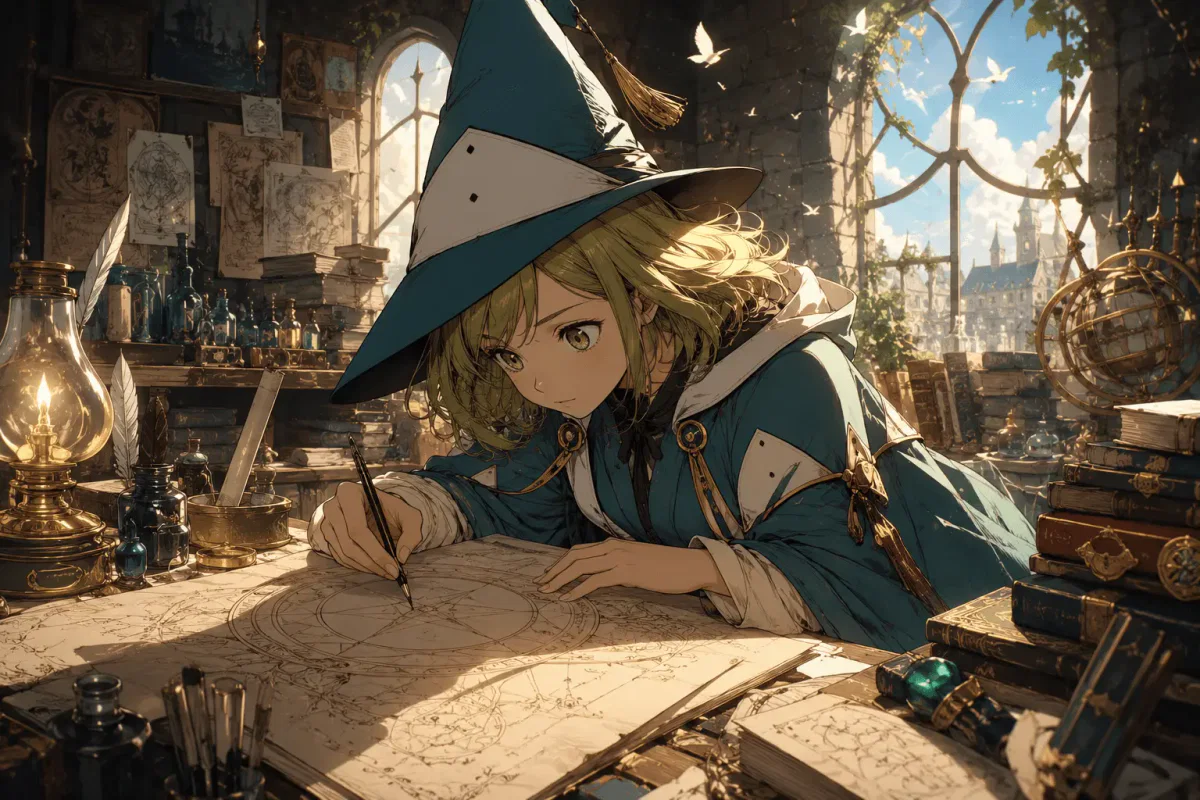
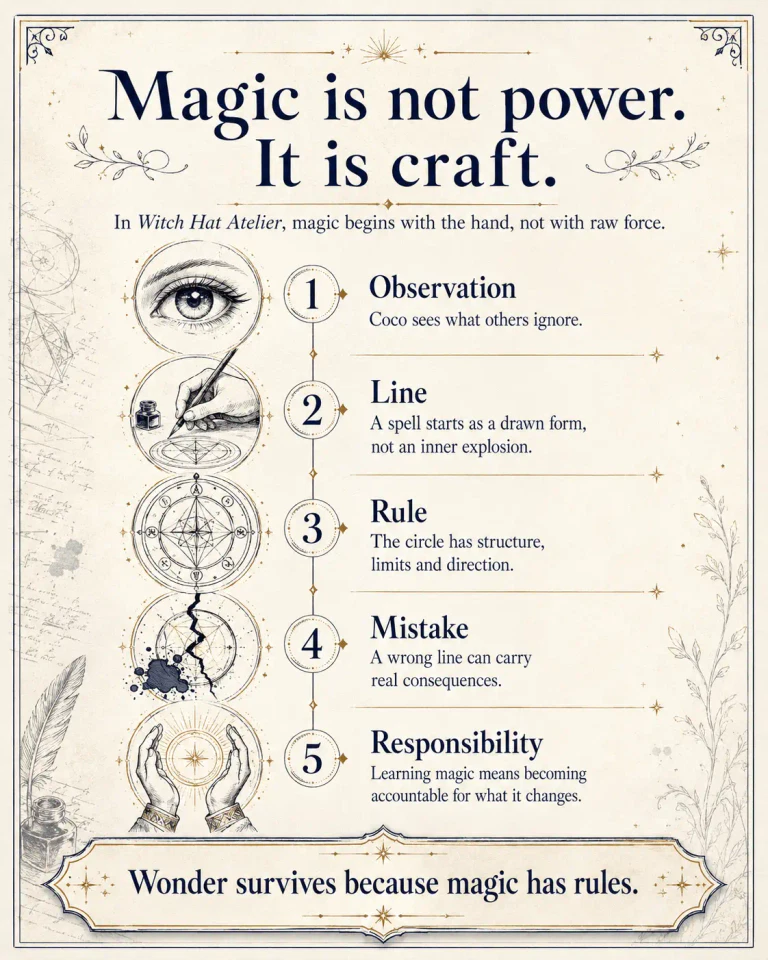
Witch Hat Atelier takes a different route. Magic has to pass through the hand.
That single choice changes everything.
A drawn spell contains hesitation. It contains training. It contains the possibility of error. The hand may tremble. The line may be wrong. The person drawing may understand the form but not the full consequence. Magic stops being a private emotional possession and becomes an external act in the world.
That is why the series feels so attentive to learning. It understands that learning is not just collecting information. Learning is the body becoming responsible for knowledge. The eye learns to notice. The hand learns to repeat. The mind learns where curiosity must slow down.
Coco’s desire to become a witch is therefore not a generic dream of power. It is closer to the hunger of someone who has seen a language being used all around her and has been told that she is not allowed to read it.
This is where Witch Hat Atelier becomes more than a charming fantasy about apprentices. It becomes a story about access.
Who is allowed to learn?
Who decides what knowledge is too dangerous?
When does secrecy protect people, and when does it become a way to preserve hierarchy?
These questions sit underneath the softness of the art. The world is inviting, almost tender in its textures, but the rules underneath it are sharp.
Coco is not chosen. She crosses a line by wanting too much
Coco’s story works because her curiosity is not treated as pure innocence.
A less interesting version of the story would make her simply special. She would discover she had hidden powers all along. The world would be wrong about her. Magic would recognise her because fantasy often loves the hidden heir, the secret bloodline, the buried talent.
Witch Hat Atelier gives her something more unstable.
Coco notices. She imitates. She reaches toward what she does not yet understand. Her mistake is not that she is evil. Her mistake is that she believes wonder can be separated from consequence.
That is a painfully human mistake. It is also one of the best reasons the series resonates beyond its fantasy shell.
Children often learn by copying before they understand what they are copying. Adults do the same with technology, language, status and power. The modern world is full of tools that people can use before they grasp the systems behind them. Witch Hat Atelier turns that anxiety into fantasy without making it feel like a lecture.
Coco does not break the world because she wants destruction. She breaks something because she wants entry.
That makes her guilt more interesting. It is not the guilt of a villain. It is the guilt of a learner who discovers that learning can harm people before it saves them.
The anime should be watched through that tension. Every beautiful spell carries a question. How much understanding is enough before someone is allowed to act? Who gets to decide that threshold? And what happens to people born outside the official path, but still drawn toward the door?
Qifrey’s atelier is not just a school
The word “atelier” matters.
A school suggests curriculum, evaluation, progression and institutional order. An atelier suggests craft, apprenticeship, proximity and slow imitation. One learns not only from lessons, but from watching how someone moves, prepares, corrects and refuses shortcuts.
Qifrey’s atelier has warmth because it is not a cold academy. It is intimate. It has the emotional shape of a place where knowledge is lived rather than merely delivered. The girls are not only acquiring techniques. They are learning how to inhabit a practice.
But that warmth should not make the atelier seem simple.
It is also a border checkpoint.
Inside, magic is taught. Outside, magic remains mystified. Inside, mistakes can be corrected. Outside, mistakes can become irreversible. Inside, the apprentice may ask questions. Outside, curiosity may be criminal, dangerous or socially impossible.
This is one of the reasons Witch Hat Atelier has such a strong underlying tension. The atelier is a shelter, but it is not freedom. It is an entry point into a regulated world. It teaches, but it also disciplines. It opens doors, but not all of them.
Qifrey himself embodies that ambiguity. He is mentor, protector and gatekeeper at once. His kindness does not erase the fact that he represents knowledge with rules around it. The anime becomes richer when it allows him to be gentle without making the system around him innocent.
Good fantasy institutions are rarely just good or bad. They are places where care and control learn to speak the same language.
Agott, Tetia and the different shapes of learning
Coco’s wonder would become too simple if the story only contrasted her with a closed magical society. The atelier works because other apprentices show that learning itself has different emotional shapes.
Agott carries the pressure of recognition. Her relationship with magic is not pure delight. It is sharpened by pride, insecurity and the need to prove that effort matters. In many stories, such a character would be reduced to rivalry. Witch Hat Atelier gives her something more precise: the wound of someone who knows that talent, discipline and social approval are never evenly distributed.
Tetia brings a different temperature. Her openness can look simpler, but it is not useless. In a world where knowledge is guarded and mistakes can harden into fear, generosity is also a form of intelligence. It keeps the atelier from becoming only a chamber of pressure.
Richeh and the others add further variations on the same question: what does magic become when filtered through temperament? Not every student learns for the same reason. Not every hand draws with the same fear. Not every mistake comes from carelessness.
This is why Witch Hat Atelier’s educational fantasy feels alive. It does not treat learning as a staircase everyone climbs at the same pace. Learning is social. It is competitive, intimate, humiliating, joyful and sometimes unfair.
The atelier becomes a small laboratory of human difference.
That may be why the anime feels warmer than many darker fantasy series without becoming lightweight. It understands that wonder does not remove comparison. It may even intensify it. When magic exists, failure becomes visible in a more painful way.
Forbidden magic is where curiosity loses its innocence
Every good magic system needs a forbidden zone.
Not because rules make a world feel bigger by themselves, but because prohibition reveals what a society fears.
In Witch Hat Atelier, forbidden magic is not just a list of banned techniques. It marks the place where knowledge becomes politically and ethically charged. Some magic is forbidden because it can harm. Some because it threatens the order of the world. Some because the people controlling magic believe that ordinary people cannot be trusted with too much of it.
The disturbing part is that these reasons may overlap.
A society can restrict knowledge for protection and for power at the same time. That is what makes the world feel mature. The series does not reduce secrecy to villainy. It also does not romanticise secrecy as wisdom. It keeps asking what happens when knowledge is both necessary and dangerous.
Coco’s position makes this question sharper. From her perspective, secrecy feels unfair because it excludes her. From the system’s perspective, secrecy may look necessary because magic can destroy lives when mishandled. Neither perspective is entirely false.
That tension is more interesting than a simple rebellion narrative. Witch Hat Atelier is not merely saying that rules are bad and curiosity is good. It is asking what kind of responsibility must accompany access.
The answer is never comfortable. If knowledge can save, it can also wound. If education can liberate, it can also initiate someone into a world of obligations they were not ready to carry.
Magic here is not a toy. It is technique with consequences.
Why the anime feels handmade
The visual appeal of Witch Hat Atelier is obvious, but “beautiful” is too weak a word for what the style is doing.
The anime needs to preserve something that the manga already understands: the magic of this world depends on the visible presence of the line. If the adaptation treated spells only as glowing effects, it would lose the central metaphor. The viewer must feel that drawing matters. That form matters. That the image is not decoration around magic but part of magic itself.
This is why the series has to feel handmade even when animated digitally.
The world should not look like a smooth fantasy theme park. It needs paper, ink, fabric, dust, tools, shelves, folded clothes, worn surfaces and small domestic spaces. The beauty is not only in wide fantasy landscapes, but in the intimacy of materials. Witch Hat Atelier works best when it makes the viewer believe that magic belongs to a workshop before it belongs to a battlefield.
That is also why the anime can feel gentle without feeling empty. Its softness is procedural. The quiet scenes matter because they teach the viewer how to look. A desk, a page, a hat, a bottle of ink, a mark on a surface — all of these are part of the magical ecosystem.
The spectacle is not absent. It is delayed by attention.
In a culture of fantasy that often races toward scale, that delay feels almost radical.
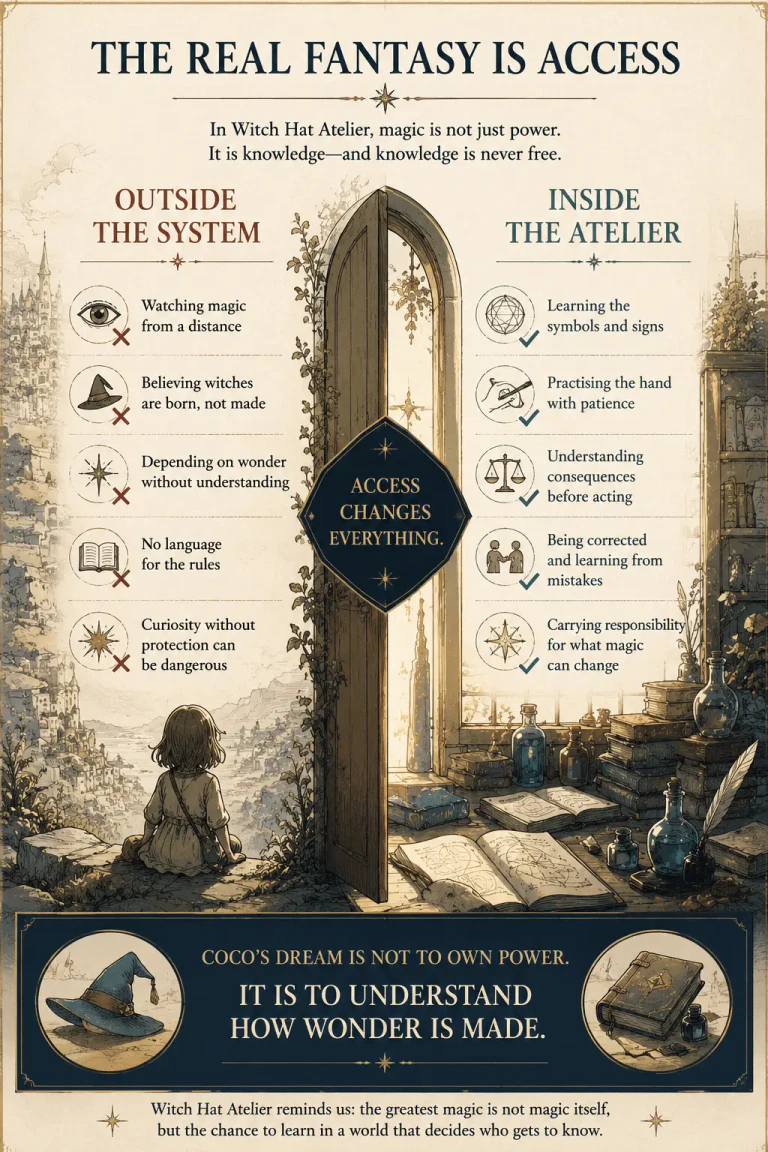
The real fantasy is not power, but access
Many fantasy stories promise that the powerless will become powerful.
Witch Hat Atelier promises something stranger: the excluded may learn the structure of the world that excluded them.
That is a deeper fantasy because it touches a more ordinary wound. Most people do not live with secret combat power waiting inside them. But many people know what it means to stand outside a room where knowledge is being used fluently. They know what it means to lack the vocabulary, the training, the credentials, the family background, the money, the confidence or the permission to enter.
Coco’s dream is magical because it is also social.
She does not only want to cast spells. She wants to cross the boundary between spectator and participant. She wants to stop being someone who receives wonder and become someone who understands how wonder is made.
That shift matters. Consumption becomes practice. Admiration becomes discipline. Desire becomes responsibility.
This is why Witch Hat Atelier can speak to viewers who are not usually invested in magic systems. Its power system is not the point. Its learning system is.
The story understands that access to knowledge is never merely technical. It changes identity. It changes guilt. It changes the way someone sees every ordinary object around them. Once Coco learns that magic can be drawn, the world can never go back to being innocent.
The door opens, but not into safety.
A quieter kind of fantasy heroism
Coco is heroic not because she is strong, but because she remains willing to learn after learning hurts her.
That is a different emotional rhythm from the usual fantasy ascent. The standard hero becomes more confident as they gain power. Coco’s path is more fragile. Knowledge gives her agency, but also exposes her to consequences she cannot undo quickly. She is not climbing toward domination. She is trying to become worthy of a practice that has already wounded her life.
This makes Witch Hat Atelier unusually patient with shame.
Shame is rarely treated well in fantasy. It is often converted into rage, revenge or motivation. Here, shame is slower. It lingers around the act of learning. Coco wants magic, but magic is also the site of her trauma. She cannot simply reject it, because it remains the only path toward repair. She cannot embrace it naively, because she has already seen what misuse can do.
That emotional contradiction gives the anime its pulse.
Wonder and guilt are not opposites here. They grow from the same event.
This is why the series can be beautiful without becoming escapist in the shallow sense. It does not let beauty erase damage. It lets beauty become the reason someone keeps moving through damage.
Why Witch Hat Atelier matters now
The timing of the anime matters because fantasy has become crowded with systems.
Modern audiences are fluent in power scaling, class mechanics, magic rankings, hidden abilities and worldbuilding taxonomies. Many fantasy stories now explain themselves like games, even when they are not games. That can be fun, but it can also flatten mystery. The viewer understands the rules too quickly and begins to watch the system instead of the people.
Witch Hat Atelier offers a different pleasure.
Its system is clear enough to feel real, but tactile enough to remain mysterious. It is not vague magic. It is not mechanical magic either. It sits in the space between instruction and wonder.
That balance is rare.
It also makes the anime feel connected to a wider cultural anxiety. We live in a time when tools become available before people understand their consequences. Image generators, code assistants, medical information, financial platforms, publishing tools, automation systems — the modern world constantly hands partial power to people who may not grasp the full system behind it.
Witch Hat Atelier is not “about AI” or modern technology in any direct sense. It does not need to be. Its fantasy already understands the older problem: knowledge becomes dangerous when access arrives without formation.
Coco’s story is therefore not only charming. It is structurally modern.
She wants to learn the hidden process behind visible miracles. That is a very contemporary desire.
Witch Hat Atelier should not be treated only as another beautiful fantasy anime
Beauty is part of its appeal, but not the whole argument.
The anime matters because it makes learning dramatic without turning it into a training montage. It makes knowledge desirable without pretending it is harmless. It makes magic systematic without killing wonder. It gives the viewer a world where the central question is not “who is strongest?” but “who is allowed to understand?”
That question gives the story its moral shape.
Coco’s journey is not a simple escape from ordinary life into magic. It is an entrance into a world where every line can carry responsibility. The fantasy is not that she becomes powerful. The fantasy is that she is finally allowed to learn — and then discovers that learning is heavier than dreaming.
That is why Witch Hat Atelier feels so human.
It knows that wonder is not destroyed by rules.
Sometimes wonder begins when the rules are finally visible.


