
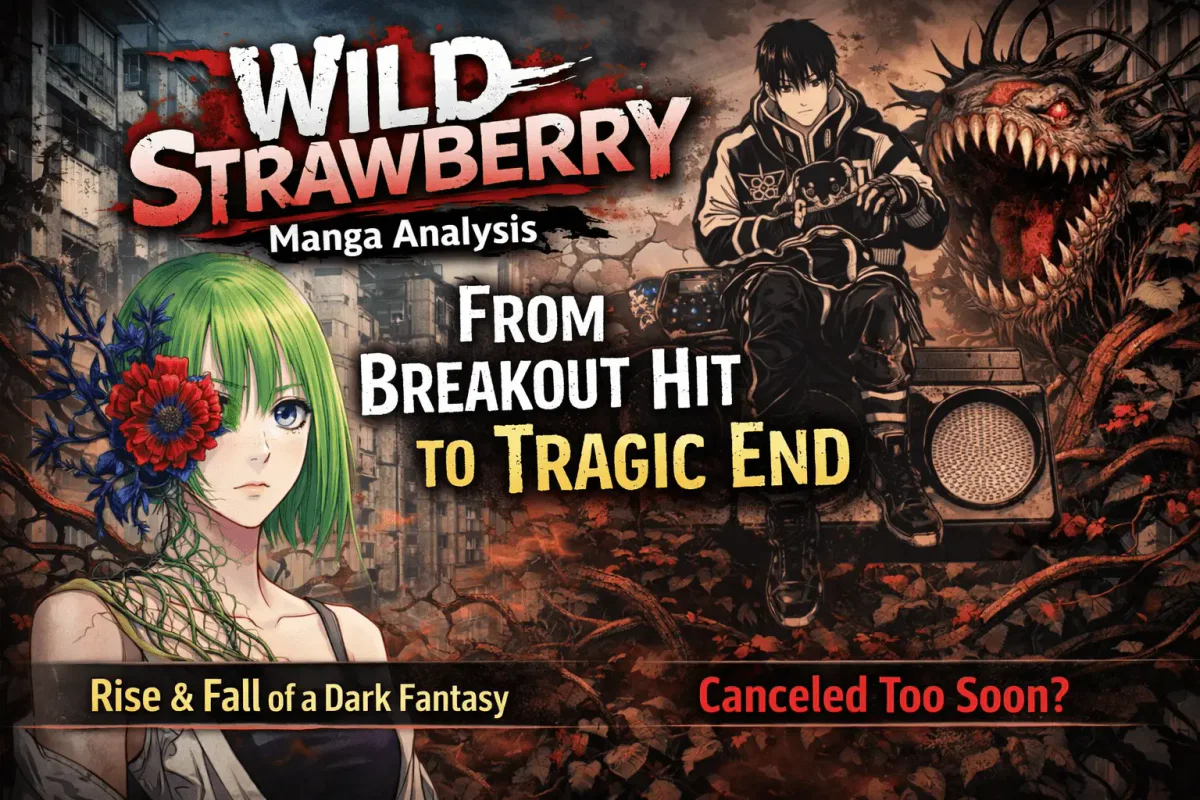
Key takeaways from the Wild Strawberry analysis
"Wild Strawberry" is a visually stunning but ultimately tragic tale of survival horror that fell victim to the ruthless publishing metrics of Shonen Jump. Blending visceral botanical body horror with deep psychological trauma, it serves as a fascinating case study of brilliant premises and forced narrative pivots:
- 1. The roots of the apocalypse & graphic brilliance The foundational premise flips reality: evolved plant life takes bloody revenge on a ruined Tokyo. Ire Yonemoto's staggeringly detailed artwork captures this claustrophobic "green hell" with absolute confidence. By utilizing visceral body horror and vibrant color contrasts, the manga brilliantly depicts the monstrous human-plant Jinka hybrids, creating an aesthetic that is sickeningly beautiful.
- 2. Deep psychological scars Anchoring the heavy, apocalyptic narrative are Kingo and Kayano, orphans bound by severe childhood trauma and a near-cannibalistic betrayal by their adoptive parents. Their intense codependency, coupled with Kingo's crushing survivor guilt, adds a painful psychological layer to their desperate scramble for food, shelter, and survival in a hostile world.
- 3. Echoes of modern pandemics The manga serves as a dark mirror to real-world anxieties, using the airborne botanical infection to explore themes of systemic inequality. Survival is heavily commodified, with life-saving vaccines restricted to the wealthy. This stark class divide breeds violent social distrust and highlights a broader ecological commentary where the Jinka act as the Earth's antibodies purging a parasitic humanity.
- 4. A sudden narrative shift & the Shonen Jump axe The series fatally pivoted from intimate survival horror to standard "battle shonen" tropes with the introduction of the Flower Funeral Force. Shifting the siblings' desperate struggle into a rigid military hierarchy diluted the manga's unique tension. This alienated readers and ultimately led to its swift cancellation due to the ruthless, metric-driven demands of the publishing giant.
- 5. A rushed finale and lingering legacy Forced to compress its narrative, the story concluded with sudden power-ups, massive lore dumps intended for longer arcs, and a jarringly fluffy time-skip. Despite the wasted potential of its supporting cast and protagonist, Wild Strawberry remains a visually iconic, albeit tragic, cautionary tale of artistic ambition crushed by rigid demographic expectations.
The world of Japanese comics is ruthless. Brilliant ideas die weekly. Within this fierce arena, Wild Strawberry manga emerged as a visceral anomaly. It erupted. It demanded attention. The series dared to invert the natural order with terrifying elegance. However, the tragedy of this story lies in its premature death.
It hurts to see a masterpiece cut down before it can bloom. Serialized on the Shōnen Jump+ platform, the series launched in July 2023. Fans recognized the undeniable potential of this dark fantasy series. Yet, the story was abruptly canceled in August 2025. This rapid rise and fall provides a fascinating case study. We are forced to examine the clash between artistic ambition and brutal commercial reality.
The roots of the apocalypse
The foundational premise flips reality with horrifying precision. For millennia, humanity harvested the botanical world. We conquered nature. Now, evolved plant life has finally taken its bloody revenge. A relentless overgrowth has swallowed Tokyo entirely. The city we know is gone. Plants no longer rely on sunlight. They crave meat.
At the epicenter of this nightmare are the Jinka. These horrifying human-plant hybrids are the result of a terrifying parasitic infection. The organism spreads silently through airborne pollen. It infiltrates the human body and waits. Then, violently, it blooms. The transformation morphs the host into a ravenous monster.
Surviving in this green hell is nearly impossible. The story anchors its massive apocalyptic scope on the fragile shoulders of two orphans. Kingo and Kayano are just kids. Their existence in post-apocalyptic Tokyo is a desperate scramble for food and shelter. Kingo's entire universe is simply keeping his sister alive.
Everything changes during one chaotic encounter. Kayano is infected. The nightmare should have ended there. Instead, she becomes a unique human Jinka hybrid. She retains her mind but gains parasitic abilities. In a moment of desperation, she uses these powers to heal Kingo's fatal gunshot wound. Their fates become biologically linked.
Detailed graphic brilliance
If one aspect commands absolute respect, it is the artwork. The visual execution is staggering. Every single panel drips with dense manga detailing. Ire Yonemoto wields the pen with the confidence of a veteran. The environments are claustrophobic and suffocating. You can almost smell the rot. Crumbling concrete is choked by overgrown roots.
The mastery of body horror here is profoundly unsettling. When a Jinka blooms, the artist does not shy away from the gore. Vines tear through muscle. Delicate petals sprout from shattered bones. This specific body horror aesthetic captures a tragic duality. The victims are horrific monsters, but also tragic hosts. It is sickeningly beautiful.
Color plays a vital, shocking role in establishing this atmosphere. In a medium defined by black and white ink, the series frequently utilizes vibrant colored panels. These sudden bursts highlight the unnatural beauty of the floral threat. A pristine white strawberry flower becomes an omen of death. The dark greens make the red blood pop off the page.
The combat choreography further elevates the visual experience. Fights are wildly organic. Weapons consist of whip-like vines and crushing branches. Kingo fights with unrefined, desperate brutality. The art captures the heavy weight of these impacts. The sheer density of the line work is undeniably impressive.
Deep psychological scars
Beneath the flashy battles lies a painful exploration of the human mind. The narrative is heavily anchored by severe childhood trauma. Kingo and Kayano are products of the Nozomi-en Orphanage. They lack the safety nets of a traditional family. This intense codependency is a desperate survival mechanism forged in systemic neglect.
Their trauma is violently compounded by the adults entrusted to care for them. The siblings believed they found salvation when a wealthy couple adopted them. This sanctuary was an illusion. In a gut-wrenching twist, the children overheard their new parents plotting. The couple planned to eat them. This realization of planned cannibalism shatters their trust forever.
The physical manifestation of this trauma is linked to Kayano's monstrous powers. It was during this attempted cannibalism that her latent Jinka abilities first bloomed. She slaughtered their abusers to save her brother. Her monstrous form is both a curse and a protective shield.
This dynamic creates an agonizingly painful sibling relationship. Kingo is utterly consumed by his need to protect Kayano. He is driven by deep survivor guilt. He views her sacrifice as a massive debt he can never repay. This psychological burden pushes him toward self-destructive actions.
Echoes of modern pandemics
One compelling layer is the sharp socio-political commentary. The setting acts as a dark mirror to the COVID-19 pandemic. The sudden spread of deadly spores mimics the terror of an airborne virus. Citizens walk the ruined streets in constant fear. Anyone could become a lethal vector. It captures our collective anxiety.
The narrative refuses to shy away from exposing cruel inequalities. In this broken Tokyo, an effective vaccine was actually developed quickly. However, survival is commodified. These life-saving vaccines are restrictively expensive. Poverty is often a death sentence. The poorer districts are abandoned to the infection.
This stark class divide breeds violent social distrust. Those living in impoverished zones view the government with bitter resentment. The elites view the lower classes as diseased liabilities. The presence of harsh government repression further exacerbates this divide. Marginals are sacrificed to maintain the safety of the privileged.
The story drops fascinating hints about broader ecological concerns. Kingo strongly speculates that global climate change played a significant role. Humanity's relentless exploitation pushed nature to a breaking point. The Jinka are the earth’s antibodies. They are attempting to violently purge a parasitic human presence.
A sudden narrative shift
Despite its strong premise, the trajectory underwent a massive shift. The early chapters thrived on claustrophobic survival horror. But then, the narrative pivoted toward traditional battle shonen elements. To save his sister, Kingo is forced to join the Flower Funeral Force. Suddenly, everything changes.
The desperate struggle of two siblings is absorbed into a rigid organizational hierarchy. This transition introduced the controversial 7th Squad arc. Kingo must prove his worth alongside other fresh recruits. The plot rapidly morphed into a sequence of standard training exams. For many readers, this completely stripped away the unique tension.
The introduction of the Flower Funeral Force fundamentally altered the tone. Critics argued that shoehorning the protagonist into a generic monster-hunting organization made the story predictable. It drew immediate comparisons to highly successful contemporaries. The unique identity of the manga began to heavily dilute.
| Narrative Phase | Core Focus | Key Characters Involved |
| Flower Funeral Force Arc | Introduction to the plant takeover and the harsh survival mechanics. | Kingo, Kayano |
| 7th Squad Arc | Kingo joins the military force to gain access to Mother Jinka. | Kingo, Kayano, Makoto, Cadet Ayari |
| Joint Mission Arc | Collaborative tactical operations within the rigid military structure. | 7th Squad members |
| Test Prison Arc | Formal evaluations, combat trials, and power scaling for the cadets. | Various Recruits |
This shift also impacted the pacing of character interactions. The new military squad dynamics required introducing a large cast in a short time. The narrative struggled to balance these additions with the core relationship. Readers felt disconnected from the stereotypical squad mates. The world got bigger, but the stakes felt smaller.
The Shonen Jump axe
The consequences of this narrative shift became brutally apparent. Despite a passionate niche following, the series failed to secure a massive readership. The dreaded Shonen Jump axe fell swiftly. Readers noticed the pacing accelerating unnaturally. Storylines that required dozens of chapters to breathe were violently compressed.
The realization that the end was near permeated the community. Yonemoto openly mentioned the climax in author comments, confirming readers' worst fears. The final chapters were a dizzying blur. The sudden narrative compression resulted in bizarre pacing choices. What was meant to be an epic confrontation devolved into a desperate sprint.
| Volume | Original Release Date | North American Release |
| Volume 1 | November 2, 2023 | November 26, 2024 |
| Volume 2 | February 2, 2024 | February 25, 2025 |
| Volume 3 | June 4, 2024 | TBD |
| Volume 4 | October 4, 2024 | TBD |
| Volume 5 | February 4, 2025 | TBD |
| Volume 6 | June 4, 2025 | TBD |
| Volume 7 | September 4, 2025 | TBD |
The cancellation sparked angry debate regarding industry metrics. Fans lamented that a story with such incredible visual artistry was not given time to correct missteps. The bi-weekly release schedule offered more breathing room, but domestic sales were painfully poor. The ruthless efficiency of the publishing giant prioritized immediate popularity.
Right as the series was dying, promotional efforts spiked internationally. Bizarre collaborations and a French art exhibition featuring manga history confused the fanbase. The creator interacted heavily with overseas distributors. However, these international overtures could not overcome low domestic engagement. The fate of the manga was sealed.
The rushed finale
The fallout of this cancellation is evident in the final chapters. Chapter 50 served as the definitive end, but the landing was bumpy. The author relied heavily on sudden power-ups. Kingo managed to turn the tide through a sheer, unexplained surge of strength. These deus ex machina moments frustrated dedicated readers.
Even more jarring were the massive plot revelations dumped in the final pages. Kingo suddenly regained lost memories, revealing he spent his early life in a laboratory. It was abruptly revealed that Kayano was a descendant of the very first Jinka. These massive lore dumps were clearly intended for a longer narrative arc.
The tonal shift of the finale was whiplash-inducing. Following the defeat of the final threat, the story violently jumps forward with a six-month time skip. Kayano remembers a promise and runs to a family restaurant. There, she finds Kingo miraculously alive with no major injuries. This fluffy reunion felt profoundly out of place.
Despite the frustration, a small segment found some solace. The author managed to provide a definitive end rather than leaving the plot hanging. The miraculous survival of the beloved sibling duo offered a shred of comfort. Yet, the overarching sentiment remained one of lingering disappointment.
Assessing Kingo as a lead
A significant criticism leveled against the series was the protagonist's characterization. For the first few dozen chapters, Kingo was widely considered a bland main character. His entire personality distilled down to a singular motivation: protecting his sister. This made him feel incredibly flat compared to complex modern protagonists.
This lack of depth placed a heavy burden on the surrounding elements. Because Kingo was a blank slate, the tension relied entirely on the desperation of the setting. The horrifying world-building had to carry all the emotional weight. As the story progressed, his lack of a dynamic personality became a glaring issue.
We must ask why he was written this way. Perhaps his emotional blunting was a symptom of severe trauma. But the text rarely explored this deeply enough. When confronted with complex moral dilemmas, he rarely offered profound insight. He simply swung his weapon. This made it incredibly difficult for readers to passionately root for him.
The tragedy is that seeds for character evolution were planted but never watered. The late-game reveals could have altered his worldview. Exploring his deep trauma regarding his true origins could have transformed him into a compelling figure. Unfortunately, the accelerated narrative pacing ensured this never occurred.
Wasted supporting cast
The antagonists and supporting characters occasionally sparked brilliant intrigue. The author had a talent for designing visually striking side characters. The introduction of a mole within the organization hinted at deep conspiracies. Readers wanted to see the corrupt human elements that matched the botanical horrors.
This intrigue peaked with the shocking betrayal by the director of Showa whole milk. This twist offered an exciting glimpse into human corruption. It suggested the monsters outside were nothing compared to those running the city. Yet, these characters were permanently removed from the narrative before being fully explored. We blinked, and potentially fascinating, multi-layered villains were defeated.
The recruits of the 7th squad suffered a similar fate. Characters like Cadet Ayari and Makoto were introduced with specific quirks. They were supposed to act as Kingo's found family. Because Shueisha publication metrics demanded a rapid conclusion, their arcs were entirely truncated. We watched them fight, but never learned why.
One of the most vocal complaints was the treatment of these new additions. Fans actively disliked the aggressive squad mates. They stole precious page time from the main plot, only to amount to nothing in the finale. Expanding a cast without adequate time actively destroys narrative cohesion.
Comparisons to the genre
To understand the failure of this work, we must place it within its genre. The dark fantasy space is incredibly crowded. Fans look for underrated horror titles that offer something genuinely new. Wild Strawberry initially promised to sit alongside brilliant psychological masterpieces. It had the visual chops to compete.
The most frequent comparisons were drawn to Chainsaw Man and Tokyo Ghoul. The similarities are undeniably glaring. A young boy merges with a monstrous entity under the control of a shadowy organization. The plant-based power system felt like a botanical reskin of familiar powers. The execution simply faltered.
Where the series truly shined was in its specific brand of eeriness. Unlike purely shock-value gore, the horror here felt organically uncomfortable. It tapped into paranormal mystery elements where the environment itself feels hostile. The idea that a beautiful garden could devour you is a primal fear.
The tragic reality is that the manga industry rarely rewards slow-burn world-building from debut artists. The series tried to balance deep psychological thriller pacing with explosive action. The resulting friction tore the narrative apart. Even the most visually stunning ideas cannot survive rigid demographic expectations.
The legacy of the series
In evaluating the final work, one must separate the brilliant conceptual framework from the flawed execution. The series will be remembered as a fascinating misfire. It is a story bursting with potential that buckled under industry demands. It stands as a cautionary tale of a unique survival premise forced into a generic template.
The visual legacy is absolutely unassailable. The artist's ability to render beautiful biological horrors ensures that panels will circulate online for years. The haunting imagery of strawberries blooming from torn human flesh is iconic. Ire Yonemoto firmly establishes herself as a visual manga powerhouse.
We must also acknowledge the intense passion of the fan base. The international community rallied around the series. Fans grieved its sudden passing. People are still discussing the rushed ending months later. This proves the initial story hook resonated deeply with its audience.
Ultimately, the story of Kingo and Kayano serves as a poignant exploration of trauma and familial love. The terrifying vision of an ecological revenge scenario offered a brilliant flash of storytelling genius. This botanical horror masterpiece bloomed too quickly and withered entirely too fast, but the vibrant colors of its petals will not be easily forgotten.


