

Key takeaways from the Tsukimichi franchise analysis
The "Tsukimichi: Moonlit Fantasy" ecosystem is suffering from a severe structural bottleneck. Despite massive global popularity, conflicting production schedules, corporate isolationism, and drastic narrative pacing issues have severely fractured the fan experience:
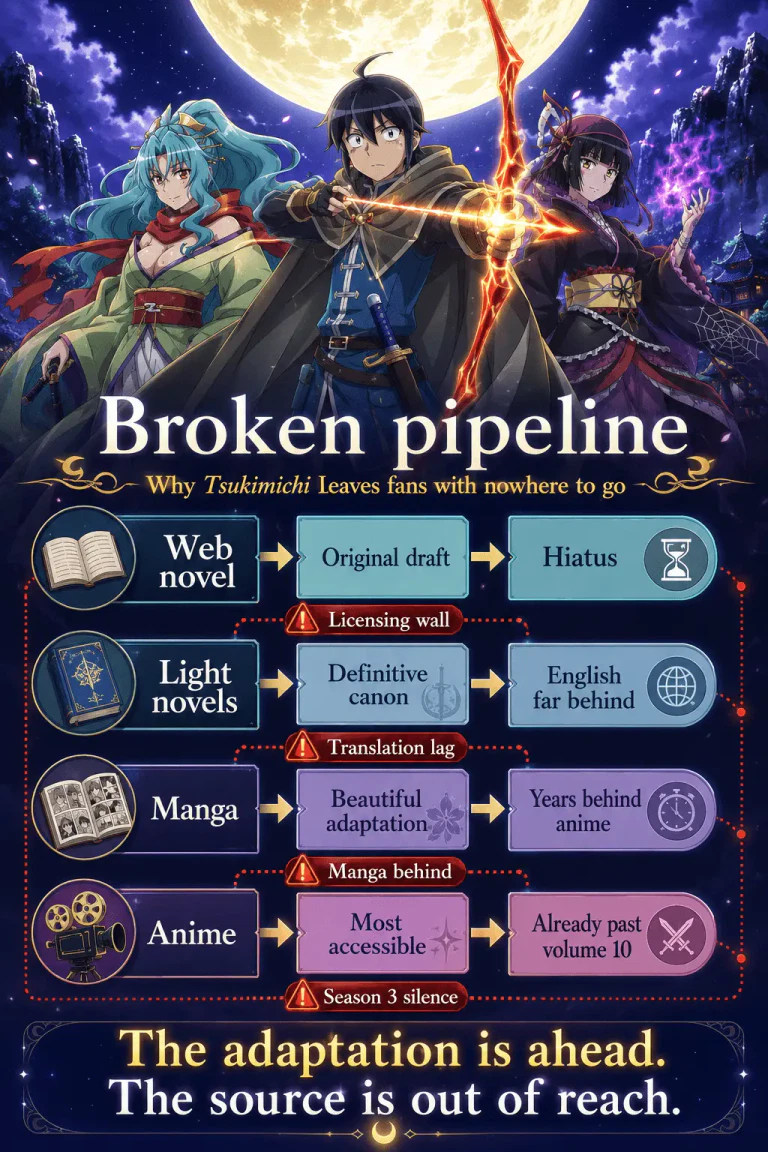
- 1. The licensing and translation gridlock AlphaPolis’s refusal to license the definitive light novels globally for a decade stranded international fans. While Hanashi Media finally acquired the rights, their slow, digital-only release schedule—projected to reach only Volume 7 by April 2026—mathematically guarantees English readers will remain years behind the anime's current storyline (which has passed Volume 10).
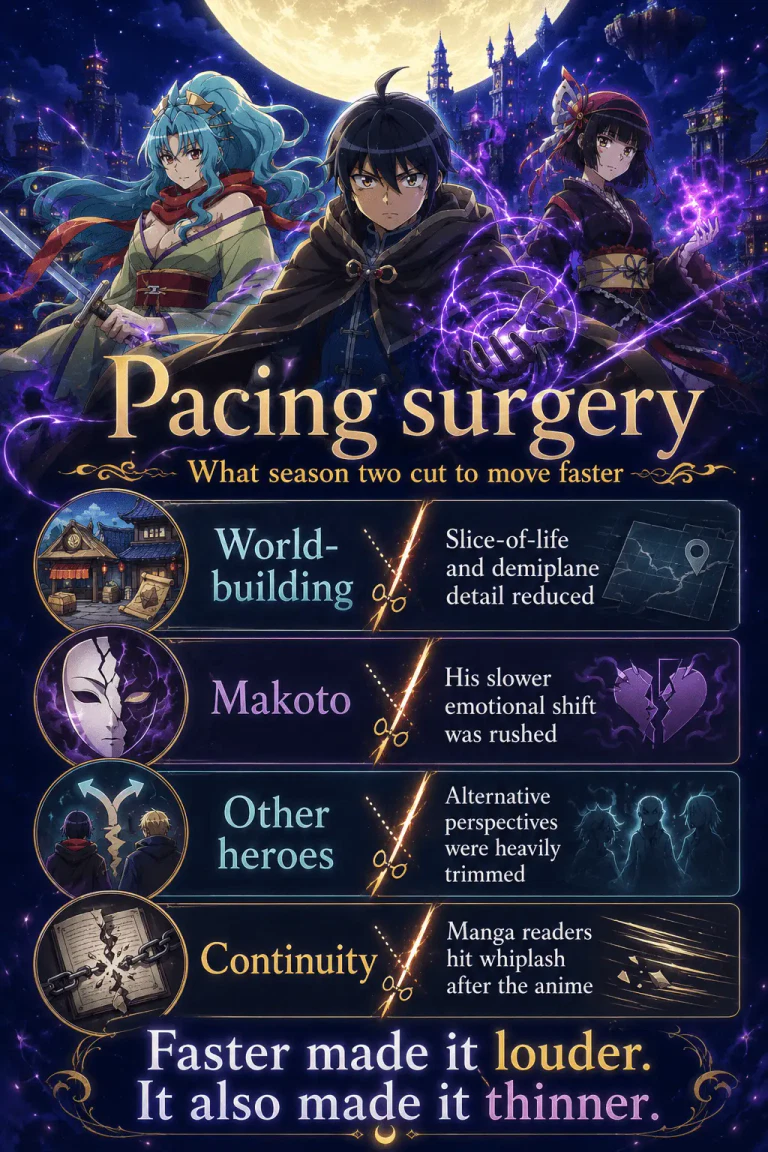
- 2. Destructive anime pacing and structural surgery To compress massive arcs into Season 2, J.C. Staff ruthlessly excised the story's core slice-of-life world-building, the protagonist's gradual psychological decay, and crucial alternative hero perspectives. This transformed a nuanced dark fantasy into a rushed action shōnen, causing severe continuity whiplash for viewers trying to transition to the manga.
- 3. Total production stagnation across all mediums Despite dominating viewership charts (securing the 9th spot in Winter 2024 with a 7.95 MyAnimeList score), the franchise is completely stalled. Season 3 is trapped in agonizing radio silence due to industry overbooking, the manga is over four years behind the anime, and the original web novel has been abandoned on a three-year hiatus, leaving dedicated fans with a dead end.
The modern entertainment in Japan relies on a highly interconnected and predictable ecosystem of source materials and visual adaptations. Typically, an animated series serves as an elaborate commercial to drive viewers back to the original comics or novels. For the Tsukimichi franchise ecosystem, this traditional pipeline has entirely fractured under the crushing weight of conflicting production schedules and corporate isolationism. Fans are experiencing a bizarre phenomenon. The television adaptation has rapidly outpaced its comic counterpart, fundamentally breaking the consumer loop.
This structural bottleneck creates severe friction within the global fandom. When a seasonal broadcast finishes airing, viewers naturally look for the next available chapter to continue the story. However, the Tsukimichi adaptation strategy completely isolates these eager consumers. The comic adaptation is trapped years behind the television narrative, offering absolutely no new plot progression for television viewers. At the exact same time, the original written volumes remain largely inaccessible to international audiences due to regional licensing barriers and agonizingly slow translation schedules.
The resulting situation is deeply frustrating for dedicated followers. Consumers are essentially forced to choose between terrible options. They can wait several years for the comic to catch up, dive into poorly translated amateur drafts, or simply abandon the property altogether. This media consumption bottleneck significantly diminishes long-term fan interest, creating a hollow void where community engagement should theoretically be thriving. It is a textbook example of how poor logistical synergy can suffocate a brilliant fantasy narrative.
Source material origins
To understand this logistical nightmare, one must trace the property back to its humble beginnings on the internet. The narrative originated as an amateur web serial in 2012, published by the author Kei Azumi on the user-generated platform Shōsetsuka ni Narō. This platform is notorious for birthing massive hits. It allowed the author to experiment with a unique blend of economic simulation and dark fantasy without the pressures of editorial oversight. The original web novel quickly garnered a massive and highly dedicated readership, proving the viability of the core concept.
Recognizing the undeniable commercial potential, a publisher stepped in to formalize the property. AlphaPolis acquired the official rights and began publishing the story as a polished light novel series, featuring illustrations by Mitsuaki Matsumoto, in May 2013. This transition from an amateur web draft to a professional publication involved significant structural changes. Editors refined the pacing, expanded character motivations, and altered specific plot points to create a more cohesive commercial product. The official light novel became the definitive, canon version of the universe.
However, the existence of two separate written drafts creates immense confusion for the fanbase. The web serial is technically the original story, and it extends far further into the timeline. Yet, it lacks the polish and canonical adjustments of the published volumes. For instance, early encounters with major antagonists play out differently depending on the version. This narrative divergence forces hardcore fans to constantly cross-reference multiple mediums just to understand the true intentions of the author, adding an unnecessary layer of complexity to the reading experience.
The AlphaPolis barrier
While the written series thrived domestically in Japan, international audiences were left completely stranded. AlphaPolis is historically known for maintaining a fiercely protective stance over its intellectual properties. For over a decade, the company categorically refused to license the written volumes to western distributors. They built an impenetrable walled garden around their content. This domestic market isolationism meant that fans outside of Japan had absolutely no legal avenue to support the author or read the definitive version of the story in English.
This corporate strategy contrasts sharply with giants like Kadokawa or Kodansha, who aggressively push their titles into the global market. AlphaPolis viewed overseas licensing as a high-risk endeavor, preferring to push users toward their proprietary Japanese web portals. By locking the Tsukimichi source material away from the world, they inadvertently fueled a massive underground market of amateur translations and piracy. International fans had to rely on unreliable, machine-translated summaries just to keep up with the evolving plotline.
The company eventually made a half-hearted attempt to bridge this gap in 2021. They launched the Alpha Manga application for smartphones, aiming to distribute English comic chapters directly to consumers without utilizing third-party western publishers. While this provided a legal reading option, the app's microtransaction model and lack of physical print options alienated many traditional readers. The AlphaPolis business model continues to prioritize corporate control over consumer accessibility, heavily restricting the franchise's global footprint.
Hanashi Media timeline
The landscape finally shifted, albeit very late in the game, when a relatively small publisher managed to secure the localization rights. Hanashi Media announced their acquisition of the English publishing rights, launching the first official digital volume on March 30, 2024. This was a monumental victory for the starved community. Finally, a professional translation of the definitive text was legally available. However, this official English localization arrived far too late to capitalize on the massive explosion of popularity generated by the first television broadcast in 2021.
Furthermore, Hanashi Media's operational capacity is highly limited. They are currently focusing strictly on digital releases across platforms like Amazon Kindle, Apple Books, and Barnes & Noble. When desperate collectors asked about the possibility of physical paperback editions, community veterans quickly shut down the hope. The publisher is simply too small to manage the logistics of printing and distributing physical books. This digital only strategy isolates a significant portion of the manga and novel community who refuse to purchase digital goods.
The most glaring issue, however, is the terrifying mathematics of the release schedule. The publisher operates on a theoretical four-month cycle between volumes. By April 2026, they will have only reached Volume 7.
| Volume Number | Japanese Release | Projected English Release | Status (As of April 2026) |
| Volume 1 | May 2013 | March 2024 | Released |
| Volume 2 | October 2013 | July 2024 | Released |
| Volume 3 | February 2014 | November 2024 | Released |
| Volume 4 | June 2014 | March 2025 | Released |
| Volume 5 | October 2014 | July 2025 | Released |
| Volume 6 | February 2015 | November 2025 | Released |
| Volume 7 | June 2015 | March 2026 | Released |
| Volume 8 | October 2015 | July 2026 | Pending |
| Volume 10 | October 2016 | July 2027 | Pending |
| Volume 15 | October 2020 | April 2029 | Pending |
The television series has already adapted material well into Volume 10. Under the current projection, English readers will not see Volume 10 until July 2027. The Hanashi Media schedule mathematically guarantees that the English novels will remain completely useless for television viewers seeking new content for at least another two years.
Manga pacing struggles
With the novels largely inaccessible, the comic adaptation should theoretically serve as the perfect bridge. Kotora Kino launched the visual adaptation in 2015, capturing the intricate world-building with beautiful, detailed artwork. The comic successfully translates the complex economic and political maneuvering of the protagonist, Makoto Misumi, into an easily digestible format. However, the manga production speed is agonizingly slow, operating on a strictly monthly schedule that frequently suffers from unannounced breaks and delays.
Readers on community forums often express intense frustration over this glacial progression. One veteran reader noted that after taking a two-year hiatus from the comic, they returned to find that barely fifteen new chapters had been released. As of early 2026, the comic hovers around chapter 113 of the web draft timeline. The narrative is currently stuck in the middle of Makoto's relatively mundane visit to a temple to distribute medicine. This glacial visual adaptation pace makes it impossible for the comic to keep up with modern consumption habits.
The math surrounding the comic's future is genuinely depressing for fans. The second television broadcast ended its run by adapting material up to roughly chapter 164 of the web draft. The comic is at chapter 113. Adapting approximately one chapter per month, the comic needs over fifty months of uninterrupted releases just to reach the finale of the 2024 television season. The manga timeline deficit dictates that it will take over four years for the comic to simply catch up to what audiences have already watched.
Anime racing forward
The television adaptation fundamentally disrupted the established hierarchy of the mediums. Studio C2C took the helm for the inaugural season in 2021, under the direction of Shinji Ishihira, a veteran known for his work on Log Horizon. They established a highly brisk, entertaining pace that resonated incredibly well with global audiences. The first season concluded by adapting material up to roughly chapter 59 of the comic. The C2C studio pacing managed to strike a delicate balance, preserving enough world-building to keep purists happy while delivering high-octane action.
However, the production baton was unexpectedly passed to J.C. Staff for the highly anticipated second season, which aired a massive 25-episode run from January to June 2024. J.C. Staff faced a monumental task. They needed to cover the sprawling Rotsgard Academy arc and the subsequent explosive demonic war within a tight broadcast window. To achieve this, they accelerated the pacing to a breakneck speed, burning through massive chunks of the source material. The J.C. Staff acceleration completely decoupled the television timeline from the comic's gentle, slow-burn approach.
This rapid burn resulted in severe continuity whiplash for fans attempting to switch mediums. Viewers who finish the second season and jump into the comic are forced to read backward. They must consume dozens of chapters of content they already watched just to bridge the massive gap. The television series skipped over so much critical context and side-character development that the comic feels like an entirely different, much denser story. This source material discrepancy alienates casual viewers who lack the patience to reread altered content.
Slicing the narrative
The transition between animation studios brought a fundamental shift in directorial philosophy. At its core, the original text is essentially a slice-of-life narrative wearing the skin of a dark fantasy. The charm of the universe lies in its quiet moments. Fans deeply enjoy watching Makoto negotiate trade routes, establish his merchant guild, build infrastructure in the Demiplane, and manage the petty squabbles of his non-human followers. The original narrative identity heavily relies on these mundane, logistical details to ground the fantastical setting.
J.C. Staff's mandate for the second season required severe structural surgery. To fit the massive war arc into twenty-five episodes, they ruthlessly gutted the slice-of-life elements. Regular conversations between characters were reduced to brief exposition dumps. Minor events, like selling items in the store or exploring the cultural nuances of the Demiplane residents, were completely excised. The television editorial cuts transformed the property from a nuanced world-building exercise into a standard, fast-paced action shōnen.
Some viewers actively noticed and despised this thematic shift. A vocal contingent on Reddit expressed severe disappointment with the second season's direction, arguing that the pacing was horrible despite the lack of constant action. They felt the useless banter inserted between rushed fight scenes served merely to stretch the animation budget, rather than build character depth. The rushed narrative climax failed to deliver the emotional payoff established by the world-building, leaving many long-time supporters feeling betrayed by the studio's choices.
Makoto character shift
The decision to excise the quiet moments of introspection directly damaged the protagonist's character arc. In the source text, Makoto Misumi's journey is a slow, chilling progression. He begins as a normal, empathetic high school student. Through repeated trauma, betrayal by humans, and the crushing burden of managing absolute power, his moral compass steadily degrades. The comic meticulously documents this psychological shift, showing his internal hesitation slowly being replaced by cold, calculated pragmatism over dozens of chapters. This protagonist psychological decay is the emotional crux of the story.
Because the television adaptation cut the internal monologues and the gradual psychological wear-and-tear, Makoto's personality changes felt entirely erratic and unearned. Viewers complained that he suddenly acted cold and sociopathic during the tournament arc, letting innocent students die without a second thought. In one episode he is a bumbling, friendly merchant; in the next, he is a ruthless killer making sarcastic remarks. The animated character inconsistency actively harmed the audience's connection to the lead, making him hard to root for.
Fans specifically highlighted the jarring nature of his power scaling. During the climax of the second season, Makoto easily overpowers massive threats like Lancer and Sofia without even removing his power-restricting rings. In the novels, the scaling and the effort required are explained with intricate detail. In the show, he simply appears vastly superior to his rivals without adequate narrative justification. The rushed power dynamics make the conflicts feel strategically shallow, robbing the villains of their imposing aura and reducing the tension to zero.
The hero perspectives
The structural surgery performed by the animation studio also severely impacted the supporting cast. The universe features two other summoned heroes, Hibiki and Tomoki. Their respective struggles, moral failings, and differing philosophies are absolutely crucial for contextualizing Makoto's own descent into darkness. They serve as dark mirrors, showing what happens when typical heroic archetypes are granted unchecked power in a brutal world. The dual hero narrative provides essential world-building from the perspective of the human empires.
The television adaptation slashed their screen time drastically. Entire arcs and dedicated episodes focusing on their perspectives were heavily truncated or entirely omitted. By reducing the other heroes to mere cameos, the show isolated Makoto's narrative, making the world feel significantly smaller and less politically complex. Important character flaws, such as Hibiki's deep-seated racism against demons and demi-humans, were glossed over, softening the narrative's edge. The supporting cast reduction sanitizes the harsh realities of the fantasy world.
This omission also breaks future plot setups. The comic and novels spend immense time detailing the political maneuverings of the Gritonia Empire and the Limia Kingdom through the eyes of these heroes. Without this context, future conflicts will lack emotional weight. Viewers will not understand the ideological differences driving the war, reducing massive geopolitical struggles to simple "good versus evil" battles. The omitted political context is a ticking time bomb that will severely handicap the storytelling potential of any future animated seasons.
Translation hurdles
The global reach of any Japanese intellectual property heavily relies on the quality of its localization. For years, the international community suffered under terrible machine translations and amateur editing. The first fifty chapters of the web draft are infamous for being nearly unreadable due to stilted grammar, lost context, and literal translations of complex idioms. This creates a massive bounce rate. If the initial reading experience is a headache, consumers simply abandon the franchise entirely rather than fight through the text.
A dedicated fan translator known as Reigokai eventually took over the project, and the community widely agrees that the prose improves drastically under their stewardship, specifically after chapter 100. However, getting to that point requires immense patience. When Hanashi Media finally released the official translation, expectations were sky-high. Unfortunately, some fans still harbored complaints about specific localization choices. The official translation controversies centered around the integration of modern internet slang into a fantasy setting.
For instance, translating a serious death threat into the phrase "go unlive yourself" sparked intense backlash on community forums. Readers felt this specific choice was an awful attempt to censor the text or pander to modern sensibilities, ultimately sounding stupid and breaking immersion. While the overall accuracy of the official release is praised, these minor localization immersion breaks highlight the incredible difficulty of translating nuanced Japanese light novels for a highly critical western audience.
Fandom engagement stats
Despite the pacing controversies, translation drama, and missing context, the franchise remains an undeniable commercial juggernaut. Fan interest is far from dead; it is merely highly localized around the broadcast windows. During its run in early 2024, the second season consistently dominated viewership charts. It ranked in the top five on all Japanese streaming platforms, proving its massive domestic appeal. The domestic streaming dominance confirms that the core premise of a rejected, overpowered merchant still resonates strongly with the general public.
The international metrics are equally impressive. For several weeks toward its finale, it actually surpassed the globally hyped Solo Leveling as the most-watched property on Crunchyroll. Furthermore, MyAnimeList data corroborates this success. The second season secured the 9th spot for the most popular anime of the Winter 2024 season, boasting a highly respectable aggregate score of 7.95, beating out legacy franchises.
| Ranking | Anime Title | MyAnimeList Score (Winter 2024) |
| 1 | The Dangers in My Heart Season 2 | 8.92 |
| 2 | Kingdom Season 5 | 8.78 |
| 3 | Solo Leveling | 8.37 |
| 8 | Mashle: Magic and Muscles | 7.95 |
| 9 | Tsukimichi: Moonlit Fantasy Season 2 | 7.95 |
| 10 | Urusei Yatsura (2022) | 7.76 |
Interestingly, the show also secured a spot as one of the top seven most pirated series of 2024. High piracy rates indicate a massive shadow audience that official global viewership metrics fail to capture fully. The numbers prove that the audience is there, hungry for the content.
Season three in limbo
The high engagement numbers guaranteed a continuation. Immediately following the conclusion of the second season on June 24, 2024, the official production committee announced a third season. A festive visual featuring Makoto and his followers was blasted across social media with the tagline "Third Act confirmed". This immediate greenlight signaled strong financial confidence from the studio and the overarching production committee. Fans naturally expected a relatively short turnaround. Instead, they got absolute, agonizing production radio silence.
Throughout the entirety of 2025, not a single piece of promotional material, staff update, or trailer was released. As the calendar rolled into April 2026, the community began to panic. The gap between the first and second seasons was roughly two and a half years. If the studio maintains that trajectory, the earliest possible release window for the third act would be late 2026 or early 2027. The complete lack of studio communication strategy leaves viewers guessing and breeds a toxic environment of rumors and apathy.
Industry insiders note that studios are currently facing unprecedented bottlenecks. Projects are routinely announced years before a single frame is drawn just to secure funding and block out scheduling slots. J.C. Staff is notoriously overbooked, juggling massive properties like One Punch Man and DanMachi simultaneously. Fans fear that the third season has been pushed to the back burner while the studio focuses on higher-priority intellectual property. This anime industry overbooking exacerbates the feeling of abandonment within the community.
Web novel stagnation
For fans who refuse to wait for the animation studio or the official translation, the web draft is the final frontier. It is the absolute rawest, furthest advanced version of the timeline. However, even this avenue is currently blocked. The author, Kei Azumi, is notoriously inconsistent with their online update schedule. The web draft has experienced multiple massive hiatuses over its lifespan. At one point, the story went completely dark for over a year without any communication from the creator, only to return randomly. The author communication vacuum is a running joke among veteran readers.
As of early 2026, the web draft has been stagnant for an agonizing three years. Fans speculate that the author is focusing entirely on the commercial light novel releases, abandoning the free web platform entirely. This leaves dedicated web readers completely stranded. They are reading a dead-end draft of a story that continues to evolve exclusively in a medium they cannot legally purchase in their native language. The web novel hiatus effectively kills the last remaining lifeline for hardcore international fans seeking new plot developments.
This stagnation creates a bizarre dynamic where the most knowledgeable members of the fandom have nothing new to discuss. Instead of theorizing about upcoming arcs, Reddit threads devolve into repetitive complaints about the lack of content. The community is trapped in a holding pattern. The very foundation of the franchise, the raw text that started it all, has seemingly been discarded in favor of commercial packaging. The abandoned foundational text represents a massive betrayal of the early adopters who championed the series back in 2012.
Artistic compromises
While the written formats struggle with pacing and translation, the visual comic never compromises on artistic integrity. Kotora Kino has spent nearly a decade refining the visual language of the series. The character designs in the comic are significantly more expressive and detailed than their animated counterparts. The artist excels at depicting the subtle, chilling shifts in Makoto's demeanor, using heavy shading and distinct paneling to convey his growing emotional detachment. This manga artistic consistency communicates volumes of psychological information without relying on heavy exposition or dialogue.
The comic also handles the varied fantasy races with immense care and respect. From the Highland Orcs to the Mist Lizards, each faction in the Demiplane is given distinct cultural markers, clothing, architecture, and body language. The television adaptation, constrained by strict time limits and animation budgets, often reduces these visual details to generic fantasy background assets. The comic takes the time to explore the infrastructure of Makoto's society. The detailed environmental design makes the Demiplane feel like a living, breathing ecosystem rather than a static stage play.
Unfortunately, this meticulous attention to detail is exactly what causes the monthly delays. Drawing intricate backgrounds, complex armor designs, and sprawling crowd scenes takes immense time. The artist refuses to cut corners, resulting in a superior product that arrives far too slowly to satisfy modern binge-consumption habits. The fandom is trapped in a painful paradox: they demand the high quality of the comic, but they loathe the visual production delays required to achieve it. It is a compromise that leaves everyone slightly dissatisfied, despite the undeniable beauty of the final product.
Visualizing the world
The discrepancy between the comic's intricate detail and the animation's streamlined approach is most evident during the action sequences. In the source material, magical combat is highly technical. Makoto's unique method of expanding his mana pool, the specific mechanics of his archery, and the physical toll of his abilities are thoroughly explained. The comic visualizes these complex magical systems with crisp, easily understandable diagrams and visual metaphors. The visualized magical mechanics add a layer of hard fantasy logic to an otherwise overpowered protagonist.
The animation studio, specifically during the second season, often opted for flashy explosions over technical accuracy. Battles that required strategic maneuvering in the text were reduced to simple beam struggles on screen. While visually spectacular, this approach sacrifices the intellectual appeal of the combat system. Fans noted that Makoto's power scaling felt unearned precisely because the animation failed to visualize the intricate mechanics behind his spells. The simplified animated combat trades narrative depth for immediate visual gratification.
This simplification also extends to the bizarre aesthetic choices introduced by the author. A prime example is the ability of a female hero to transform her wolf companion into a literal bikini. In the text, this absurdity is contextualized by the aesthetic obsessions of the bug goddess who granted the power. On screen, without that context, it feels incredibly random and unneeded, prompting intense "WTF" reactions from viewers. The bizarre aesthetic context is completely lost in translation, making the universe feel disjointed and confusing to casual observers.
Community frustrations
The culmination of all these logistical failures is a highly vocal, incredibly frustrated community. Online forums like Reddit serve as an echo chamber for these grievances. Threads titled "2025 is almost over..." and "Still No Release Date for Tsukimichi S3 in 2026" dominate the discussion boards. Users lament the fact that an entire year passed without a single new web chapter, without a new English volume, and without any news regarding the television broadcast. The fandom echo chamber amplifies the collective feeling of abandonment.
Veterans of the community constantly find themselves having to explain the massive discrepancies between the mediums to confused newcomers. When a viewer asks where to start reading after the second season, the standard response is a disheartening "start from the beginning". Explaining that the comic is years behind, the official translation is years away, and the free draft is unreadable or abandoned is a depressing initiation ritual. The community onboarding friction prevents the fandom from growing organically during the broadcast downtime.
Despite the negativity, there is a resilient undercurrent of passion. Fans still debate the morality of Makoto's actions, analyze the geopolitical landscape of the human empires, and eagerly await any scrap of news. They endure the terrible pacing and the corporate silence because the core narrative is genuinely unique. The concept of an ugly, discarded hero building a morally ambiguous merchant empire alongside a dragon and a spider remains an intoxicating premise. The enduring narrative passion proves that the property can survive almost any amount of logistical mismanagement.


