

Key takeaways from the Janice and Casshern Sins analysis
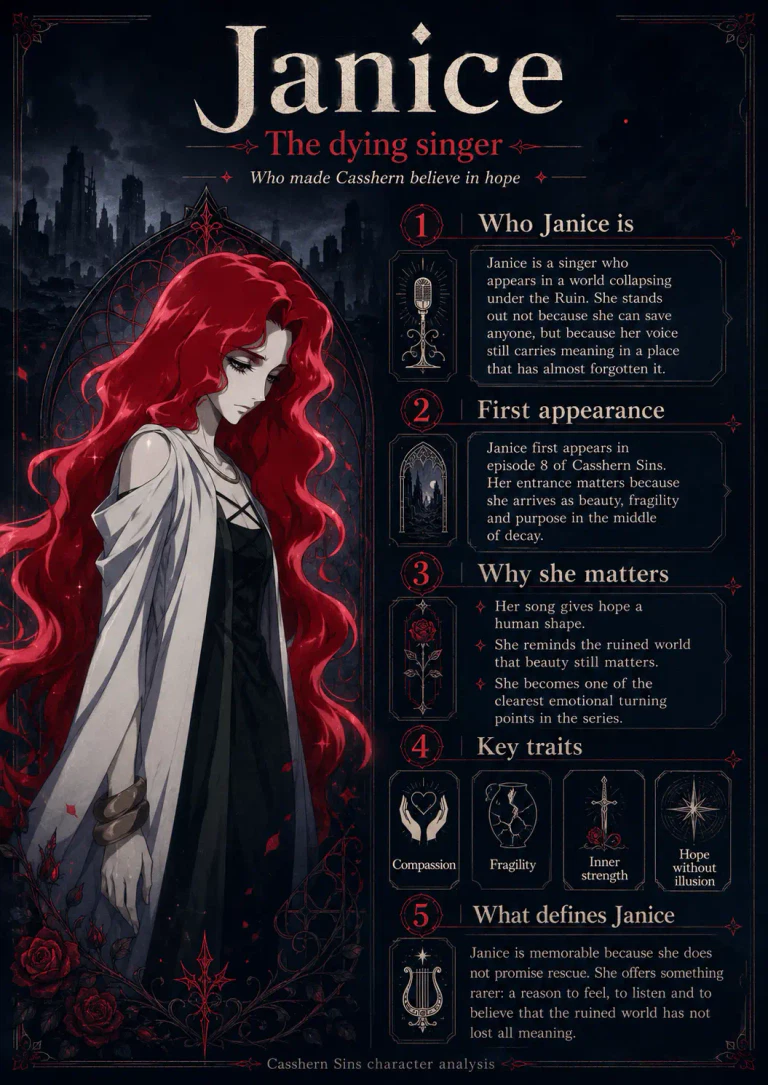
Janice does not bring hope to Casshern Sins because she can save the world. Her power is quieter and more painful: she sings inside a collapsing world, giving Casshern and the survivors a reason to protect one fragile moment from becoming meaningless:
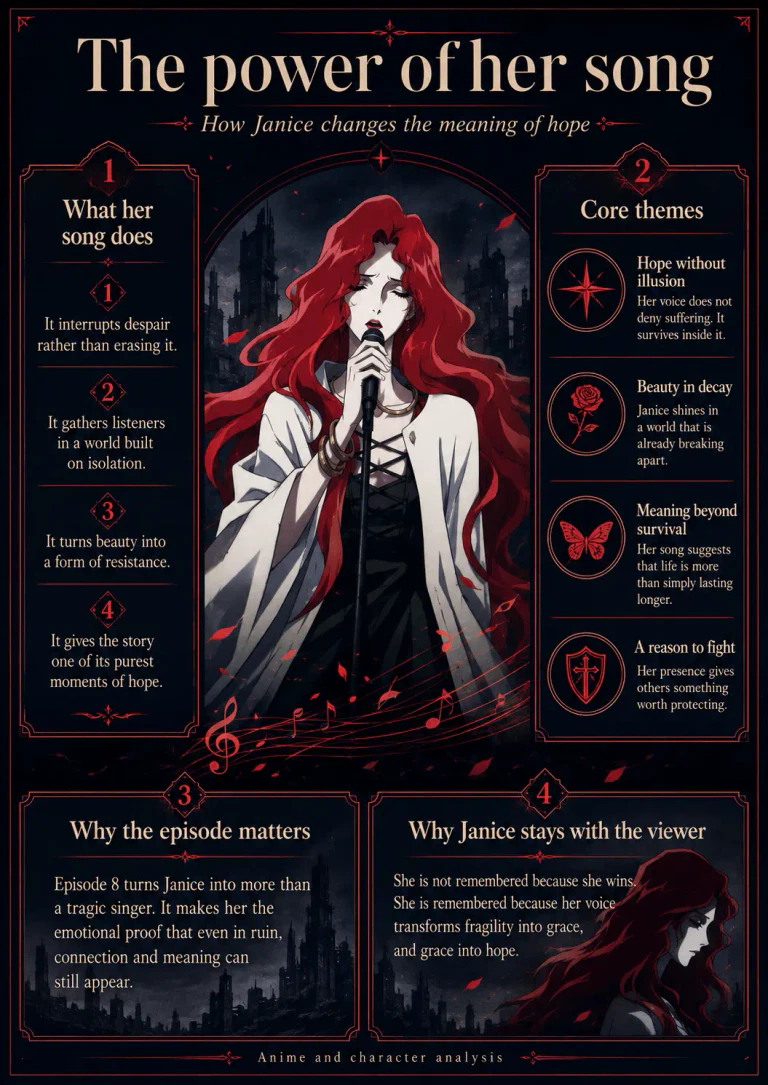
- 1. Janice represents hope without illusion Her song does not deny the Ruin, death or fear. It exists inside them. That is why Janice feels so powerful: she does not promise that everything will be saved, but she proves that beauty can still matter even when the world is already falling apart.
- 2. Her song gives Casshern something worth protecting Casshern’s violence changes meaning when it is used to defend Janice and her listeners. He is no longer only a cursed body, a weapon or a source of fear. For one brief moment, his strength protects a voice, a gathering and the fragile possibility of hope.
- 3. Janice matters because she is temporary Her role is not built around victory or survival. It is built around presence. Janice shows that a song, a performance and a shared moment can remain meaningful even if they cannot last. In Casshern Sins, that may be one of the purest forms of grace.
Casshern Sins is not the kind of anime that usually allows hope to enter the room cleanly.
Its world is poisoned, exhausted, and spiritually rusted. Robots fear death because they have learned that immortality was never guaranteed. Humans survive more like echoes than rulers of the earth. Casshern walks through this landscape as a living contradiction: the one blamed for the Ruin, the one others want to devour, the one whose body keeps healing while everyone else falls apart.
Then Janice appears.
Not as a warrior. Not as a prophet. Not as another figure chasing eternal life. She appears as a singer.
That sounds almost too delicate for a series this bleak. A song should not matter in a world where bodies corrode, cities collapse, and strangers kill each other for the rumor of survival. Yet episode 8, “A Hymn of Hope,” works precisely because Janice’s gift seems useless at first. She cannot stop the Ruin. She cannot cure the dying. She cannot rewrite Casshern’s past.
What she can do is stranger and, in some ways, more powerful.
She can make people gather.
She can make them listen.
She can make Casshern protect something that does not exist as a weapon, a cure, or an answer.
She can make hope feel dangerous again.
Janice enters as a contradiction
Janice is introduced as a robotic songstress moving through a world that no longer has much room for beauty. Her destination is not strategic. It is emotional. She wants to sing for those who have survived long enough to need something more than survival.
That distinction matters.
In many post-apocalyptic stories, hope is treated as a resource, almost like food, medicine, or ammunition. Characters need hope because it keeps them moving toward a concrete objective. In Casshern Sins, hope is more uncomfortable. The world may not be repairable. The Ruin may not be reversible. The promise of salvation has already been corrupted by fear, hunger, violence, and myth.
Janice does not enter this setting with a plan to fix it.
She enters with a song.
That makes her both fragile and threatening. Fragile, because music cannot shield her body from destruction. Threatening, because music can still do what violence cannot: it can interrupt despair before despair becomes the only logic left.
The robots who want her dead understand this better than anyone. They do not simply attack her because she is physically valuable. They attack what she represents. In a world ruled by decay, even a small act of shared hope becomes a rebellion.
Janice is not dangerous because she is strong.
She is dangerous because people still believe her voice is worth reaching.
Hope without comfort
The weakest version of Janice would be the simple one: a sweet singer who brings light into darkness.
But Casshern Sins is too severe for that.
Janice does not represent comfort. Her hope is not soft background music placed over suffering to make it easier to digest. Her presence makes the suffering sharper because it reminds everyone what has been lost: gathering, listening, tenderness, anticipation, the almost forgotten idea that a voice can belong to more than one person.
Her hope is not denial.
It is not the claim that death can be avoided. It is not the promise that the world will heal if everyone believes hard enough. That would betray the emotional intelligence of the episode. Janice matters because her hope exists inside the Ruin, not outside it.
She is already fading. Her listeners are not safe. Casshern is not absolved. The attackers are still coming.
And still, the concert matters.
That is the wound at the center of the episode. Janice does not sing because the world has become bearable. She sings because the world has become almost unbearable, and because the refusal to let despair become the only remaining language is itself a form of resistance.
This is why her hope feels adult rather than sentimental.
It does not erase death.
It gives the dying one more reason not to become cruel before the end.
The song as a path rather than an answer
Janice’s song is often remembered by fans through “A Path,” the track associated with her performance. It is important not to treat the song as decorative. In the episode, it becomes a structure for meaning.
The song does not function like a magical cure. Nobody is saved in the obvious sense. There is no sudden reversal of decay. No divine light descends. Instead, the music redirects attention inward and outward at the same time. It asks for listening, for recognition, for movement with others, for the possibility of a home that may no longer be a place on the map.
That is why the idea of a path is so important.
A path is not the same thing as salvation. A path does not guarantee arrival. It only means that direction is still possible.
In Casshern Sins, this is radical. The Ruin has frozen many characters in panic. Some chase Casshern because they believe his body can give them eternal life. Others cling to old violence because fear has narrowed their imagination. Many simply wait for corrosion to finish what history began.
Janice offers something quieter: not immortality, but orientation.
Her song suggests that being alive is not only a biological or mechanical condition. It is also the ability to respond to a voice, to remember that another being is present, to move through terror without becoming identical to it.
That is why the song reaches beyond Janice herself. It is not only her performance. It becomes a temporary community. A ruined world, for a few minutes, remembers how to listen together.
Casshern finds something worth protecting
The most powerful dramatic choice in the episode is not simply that Janice sings. It is that Casshern fights while she sings.
This parallel could have become obvious or melodramatic. Instead, it reveals something essential about Casshern. Until this point, his violence is often a curse. He destroys because he is attacked, because his body reacts, because others project salvation or revenge onto him. He is feared, desired, hunted, blamed. His power is immense, but it does not yet know what it is for.
Janice gives his violence a boundary.
That is the difference.
Casshern does not fight to dominate. He does not fight to prove his superiority. He does not fight because destruction is his nature, even if the world keeps trying to reduce him to that. He fights so that a song can continue.
For a character like Casshern, that is not a small shift. It is almost a moral awakening.
Janice cannot defend the audience in the same way Casshern can. Casshern cannot give the audience what Janice gives them. Each has something the other lacks. Her song gives meaning to his strength. His strength gives time and space to her song.
This is where the episode becomes more than a side story.
For one brief moment, Casshern’s destructive power is subordinated to protection. The killer becomes a guardian not because someone forgives him, and not because the past disappears, but because the present offers him a task that is not centered on himself.
Protect the singer.
Protect the listeners.
Protect the fragile interval in which hope is still audible.
That is the moment Janice changes the emotional logic of Casshern Sins. The series does not suddenly become optimistic. It becomes more painful than that. It shows that even in a dying world, protection can still be meaningful.
Janice is hope because she does not survive as an idea of victory
There is a common mistake in reading characters like Janice. Because she is associated with hope, it is tempting to make her into a symbol of triumph.
But Janice is not triumphant.
She is luminous because she is temporary.
That temporariness is not a weakness in the writing. It is the whole point. Casshern Sins repeatedly asks what life means when permanence has been exposed as an illusion. Janice gives one of the series’ clearest answers: something can matter even if it cannot last.
A song ends.
A concert ends.
A body fails.
A listener eventually walks away.
And still, the event was real.
This is the emotional severity of Janice’s role. She does not defeat the Ruin. She creates a form of meaning the Ruin cannot fully consume. Her song cannot stop death, but it can prevent death from becoming the only truth.
That is a different kind of hope.
Not hope as rescue.
Hope as dignity.
Hope as attention.
Hope as the courage to offer beauty without demanding that beauty be permanent.
The audience matters as much as the singer
Janice’s performance works because she is not singing into emptiness. People are waiting for her. They have gathered despite danger. Their gathering is not passive. In a world where movement can kill, waiting for a song becomes an act of belief.
This is one of the episode’s most quietly devastating ideas. The audience does not need Janice because they are naive. They need her because they know exactly what kind of world they live in.
They know the Ruin exists.
They know violence follows hope.
They know beauty attracts those who want to destroy it.
And they still come.
That choice gives the episode its moral texture. Janice is not simply giving hope to the audience; the audience is also giving meaning to Janice. Without them, her song would still be beautiful, but it would not become communal. With them, it becomes a fragile social contract: we are still here, we can still listen, we have not yet surrendered the inner space where music can enter.
In many darker anime, hope belongs to protagonists. It is carried by the hero, protected by the hero, proven by the hero.
Here, hope belongs to the gathering.
Casshern protects it, Janice voices it, but the listeners complete it.
Why Janice feels different from a typical inspirational character
Janice avoids the usual traps of the inspirational side character because the episode does not use her to simplify Casshern’s suffering.
She does not give him a speech that solves his guilt. She does not explain the meaning of life in clean philosophical terms. She does not become a romanticized victim whose only purpose is to motivate the male protagonist. The episode is more careful than that.
Janice changes Casshern because she shows him a form of purpose that does not require self-hatred.
He has been treated as a monster, savior, weapon, curse, and object of hunger. Janice allows another possibility: Casshern as someone who can protect a moment of grace without owning it.
That is crucial.
He does not become the center of her song. He becomes its defender. The distinction saves the episode from emotional cheapness. Janice is not there merely to heal Casshern. She has her own destination, her own audience, her own artistic and spiritual urgency.
Casshern’s transformation happens because he witnesses something that is not about him and chooses to guard it.
In a series obsessed with the burden of being Casshern, that is a profound release.
The beauty of useless things
One reason Janice’s episode remains memorable is that it argues for the value of what an apocalyptic world would call useless.
A song does not repair machinery.
A performance does not rebuild civilization.
A voice does not stop corrosion.
Yet the episode insists that usefulness is not the only measure of value. In fact, one of the tragedies of the Ruin is that it has forced beings to think only in terms of survival. Who has parts? Who has power? Who can be eaten? Who can be used?
Janice breaks that economy.
Her song is not useful in the crude sense. It is not a tool. It is not a transaction. It does not extend life by mechanical means. It changes the quality of the time that remains.
That may be the most humane idea in Casshern Sins.
When the future collapses, the present does not become worthless. It becomes heavier. More exposed. More morally demanding. A single song can matter more in such a world, not less, because it refuses to let existence shrink into maintenance and fear.
Janice’s performance says: there is still something in us that cannot be reduced to survival.
That is why her hope hurts.
Because it is true.
The dying singer as the soul of Casshern Sins
Janice appears in one episode, but she clarifies the whole series.
Casshern Sins is often described through its bleakness, and that is understandable. Its landscapes are empty, its bodies are fragile, and its philosophy circles death with unusual patience. But the series is not nihilistic. It keeps returning to characters who find meaning without guarantees.
Janice is one of the clearest examples.
She does not need the world to be saved before she sings. She does not need certainty before she moves. She does not need permanence before she gives herself to the moment. Her hope is not based on evidence that things will improve. It is based on the conviction that beauty still deserves to happen even when improvement is impossible.
This is where the title becomes true.
Janice is the dying singer who made Casshern Sins believe in hope.
Not because she changed the genre.
Not because she defeated despair.
Not because she delivered a message bright enough to cancel the darkness.
She made the series believe in hope because she gave hope a form the series could respect: wounded, temporary, embodied, costly, and free of false promises.
In Janice, hope is not a cure.
It is a song sung before the end.
And somehow, that is enough to make Casshern fight differently.
What this changes
Janice’s episode changes how Casshern Sins can be read. The series is not only about guilt, decay, and the terror of death. It is also about the fragile forms of meaning that survive when every grand promise has failed.
That is why Janice should not be remembered as a minor tragic singer. She is one of the anime’s most concentrated images of hope: not hope as victory, but hope as the refusal to let ruin decide what still has value.
Her song does not save the world.
It saves a moment from becoming meaningless.
And in Casshern Sins, that may be one of the highest forms of grace.


