

Canonical close reading · Princess Tutu
The series wins by returning authorship to the people inside the story
Four distinctions explain why restoring Mytho’s heart is only the first task—and why the finale treats refusal as a creative act.
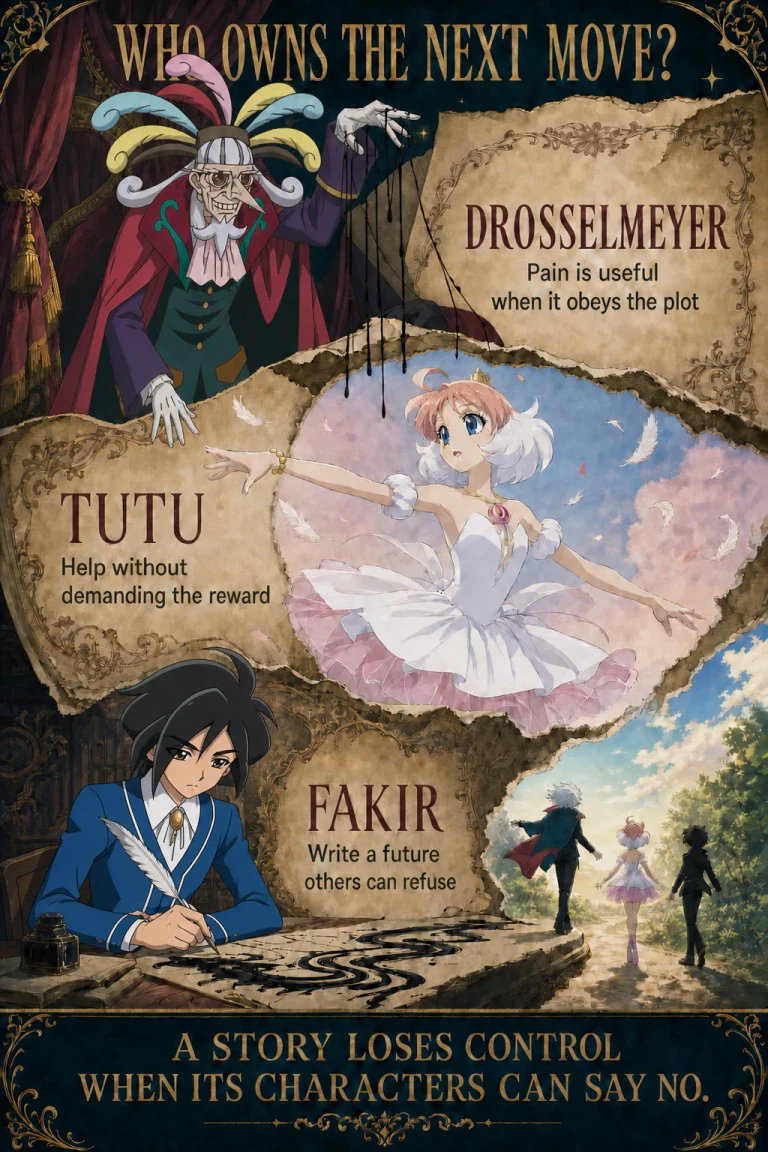
- Tutu helps without claiming the rewardAhiru repeatedly returns feelings to Mytho even though the completed prince may not choose her. Care becomes ethical when it restores a choice it cannot control.
- Drosselmeyer confuses authorship with ownershipHe does not merely tell a story. He treats pain, repetition and even rebellion as material that must still end where his tragedy requires.
- Fakir becomes a better writer by accepting refusalHis power changes meaning when writing stops being a way to keep Mytho safe and becomes a way to create possibilities others can reject.
- The ending does not reward Ahiru with a superior formReturning to a duck is not narrative punishment. It proves that moral agency never depended on keeping the princess role.
Full-series spoilers follow. Princess Tutu begins like a rescue fairy tale: a duck becomes a girl, the girl becomes a ballerina, and the ballerina gathers the pieces of a prince’s shattered heart. The official King Records synopsis presents that wish with deliberate innocence. Ahiru wants to see Mytho smile. The series then asks a harder question: if you restore another person’s capacity to want, do you also accept that their desire may lead away from you?
That question turns a magical-girl premise into an argument about authorship. Drosselmeyer wants the town to finish his tragedy. Rue wants love to eliminate the risk of abandonment. Early Fakir wants protection to eliminate Mytho’s risk of self-direction. Even Tutu could treat kindness as an investment in the ending she hopes to receive. The series’ central achievement is not that one role defeats the others. It is that Ahiru learns to help without converting help into ownership.
The rescue-story promise
Return the missing heart
Each recovered feeling makes Mytho more recognizably human. The work looks additive: find the shard, stage the pas de deux, heal the prince.
The authorship problem
Return the right to use it
A complete heart can choose danger, Rue, separation or a future nobody planned. Restoration is unfinished until the restored person owns the next move.
Princess Tutu makes every role a theory of love
The four central roles are not simply hero, rival, prince and protector. Each contains a different answer to the same problem: what may one person decide for another? Tutu offers feelings back. Kraehe tries to secure love by narrowing the prince’s available attachments. Fakir initially guards an empty prince because emptiness can be managed. Mytho’s development is the recovery of the very capacity that makes all three strategies unstable.
This is why the heart shards are not collectible rewards. Fear, curiosity, affection and grief complicate the mission as soon as they return. A feeling is not valuable because it makes Mytho more agreeable; it is valuable because it gives him another way to register the world. The apparent cure therefore increases unpredictability. The closer Tutu gets to success, the less power she has over what success will mean for her.

Drosselmeyer wants characters who can suffer but not revise
Drosselmeyer’s power is more disturbing than ordinary prophecy because he needs characters to act. A puppet that merely obeys would produce no suspense. He therefore gives the town enough freedom to generate conflict while reserving the authority to classify every action as another movement in his tragedy. Resistance becomes especially entertaining because he assumes it cannot escape the frame.
The official Blu-ray description foregrounds this structure before it introduces Ahiru: a writer dies with a story unfinished, leaving its characters behind. The series does not treat incompletion as an empty space waiting for the author’s final instruction. It treats it as a constitutional crisis. Do the characters exist to complete the manuscript, or does the manuscript now belong to lives that have continued after its maker?
Drosselmeyer’s answer is cruelly consistent. Suffering matters when it sharpens the ending. Repetition matters when it keeps the audience inside the mechanism. Individual desire matters only as combustible material. The horror is not that he misunderstands emotion. He understands it well enough to use its texture while denying its authority.
§
The series separates narrative meaning from narrative permission
Drosselmeyer may be able to make suffering meaningful inside a plot. That does not grant him the moral right to produce the suffering or to deny its victims a different ending.
Fakir has to unlearn the protector’s version of authorship
Fakir begins closer to Drosselmeyer than his loyalty allows him to admit. He wants to protect Mytho, but protection often means preserving the prince in a state that cannot choose danger. Fakir has excellent reasons: the recovered heart may reactivate the story’s catastrophe. Yet the structure of his care remains paternal. Safety belongs to the protector; the protected person supplies the body.
His discovery that he can write reality creates the ultimate temptation to solve this problem by force. Instead, the ability becomes ethical only when Fakir refuses to use authorship as remote control. He writes toward openings, not guaranteed outcomes. His words matter because they support another action rather than substituting for it.
This distinction explains why Fakir and Ahiru become genuine collaborators. Tutu cannot complete the finale through power; Fakir cannot complete it through prose. Each can create a condition in which someone else acts. Their bond is not the fusion of two saviors. It is a division of authority that keeps either one from becoming a kinder Drosselmeyer.
Signature module · The Story Rights Score
Test whether a “happy ending” still belongs to the people living inside it
Activate the rights the ending protects. A story can be beautiful, coherent and emotionally satisfying while still failing the personhood test.
Ahiru’s love is strongest where it gives up the prize
Princess Tutu cannot confess love without disappearing. The rule initially resembles the familiar fairy-tale demand that virtue prove itself through sacrifice. But the series uses the limit to expose a deeper issue. If Ahiru’s care were justified only by winning Mytho, every recovered heart shard would become leverage. The possibility that she may receive nothing forces love and possession apart.
Ahiru is not free of desire. She wants closeness, recognition and a human life. Her moral strength lies in neither denying those wants nor turning them into a debt Mytho must repay. She continues to act while the desired outcome becomes progressively less controllable. That is more difficult than selfless purity because it requires disappointment to remain possible.
The same logic complicates Rue. Kraehe’s possessiveness is harmful, but it is not empty malice. Rue has learned that love is scarce and revocable, so control feels like the only durable form of being chosen. Her arc matters because she also has to become someone whose desire can be answered rather than someone who can only secure an answer through captivity.
Role given
Dance the prince back into the script
The pas de deux resolves an emotional disturbance and returns the scene to a recognizable fairy-tale grammar.
Action chosen
Dance until another person can leave the script
The same art becomes emancipatory when it restores a capacity Tutu does not reserve for herself.
Returning to a duck is the proof, not the defeat
The ending denies the easiest visible reward. Ahiru does not remain Princess Tutu, take permanent human form and occupy the place beside the prince that fairy-tale arithmetic appears to promise. She returns to a duck. Read only as status, this looks like loss. Read through the series’ argument about roles, it is the final separation of personhood from narrative prestige.
Ahiru mattered before the transformation. The pendant gave her a language of action, not the moral worth that made the action meaningful. Losing the costume therefore cannot erase what she authored through it. Fakir’s continuing recognition is important for the same reason: he addresses the person who remains when the socially legible heroine has disappeared.
This also prevents the finale from replacing one controlling story with a more flattering one. Ahiru is not promoted into permanent royalty by an author who has learned to reward the correct protagonist. She keeps a small, finite and unglamorous life outside the promised hierarchy. The series calls that life real enough.
The final reversal
Drosselmeyer believes a character becomes meaningful by finishing the author’s tragedy. Princess Tutu answers that a story becomes meaningful when its characters acquire the right not to finish it as ordered.
Questions about the Princess Tutu ending
Why does Ahiru turn back into a duck?
The magical role was conditional, and the finale removes it. Thematically, the return proves that Ahiru’s courage and moral agency were never created by the princess costume. Fakir’s recognition preserves continuity between the heroine and the duck.
Is Drosselmeyer the villain of Princess Tutu?
He is the principal controlling antagonist, but his importance is structural. He represents an author who grants characters enough life to suffer and surprise him while denying them authority over the ending.
Does Princess Tutu end with Ahiru and Fakir together?
The finale leaves them together in a deliberately modest form: Fakir continues writing while Ahiru, again a duck, remains beside him. The scene values recognition and shared work over a conventional romantic coronation.
How many episodes are in Princess Tutu?
The standard home-video presentation contains 26 episodes. The official Japanese Blu-ray divides them between the Chapter of the Egg and Chapter of the Fledgling across four program discs.
Official production and interpretive sources
Materials checked 22 August 2026
- King Records official Princess Tutu site — official story premise, staff, cast, Blu-ray structure and canonical visual references.
- Official Princess Tutu Blu-ray product description — the unfinished-author premise, Duck’s transformation and the 26-episode release.
- Ushicon 2019 Princess Tutu concept-to-anime panel transcript — Ikuko Itoh and Junichi Sato on Drosselmeyer, ballet choices and the original concept.
- Sentai Filmworks — North American rights-holder and home-video context for the complete series.
- Encyclopaedia Britannica, Swan Lake — the ballet’s transformation, curse and competing endings as part of the series’ intertextual vocabulary.
- Journal of Anime and Manga Studies — peer-reviewed context for anime form, adaptation and narrative analysis.


