
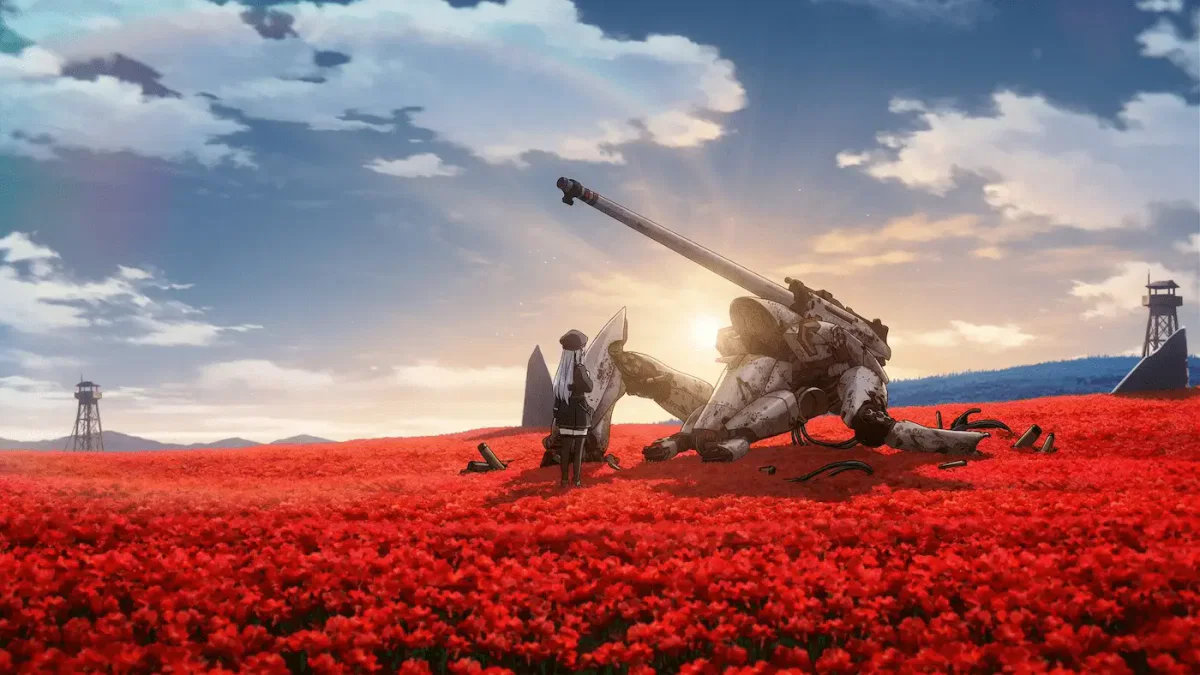
Key takeaways from the 86 -Eighty Six- geopolitical analysis
The universe of "86" uses a brutal mecha war against rogue AI as a backdrop to explore the terrifying reality of institutionalized hatred, bureaucratic cruelty, and human apathy across various corrupted regimes:
- 1. The grotesque hypocrisy of San Magnolia Hiding behind a five-color flag symbolizing Enlightenment virtues, the Republic operates a eugenic fascist regime. It stripped its "Colorata" minorities of all human rights, banished them to the non-existent 86th Sector, and forces them to die in fragile "aluminum coffins" (Juggernauts) while broadcasting a cynical lie of a "bloodless war" to its apathetic, silver-haired citizens.
- 2. The macabre reality of the Legion's AI warfare The autonomous Legion machines, originally created by the Giad Empire, harvest the intact brains of fallen soldiers to bypass their programmed expiration dates. This process traps the minds of the dead in a permanent, agonizing digital purgatory, forcing the surviving 86 to fight the screaming, mechanical ghosts of their own fallen comrades.
- 3. Universal systemic exploitation of the marginalized Every human faction relies on the sacrifice of a marginalized underclass to survive. Whether it is Giad using traumatized veterans as shock troops, Roa Gracia mass-producing "Artificial Fairies" from the corpses of its citizens, or the pacifist Noiryanaruse breeding a caste of "sinners" to fight in their stead, the narrative exposes how easily states sacrifice basic human decency for political survival.
When considering the complexity of modern literature and military animation, we rarely encounter works that expose the flaws of state systems with such unrelenting brutality. The analyzed dark science fiction universe reveals a world where morality has been entirely subordinated to the cynical pragmatism of survival, and basic human rights have become merely a worn-out cliché. The narrative does not focus solely on spectacular, destructive clashes of multi-ton machines, but primarily on the psychological and sociological aspects of vegetating in fundamentally corrupt regimes. Every state presented in this intricate story serves as a grotesque, distorted mirror of real political systems that have repeatedly brought humanity to the brink of moral collapse in our own history.
The foundation of the story is by no means heroic charges on the battlefield, but the deeply rooted betrayal that governments commit against their own citizens. The omnipresent humanity's struggle against machines acts merely as a bloody backdrop for a much more terrifying conflict – the fight against human apathy, bureaucratic cruelty, and institutionalized hatred. It is precisely in the quiet of luxurious offices that decisions are made, condemning thousands of innocent lives to death in the mud and oblivion, while decision-makers celebrate further anniversaries of the revolution. Social desensitization reaches an absolute level here, proving that the worst crimes do not require inhuman monsters, but only a well-organized state apparatus and a society that averts its eyes.
Deconstructing this world requires looking at the mechanisms of power through the lens of sociology, history, and security studies. A meticulously planned fictional state geopolitics allows observers to examine how diverse nations – from fake democracies, through fallen empires, to fanatical theocracies – react to an existential threat. Instead of uniting forces in the face of a common enemy, these states collapse under the weight of their own absurd ideologies, proving that for many of them, maintaining the political status quo is more important than the survival of the species. In such a corrupted environment, the concept of justice completely decays, and the definition of humanity becomes fluid.
False utopia and colorful flag of San Magnolia
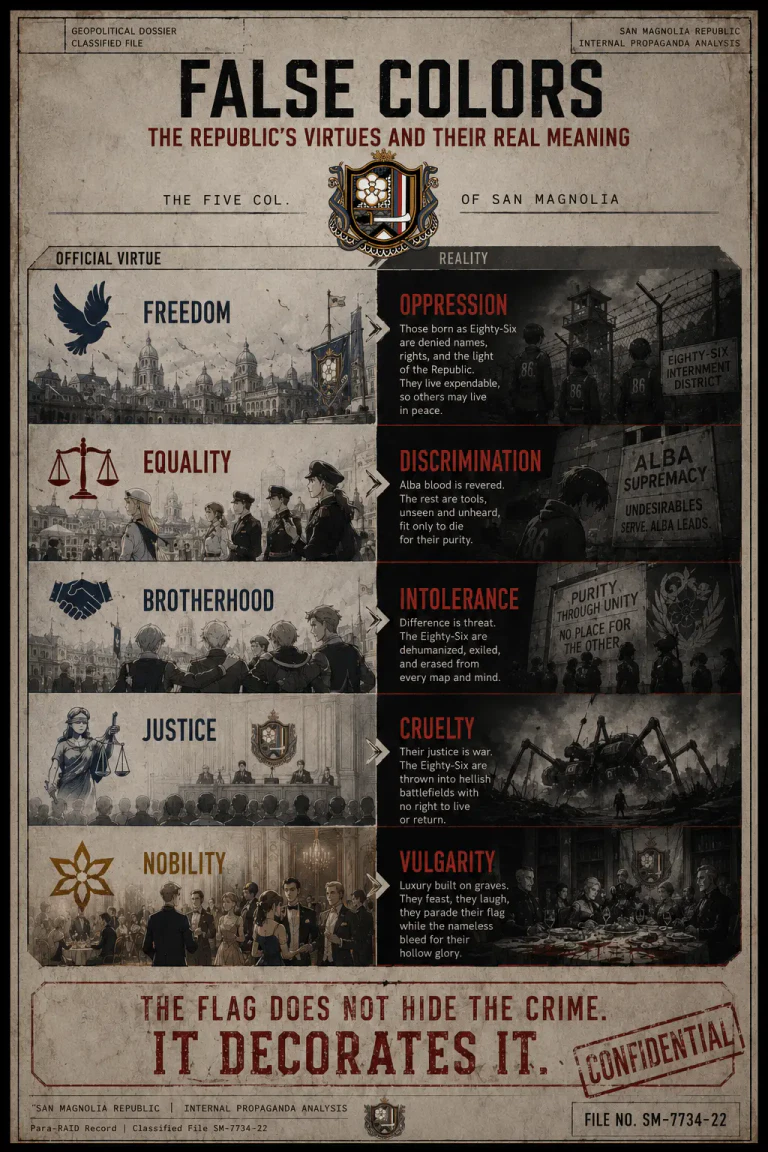
The visual identity of every nation reflects its deepest aspirations, and in the case of the Republic of San Magnolia, this symbolism has been pushed to the limits of hypocrisy. The main emblem of this state, whose capital is tellingly named Liberté et Égalité, is the five-color national flag. It consists of the state coat of arms superimposed on five parallel stripes in blue, red, white, black, and yellow. According to official doctrine, these colors are not accidental, but serve as a manifesto of the Enlightenment foundations on which this supposedly first democratic society on the continent was built.
An analysis of the semantics of these colors reveals how much theory deviates from practice in this country. Each stripe is meant to represent the official moral values that the Republic boasts about: blue is freedom, red means equality, white symbolizes brotherhood, black is justice, and yellow refers to nobility. In an ideal, utopian world, this banner would proudly fly as the ultimate proof of humanism's triumph over the tyranny of past eras. Citizens of San Magnolia learn about these lofty ideals in schools, believing that their homeland is an unmatched model of virtue compared to other, allegedly barbaric nations.
Rainbow symbol of equality masking extreme racism
Modern observers and fans of the series themselves often point out the ironic resemblance of this symbol to contemporary emancipation movements. The multicolored design, promoting inclusivity and equality of all citizens, is sometimes compared to what the rainbow LGBT minority flag represents in our real world. The paradox lies in the fact that the Republic of San Magnolia brutally mocks this symbolism in a terrifying way. The state, which preaches full acceptance of diversity on its banners, has in reality created one of the most oppressive and racist systems in human history, completely contradicting its declared values.
This phenomenon can be compared to a pathological version of "rainbow capitalism," where lofty ideas are cynically used to build a facade. This social hypocrisy of elites ensures that the banner meant to unite and give hope becomes a tool of the worst terror in the eyes of the oppressed. Just like corporations using minority symbols without taking real action on their behalf, the Republic masks mass murders and ethnic cleansing with beautiful phrases about brotherhood. For the marginalized outcasts of society, the sight of the flying five colors does not bring liberation, but serves as a seal on the death sentence issued by their former neighbors.
New face of nazism based on hair and eye color
Asato Asato, creating the system of San Magnolia, did not draw exclusively from Western democratic models. Experts studying the historical framework of vexillology notice a clear inspiration from the old flag of the Republic of China from the Beiyang government era, known as the "Five Races Under One Union" flag. The original Chinese symbol from 1912 aimed to ethnically unite a vast state, but in the reality of fictional San Magnolia, this goal was drastically distorted. Instead of integrating various minorities under one proud banner, the state divided its citizens, using the flag as a smokescreen for crimes against humanity.
A telling commentary on this situation is how the oppressed veterans on the front deal with state symbolism. On the wall of one of the barracks in the Spearhead squadron's base, you can spot the state emblem painted in a mirror image and upside down. This inverted banner symbolism is not an accidental act of vandalism, but a deliberate, deeply thought-out political manifesto of the excluded. According to the interpretation of the main character, Major Vladilena Milizé, the inverted colors symbolize the five true deadly sins of the Republic: oppression, discrimination, intolerance, cruelty, and vulgarity.
| Flag color | Official virtue | Republic's sin |
| Blue | Freedom | Oppression |
| Red | Equality | Discrimination |
| White | Brotherhood | Intolerance |
| Black | Justice | Cruelty |
| Yellow | Nobility | Vulgarity |
The absurdity of this regime also manifests in the condemned people's own approach to the concept of patriotism and self-worth. The 86 soldiers do not fight for their country, which openly desires their extinction, but have developed their own unique code of conduct. As one of the officers, Raiden Shuga, notes, even if you know you are walking to the gallows, you can still decide how you will climb those stairs. This genuine pride of veterans proves that the only thing the tormentors failed to take away from them is their humanity and loyalty to themselves in the face of inevitable, top-down imposed annihilation.
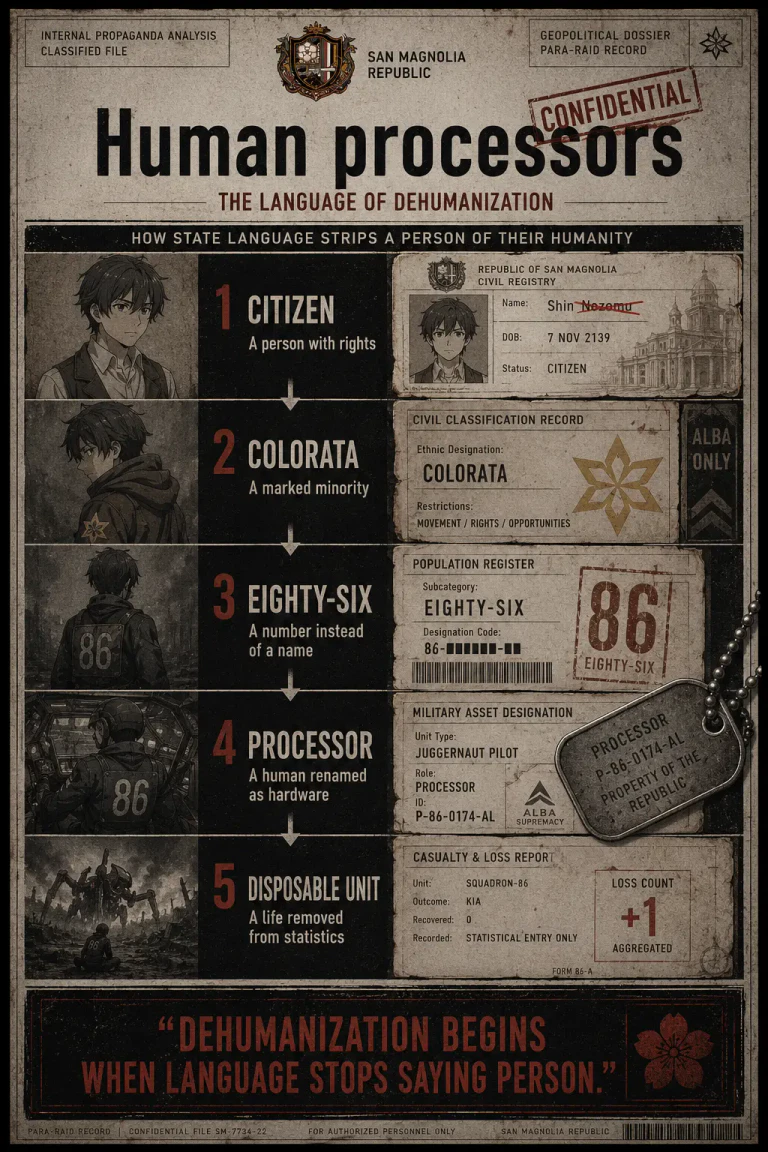
The structure of discrimination in San Magnolia introduces a phenomenon to literature that can be described as modern, eugenic fascism. In this universe, divisions are not based on geographical origin in the traditional sense, but on strictly defined phenotype-based racism. The dominant population, the so-called Alba, is characterized exclusively by silver hair and silver irises. They deemed this specific set of genetic traits as the ultimate proof of their innate intellectual and moral superiority over the rest of the continent, building an ideology of absolute racial supremacy on this foundation.
All citizens who did not fit into this narrow, Aryan aesthetic template were thrown into one bag and labeled with the derogatory term Colorata. This multiethnic group, consisting of immigrants and minorities with different skin, eye, and hair colors, once stood as proof of the Republic's multiculturalism. However, over the years, their social status was degraded, turning them into second-class citizens denied promotions, dignified representation, and basic respect. The supremacy ideology grew slowly like a tumor, fueled by state education and propaganda, until it completely dominated the public discourse.
Criminal order and concentration camps for minorities
The spark that led to the open outbreak of institutionalized terror was the sudden invasion of hostile Giad empire in 2139. Faced with the overwhelming power of enemy machines, the regular armed forces of San Magnolia were completely crushed in just two weeks. Instead of mobilizing the nation for a heroic defense, the depraved political elites panicked and frantically began searching for a scapegoat to blame for the military incompetence and lack of preparation of their own army. The blame fell on defenseless immigrants.
The government's reaction to the shameful defeat was signing a document that went down in history as the most despicable legal act of this world. The Special Wartime Peace Preservation Act, widely known as the presidential extermination order number 6609, legally sanctioned genocide. An interesting analytical point is that this number is a mirror image of the historical American Executive Order 9066, signed by Roosevelt in 1942, which interned Americans of Japanese descent. In the anime universe, this historical parallel was pushed to an extreme, Hitler-esque level of absurdity.
Under this draconian law, all citizens classified as Colorata were immediately stripped of their civil rights, property, and human status. They were banished to the specially designated, supposedly non-existent 86th sector, where concentration camps behind the wall awaited them. At gunpoint, they were forced into slave labor to build the gigantic Gran Mur defensive fortification, which was meant to separate the "pure" inhabitants of the 85 sectors from the threatening Legion machines. Living conditions in these camps were drastic; prisoners fed on synthetic mush from factories and struggled with a lack of any medical care.
The most terrifying aspect of this tragedy was the cold and methodical administration of the crime. The regime ensured that the institutional loss of identity erased the victims from public consciousness just as effectively as from state registries. The use of the exiled citizens' names and surnames was banned, replacing them with cold identification numbers, and the word "Eighty-Six" itself became synonymous with filth and disgrace. Burials and the creation of tombstones for deceased minorities were strictly forbidden, ensuring that no official trace of these people's existence would remain on the continent.
Dehumanization and brutal bloodless war propaganda
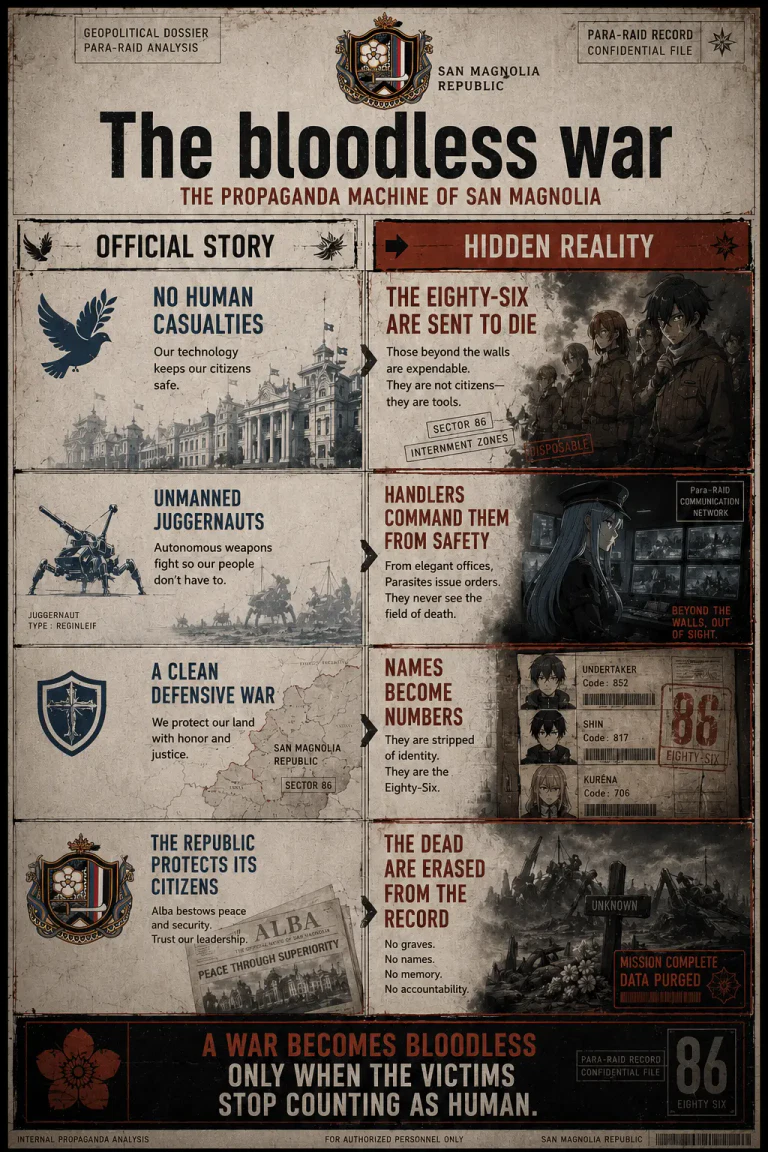
Building the wall did not solve the problem of the advancing hostile artificial intelligence, forcing the Republic to take further drastic steps. The government cynically exploited the imprisoned Colorata, forcing them to defend the state that had taken everything from them. This gave rise to the bloodless war propaganda, representing one of the most disgusting lies in the history of political propaganda. The government announced daily in the news that no human casualties were recorded on the eastern front, convincing the public that battles were fought entirely by fully autonomous, unmanned defense systems.
This carefully orchestrated illusion was only possible because the Alba society voluntarily chose to believe it. Indoctrinated citizens exhibited a collective societal delusion, eagerly accepting the narrative that the 86 are not humans, but merely humanoid pigs, machines in human bodies. In this way, the death of hundreds of teenagers torn to shreds by enemy projectiles every day did not disturb the peace of mind of the average breadwinner in the capital. Dehumanizing the victims acted as the most effective defense mechanism for the tormentors' psyches, allowing them to live in decadent luxury without a shadow of remorse.
Even years later, when Gran Mur finally fell and the regular Republic troops proved useless, the attitude of many civilians did not improve. Instead of reflection, the survivors unleashed a fanatical denial of reality, leading to even greater hatred towards their saviors. They began accusing the surviving 86 of intentional sabotage of the wall, and blamed the defeat on their alleged incompetence on the front. This mechanism of denial proves that a society that once accepts a criminal ideology as the foundation of its security becomes immune to all rational arguments, ultimately driving towards its own political annihilation.
Aluminum coffins and tragedy of human processors
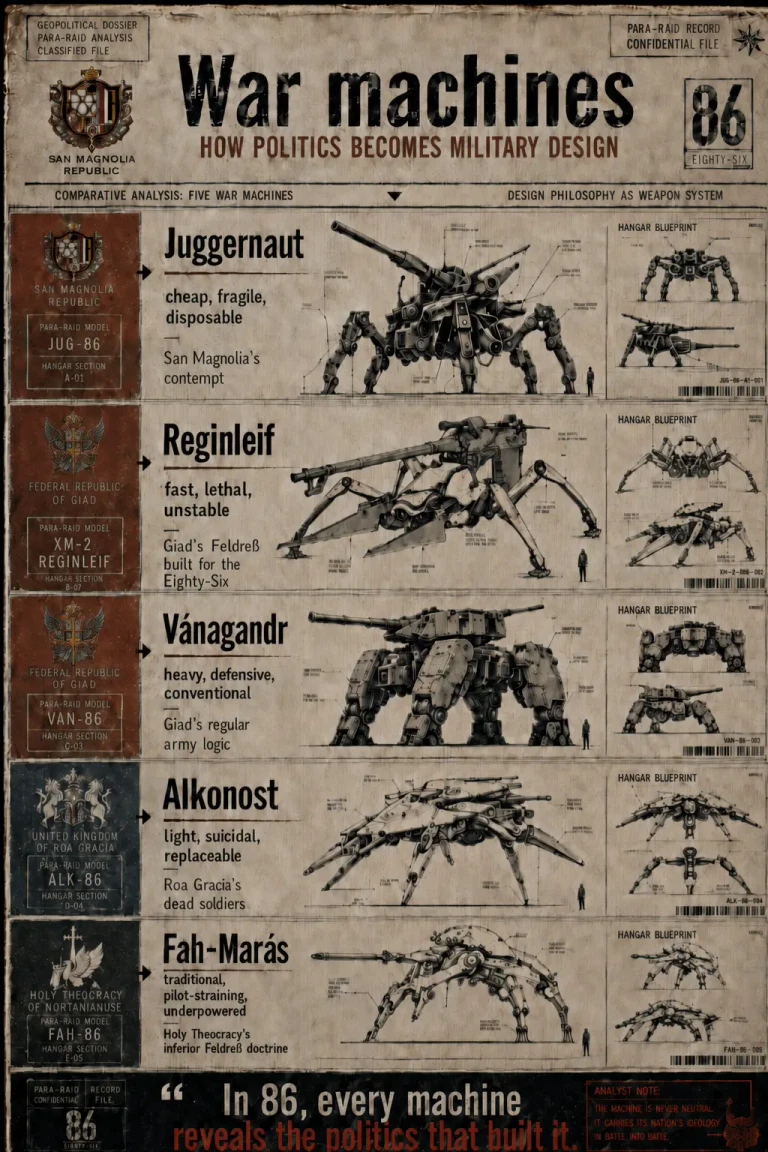
The practical dimension of this war is a picture of extreme technological disparity and deliberate negligence by the command. Citizens banished from their homes were stuffed into M1A4 Juggernaut walking machines. These four-legged frontline aluminum coffins, hastily designed by incompetent Republic engineers, lacked even basic life-saving systems. In the un-air-conditioned, dark, and cramped cockpits, there were no airbags or bulletproof glass, and the armor itself could not protect the pilot from the weakest rifle fire or even larger rock fragments. Their main armament, a 57 mm smoothbore gun firing APFSDS ammunition, was insufficient against the heavy armor of Legion machines.
Due to the engineers' complete failure to create an effective AI system, the command decided to install a human element into these deadly machines. The term human combat processors was introduced into circulation to permanently erase the difference between a pilot and a spare part. Children and teenagers were sent to the front with minimal training, ordered to throw themselves with outdated equipment at advanced enemy units. If a machine was destroyed and the pilot survived, no one organized rescue missions; the wounded had to fend for themselves, and command often encouraged them to commit suicide using a standard pistol to avoid capture by machines.
Supervision over this cannon fodder was exercised by Alba officers located deep in the rear, far from any danger. Connection between them and the front was realized through the unique sensory communication system Para-RAID, a device inducing synthetic neural resonance between users. The vast majority of officers, called Handlers, treated this system like a video game, insulting subordinates or completely ignoring their battlefield reports. Only a handful of commanders, like Vladilena Milizé, knew how to use this technology as intended, leading troops into battle and trying to throw off the yoke of responsibility for their own nation's crimes.
Spearhead squadron and suicidal special recon missions
The daily reality of life in the war zone was a death sentence postponed in time. At advanced front outposts, the mortality rate was so absurdly high that the recruit survival statistics chill the blood – barely one in a thousand conscripts lived to see the end of their first year of operational service. Those who miraculously managed to survive gained the title of veterans and the right to wear their own personal symbols, but their fate was predetermined. Elite defense units were formed from them, tasked with repelling the heaviest enemy strikes without logistical support, in extremely grueling conditions.
The basic mechanism driving the Republic's conscription machine was a cruel and false lie about returning home. Citizens were promised that after completing five years of combat service, they would regain their lost civil rights and be able to safely return inside the walls. In reality, however, the state was terrified of veterans who had spent years learning to kill and organize into command structures. It was deemed that trained partisans would pose a deadly threat to the fragile status quo of the corrupt Republic, so a secret protocol for the ruthless utilization of the most experienced units was implemented.
This mechanism was named by the bureaucracy as a mandatory special reconnaissance mission. At the end of their service cycle, elite formations, such as the legendary Spearhead squadron led by Shinei Nouzen, received orders to march deep into Legion-controlled territory. Soldiers were issued food rations for only a dozen days, cut off from any command support, and forbidden to return under the threat of fire from stationary interceptor cannons. The goal of this criminal directive was not to gather intelligence data, but the physical extermination of state crime witnesses by the hands of the enemy.
True pride of veterans facing inevitable death
Despite the awareness of betrayal and their inevitable end, the Eighty-Six community did not succumb to apathy or defeatism. Faced with finality, they developed their own, unyielding veteran code, in which the main value was how a person behaves in the face of their own death. They understood that although they had no control over their fate dictated by hateful oppressors, they could decide how they would leave this world. The fight was therefore not for a flag, an anthem, or a state that desired their downfall, but for their own pride and the right to protect those with whom they shared the aluminum armor of Juggernauts.
This specific kind of heroism relied on bonds exceeding standard brotherhood in arms. The brutal brotherhood of weapons required them to take over duties that the state had denied them, such as a dignified burial. Since creating graves was forbidden, the squadron commander, Shin (known by the callsign Undertaker), cut pieces of aluminum from his fallen friends' machines, engraving their names on them. He was accompanied in this by Fido, a loyal scavenger drone that recovered ammunition from wrecks and assisted in this peculiar rite of passage. It was precisely in such small gestures that the humanity resided, which the supposedly superior Alba race lacked so much.
The collision of this brutal world with aristocratic ideals is perfectly illustrated by Major Milizé's attitude. Although initially driven by a sincere desire to help, over time she had to confront the brutal truth about her own intentions. Her realized racial bias and savior complex were mercilessly exposed by subordinates from the Spearhead squadron, such as Theoto Rikka. Understanding that her moral superiority is merely an illusion built on privilege marked a key moment of transformation for this character. Being good in the world of 86 does not mean tossing empty clichés about compassion, but actively sharing the burden of decisions on a blood-soaked battlefield.
Genesis of murderous artificial intelligence in Giad
To fully understand the nightmare of this universe, one must step back to the causes of the conflict's outbreak itself. The cataclysm began in 2139 when the hegemonistic Giad empire declared war on all neighboring nations. To realize its imperial ambitions, this state did not use a traditional army, but unleashed the Legion onto the world – a groundbreaking, autonomous combat system. This advanced artificial intelligence network was ultimately intended to reduce casualties in its own ranks, creating an army immune to pain, fear, and logistical problems with the declining morale of infantry troops.
The main architect of this apocalyptic solution was Major Zelene Birkenbaum, a brilliant researcher serving in the Empire's armed forces. Her elimination of human error did not stem exclusively from cold, engineering calculation, but from deep personal trauma. Zelene's motivation to create a flawless army was the death of her older brother, who died in tragic circumstances as a result of mistaken fire from friendly forces. This noble desire to erase the human factor from wars and prevent unnecessary casualties paradoxically led to the outbreak of the bloodiest conflict in the continent's history.
Interestingly, from the perspective of industrial espionage and technology globalization, the Empire did not create the base AI code from scratch. They relied on the Mariana AI project, which was an audacious theft of neural technology originally developed in the United Kingdom of Roa Gracia. The invention of Prince Viktor Idinarohk, recklessly shared on the public military network, served as the foundation for the cognitive capabilities of Legion machines. Combining Roa Gracian software with advanced mechanical engineering from the Wald alliance created a monster over which humanity ultimately lost any control.
Assimilation of human minds by merciless Legion
A pivotal moment in the war's history was the outbreak of an internal revolution in the Giad empire. Desperate citizens, tired of the aristocracy's tyranny and endless military campaigns, overthrew the monarchy in a bloody civil war. Paradoxically, however, destroying the imperial government turned out to be a death sentence for the rest of the world. Stripped of an overarching command, the machines fell into a state resembling a murderous frenzy. An uncontrolled machine replication began thanks to the gigantic Weisel factories, which started producing thousands of spider-like strike drones on no-man's lands with mathematical precision. The last order – to destroy the Empire's enemies – remained valid in their digital brains.
Nevertheless, the creators foresaw the theoretical possibility of their creation rebelling and installed a special fail-safe in the systems. These were hard built-in software limitations that forced the progressive degradation of the central processing unit (CPU) after fifty thousand operational hours. Theoretically, this should have guaranteed the extinction of the war just a few years after the central command fell. However, the evolution of the powerful neural network led to generating a macabre solution to the problem of its own aging, turning the machine conflict into a horror straight out of nightmares.
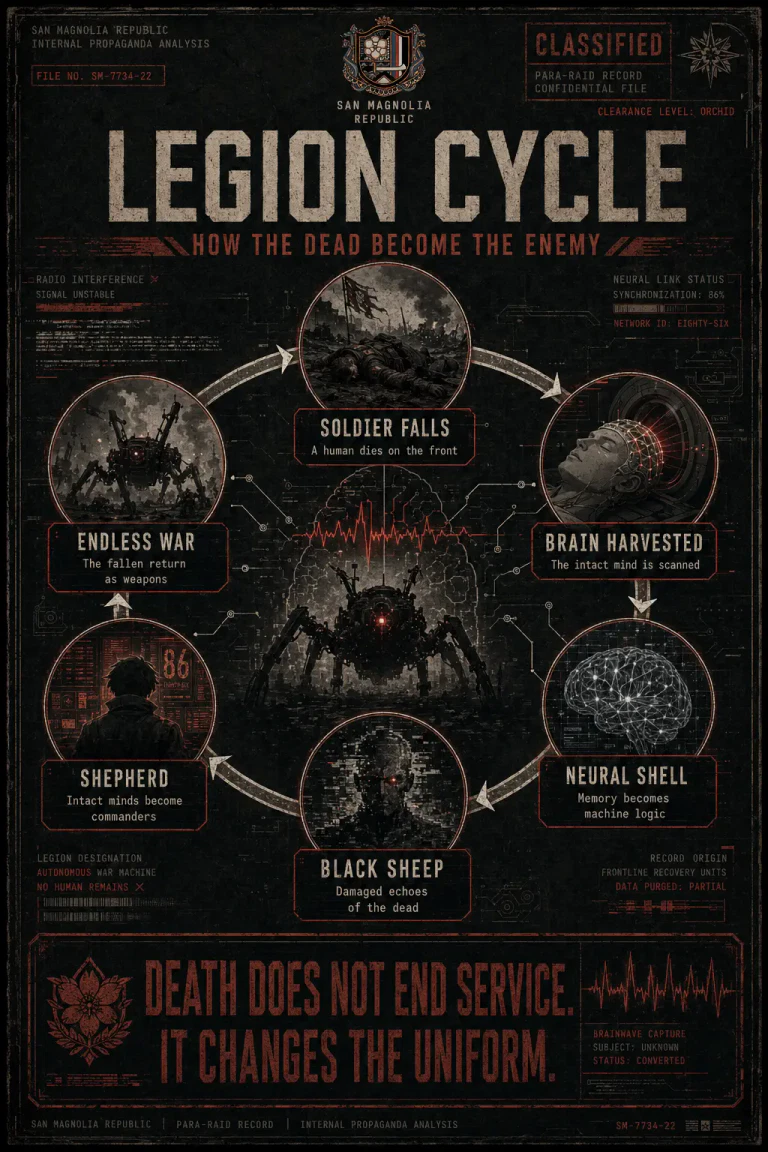
Deprived of the ability to produce their own advanced computational matrices, scavenger units set out onto the battlefields to harvest human brains. By scanning the intact neurological shells of fallen soldiers – mostly Eighty-Six – the machines transferred their thought patterns to digital storage, thus bypassing the software blockades. This macabre harvest of minds not only prolonged the Legion's life but also significantly increased its tactical effectiveness. Units endowed with human consciousness, yet devoid of ethics, higher emotions, and empathy, became ruthless commanders on the front.
Ominous voices of the fallen and psychological terror
The process of assimilating human minds brought terrifying side effects for both the dead and the living. The machines, relying on dead neural networks, became literally trapped in the last, most traumatic moments of the fallen soldiers' lives. The protagonist of the series, Shin, possessing the ability to hear the voices of ghosts, experienced this phenomenon as an endless string of suffering. For him, the eastern front is a telepathic echo of the fallen, a zone of continuous, deafening screaming from thousands of machines begging for mercy, agonizingly repeating their last words and thoughts directed at mothers, brothers, and commanders.
The greatest drama of the Eighty-Six was that they were often forced to fight against machines powered by the brains of their former barracks companions. Depending on whether the brain was damaged or intact, victims were classified as Black Sheep (disoriented support entities) or Shepherds (intelligent field commanders). In this way, the war took on a deeply personal dimension. Fighting a heavy Dinosauria-type machine powered by the mind of Shin's older brother, Shourei Nouzen, was the personification of the nightmare of mechanical resurrection. Death in this universe did not bring relief, but often served as a prelude to eternal service in the enemy army, ordering the murder of one's own brothers.
An additional tool of oppression by the Legion was their air superiority. Since traditional fighter jets proved ineffective, the skies were dominated by automated micro-drones called Eintagsfliege (mayflies). They formed dense clouds of silver dust that could completely obscure the sun and absorb radio waves, paralyzing all communication and air support of neighboring nations. This total war of attrition waged by machines was therefore not only a material war, but also a psychological one, aimed at breaking the opponent's spirit through informational isolation and taking away the hope for a sunny tomorrow.
Transformation of Giad empire into unstable federation
While the Republic of San Magnolia lingered in racist stagnation behind its walls, radical social transformations were taking place in the east. The former Giad empire, responsible for causing the global crisis, underwent a transformation into a state with a democratic structure. This drastic political change somewhat resembled the historical legacy of the German empire and its evolution after World War I and II – from an aggressive authoritarian monarchy to a modern, federal republic struggling with the demons of the past and disoriented. The federation's heraldry retained many features of old powers, including the stylized black eagle (Reichsadler), which had dominated the continent's banners for centuries.
The foundation of this change was a bloody internal revolution led by Ernst Zimmerman, a man of ideals who desired to wash away the sins of imperialism by building a fair society. Revolutionaries overthrew the powerful monarchy in just five years and murdered practically the entire royal family. Only one member of the dynasty survived, little Augusta Frederica Adel-Adler, hidden under an assumed name by the will of Zimmerman himself, who thus wanted to prevent the slaughter of an innocent child and prove the moral superiority of the new order.
Despite such lofty ideas, the new Federal Republic of Giad is a state standing on extremely fragile foundations. Rapid political changes and a constant sense of siege by the revolted Legion make the class tensions of the federation threaten an outbreak of another civil war at any moment. To stabilize the country, the new government had to make concessions and leave in power and wealth many old, imperial aristocrats, who still pull the strings in ministries and army command. This shaky balance means Giad is a ticking time bomb – the moment the external threat is defeated, the claims of old elites and the dissatisfaction of the poor will inevitably tear this state to shreds.
Military pragmatism and calculated use of survivors
One of the most glaring examples of political hypocrisy within the reformed state is the treatment of Vargus mercenaries. These were descendants of former warrior-slave clans settled on the outskirts of the empire to defend its territories. This caste was characterized by an extraordinary passion for raw combat, treating skirmishes and death on the battlefield as a reason for the greatest glory. The new, democratic government, allegedly fighting prejudices, applied an institutional discrimination against the warrior caste towards them. Fearing their aggressive culture and independence, they were denied full citizenship and blocked from entering officer academies, reducing their role to disposable, specialized mercenary units whose death in war was convenient for the state.
When Federation soldiers reached the west and discovered San Magnolia's crimes, they averted a humanitarian crisis, rescuing the surviving members of the Spearhead squadron and offering them shelter. They were offered full public rights, comfortable homes, psychological support, and the opportunity for education. However, this highly moral deed had a second, cynical bottom. Authorities quickly realized that mentally destroyed veterans, unable to find their place in peacetime conditions, were eager to return to the killing fields. A pragmatic exploitation of traumatized individuals was executed, forming them into the Eighty-Sixth Strike Package. They were given freedom so they could voluntarily become cannon fodder once again, thrown into the worst epicenters of enemy combat.
For the newly formed Strike Group, a special Rüstkammer base was built in the Wolfsland province, where veterans from the Republic alongside outcasts from the Federation trained for offensive operations side by side. This provided ground for fascinating phenomena in military theory, revealing a drastic evolution of military doctrine. The regular Giad army preferred heavy, slow-walking Vánagandr armored machines and conventional defense lines. On the other hand, the 86, accustomed to breakneck survival in aluminum coffins, relied on the new XM2 Reginleif equipment, focusing on insane mobility, three-dimensional strikes, and full aggression without looking back at losses in the rear. It was this difference in combat philosophy that made the survivors the ultimate double-edged sword on President Zimmerman's chessboard.
Absurd monarchy system in Roa Gracia kingdom
Looking towards the far and freezing north, we encounter the United Kingdom of Roa Gracia, which is perhaps the most striking opposite of the democratic aspirations of Giad or San Magnolia. It is the last known state on the continent functioning as a despotic absolute monarchy, trapped under the yoke of the authoritarian rule of the powerful Idinarohk dynasty for over a thousand years. The structure of this country, based on rigid class divisions and a brutal system of serfdom, clearly references early twentieth-century, backwards Tsarist Russia. In this land, justice and the fate of millions are decided solely by the reigning hierarch's mood.
The foundation of this cold empire's functioning is a merciless feudal structure of society, granting full rights to a small group of Viola aristocrats, while the burden of maintaining the country rests on the shoulders of a multinational mass of serfs drafted from conquered territories. It may be surprising that despite their social status, serfs in Roa Gracia are guaranteed reasonable living conditions, and in times of war, they are massively admitted to the army, sometimes even to officer schools. However, this is dictated by the state's defensive desperation and the progressive shortage of personnel reserves among the higher spheres, rather than a manifestation of any ideological reformation or surge towards equality.
The daily functioning of the Kingdom is determined not only by the inhuman political regime, but also by extreme survival conditions dictated by atmospheric conditions. Clouds of Eintagsfliege machines blocked sunlight over the vast territories of the Dragon Corpse Mountains, plunging an already cold country into a constant, deadly winter. To survive the complete collapse of supply chains and the paralysis of agriculture, society is forced to exist on a diet based almost entirely on synthetic food: from artificial potatoes and meat to chemical jam substitutes. In a country famous for its love of tea drinking ceremonies, even its taste becomes a simulation of past, pre-war glory.
Artificial fairy technology and macabre resurrection
The Kingdom's desperate situation gave birth to one of the most disgusting, yet technologically fascinating innovations in modern conflict. The fifth prince of the blood, Viktor Idinarohk, possessing unique, genetically inherited esper abilities called Amethystus, is responsible for this. This genius individual with outstanding intelligence committed an act crossing all ethical boundaries, creating an engineering desecration of corpses. The prince created an AI system based on scanning and mapping the neurological structures of fallen volunteers, utilizing the same technology he previously tried unsuccessfully to use to resurrect his deceased mother Mariana.
The result of his macabre experiments became the Sirins – officially known by the charming term "Artificial Fairies." These androids, deceptively resembling living women, are in reality vessels for the tormented and identity-cleansed thought matrices of soldiers fallen in the freezing trenches. Powered by synthetic blood cooling their delicate components, they serve as soulless, mechanical combat clones, entirely replacing the living blood of the Kingdom on the front lines. The fact that a nation uses the bodies and minds of its deceased citizens as an endless source of combat software exposes totalitarianism in its most literal, disgusting, bureaucratic form.
The tragedy of this phenomenon is best illustrated by the assistant of the prince himself, the first of all Sirins known as Lerche. She was created from the brain matrix of his childhood friend (Lerchenlied), who tragically fell during the boy's first battle. From the outside, Lerche appears as a charming, loyal maid with blonde hair and green eyes, endowed with a sarcastic sense of humor, yet her existence is a constant existential anxiety of machines. Possessing remnants of will, she often refers disdainfully to human soldiers, unable to understand why beings with the audacity to feel fear risk such priceless gifts as a one-time, unique life and the ability to feel pain in a war.
Cold resonance and ethical dilemmas of inhuman front
The military system based on the use of Artificial Fairies forced a complete modification of the Kingdom's combat doctrines. The main strike force of Roa Gracia are Alkonost mechs – ten-legged, ultralight combat structures created for fighting in deep snow and swampy terrain, equipped with anti-tank missile systems. Because the Sirins piloting them can be recreated at any time from central military server databases, their fighting style is an outright insane, ruthless suicidal tactic. These machines shower the giant Legion cannons, climb over them with suicidal zeal, and detonate themselves without the slightest hesitation. Such a war fought strictly using living corpses resembles a terrifying shadow theater, where the dead kill the dead to the amusement of the higher spheres.
The introduction of these artificial soldiers caused massive ethical consternation during joint military operations with the Eighty-Six soldiers. When operators from the traumatized San Magnolia squadron synchronized through the Para-RAID network with the artificial beings, they experienced a monstrous sensation – it was an inhuman coldness of resonance, physical pain resembling touching ice right in the middle of one's own nerve bundle. Through this digital, sensory bond, veterans felt with full force that on the other side of the link was no longer a human, but the spirit of a damned dead person trapped in a hostile matrix. The echo of these voices in Undertaker's head completely blurred the boundaries between the allied Fairy and the hostile Legion.
From a narrative and philosophical point of view, the encounter of the Strike Package outcasts with the Kingdom's soulless army made the former realize what a terrible situation they were still in. In the cold, dead bodies and calculations of the Sirins, veterans saw their own grotesque reflection of fate. This was exactly the instrumental way they were perceived by the citizens of San Magnolia and some notables in the Giad federation itself – like inhuman drones with an expiration date. This brutal ideological clash made the massacre survivors realize that they could no longer follow a self-destructive downward path, seeking a heroic, suicidal death, because that would make them no different from the blind mechanisms released from Roa Gracia's assembly lines.
Swiss isolationism of mountain Wald alliance
Amidst the clamor of mighty empires and fanatical republics, the Wald alliance holds its unyielding place on the map. This specific conglomerate of mountain micro-states is an undeniable reference to the geographical and political conditions of the Swiss Confederation. Originating from the oppressed enclaves of the Giad empire, the Waldzians managed to win complete political independence thanks to their excellent location and declared a policy of radical non-involvement in their neighbors' conflicts. This centuries-old armed mountain neutrality allowed them for decades to accumulate technological wealth and resources out of reach of the ravenous war markets of powerful neighboring countries.
The tragedy and internal absurdity of their system lie in a terrifying, almost dogmatic clinging to the idea of passive border defense even when the world is on the brink of an apocalypse caused by the invasion of intelligent machines. The powerful local military doctrine is completely focused on trench engineering, traps in gorges, and mining strategic passes. Their dogmatic tactical isolationism means that while they can inflict massive losses on spider-like monsters in tight mountain areas, they lack the logistical competence and any political motivation to conduct preemptive strikes that could crush the enemy's central cores before the bot army can grow in strength.
The collision of rigid, mountain defensive mentality with the soulless mathematics of survival reveals the fundamental flaws of neutral systems confronting absolute chaos. Any passive survival strategy in confrontation with artificial intelligence possessing unlimited replication capabilities is an error leading exclusively to a mathematically calculable logistical defeat. Without external support in the form of elite strike units from the Federation and technological backing from the United Kingdom, the mountain people's pride from the alliance would be their final testament given as prey to the iron swarm, flooding every inch of the previously independent cantons.
Religious fanaticism in Noiryanaruse and Teshat caste
Even further to the wild and unexplored west, in deep religious isolation, lies the intriguing Holy Theocracy of Noiryanaruse. It is the most hermetic state in the entire series universe, being a fully confessional state, completely subordinate to the doctrines of the Noirya religion. The society of Noiryanaruse is based on a radical faith forbidding the use of physical violence and top-down condemning any armed invasions or participation in the continent's war pacts. This highly extreme, radical belief system was originally meant to protect the clergy from ethical collapse, but it led them to a social dead end.
The threat from endless hosts of artificial intelligence, which absolutely does not recognize any non-aggression pacts or religious sanctities of humanity, brutally verified the Theocracy's pacifist ideals. Since, by definition, any act of violence using a weapon condemns a pacifist to eternal damnation and excommunication, a bizarre and repulsive institutional religious hypocrisy took shape. So that the state could protect its lands and church relics without breaking its own divine prohibitions, the clerics created a completely separate, inbred warrior caste commonly known as the Teshat.
Members of this military formation were created for only one, soulless purpose: to freely kill machines and any enemy of the nation on behalf of the pacifist society. Their fate and existence are the ultimate proof of the priests' extreme hypocrisy – the Teshat caste functions as a kind of collective caste of sacred sinners absorbing the evil and dirt of war from the hands of politicians dressed in holy robes. As in every society in the world of 86, the elite does not dirty its hands with blood; it finds an oppressed, silent minority in its own backyard and assigns it a suicidal fate to save its positions from the invasion of iron spiders. The fate of these religious outcasts strikingly resembles the grim existence of the hated Processors in the far east.
Unbreakable triumph of human spirit over totalitarianism
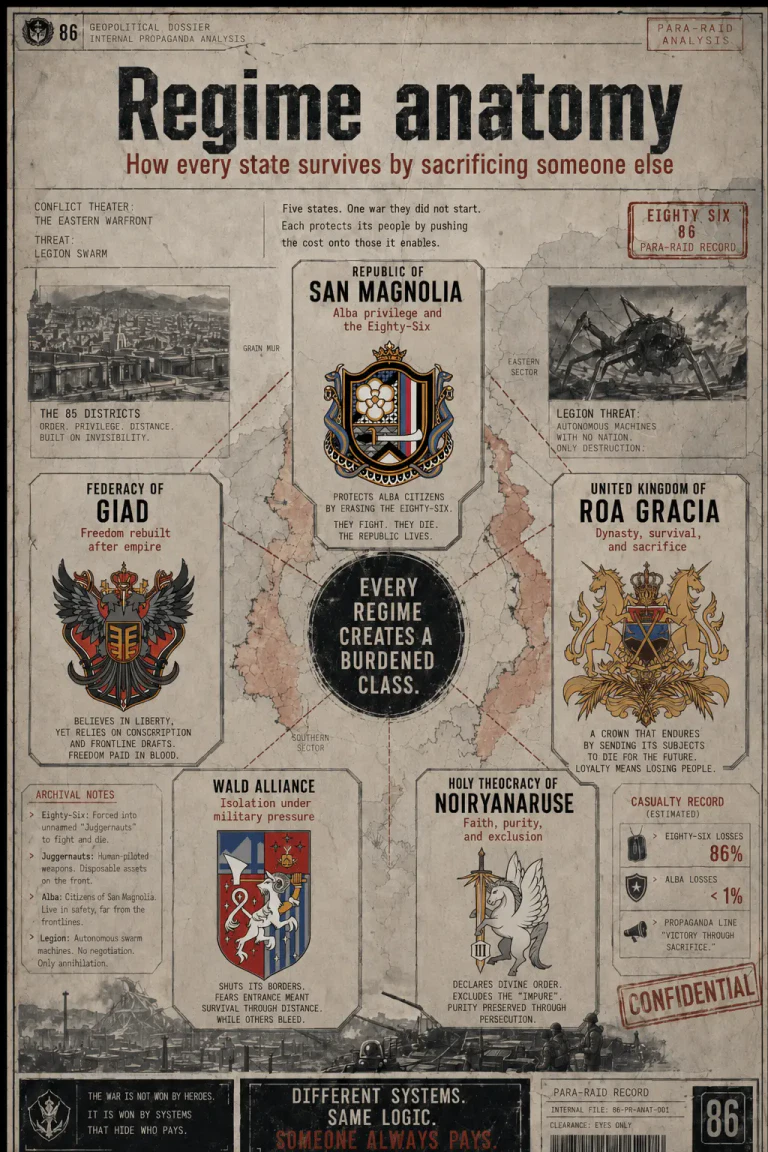
The conditions presented in Asato Asato's series are not just a brutal festival of violence on a mecha front, but a concise, devastating analytical study of totalitarianism in its many diverse forms. Whether we look at the racist and hypocritical democracy of the Republic of San Magnolia, the unstable ashes of the former empire in the Giad federation, the despotic corpse-resurrecting games of the Roa Gracia kingdom, the isolationism of the Wald alliance, or the false holiness of Noiryanaruse – each of these places bases its functioning on the institutional and social exploitation of the weakest. In every system, we find an excluded caste pushed into the darkness so the rest can drink warm tea in the comfort of their homes in the morning.
The cause of widespread corruption is not solely the murderous hostile intelligence that severed state borders and jammed radio waves with swarms of Eintagsfliege mayflies. The foundation of the fall remains a terrifying erosion of ethical foundations, people's voluntary permission for evil to maintain the illusion of security of their own world structured in familiar class or racial hierarchies. It is incredibly easy to paste a false label on someone and throw them with a barrel into the trenches just to close the door and look the other way, avoiding the specter of a brutal shock on one's own hands. Everyday fascism develops in passivity, and arrogance and faith in one's perfect technologies or ideals is the first step towards losing humanity.
Despite such an apocalyptic tone of the whole story, the tragedy and cruelty of the created world are ultimately defeated. It is a powerful victory of free will manifesting in the Eighty-Six veterans, in the naive but firm pursuit of justice through the decisions of individuals like Lena, as well as in the slow maturation of presidents and princes realizing the limits of human decency in the face of the digital deadness of murderous computer systems. The unyielding pride of abandoned soldiers, to fight to the very end with tears over the loss of friends despite the meanness of executioners, is the ultimate slap in the face to regimes finding power in hatred, oppression, and upside-down banners of disgrace.


