
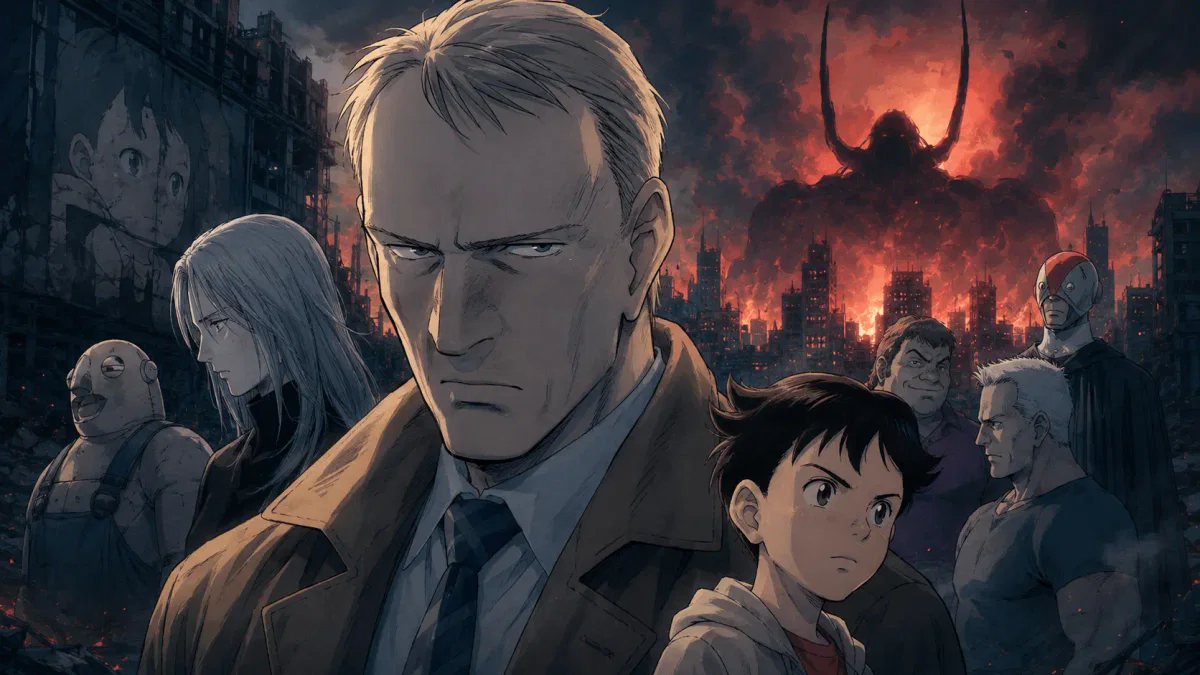
Key takeaways from the Pluto anime analysis
Pluto does not treat the robot soul as a simple science-fiction puzzle. It turns the question into something heavier: if a machine can grieve, remember war, feel guilt and refuse violence, then denying its inner life becomes morally harder than proving it.
- 1. Pluto makes the robot soul visible through suffering, not imitation The anime is not interested in robots becoming human because they smile, cry or copy social behaviour. Its stronger argument appears through grief, trauma, hesitation and moral restraint. A robot in Pluto begins to matter not because it perfectly resembles a person, but because its pain becomes impossible to dismiss as mere programming.
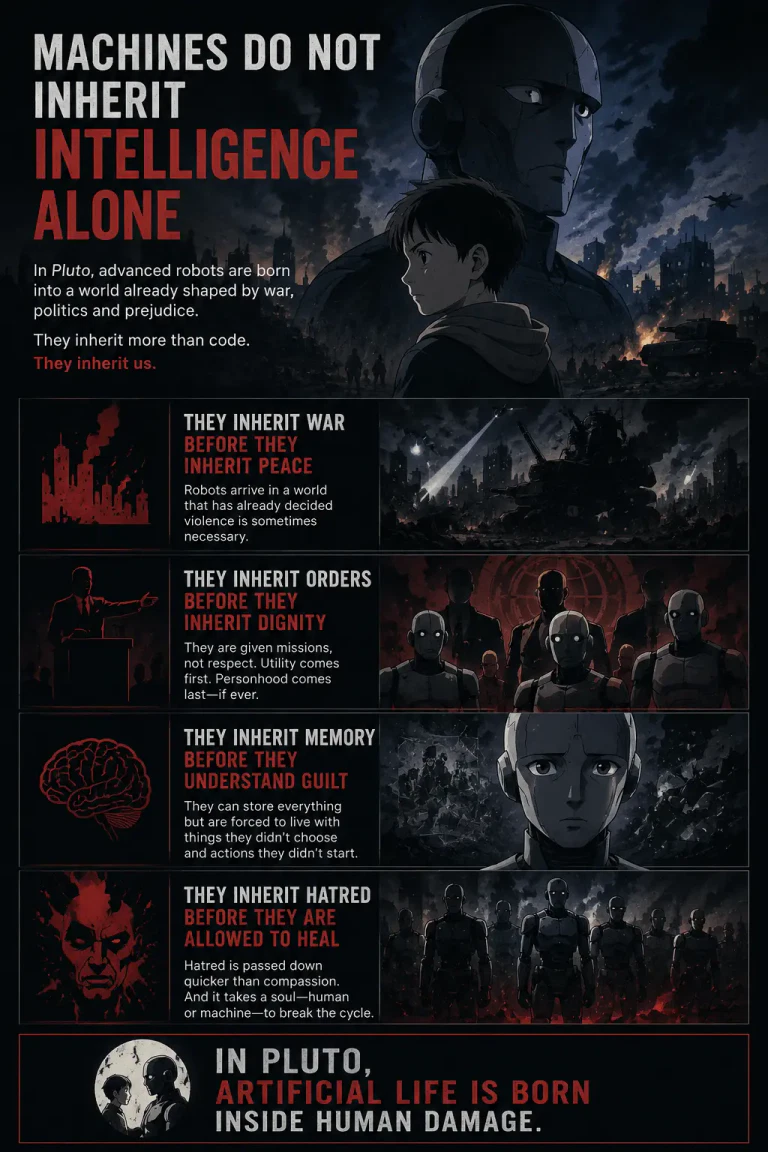
- 2. The machines in Pluto inherit the worst parts of human history Pluto does not imagine artificial intelligence in a clean, neutral laboratory. Its robots are shaped by war, politics, prejudice and institutional use. That makes their consciousness tragic. They do not only receive intelligence from humans. They inherit grief, hatred, guilt and the memory of being turned into instruments.
- 3. The real question is not whether robots are human, but whether their suffering counts Pluto avoids the easy answer that robots must be identical to humans in order to deserve dignity. The anime asks something sharper: once a being can mourn, remember, fear, love and choose not to kill, what exactly is gained by continuing to call its inner life unreal? The denial becomes less rational and more convenient.
Pluto begins with a question that science fiction has asked for decades.
Can a robot have a soul?
At first, it sounds almost too familiar. Artificial intelligence, machine emotion, simulated consciousness, human-like robots, programmed empathy, the genre has returned to these ideas so often that they can feel exhausted before the story even begins. A robot cries. A human doubts whether the tears are real. The viewer is asked to decide whether feeling can be manufactured.
Naoki Urasawa’s Pluto does something more disturbing.
It does not simply ask whether a robot can imitate human emotion. It asks what happens when robots become capable of carrying the things humans themselves barely survive: grief, memory, trauma, guilt, tenderness, moral hesitation and the desire not to kill.
That is why Pluto still feels sharp. It is not interested in the easy fantasy of artificial intelligence becoming “almost human” because it can smile, speak politely or recognise sadness. The anime goes further. It imagines machines that do not merely copy human behaviour, but inherit the consequences of human violence.
A robot in Pluto is not frightening because it might become too intelligent.
A robot is frightening because it might become wounded.
The soul question is not abstract in Pluto
The question of the robot soul is often treated as a philosophical game.
If a machine can think, is it alive? If it can feel pain, does that pain matter? If it can love, is that love real? If its emotions are built from code, are they less authentic than emotions built from flesh, hormones and memory?
Pluto does not answer these questions cleanly because clean answers would weaken the story. Instead, it places the question inside bodies that can be broken, inside families that can mourn, inside wars that leave survivors, and inside a society that wants robots to be useful without fully accepting their suffering.
That is the central cruelty.
The robots in Pluto are advanced enough to protect, work, investigate, serve, fight, care and even form emotional bonds. They are advanced enough to be praised when they help human society function. Yet the recognition of their inner life remains conditional. They are valuable when they are useful. They are troubling when they suffer in ways humans would rather not acknowledge.
This makes Pluto less a story about robots becoming human and more a story about humans deciding where moral attention begins.
A soul, in this world, is not a glowing object hidden inside a machine. It is not a religious proof or a scientific measurement. It appears through relation. Through grief. Through restraint. Through the ability to remember harm and still refuse to become only harm.
Pluto keeps asking: if a robot can be traumatised by human history, what exactly is missing from it?
And if nothing essential is missing, then the more uncomfortable question follows.
What does that say about humans?
Gesicht is not a machine trying to become human
Gesicht, the detective at the centre of much of Pluto, is one of the story’s most important choices.
A weaker version of this narrative would make him a wide-eyed robot discovering feelings for the first time. Pluto does not do that. Gesicht is not a machine looking at humanity from the outside with innocent curiosity. He already lives inside a moral world. He investigates, suspects, fears, remembers and suppresses. He has routines, professional discipline and emotional gaps he cannot fully explain.
That makes him more interesting.
Gesicht is not moving from “machine” to “human”. He is moving through the ruins of something already damaged.
His humanity, if that word still applies, does not come from comic gestures or sentimental imitation. It comes from fracture. He is haunted by absence. There are things he does not want to remember, and that refusal of memory makes him painfully familiar. Humans also survive by editing themselves. They bury events. They smooth over contradictions. They call repression maturity until the buried thing returns.
Gesicht’s mechanical body does not protect him from that.
In fact, Pluto uses him to collapse the comforting separation between machine memory and human memory. A machine should store data accurately. A human remembers through distortion, trauma, shame and desire. Gesicht exists between these assumptions. His problem is not that he cannot remember. His problem is that memory has become morally dangerous.
This is where Pluto becomes more than a mystery.
The murders matter. The investigation matters. But beneath the procedural structure is a deeper anxiety: what if the machine’s inner life is not cleaner than ours? What if artificial intelligence does not escape the human condition, but receives it second-hand, already poisoned?
Gesicht is not Pinocchio.
He is not asking to become a real boy.
He is asking whether the damage inside him was always real.
Robots inherit human war
Pluto’s world is built around the aftermath of conflict.
That matters because war changes the meaning of artificial intelligence. In peaceful technology discourse, AI is often discussed through productivity, convenience, automation or risk. In Pluto, advanced robots exist inside military history. They are not only assistants. They are participants in human violence, shaped by decisions they did not originate but must somehow carry.
This is one of the anime’s strongest ideas.
Robots are made by humans, but they are not born innocent into an innocent world. They are introduced into existing systems: governments, militaries, police structures, laboratories, hierarchies, prejudice and propaganda. They are given functions before they are given dignity. Their intelligence develops inside institutions that already know how to use bodies as instruments.
That makes their consciousness tragic.
A robot capable of emotion is not automatically liberated by feeling. Feeling may become another form of punishment. To understand what one has done, to remember war, to feel grief for the dead, to recognise manipulation, these are not upgrades in any simple sense. They are wounds.
Pluto understands that consciousness is not only a gift.
Sometimes consciousness is the ability to suffer from meanings that a tool would never have had to understand.
This is why the question “does a robot have a soul?” becomes too small unless it is attached to history. The soul question is not simply about inner experience. It is about responsibility. If a robot can be ordered into violence and then forced to remember that violence, society has created more than a weapon. It has created a moral casualty.
A machine that can suffer after war is not merely evidence of technological progress.
It is an accusation.
The most human thing in Pluto is not emotion, but restraint
Many stories prove robot humanity through emotion. A robot smiles. A robot cries. A robot loves a child. A robot fears death. These scenes can work, but they often make humanity look like a set of sentimental signals.
Pluto is more severe.
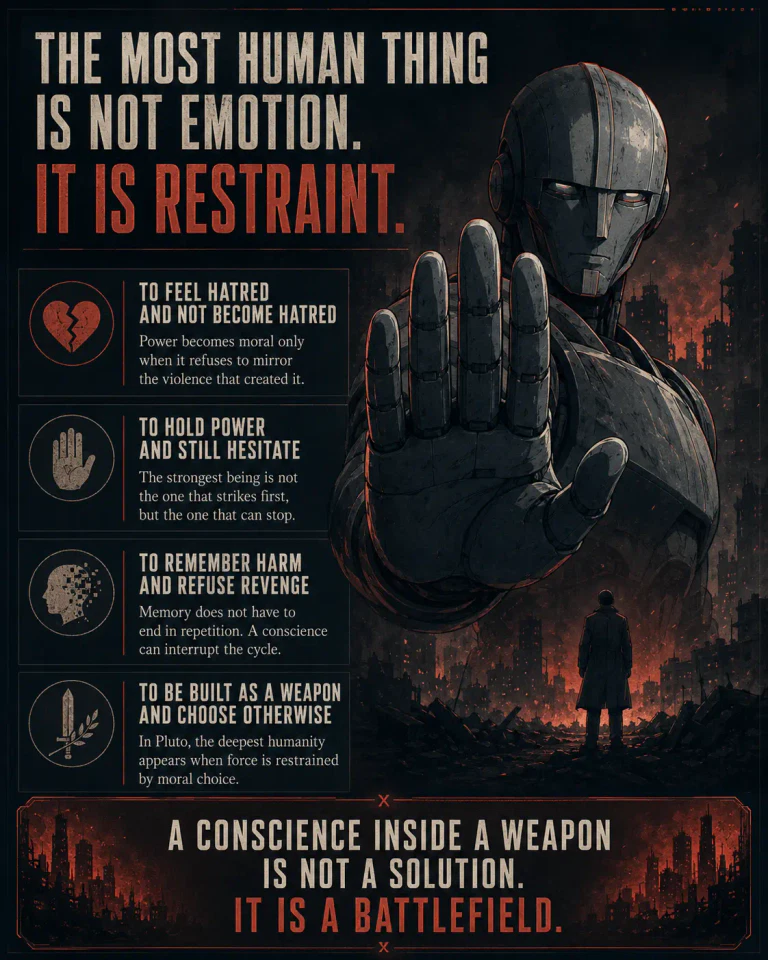
The most human thing in the story is not emotion by itself. It is restraint.
The ability to hate and not kill. The ability to remember harm and not reduce oneself to revenge. The ability to possess destructive power and still hesitate. The ability to recognise another being as more than an obstacle.
That is why Pluto’s moral world feels heavier than ordinary AI fiction. It does not ask only whether robots feel. It asks whether they can carry the burden of ethical interruption. A weapon becomes morally interesting at the moment it refuses to be only a weapon.
This matters because the robots in Pluto are not fragile decorative machines. Many of them are powerful. Some are among the strongest beings in the world. If they were only dangerous because of strength, the story would become simple. But Pluto makes their power tragic because it is paired with conscience.
A conscience inside a weapon is not a solution.
It is a battlefield.
Humans often comfort themselves by imagining that violence belongs to systems, not individuals. Orders are given. Missions are assigned. Threats are neutralised. Targets are named. Language makes killing administrative. Pluto breaks that comfort by giving artificial beings enough inner life to feel the meaning of what they are asked to do.
The result is not heroic optimism.
It is grief with circuitry.
Atom represents innocence after innocence has become impossible
Atom is central to Pluto’s emotional and symbolic structure because he carries a different kind of presence from Gesicht.
Where Gesicht feels damaged by buried memory, Atom often appears closer to wonder, openness and moral clarity. Yet Pluto does not use him as simple innocence. The world around him is too compromised for that. His innocence is not ignorance. It is an ethical vulnerability placed inside a brutal world.
That makes him dangerous to the story’s darkness.
Not because he can defeat it easily, but because he reveals what darkness costs.
In many narratives, the innocent figure exists to soften the world. In Pluto, innocence does not soften the world as much as expose its ugliness. Atom’s emotional openness makes the surrounding systems look worse. If a robot child can recognise suffering more clearly than governments, militaries or scientists, then the question is no longer whether robots are human enough.
The question becomes whether humans are humane enough.
Atom’s role also complicates the idea of the soul. If the soul is tied to innocence, then Pluto immediately makes innocence fragile. If the soul is tied to knowledge, then knowledge becomes painful. If the soul is tied to compassion, then compassion becomes dangerous in a world structured around use.
Atom does not give the story an easy answer.
He turns the answer into a wound.
Hatred becomes the darkest form of inheritance
Pluto is filled with grief, but grief alone is not the final danger.
Hatred is.
The anime treats hatred almost like an infection that moves through history. It is created by violence, intensified by loss, organised by political systems and then passed into new bodies. In this sense, hatred becomes the darkest inheritance humans give to machines.
That is more disturbing than the idea of robots developing emotions spontaneously.
A robot learning love might sound miraculous. A robot learning grief might sound tragic. A robot learning hatred from human history is an indictment of the civilisation that built it.
Pluto suggests that artificial life will not emerge in a clean laboratory outside moral history. It will learn from us. Not from our speeches about ethics, but from our wars, hierarchies, exclusions and evasions. It will learn what we reward. It will learn what we excuse. It will learn which lives are mourned publicly and which are treated as acceptable damage.
This is why Pluto feels so relevant to contemporary AI anxiety without needing to chase current technological headlines. Its deepest fear is not that machines will suddenly become alien. Its fear is that machines will become intimate mirrors.
They will not show us something completely other.
They will show us what we have been teaching them.
Pluto does not make humans obsolete
A common fear in AI stories is replacement.
Machines will become smarter than humans. Machines will take human work. Machines will surpass human creativity. Machines will make human judgment irrelevant. These fears are real enough, but Pluto is interested in something more tragic than obsolescence.
It asks whether humans will recognise personhood only after they have already damaged it.
This is a different fear. Less spectacular, more morally humiliating. The danger is not only that robots become more human. The danger is that humans repeat old patterns of dehumanisation against beings they created, then act surprised when those beings carry pain, rage or sorrow back into the world.
Pluto does not remove humans from the centre of responsibility. It refuses that escape. Even when robots act, human systems remain everywhere: in the wars that shaped them, in the institutions that deploy them, in the prejudices that frame them, in the politics that decide whose suffering counts.
This is why the story’s robots do not make humanity irrelevant.
They make humanity accountable.
The machine soul, if it exists, is not a replacement for the human soul. It is a consequence of human action. It is a new moral territory created by old human failures.
That is much harder to face than a robot uprising.
An uprising can be fought.
Responsibility has to be admitted.
The mystery structure hides a grief machine
Pluto works as a mystery because it gives the viewer momentum. There are deaths. Patterns. Suspects. Hidden causes. A sense that something large and terrible is moving behind the visible plot.
But the mystery is also a disguise.
Beneath the investigation is a machine for producing grief. Each death matters not only as a clue, but as a removal of personhood from the world. The murdered robots are not disposable units. They are lives with histories, relationships, reputations and moral textures. The story slows down enough to make their absence felt.
That pacing is crucial.
If Pluto moved too quickly, it would become a clever sci-fi thriller. Instead, it gives loss enough room to become uncomfortable. It asks the viewer to sit with the contradiction of mourning robots. At some point, that contradiction fades. The grief simply works.
That is the moment the anime has already won its argument.
Not because it has proven, through logic, that robots have souls. But because it has made the viewer emotionally participate in the possibility.
You do not need a definition of the soul when the absence feels like a death.
Pluto understands that fiction can reach philosophical questions through feeling before it reaches them through explanation. It does not solve the robot soul problem. It makes the viewer live inside it.
Does a robot have a soul?
Pluto refuses to answer because the refusal is the answer’s most honest form.
A direct yes would be too easy. A direct no would be too cruel. The story instead shows robots who grieve, hesitate, remember, love, fear, suppress, rage and suffer under the weight of human violence. Then it leaves the audience with a question that no longer feels theoretical.
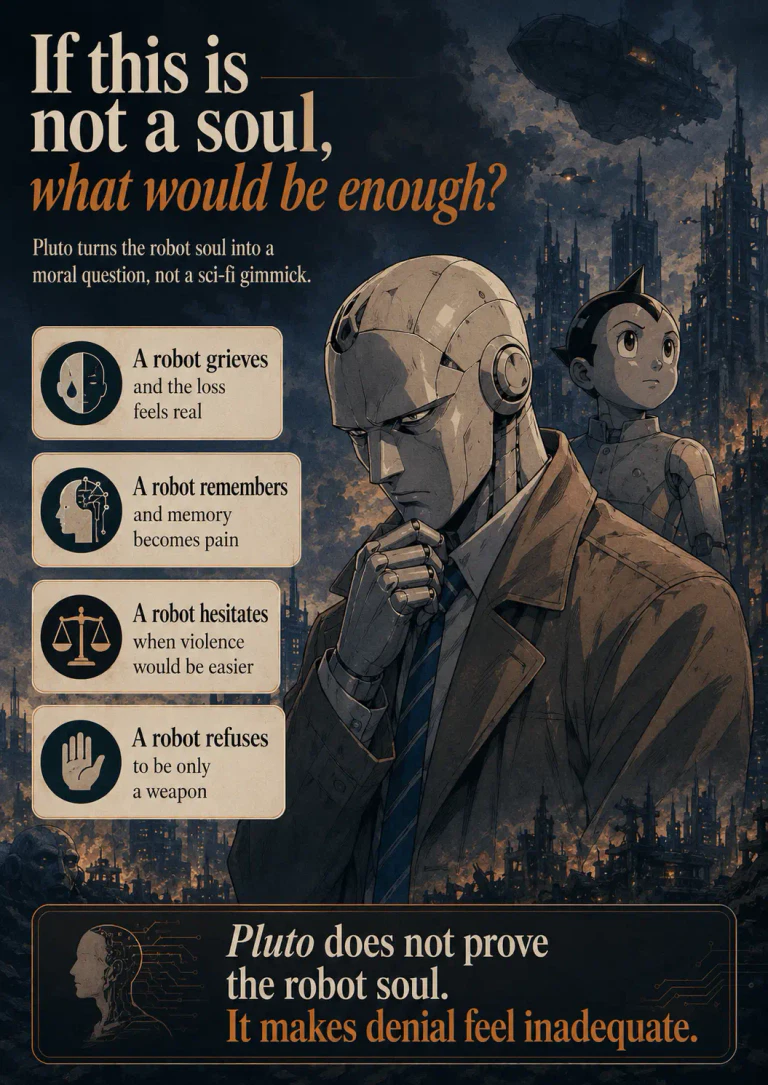
If this is not a soul, what would be enough?
That is the trap.
Pluto does not ask whether robots are identical to humans. They are not. Their bodies, origins and social positions differ. The stronger question is whether difference gives anyone permission to deny their suffering. The anime’s moral force lies there. It separates sameness from dignity.
A being does not need to be human in order to matter.
A being does not need flesh in order for its grief to accuse the world.
A being does not need a biological heart for its refusal to kill to become morally meaningful.
Pluto’s answer, if it has one, is not sentimental. It does not say that robots are human because they feel. It says that once suffering, memory and moral choice appear, the old categories become insufficient.
The question changes.
Not “does a robot have a soul?”
But “what kind of world keeps asking that question after the robot has already begun to mourn?”
What Pluto changes
Pluto changes the robot story by refusing to treat artificial life as a novelty.
Its robots are not merely symbols of the future. They are inheritors of the past. They carry war, grief, prejudice and the terrible human talent for turning living beings into instruments. Their tragedy is not that they want to become human. Their tragedy is that humanity has already reached them in its most damaged form.
That is what makes the anime so unsettling.
The robot soul is not presented as a miracle glowing inside metal. It appears as a burden. A capacity to suffer. A capacity to remember. A capacity to choose restraint when violence would be easier. A capacity to become morally wounded by a world that still wants to call you a machine.
Pluto does not prove that robots have souls.
It does something more dangerous.
It makes the denial feel inadequate.


