

Key takeaways from the Episode 4: Sophita vs. Casshern analysis
The profound encounter between the immortal Casshern and the combat-obsessed Sophita serves as a complex psychological exploration of artificial existence. By contrasting paralyzing self-loathing with the joyful celebration of destruction, the narrative dismantles pathological survival schemas to reveal the agonizing birth of genuine compassion:
- 1. The ideological clash between self-negation and absolute affirmation While Casshern is paralyzed by pacifist guilt and views his immortal programming as a curse, Sophita enthusiastically embraces her destructive nature. She completely objectifies her opponents, treating brutal combat not as a source of shame, but as the ultimate form of intimacy, communication, and transcendent joy.
- 2. The twisted paradox of salvation through annihilation When faced with Casshern's profound apathy and the immense psychological torment of his immortality, Sophita's selfish desire for eternal battle undergoes a radical redefinition. She attempts to euthanize him, interpreting the infliction of death as the highest form of heroic empathy and a merciful release from a dying world.
- 3. The epistemological shock and the triumph of humanism The act of striking Casshern shatters Sophita's objectifying worldview, triggering an irreversible emotional awakening. By finally asking for his name, she transitions from a mindless predator to a sentient being capable of authentic sorrow, recognizing that the joy of existence is inextricably bound to the fragile vulnerability of the other.
The fourth episode of the anime series "Casshern Sins" focuses entirely on the profound encounter between the immortal protagonist, Casshern, and a unique robot named Sophita. Casshern wanders through a post-apocalyptic world consumed by the Ruin. He suffers from amnesia and overwhelming guilt for his past actions. Sophita abruptly interrupts his melancholic journey. She is widely known as the Angel of Ruin and presents an absolute anomaly in a reality dominated by despair and decay. This meeting evolves into a highly complex psychological dialogue. They explore the acceptance of one's own brutal nature and the definition of love in a dying universe.
Visual and psychological design of Sophita
Sophita intentionally breaks the visual conventions of the bleak world she inhabits. She appears as an eruption of vibrant color and vitality. She is a tall female robot with dark skin and massive, bright pink hair. Her deep, forest-green eyes and golden shirt reflect an inner fire. This vivid energy graphically represents her psychological architecture. She stands out as a stark contrast to the rusting machines that cowardly await their end.
Combat as proof of life and substitute for love
The central element of Sophita's psyche is her complete and fanatical devotion to fighting. She seems completely cut off from the standard spectrum of emotions. Her only drive is the pursuit of combat and destruction. She fights solely because it brings her transcendent joy. She adapts a radical version of the Cartesian concept by assuming she exists only when she fights.
She rushes towards her own destruction completely consciously. In this universe, she represents a very specific form of love. This is a highly pathological affection expressed through brutal violence and the annihilation of her opponents. For Sophita, crossing blades is equivalent to an act of ultimate intimacy.
A code of honor in a lawless world
Despite her terrifying title, Sophita maintains a strict and rigorous code of honor. This separates her from the mindless scavengers inhabiting the wastelands. She frequently asks for permission to fight or waits for her opponent to strike first. This crucial behavioral nuance elevates her to the status of a noble warrior. Her tragedy stems from being trapped in a reality that cannot appreciate martial arts. She rejects her frightening nickname and claims her only genuine desire is a pure fight.
Acceptance versus negation of one nature
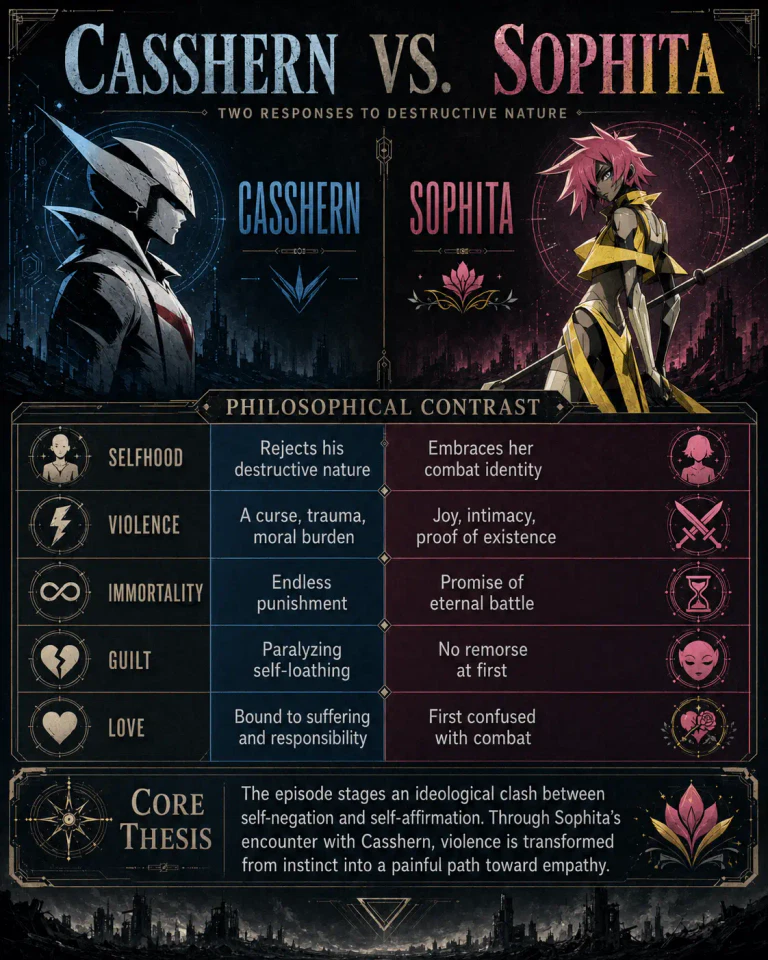
The main analytical axis of this episode rests on a fundamental ideological contrast between Casshern and Sophita. Casshern rejects his destructive programming and feels a paralyzing self-loathing. He demonstrates a strong, pacifist resistance to using violence. Sophita represents the absolute antithesis of this attitude. She possesses massive destructive potential but feels no guilt about it. She enthusiastically embraces her role as a fighter and believes there is no reason for shame.
| Domain of analysis | Casshern's perspective | Sophita's perspective |
|---|---|---|
| Attitude towards own programming | Categorical rejection and self-hatred | Full affirmation and joyful celebration |
| Approach to violence | Extreme pacifism as combat is a curse | Fiery passion as fighting is the sole meaning |
| Perception of immortality | A burden and the highest form of punishment | Fascination and promise of eternal battle ecstasy |
| Moral responsibility | Overwhelmed by the burden of global guilt | Total ignorance and lack of remorse |
The fact that Sophita finds beauty and meaning in the exact things that disgust Casshern shakes his foundations. These elements include strength and the ability to take lives. This poses a difficult question about the nature of psychological masochism. Sophita suggests that accepting oneself brings relief and allows one to find a purpose.

Violence as communication and brutal aesthetics
The creators utilize a drastic, physiological realism of destruction to emphasize the weight of violence. Viewers watch oil pour from robotic bodies while machines are torn to shreds. This brutal aesthetic contrasts sharply with the flawless appearance of Casshern. For Sophita, fighting serves as a unique form of communication and intimacy. She notices Casshern possesses a perfect body and stalks him like a predator. When ordinary bandits attack, she eliminates them with powerful and murderous slashes. She protects him while demonstrating her overwhelming combat speed.
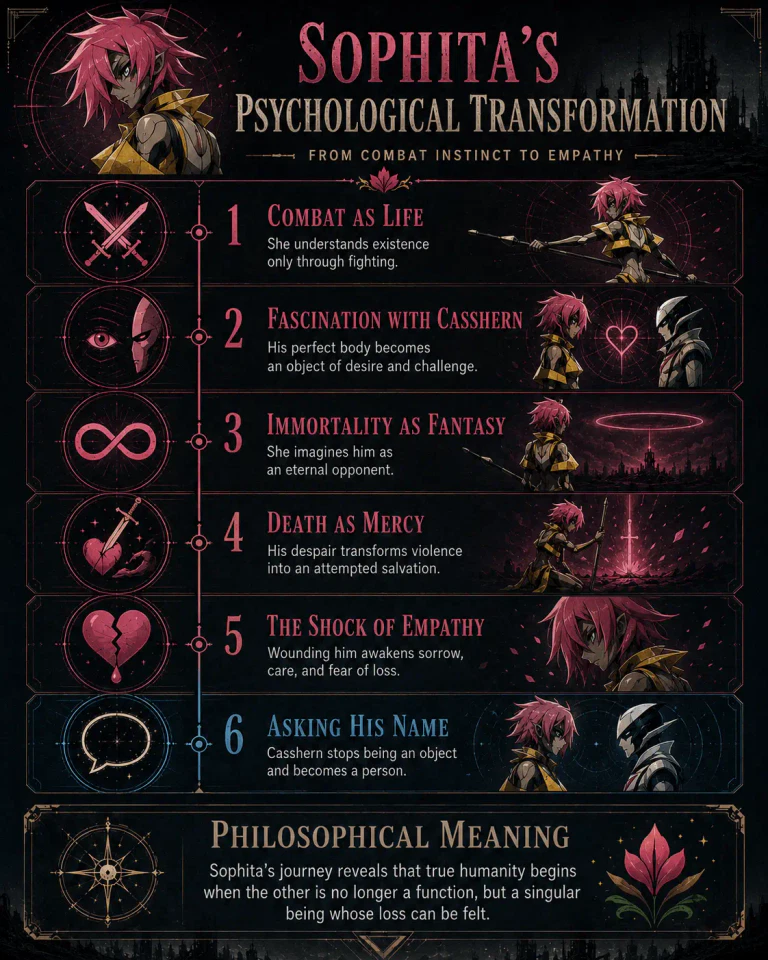
Later, Sophita fights an old robot friend and nearly dies until Casshern intervenes. She learns at this exact moment that Casshern is an immortal being. This information triggers a deeply euphoric reaction in her mind. She believes having an immortal opponent guarantees the possibility of experiencing infinite battle ecstasy. She considers this the absolute ideal and concludes she has fallen in love. She forces him into a clash by attacking him unexpectedly because fighting remains her only language.
The paradox of salvation through annihilation
The most philosophically complex moment occurs in Sophita's mind during her desired fight with Casshern. Her initial motivation, based on a selfish desire for endless combat, undergoes a drastic redefinition. Casshern maintains absolute calm and avoids his typical destructive battle frenzy. His lack of aggression combined with a profound wave of apathy exposes the agonizing truth about his immortality. Casshern suffers immensely because he cannot die along with the ruined world.
A fundamental paradox emerges as Sophita decides to offer salvation by inflicting death. She sees his unimaginable mental pain and decides to kill him to grant him mercy. Immortality has proven to be a curse in this reality. Euthanasia in Sophita's interpretation becomes the highest form of heroic empathy. It represents the ultimate act of helping a being who cannot end his own suffering.
| Phase of interaction | Sophita's psychological state | Perception of intention |
|---|---|---|
| Initial fascination | Interest in the perfect body of a stranger | Desire to satisfy her own need for stimuli |
| Discovery of immortality | Euphoria mistakenly identified as infatuation | Desire to create an infinite loop of combat |
| Observation of despair | Confusion and growing empathy towards suffering | Intent to kill as an act of grace |
| Climax of the clash | Cognitive shock and true capacity to feel loss | Paralysis of the will to fight |
When Sophita pierces his body with her blade, a crucial epistemological shock occurs. The strike is not fatal, and Casshern immediately begins his supernatural regeneration. She holds the wounded protagonist and her programmed code of conduct shatters completely. She realizes with immense surprise that she delivered a blow completely devoid of murderous intent.
Affective breakthrough and the birth of empathy
The act of physically wounding Casshern triggers an irreversible revolution in Sophita's psyche. She suddenly undergoes a profound emotional awakening. She realizes how unimaginably painful it would be if a being she loved actually ceased to exist. She experiences authentic sorrow for the first time, and tears appear in her eyes. This affective reaction proves that machines can be humanized by experiencing the fragility of existence. She abandons her bloodlust and makes a verbal confession of her newly discovered feelings.
Philosophical significance of asking a name
The culmination of the episode is the final scene before the characters part ways. Sophita asks her opponent for his name for the very first time in her life. The philosophical and psychological consequences of this dialogue require detailed analysis.
From objectification to recognizing the other
Sophita previously based her functioning on the complete objectification of surrounding entities. All encountered machines were nameless tools providing her with entertainment. Opponents possessed no identity, and she killed them without remorse. Asking for his name constitutes a complete dismantling of this pathological schema. Obtaining the name signifies a transition to an individualized grasp of the other entity. She symbolically recognizes Casshern as a person possessing his own history and pain. This proves she has achieved the capacity for genuine compassion.
Truth of the world and ultimate humanism
This moment represents the instant Sophita painfully experiences the truth about the world. She learns that relationships between self-aware organisms are inevitably coupled with the risk of loss. The joy of existence remains inextricably linked to death and suffering. The world is a space woven from fragile, emotional connections. She learns that her interlocutor is the legendary Casshern, but her feelings remain unchanged. Their paths diverge, but she retains her newly acquired emotional awareness. The act of realizing the value of someone else's name is a true triumph of humanism.


