
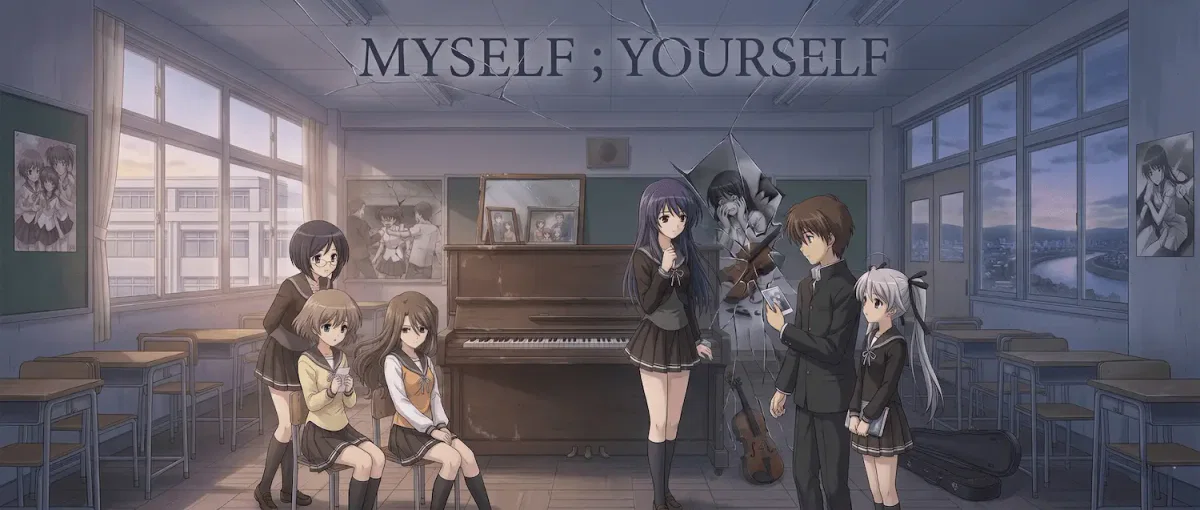
Key takeaways from the Myself ; Yourself analysis
Masquerading as a generic slice-of-life romance, this 2007 anime systematically shatters viewer expectations by plunging into uncomfortable, grounded depictions of severe psychological trauma and human fragility:
- 1. The deceptive narrative and deeply scarred characters The series weaponizes misdirection, lulling viewers with comedic tropes before revealing that its cast is drowning in repressed trauma. From brutal bullying and suicide attempts to horrific domestic abuse and murder-suicide, the characters are desperately masking their psychological devastation.
- 2. A victim of a brutal competitive landscape The show's raw, ugly realism struggled to find a mainstream audience in the autumn of 2007. It was completely overshadowed by the polished, magical catharsis of Clannad and the avant-garde brilliance of Ef: A Tale of Memories, relegating it to a forgotten cult classic status.
- 3. Structural adaptation flaws and a polarizing finale Compressing a sprawling, branching visual novel into a linear timeline resulted in rushed pacing and sanitized plotlines. Furthermore, the abrupt 10-year time jump ending provided a jarring emotional whiplash with unearned redemptions, even though it ultimately delivered a deeply cathartic musical payoff.
Time is a cruel thief. It steals away precious memories and buries brilliant works of art beneath the relentless march of seasonal trends. The Myself ; Yourself anime is a profound victim of this temporal theft, airing in the fall of 2007 only to slip into obscurity. This old classic deserves much better.
At first glance, this series masquerades as a standard high school romance. A teenage boy returns home after five long years, ready to playfully reconnect with his childhood friends. However, this sunny exterior is an elaborate trap designed to completely shatter the viewer's expectations. It promises laughter but delivers devastation.
The narrative quickly abandons its lighthearted premise to explore the darkest corners of the human psyche. It plunges into horrifying themes of suicide, domestic abuse, and crippling mental illness with shocking sincerity. For those who endure its brutal emotional whiplash, it remains a true hidden gem. The emotional weight is staggering.
Modern audiences often crave stories that do not shy away from ugly truths. This show systematically breaks down the emotional defenses of its cast, refusing to offer simple solutions to deeply ingrained trauma. It stands as a testament to narrative bravery. Unearthing this forgotten anime masterpiece rewards the viewer with an uncomfortably real portrayal of human fragility.
Unearthing the forgotten anime
The history of this production is intrinsically linked to the evolution of its creative team. The source material was a sprawling visual novel developed by Regista and published by Yeti for the PlayStation 2 console. It featured a remarkably dense narrative structure. Translating this interactive experience into a linear television format was a monumental challenge.
The original script was heavily influenced by Takumi Nakazawa, a writer renowned for his mind-bending work on the Infinity series. Nakazawa injected a distinct layer of psychological complexity into the foundation of the story. The characters were never meant to be simple archetypes. They were designed as deeply flawed individuals, each carrying a secret burden that would eventually crush them.
Directorial duties for the television adaptation were shared by Tetsuaki Matsuda and Yasuhiro Kuroda, with series composition by Gō Zappa. They faced the daunting task of condensing dozens of hours of gameplay into a strict thirteen-episode run. This required ruthless editing. Certain character routes had to be truncated, consolidating the overarching mystery into a single, devastating timeline.
Visually, the team leaned heavily on the original character designs provided by Mutsumi Sasaki. Sasaki was already a respected figure in the industry, known for generating appealing yet grounded aesthetics. The translation from static game sprites to fluid animation was handled competently. The artistic direction succeeded in capturing the melancholic, oppressive atmosphere required by the heavy script.
Studio Doga Kobo origins
The production of this series represented a massive milestone for its animation studio. Founded in 1973, the company spent decades quietly assisting other prominent studios with their monumental projects. They were industry veterans, yet they lacked a signature project of their own. It was not until 2007 that Studio Doga Kobo finally secured the opportunity to helm a solo television production.
This debut was a massive undertaking with everything on the line. Transitioning from a supporting player to a lead creative force required an entirely new level of internal organization. They had to prove they could carry a dramatic narrative arc from conception to final broadcast. The pressure to succeed in a highly competitive market was immense.
While their later works would heavily define the slice-of-life comedy genre, their first independent outing was surprisingly grim. The animation quality occasionally betrayed their lack of experience as a solo lead, with some awkward transitions and inconsistent character models. Nevertheless, their raw ambition bled through the screen. They tackled the harrowing subject matter without flinching.
Constructing the narrative
The brilliance of the series lies in its masterful, almost cruel use of misdirection. The opening episodes present a charming, if slightly unoriginal, comedic slice-of-life experience. The protagonist returns to town, rediscovers his friends, and navigates mild teenage awkwardness. The vibrant colors establish a comfortable visual baseline. Viewers are lulled into a false sense of security.
The cracks begin to show in subtle, almost imperceptible ways. A harmless riverside picnic takes a dark turn when the sight of a bloody fish causes a severe panic attack. A character freezes in absolute terror at the mere sight of a cooking stove. These brief glimpses of underlying psychological distress hint that the characters are merely acting out the roles of normal teenagers. They are terrified children pretending that everything is fine.
By the middle of the season, the facade shatters completely. The show abandons the comedic interludes and plunges headfirst into unrelenting melodrama. The shift is incredibly jarring. It alienates viewers who were expecting lighthearted fun while captivating those drawn to tragedy. The contrast between the cheerful opening animation and the grim reality of the episodes becomes a profound statement on how people mask their pain.
| Episode Number | Episode Title | Original Air Date |
| 1 | Nostalgic Place | October 3, 2007 |
| 2 | The Important Melody | October 10, 2007 |
| 3 | Cookies and Pebbles | October 17, 2007 |
| 4 | Not a Child | October 24, 2007 |
| 5 | The Cherry Tree That Won't Bloom | October 31, 2007 |
| 6 | I'm An Adult | November 7, 2007 |
| 7 | Teacher's Caramel | November 14, 2007 |
| 8 | Secret Post | November 21, 2007 |
| 9 | Do Your Best! Animenger! | November 28, 2007 |
| 10 | For Sakura's Sake | December 5, 2007 |
| 11 | Confession | December 16, 2007 |
| 12 | Red Memories | December 19, 2007 |
| 13 | Bonds | December 26, 2007 |
This episode structure demonstrates the slow burn. The initial titles suggest innocent childhood memories. However, as the broadcast continued through November, the narrative aggressively pivoted. The safety of the early television episodes was completely eradicated by the time the winter finale approached.
Sana Hidaka and deep depression
Sana is initially presented as the quintessential blank-slate protagonist. He is polite, somewhat generic, and seemingly well-adjusted to his return to Sakuranomori. He eats a lot of chicken and tries to smile through his awkward reunions. However, his calm exterior hides a deeply scarred psyche. He is a boy constantly running from his own shadow.
During his five years away from his hometown, he was subjected to relentless, soul-crushing torment. The severe bullying at his new school escalated to a point where he could no longer endure the daily agony. Driven to absolute despair, Sana attempted to end his own life. He brutally slashed his wrists. This desperate act left him with severe physical and emotional scars.
He survived, but the trauma fundamentally broke him. He developed a crippling fear of blood, leading to his severe panic attack during the fishing trip. To hide his immense shame and the physical evidence of his attempt, he constantly wears a large wristwatch. It acts as a physical barrier. The heavy metallic watch separates his hidden trauma from the judgmental outside world.
His return to his hometown is an act of sheer desperation. He is searching for the innocence he lost, hoping the familiar streets will magically heal his fractured mind. He fails to realize that the friends he left behind have their own profound issues. Sana's journey is not about fixing others. It is about finding the courage to finally confront his own bleeding emotional wounds.
Nanaka Yatsushiro and the fire
If Sana's trauma is an internal rotting, Nanaka's is an explosive devastation. As a child, she was cheerful, clingy, and deeply attached to Sana. When they finally reunite, she is cold, distant, and prone to violent outbursts, even slapping him upon their first meeting. Her transformation from a sweet girl into a gloomy cynic is the central narrative driving mystery of the first half of the show.
The truth behind her demeanor is undeniably horrific. During the years Sana was away, Nanaka's family was destroyed in a single night. Her father discovered a devastating secret: Nanaka was not his biological daughter. Her mother had an affair with Kaoru Sakuraba, Nanaka's beloved violin teacher. Upon learning this after Sakuraba's death, the father snapped into a violent psychotic rage.
He brutally beat his wife before dousing the living room—and himself—in gasoline. He ignited a lighter, causing a catastrophic murder-suicide that Nanaka witnessed firsthand. She barely escaped the inferno, clutching only her violin and a bracelet Sana had given her. The sheer magnitude of the horror caused her mind to completely fracture. She developed severe repressed childhood memories.
She blocked out the reality of the fire, living in a state of traumatized denial. When the memories finally break through her mental barriers, the emotional weight crushes her. She attempts suicide by slitting her own wrists and drowning in a bathtub. It is only through Sana's intervention, and their shared understanding of absolute despair, that she begins to crawl back from the dark psychological abyss.
The Wakatsuki twins run away
The Wakatsuki twins represent a different flavor of psychological horror. They are the victims of domestic abuse and societal condemnation. Shusuke and Shuri are fiercely loyal to one another, presenting a united, boisterous front to their friends. However, their home life is a literal nightmare. They suffer under the tyrannical rule of an abusive family patriarch who beats them relentlessly.
Shusuke frequently takes the brunt of the physical violence to protect his sister. This constant shared suffering fosters an intensely codependent bond between them. Their closeness, born out of mutual survival, eventually crosses the line of societal acceptability. The series heavily implies an incestuous romantic subtext between the twins. They are two wounded animals who only feel safe in each other's presence.
When a malicious rumor about their relationship spreads through the school, the societal backlash is immediate and severe. Their father plans to separate them forever, a prospect they find entirely intolerable. Rather than submit to a system that has only ever brought them pain, they choose to completely abandon their lives. The twins run away together, rejecting the oppressive societal expectations that seek to tear them apart.
Their departure is a tragic victory. They secure their physical freedom, but at the cost of their entire established world. The show does not condemn them; instead, it condemns the cruelty of the adults who forced them into this corner. Their storyline serves as a brutal indictment of a community that ignores domestic violence while punishing unconventional coping mechanisms.
| Character Name | Core Psychological Trauma | Coping Mechanism |
| Sana Hidaka | Severe bullying, suicide attempt | Wearing a watch, avoiding conflict |
| Nanaka Yatsushiro | Witnessed parental murder-suicide | Repressing memories, violent outbursts |
| Shusuke Wakatsuki | Physical abuse, protecting sister | Codependency, self-sacrifice |
| Shuri Wakatsuki | Domestic violence, societal judgment | Extreme reliance on her twin brother |
| Asami Hoshino | Romantic rejection, intense jealousy | Forging rumors, manipulating friends |
This table outlines the psychological devastation central to the plot. The series refuses to pull punches. Each character is trapped in a specialized cycle of suffering, requiring immense effort to break free.
Asami Hoshino and toxic malice
Asami Hoshino is perhaps the most complex and frustrating character in the entire narrative. Introduced as a sweet, gentle junior who actively volunteers at a local retirement home, she appears to be the paragon of innocence. This is a terrifyingly effective mask. Beneath her soft-spoken exterior lies a highly vindictive and deeply disturbed individual. She represents the terrifying psychological duality that can fester in seemingly perfect people.
Her hidden malice is violently triggered by romantic rejection. Asami harbors a deep, obsessive, homosexual love for Shuri Wakatsuki. When she confesses her intense feelings and Shuri gently turns her down, insisting they remain platonic friends, Asami's affection twists into pure hatred. Consumed by a desperate need for revenge, she pens an anonymous letter to the school administration. This single act of calculated social betrayal destroys the lives of her supposed friends.
What makes Asami so chilling is her unnatural ability to maintain her sweet facade while orchestrating total ruin. She easily manipulates everyone around her, actively sabotaging the mending relationship between Sana and Nanaka. Yet, the anime refuses to paint her as a simple cartoon villain. She occasionally demonstrates genuine care, even protecting Shuri from physical harm at one later point. Ultimately, her toxic teenage jealousy costs her the very person she loved most.
Aoi Oribe as acoustic relief
In a cast drowning in unspeakable trauma, Aoi Oribe serves as the vital emotional life raft. She is Sana's older cousin, characterized by her energetic personality, busty figure, and impossibly high-pitched voice. Her primary narrative function is to provide necessary levity. She injects bursts of humor into an otherwise suffocating storyline. She acts as the critical comedic tension relief, preventing the show from collapsing under its own depressive weight.
Her voice actress, Tomoko Kaneda, delivers a highly polarizing performance. Many viewers find the squeaky, absurdly high register grating, claiming it actively ruins their immersion in the drama. However, others argue that her voice is a stroke of unhinged genius, perfectly conveying raw, unfiltered emotion. When Aoi is excited, she sounds genuinely unhinged in her joy. Her unique vocal acoustic performance is a chaotic element that adds a bizarre realism to her character.
Despite her comedic framing, Aoi is an essential gear in the narrative machine. She is the social glue that forces the fractured group back together. It is Aoi who pushes Sana to reconnect with Nanaka, and it is Aoi who consistently refuses to let her friends succumb to their despair. Her unwavering optimism stands in stark contrast to the pervasive darkness surrounding her. Without Aoi's tireless efforts, the entire cast would have spiraled into total isolation.
Analyzing the haunting music
Music in this series is not merely background noise; it is a vital, beating narrative organ. The score, composed by 5zizz and Chiyomaru Shikura, is incredibly deliberate in its emotional manipulation. The background tracks shift seamlessly from lighthearted pop to haunting strings, directly mirroring the mental degradation of the cast. The music speaks when the characters lack the words, relying heavily on auditory thematic storytelling.
This deception is heavily reinforced by the show's auditory presentation. The opening theme, performed by KAORI, is a fiercely energetic track. Known as "Tears Infection", the song features a groovy motive that explodes into an upbeat, infectious chorus. It is entirely at odds with the harrowing events that unfold later in the series. This dissonance is intentional, serving to amplify the shock when the narrative inevitably fractures. It is a brilliant musical misdirection tactic.
The most crucial piece of music in the show is "The Important Melody" (Taisetsu na Merodī). This is the song Nanaka composes on her violin for Sana before his departure. It is an unfinished piece, symbolizing their interrupted childhood and the distant promise of a future reunion. The melody itself is deeply melancholic, played with a raw intensity that cuts through the silence. It serves as a recurring thematic musical motif, representing both the innocence they lost and the bond that still ties them together.
The violin itself is a heavily loaded symbol. Nanaka was forced to learn the instrument by her mother, a desperate attempt to connect the girl to her biological father, the violin instructor. Thus, the very instrument she uses to express her pure love for Sana is intimately tied to the horrific secret that destroyed her family. Every time Nanaka plays the solo violin, she is grappling with the ghost of the father she never knew. The music becomes a beautiful, agonizing auditory contradiction.
Clannad and Ef comparisons
To understand why this brilliant series fell into obscurity, one must critically examine the year it aired. The autumn of 2007 was an absolute juggernaut season for emotional anime adaptations. It was the season that unleashed Clannad upon the world, an adaptation of a Key visual novel that fundamentally redefined the dramatic romance genre. The sheer cultural dominance of Clannad absorbed nearly all the oxygen in the room, completely overshadowing dozens of competing seasonal productions.
Clannad excelled through its polished animation by Kyoto Animation and its sprawling, multi-generational narrative. It used subtle supernatural elements to heighten the emotional stakes. In contrast, Doga Kobo's work was grounded in brutal, ugly reality. It lacked the magical realism of its competitors, offering instead a stark portrayal of arson, suicide, and incest. This made the show a much harder sell. It was a deeply uncomfortable viewing experience, lacking the warm, fuzzy catharsis universally provided by Clannad.
Another major competitor airing simultaneously was Ef: A Tale of Memories, directed by Shin Oonuma at studio Shaft. Ef boasted wildly experimental visuals, dazzling cinematography, and a highly stylized approach to its intersecting romantic dramas. Squeezed between the emotional titan of Clannad and the avant-garde brilliance of Ef, the more grounded, visually standard approach of our subject matter simply got lost in the shuffle. It became the quintessential underrated anime classic, praised by a small cult following but ignored by the mainstream.
| Anime Title | Animation Studio | Core Narrative Themes | Visual Style Approach | Legacy Status |
| Myself ; Yourself | Doga Kobo | Abuse, suicide, memory loss | Standard, muted realism | Forgotten cult classic |
| Clannad | Kyoto Animation | Family, illness, parallel worlds | Highly polished, moe aesthetics | Universally acclaimed masterpiece |
| Ef: A Tale of Memories | Shaft | Amnesia, artistic passion, grief | Avant-garde, heavy shadows | Respected stylistic benchmark |
This table clearly illustrates the impossible competitive landscape of late 2007. Doga Kobo's debut struggled because it lacked the visual flair of Shaft and the massive built-in fanbase of Key. It was a bleak, demanding show competing against polished titans in a saturated romantic drama market.
Visual novel adaptation flaws
Adapting a sprawling, interactive game into a linear, thirteen-episode television show requires massive structural changes. The visual novel format allows a player to spend dozens of hours exploring individual character routes, deeply internalizing their specific traumas. The television adaptation, however, was forced to combine all these distinct, heavy storylines into a single, cohesive narrative. This resulted in an incredibly dense story pacing structure.
In the original game, the player can choose to pursue different girls, leading to entirely distinct resolutions. For example, the game features a sequel scenario where Shusuke officially ends up with Asami Hoshino—a deeply unsettling pairing considering her actions in the anime. The television show had to establish a single, canonical timeline. It wisely chose to focus primarily on the relationship between Sana and Nanaka, pushing the other girls into secondary supporting cast roles.
While this created a strong central narrative, hardcore fans of the game criticized the severe lack of development for characters like Yuzuki and Hinako. Furthermore, the game explores the incestuous undertones between the Wakatsuki twins much more explicitly. If the player chooses to pursue Shuri, Shusuke is forced to acknowledge his buried romantic feelings for his sister. The anime dials this back significantly to pass broadcasting censorship. The adaptation is ultimately a sanitized, condensed version of the original source material, sacrificing interactive depth for narrative momentum.
| Aspect of Story | Visual Novel Experience | Anime Adaptation Approach |
| Character Focus | Multiple branching romantic routes | Linear focus on Sana and Nanaka |
| Twin Relationship | Explicitly explores incestuous feelings | Ambiguous, deeply codependent framing |
| Asami Hoshino | Can become a primary romantic interest | Remains a tragic, vindictive antagonist |
| Pacing | Slow, methodical exploration of trauma | Highly compressed, rapid emotional shifts |
This table highlights the necessary compromises made by the writing staff. While the interactive medium allows for exhaustive detail, the rigid television format demands continuous forward momentum. This dichotomy always alienates a portion of the original gaming fan base.
The polarizing anime epilogue
One of the most polarizing and heavily criticized aspects of the entire series is its conclusion. After relentlessly dragging the characters through unimaginable suffering for twelve episodes, the final episode abruptly skips forward ten years. This massive time jump attempts to provide neat closure for the entire cast in a remarkably short amount of time. The sudden shift from intense psychological trauma to a neat, happy ending gave many viewers severe emotional storytelling whiplash.
The ten-year jump reveals a drastically altered landscape. Little Hinako is now grown up and preparing for a romantic date with Youta. More controversially, Asami is miraculously absolved of her sociopathic teenage behavior. She is praised as a local hero for saving the town's nature park from corporate demolition. This particular resolution infuriated many critics, who felt that Asami suffered absolutely no consequences for destroying the Wakatsuki twins' lives. Her redemption feels entirely unearned, a hollow narrative resolution tacked onto a complex character.
Despite these glaring flaws, the finale delivers one undeniable moment of pure catharsis. The entire cast gathers at an open-air concert, where a beautiful, adult Nanaka steps onto the stage. She addresses the crowd, explaining that her first song is a culmination of all her painful memories and struggles. She finally plays the completed version of "The Important Melody", filling the park with the music she promised Sana a decade ago. This singular moment of artistic musical triumph provides a deeply satisfying payoff for her character arc.


