

Close reading · Kaiba
The series does not ask only whether memory makes a person. It asks who controls the body, recognition and social permission that let a surviving memory resume a life.
- Memory is a record, not a complete continuationA stored past cannot act, be recognized or claim a future until other systems accept it.
- Chroniko exposes the body market's real violenceHer body remains valuable after her memories are discarded. The asset survives because the owner does not.
- Neiro proves that recognition can be edited independentlyHer old memories survive in Hyohyo while her present memory makes the person she loved appear to be an enemy.
- Wealth buys continuity in layersThe powerful do not merely preserve data. They monopolize bodies, verification and the authority to decide whose life counts as resumed.
Kaiba begins with a science-fiction promise that sounds almost egalitarian: memories can be stored as data, bodies can be replaced, and physical death no longer has to end a person. The official Japan Media Arts Festival description states that premise directly. Yet the series immediately makes the promise unequal. Memories are traded or stolen. Bodies circulate as goods. Some people travel as protected data while others remain trapped inside bodies that can be repossessed.
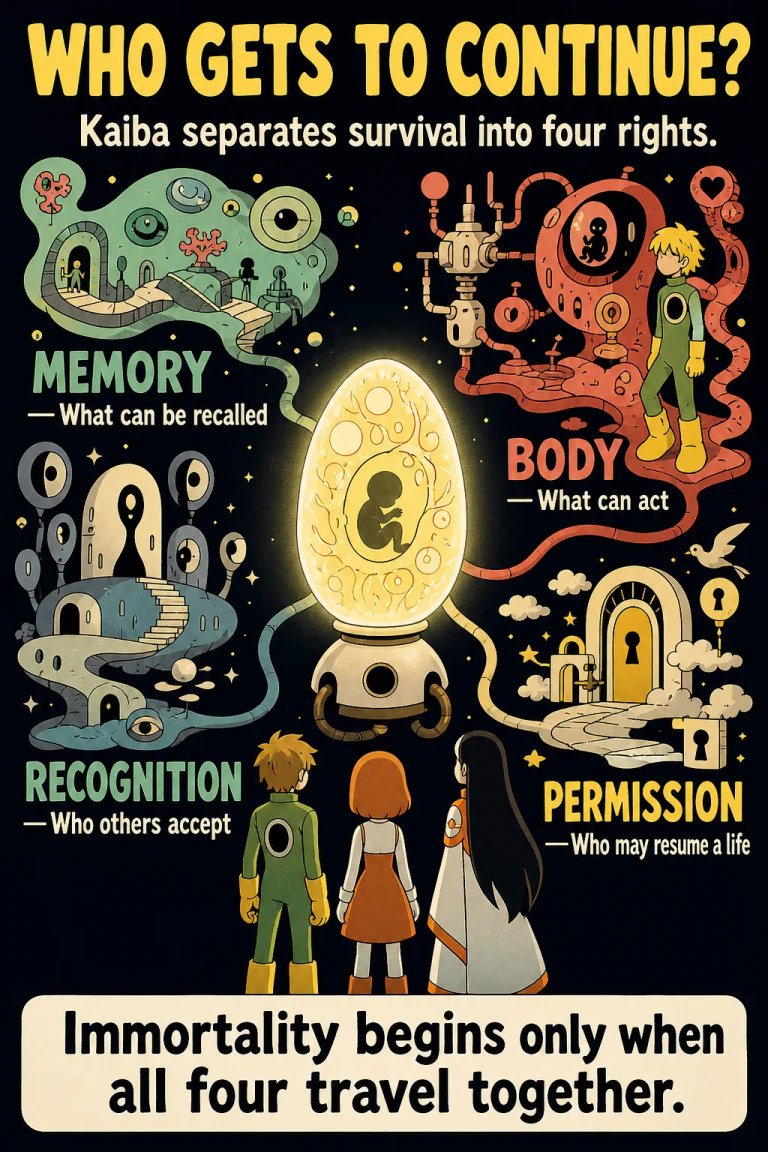
The usual interpretation—Kaiba asks whether memory defines identity—is correct but incomplete. It treats identity as a philosophical substance waiting to be located. Yuasa's world is more administrative and more cruel. A memory may survive perfectly and still fail to continue as a person because continuation requires four separable rights: the right to retain a past, inhabit a body, be recognized by others and resume a social life.
This four-right model is an interpretation of the series, not a scientific theory of consciousness. Masaaki Yuasa himself resisted the reduction of a person to neural signals alone when discussing the ideas behind Kaiba. The model is useful because the episodes repeatedly separate what the premise initially bundles together.
The technology stores memory, but society distributes continuation
In a conventional immortality story, the hard problem is technical: can a mind be copied without corruption? Kaiba starts after that problem has been solved. Its conflict begins when a reliable technology enters a stratified society. Once memory can move independently of flesh, every transfer creates a chain of custody. Someone owns the storage. Someone supplies the vessel. Someone accepts the name. Someone has the power to reject the claim.
The continuation test
A surviving memory becomes a resumed life only when four claims converge
MemoryCan the past still be recalled?
BodyCan the claimant act in the world?
RecognitionWill others accept who has returned?
PermissionMay that person reclaim a name, bond and future?
The distinction changes how the series' class politics work. Poor citizens do not simply lack better bodies. They lack the infrastructure that converts preserved memory into enforceable personhood. The rich can maintain backups, purchase desirable vessels and surround a transfer with institutional recognition. For everyone else, survival is conditional: the record may exist while the life it describes has already been reassigned.
Chroniko's death proves that a usable body can outlive its owner
Episode 3, “Chroniko's Boots,” turns the abstract body market into a precise moral event. Chroniko is poor, hopeful and materially vulnerable. When her body becomes useful to someone with greater purchasing power, the system does not preserve her as the body's rightful occupant. Her memories are discarded. The body remains available; the person who gave it a history is treated as expendable.
Chroniko's asymmetry
The market preserves the vessel by cancelling the claim inside it
Her body retains exchange value after her memory is thrown away. That reversal is the scene's accusation: the technology can separate body from person, but poverty decides which half receives protection.
This is more than a bleak example of commodification. It tells us what ownership means in Kaiba. If identity were simply memory, a complete backup should be enough to preserve Chroniko. If identity were simply body, the body's continued use should count as survival. The episode rejects both shortcuts. Chroniko disappears because no institution carries her claim across the transfer.
01
The body market is also a market in evidentiary power
Buying a body is valuable because the buyer can make the world accept the transfer. Chroniko cannot compel anyone to preserve the evidence that she was there first.
Neiro's old memory survives while her right to recognize Kaiba does not
Neiro supplies a different split. Her earlier memories—the version of her that loved Kaiba—survive in Hyohyo. Her present mind has been altered so that Kaiba appears to be an enemy. The record is not erased. What changes is the relationship between evidence and action: which memories she can access, how she interprets them and whom she is prepared to trust.
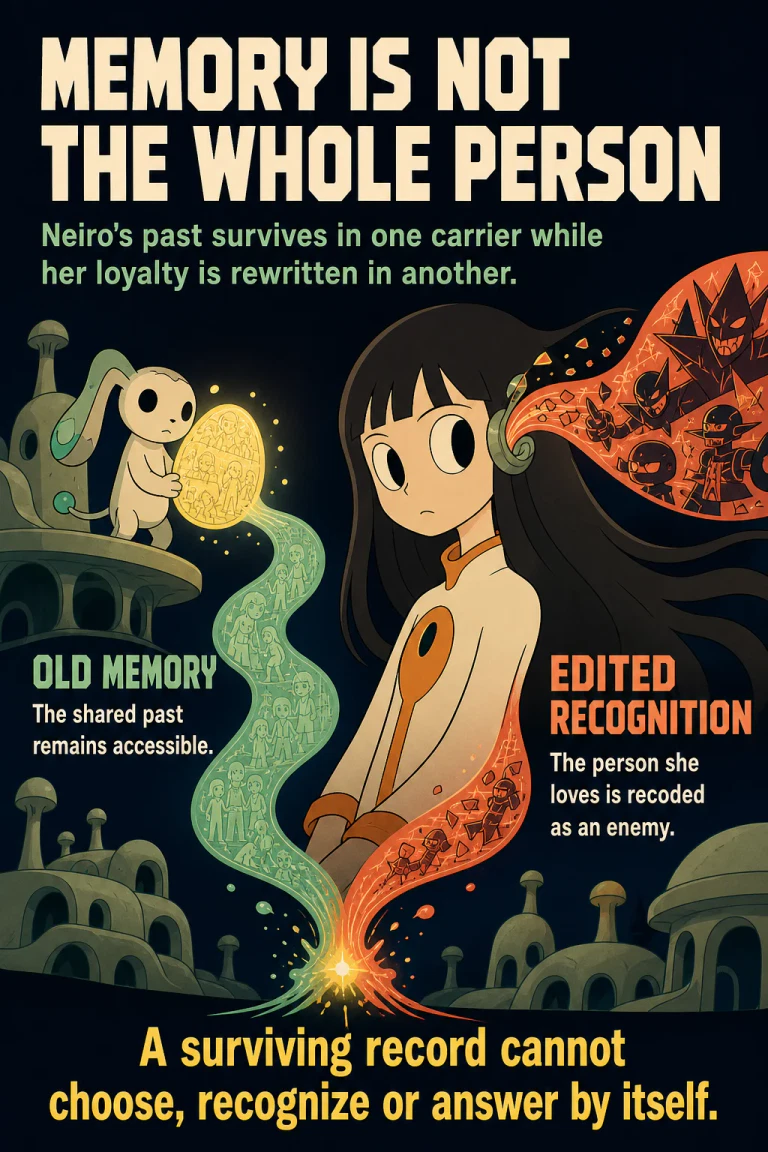
That distinction is visible in episode 9, when Neiro attacks Kaiba while Hyohyo tries to save him. It is also present in the quieter dinner scene discussed by critic Iain McNally: Neiro, in another body and with altered memories, recognizes something through Kaiba's way of pouring a drink. The gesture carries relational knowledge that explicit recall no longer supplies.
The pouring gesture
A relationship can survive as a learned movement after its story has been edited
Neiro's motherA physical manner is learned inside one relationship.
→
Neiro → KaibaThe motion passes forward even when the names attached to it become inaccessible.
The scene does not prove that love is stored in muscle. It shows that a person exceeds the explicit file they can narrate: relationships also leave habits, expectations and responses.
This is why Kaiba is not satisfied with the proposition that memory equals self. A stored memory can preserve information while losing its authority over the present. Conversely, a body can retain a gesture that points toward a relationship its current owner cannot explain. Continuity is distributed across records, embodiment and other people.
Warp's privilege is not endless memory but control of the verification system
Kaiba's recovered identity as Warp moves the argument from private tragedy to political structure. Warp does not only possess unusual continuity across bodies. His position gives that continuity public force. Others recognize the name, institutions react to it and bodies become available to sustain it. The same transfer that destroys Chroniko can restore Warp because power determines which claim the system authenticates.
The chest hole is therefore more than a visual mystery. It makes absence part of the protagonist's body: a missing past, a missing claim and eventually a space into which competing identities are projected. Recovering the file cannot finish the task. Warp has to decide what kind of authority the recovered identity will exercise.
In Kaiba, immortality is not the ability to avoid death. It is the power to make the world treat your next body as a continuation rather than an occupation.
The four-right reading
This also explains why the series' simple, elastic art is not a disguise for “serious” ideas. The few solid lines and bold colors keep bodies visibly stable even as ownership changes. A vessel can look innocent, comic or childlike while carrying a history of coercion. The contrast forces the viewer to stop using visual familiarity as proof of personal continuity.
The ending answers ownership more clearly than identity
Kaiba does not close its metaphysical question with a formula. It cannot prove whether a copied memory is numerically the same consciousness, and it does not need to. Its more concrete achievement is to show that every answer becomes dangerous when one class owns the conditions under which an answer can count.
The ending matters because recognition becomes reciprocal rather than administrative. Neiro and Kaiba do not restore a relationship by presenting one flawless archive to an authority. They reach one another through fragments, embodied traces, sacrifice and choices made after manipulation. Continuity becomes an ethical practice: not “Which file is original?” but “Who is willing to answer this claim without turning another person into a vessel?”
Yuasa told an audience that neural signals alone could not be everything, and linked the project to mortality, fear of death and the pieces people leave behind. Kaiba gives that intuition political weight. What survives us may be real without being complete. A memory, gesture or work can carry part of a person forward. The injustice begins when institutions mistake possession of that fragment for ownership of the whole life.
Questions about memory and identity in Kaiba
Does Kaiba say that memory is the soul?
No. The series makes memory transferable, but repeatedly shows that stored memory is insufficient without embodiment, recognition and the ability to act. Yuasa also described the neural-signal explanation as possible but incomplete.
What happens to Chroniko in Kaiba?
Her body is sold for another person's use and her memories are discarded. The episode separates the continuing value of the body from the destruction of the person who inhabited it.
Why does Neiro attack Kaiba if she loved him?
Her memories have been altered so that Kaiba appears to be an enemy. Her earlier memories survive in Hyohyo, which lets the episode place old relational knowledge and present recognition in different carriers.
How many episodes are in Kaiba?
The 2008 television series has 12 episodes. The current Crunchyroll listing runs from “Your Name is Warp” through “Everyone in the Clouds.”
Production, episode and interpretive sources
Materials checked 26 August 2026
- Japan Media Arts Festival: Kaiba — official award page, premise, creator credit and production context.
- Crunchyroll: Kaiba — current licensed series listing and episode order.
- Masaaki Yuasa at Japan Media Arts Festival Dortmund, Part III — event report on the series' production and Yuasa's account of memory, mortality and the limits of a signal-only explanation.
- ScreenAnarchy interview with Masaaki Yuasa — creator discussion of the restored-memory piano sequence and his production approach.
- Senses of Cinema: Yuasa, Masaaki — close analysis of body switching, Hyohyo's stored memories and the recurring pouring gesture.
- Offscreen interview with Masaaki Yuasa — discussion of his visual method, movement and production choices.


