
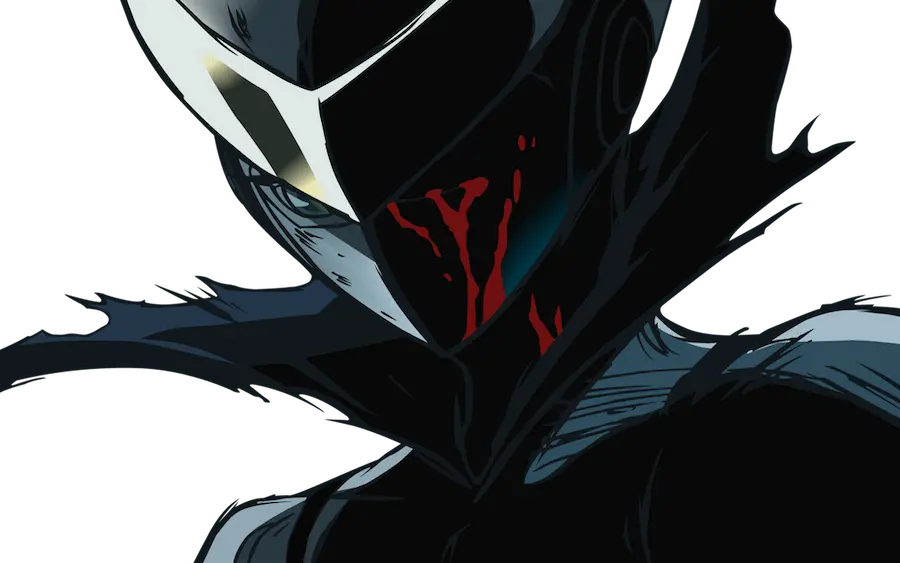
⚙ Key Takeaways: The Philosophy of the Ruin
Casshern Sins does not treat apocalypse as spectacle. It uses a dying world to ask what remains when bodies fail, memory becomes painful, and survival is no longer the same as living.
- 1. Mortality gives life its urgency The series reverses the usual fantasy of immortality. Casshern endures without peace, while the dying characters often appear more alive because their time is limited. The Ruin makes every act of care, memory, creation and attachment more fragile, but also more meaningful.
- 2. Decay becomes a visual language The empty landscapes, washed-out colors and expressive line work do more than create atmosphere. They make exhaustion visible. The world looks drained because the story is not about a single catastrophe, but about slow erosion: of bodies, hope, identity and memory.
- 3. Casshern survives as a witness Casshern’s tragedy is not only that he caused destruction, but that he must continue after it. His immortality forces him to carry guilt without the relief of an ending. He becomes a witness to the Ruin, and through that burden the series asks whether meaning can still exist when repair is impossible.
When people feel low, the usual advice is simple: watch something light, avoid the darkness, choose comfort. On the surface, that sounds reasonable. Why would anyone who feels depressed reach for a story about a dying world, rusting bodies, unbearable guilt and the slow collapse of hope?
And yet many people do exactly that.
Sometimes forced optimism feels more alienating than darkness. A cheerful story can feel like it belongs to another species. A comedy can become exhausting because it asks the viewer to participate in a mood they cannot reach. A bleak work of art, by contrast, may feel strangely gentle, not because it makes pain disappear, but because it stops pretending pain is not there.
This is the paradox at the center of Casshern Sins. The anime is not comforting in the obvious sense. It does not offer easy recovery, triumphant heroism or clean emotional resolution. It moves through ruins, silence, decaying bodies and characters who are trying to understand what it means to live when everything is already ending. But precisely because it refuses false brightness, it can feel deeply recognizable to viewers who know something about inner darkness.
This article does not argue that dark anime cures depression. It does not treat Casshern Sins as therapy, and it should not be read as medical advice. Depression is a serious health condition, and the World Health Organization states clearly that effective treatments exist, including psychological treatments and, for some people, medication. Professional support matters. If symptoms are severe, persistent or connected with self-harm, immediate help from a qualified professional or emergency service is necessary.
The question here is narrower and more cultural: why can some people experience dark art as recognition rather than damage? Why can a story as bleak as Casshern Sins feel less like a trap and more like a hand held in the dark?
What is Casshern Sins really about?
Casshern Sins is a 24-episode anime series from 2008–2009, connected to the older Casshern franchise but reimagined as something much slower, stranger and more philosophical. Its world is dying. A mysterious plague-like condition called the Ruin causes robots and environments to decay. Casshern, a cybernetic assassin with no memory, wakes in a wasteland and gradually confronts the truth that he is tied to the death of Luna, the figure once associated with life and salvation1.
That premise matters because the series reverses one of the oldest fantasies in action storytelling. Immortality is not a reward here. It is not liberation, power or victory. Casshern’s inability to die becomes a curse because he must witness a world where everyone and everything else is falling apart. The mortal characters decay, rust and vanish, but they often appear more alive than he does. Their lives have urgency because they are limited.
The show’s emotional logic is built on that reversal. The dying characters still create, remember, fight, protect, love and search for meaning. Casshern survives, but survival alone does not give him peace. His body endures while his selfhood remains broken. He cannot die, but he also cannot escape memory, guilt or responsibility.
That is why Casshern Sins is not simply a show about apocalypse. It is a show about what remains when the usual promises collapse. No stable world. No guaranteed salvation. No easy redemption. No heroic solution that repairs everything. Only the question: what can still matter when the end is already inside the world?
Where this article draws the line
Before discussing mental health, one distinction is essential.
Dark art can help some people name emotions, process grief or feel less alone. But it can also intensify rumination in others. The same story that gives one viewer recognition may push another viewer deeper into hopelessness. There is no universal rule that says bleak media is either good or bad for everyone.
The safest way to understand dark art is as a companion, not a cure. It can sit beside pain. It can give shape to it. It can make isolation less absolute. But it cannot diagnose, treat or stabilize a mental health condition. Watching Casshern Sins is not the same as therapy. It should never replace therapy, medication, crisis support or a conversation with someone trained to help.
This matters because the series is heavy. It is slow, mournful and visually desolate. For some viewers, that honesty may feel validating. For others, it may feel too close. If dark media worsens symptoms, increases hopelessness or makes self-destructive thoughts feel more present, then it is not the right work for that moment.
The point is not to romanticize sadness. The point is to understand why certain works of art can meet sadness without lying to it.
Mechanism 1. Validation through resonance
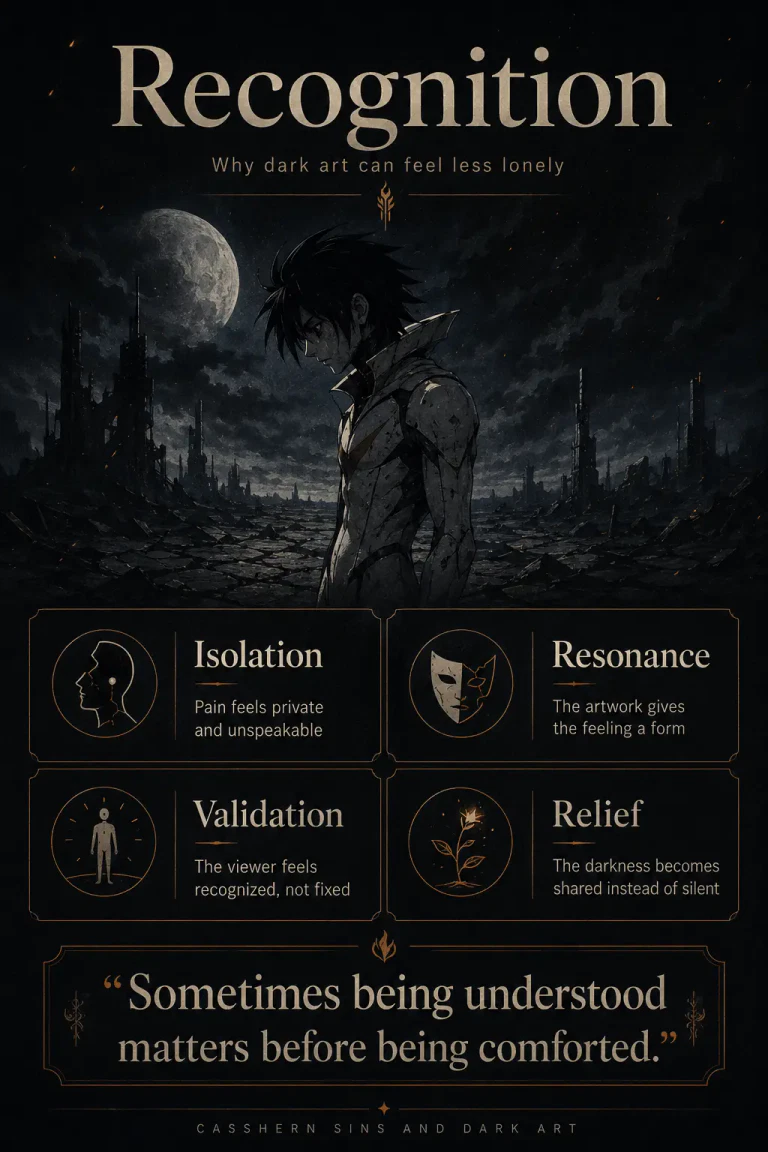
Depression often isolates before it explains itself. A person may not only feel pain, but also feel ashamed of feeling it. The suffering becomes doubled: first the actual heaviness, then the suspicion that one is weak, broken or somehow disqualified from normal human life.
That is where certain works of art can become powerful. Not because they solve anything, but because they say: this experience has a shape. Someone else has seen something like it. Someone has rendered it in images, sound, silence and story.
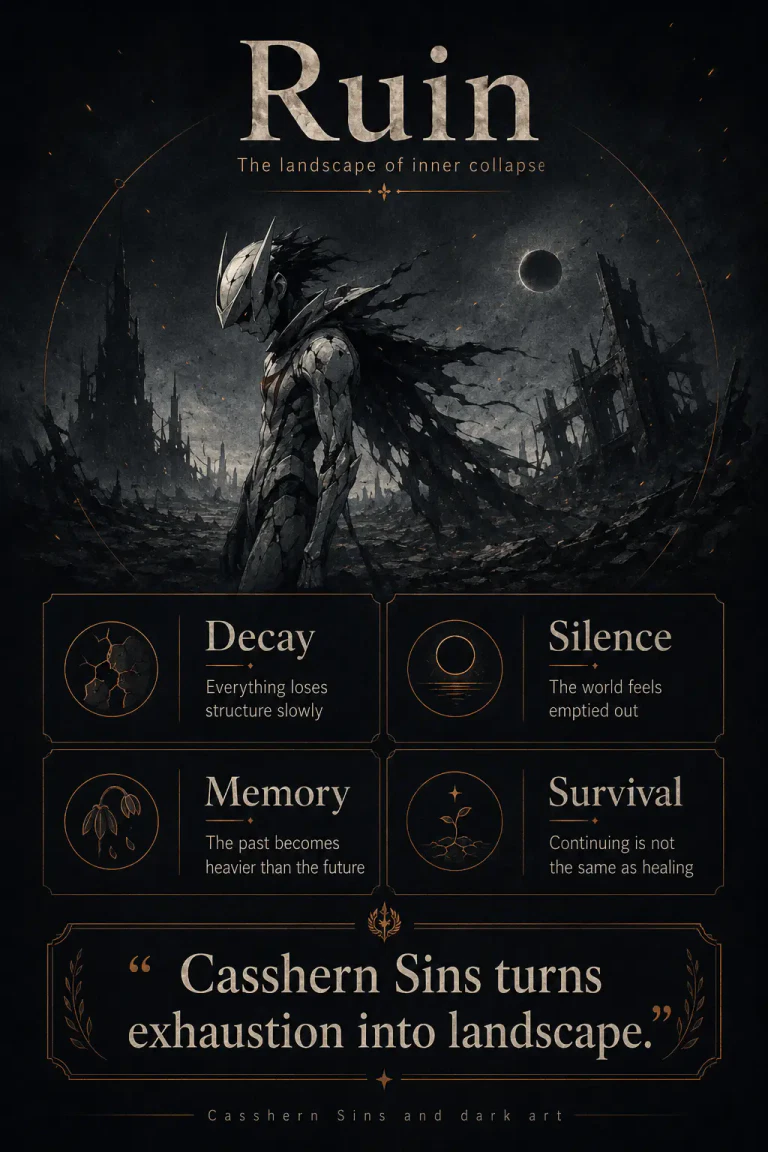
In Casshern Sins, the Ruin is not merely a plot device. It is a visual language of deterioration. The world does not explode in one spectacular catastrophe. It decays slowly. Bodies fail. Landscapes empty out. Machines rust. Memory weakens. Characters continue moving through a condition they cannot simply defeat.
This is one reason the series can resonate with depressive experience. Depression is often described not as dramatic pain, but as erosion. A person may feel that motivation, pleasure, time and selfhood are slowly losing their structure. The world still exists, but everything arrives muted. Casshern Sins externalizes that feeling. It turns inner depletion into landscape.
The show does not say, “This pain is easy.” It does not say, “Everything happens for a reason.” It does not rush toward comfort. Instead, it gives suffering room to exist without immediately correcting it. That can matter deeply for viewers who are tired of being told to cheer up, think positive or move on.
Validation is not the same as indulgence. The best dark art does not simply confirm despair. It recognizes the reality of pain and then asks what kind of life might still be possible inside or beside that pain. Casshern Sins does this repeatedly. Characters do not wake up cured of decay. They carry decay with them. Some become cruel. Some collapse. But others find small acts of dignity precisely because the end is near.
A painter continues to paint. A fighter keeps moving. A child cares for others in a world that gives her no safety guarantee. Casshern himself wanders not because he knows how to fix the world, but because he has to face what he is.
For someone who feels internally ruined, this kind of art can offer a rare form of recognition. Not sympathy from above. Not advice from outside. Recognition from within the same darkness.
Mechanism 2. Catharsis in a controlled space
There is a difference between being overwhelmed by emotion and being allowed to feel emotion inside a frame.
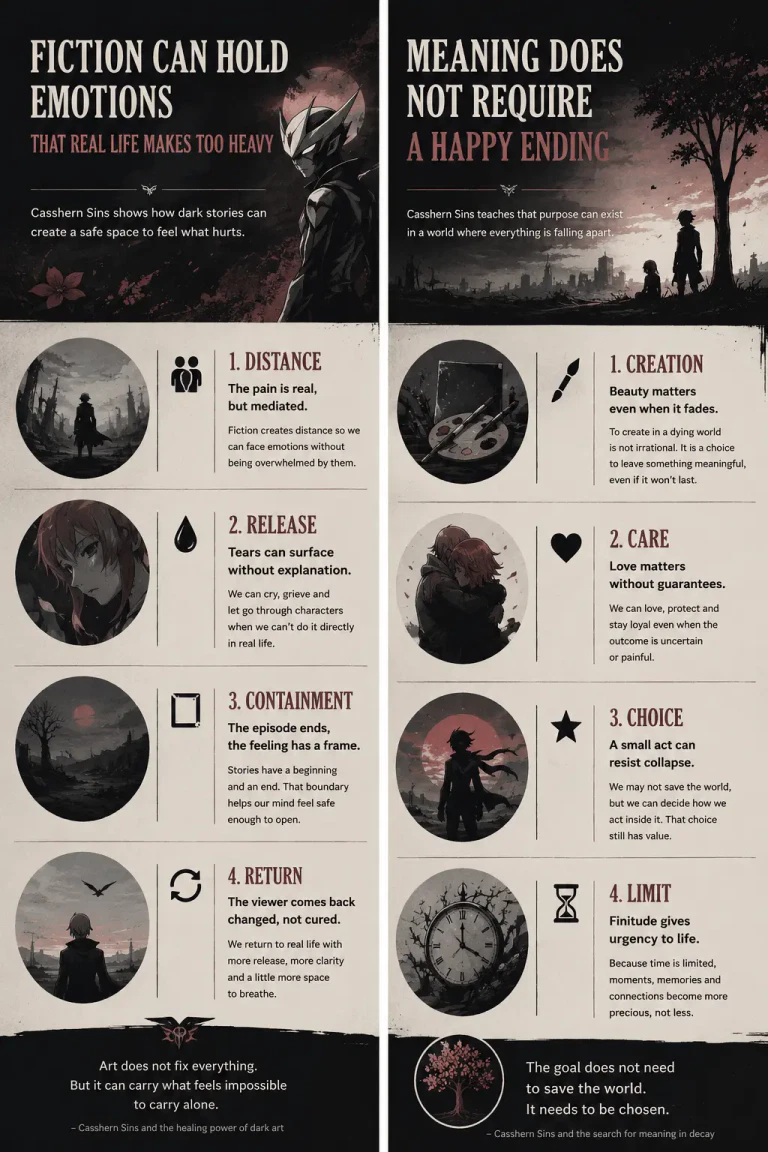
Art creates frames. A song ends. An episode ends. A film has credits. A novel has a final page. That boundary matters. It gives the viewer permission to approach grief, fear, guilt or loneliness without being completely consumed by real-world consequences.
This is one reason tragic art has survived across cultures. It allows people to experience difficult emotions at a distance. The emotions are real, but the situation is mediated through fiction. The viewer can cry for a character and, through that character, release something of their own.
Casshern Sins is built almost entirely around this kind of emotional release. Casshern meets characters whose lives are already marked by loss. Many appear briefly and vanish. Their stories are not always resolved in a satisfying way. A robot may fight to preserve a memory. Another may seek beauty before rust takes over. Someone may protect a person, a place or an idea that cannot ultimately be saved.
The show rarely offers victory in the usual sense. Yet it treats these small lives with enormous seriousness. That seriousness is important. It says that ordinary grief matters. It says that a life does not need to change history in order to have weight.
For viewers carrying grief or numbness, this can open a controlled emotional space. The sadness of the show becomes a container for feelings that may have been too diffuse or too private to access directly. Instead of asking, “Why am I like this?” the viewer can feel through the story. The tears are attached to Casshern, Lyuze, Ringo, Luna, the decaying robots, the empty world. But they may also touch something personal.
Research on art therapy and art-based interventions suggests that creative engagement can reduce depressive symptoms in some groups, although this evidence should be handled carefully. Clinical art therapy is not the same thing as watching anime alone at night. A structured intervention with a therapist, group or research protocol cannot be reduced to ordinary media consumption. Still, the broader principle is relevant: artistic forms can help difficult emotions become visible, expressible and less chaotic2.
That is the careful claim. Not that Casshern Sins treats depression. Not that bleak anime is therapeutic for everyone. But that emotionally intense art can sometimes provide a safer symbolic place for emotions that otherwise remain locked inside.
Mechanism 3. Meaning inside unavoidable suffering
The philosophical heart of Casshern Sins is close to a question associated with Viktor Frankl’s logotherapy: what kind of meaning can remain when suffering cannot simply be removed?
Frankl’s logotherapy places the search for meaning at the center of human existence. The Viktor Frankl Institute describes it as both a philosophy and a treatment modality focused on meaning, freedom of will and the human capacity to choose one’s attitude, especially in unavoidable suffering3.
This idea should not be simplified into a motivational slogan. It does not mean suffering is good. It does not mean pain is automatically meaningful. It does not mean a person should passively accept harm. Rather, it asks whether human beings can still discover responsibility, love, creation or dignity when circumstances cannot be fully controlled.
Casshern Sins returns to that question again and again.
Casshern cannot undo Luna’s death. He cannot reverse the Ruin by sheer will. He cannot offer the dying world a simple cure. His suffering is tied to guilt, memory and the horror of being unable to escape consequence. For much of the series, he is less a savior than a witness.
Other characters respond differently to the same dying world.
Lyuze is driven by revenge. Her purpose is painful and destructive, but it still gives her movement. Her hatred of Casshern structures her grief. It gives her a direction, even when that direction cannot heal the original wound.
Ringo represents another response: attachment without guarantees. She does not live because the world is safe. She lives because she still has the capacity to care. Her existence refuses the idea that love requires certainty.
The artist figures in the series represent creation without permanence. To create beauty in a collapsing world seems irrational if permanence is the only measure of value. But Casshern Sins suggests the opposite: fragility can intensify value. A painting matters not because it lasts forever, but because someone chose to make it while everything was fading.
The decaying robots embody the fear of finitude. Many are terrified of death because they once existed under a different assumption. Their desperation can become grotesque, even violent. Yet their fear also awakens something like humanity. Once they can die, they begin to desire, remember, love and grieve differently.
This is one of the show’s most important inversions. Mortality is horrifying, but endless life without meaning is also horrifying. Casshern’s immortality gives him duration, not peace. The dying characters have limits, but those limits often make their choices more urgent and more alive.
For someone experiencing depression, this distinction matters. Depression often whispers that meaning requires happiness, that purpose requires success, that life is only worth living if it leads somewhere obviously positive. Casshern Sins argues something quieter and more difficult: meaning can exist without triumph. A chosen act can matter even if it does not save the world.
The goal does not always need to be achievable. Sometimes it needs to be chosen.
Mechanism 4. The paradox of stuckness
Depression is often described as being stuck. People use bodily language for it: frozen, trapped, heavy, unable to move. Time continues outside, but internally the same day repeats. Thoughts loop. Motivation weakens. The future becomes difficult to imagine.
Casshern is the perfect fictional embodiment of that condition because he is literally unable to arrive at an ending. He cannot die. He cannot rest. He cannot become ordinary. He remains while others disappear. His immortality does not free him from suffering; it traps him inside witness.
This is why the show’s treatment of immortality feels so unsettling. In many stories, immortality is a fantasy of control. In Casshern Sins, it is the collapse of rhythm. Life needs limits, not because death is pleasant, but because finitude gives shape to time. Without an ending, Casshern becomes suspended. He survives without knowing how to live.
That suspension mirrors something many viewers recognize emotionally. Depression can feel like existence without movement. You are present, but detached. Alive, but not fully participating. The world continues, but you remain fixed in a private ruin.
Yet Casshern Sins does not leave the viewer there. The mortal characters, the ones who are actually decaying, often display more vitality than Casshern. They act not because they are guaranteed success, but because action itself becomes the last available freedom. They care, fight, paint, remember or protect, even when the outcome is temporary.
This does not invalidate the paralysis of depression. It does not say, “Just move.” The series is too honest for that. But it suggests a gentler possibility: maybe the first movement is not escape from limitation, but movement inside limitation.
A person may not be able to fix their life in one dramatic act. They may not be able to feel hope on command. They may not be able to believe in a bright future. But they may still choose one small act that resists total collapse: making food, answering a message, taking a walk, creating something, speaking honestly, asking for help.
In Casshern Sins, these small acts are not sentimental. They are almost sacred because the world gives them no guarantee.
Four ways Casshern Sins visualizes inner suffering
The strength of Casshern Sins lies in how consistently its characters embody different forms of suffering. The show does not only talk about despair. It distributes despair across bodies, landscapes and relationships.
Casshern embodies guilt without closure.
He cannot remember everything at first, but his body carries consequence before his mind fully understands it. His immortality forces him to remain near the damage associated with his existence. He is not allowed the comfort of ignorance forever.
Lyuze embodies revenge as a structure for grief.
Her anger gives her purpose, but that purpose is unstable. Revenge can organize pain, but it cannot restore what was lost. Through Lyuze, the series shows how grief can harden into direction while still remaining grief.
Ringo embodies care without guarantees.
She lives in a world where innocence should be impossible, yet she still offers attachment. Her tenderness is not naive because the series never pretends the world is safe. Her care matters precisely because it is vulnerable.
The decaying robots embody the terror of ending.
Their bodies rust, but their fear is not merely mechanical. Once they understand death, they become desperate for permanence. Some turn violent. Others turn toward memory, beauty or companionship. Their decay becomes the condition under which emotion becomes urgent.
Together, these figures make the anime more than a mood piece. They turn the Ruin into a psychological system. Every character carries a different answer to the same question: how do you live when the structure that once promised permanence has failed?
When dark art stops helping
The line between recognition and rumination is thin.
Recognition says: this work understands something I could not express.
Rumination says: this work proves that nothing can change.
The first can reduce isolation. The second can deepen it.
That distinction is essential when discussing Casshern Sins. The series is bleak, but it is not empty. It does not say decay makes action meaningless. It repeatedly shows characters choosing small acts of care, creation and loyalty even when no final victory is available.
If a viewer only takes despair from the series, the show may not be useful for them at that moment. The same is true of any dark work of art. A piece of media becomes harmful when it does not help a person feel seen, but instead reinforces the belief that suffering is total, permanent and proof of personal worthlessness.
A healthy engagement with dark art usually contains some movement: from numbness toward feeling, from isolation toward recognition, from chaos toward language, from despair toward at least one small form of agency.
An unhealthy engagement often becomes circular. The viewer watches only to confirm hopelessness. They return to the work not because it opens emotion, but because it seals them inside it. The art becomes evidence against life.
This is why the best reading of Casshern Sins is not nihilistic. The Ruin is real, but so are the acts performed inside it. The world is dying, but the show still cares about how people behave while dying. That distinction is the whole ethical center of the series.
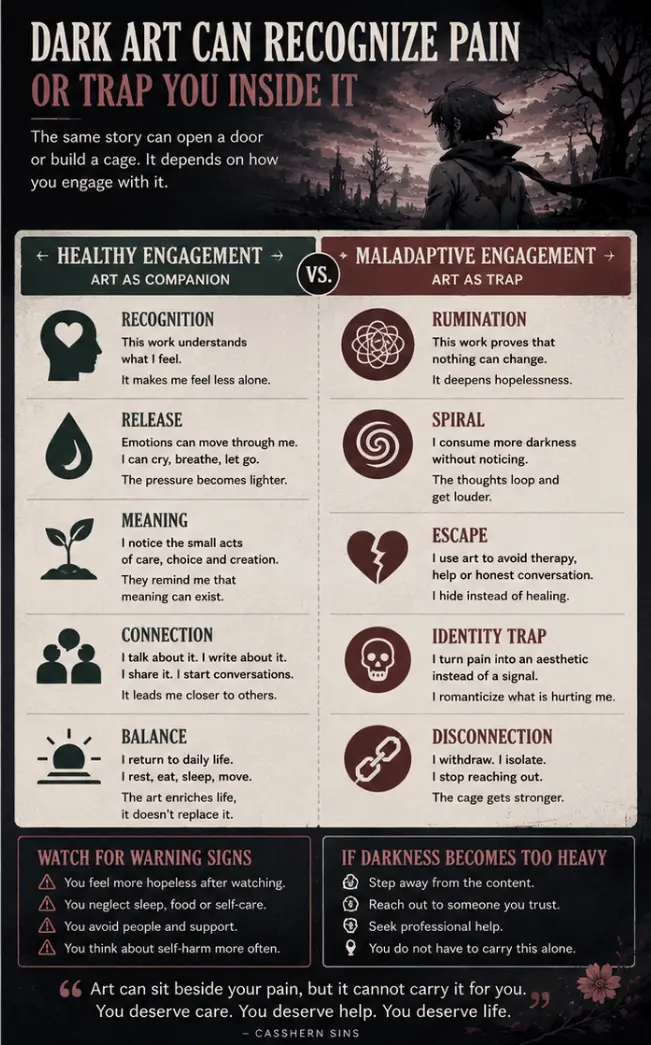
Healthy engagement and maladaptive traps
Dark art is not automatically good or bad. The question is how it is used, what state the viewer is in, and what happens afterward.
Healthy engagement may look like this:
Active recognition.
The viewer uses the artwork to put words or images to feelings that previously felt formless.
Controlled exposure.
The viewer watches one episode, sits with the emotion, then returns to ordinary life rather than spiraling endlessly.
Emotional release.
The artwork allows grief, tears or fear to surface in a contained way.
Meaning-focused reflection.
The viewer notices not only the darkness, but also the small acts of choice, care and creation inside that darkness.
Connection.
The viewer talks about the work, writes about it, shares it or uses it to begin a more honest conversation.
Maladaptive engagement may look like this:
Rumination loops.
The viewer consumes dark media only to prove that everything is hopeless.
Aestheticizing despair.
The darkness becomes attractive as an identity rather than understandable as a state that needs care.
Avoiding support.
The viewer uses media to avoid therapy, medication, honest conversation or practical help.
Ignoring warning signs.
The viewer keeps watching even when the work clearly worsens symptoms, deepens isolation or brings self-harm thoughts closer.
The difference is not always obvious in the moment. That is why self-observation matters. After watching, ask: do I feel more recognized, or more trapped? More able to speak, or more sealed off? More connected to human experience, or more convinced that nothing matters?
The answer may change from one day to another. A work that helps in one season of life may harm in another. That does not make the work bad. It means the viewer’s nervous system, circumstances and needs matter.
Why Casshern Sins feels different from simple despair
There are many bleak stories. Not all of them are meaningful. Some confuse darkness with depth. Some mistake shock for seriousness. Some use suffering as decoration.
Casshern Sins works because its darkness is not merely aesthetic. The show’s slowness, empty landscapes and repeated confrontations with decay are not there only to look sad. They create a rhythm of exhaustion. The viewer is made to inhabit a world where the usual dramatic pleasures are reduced. There is no constant escalation, no easy triumph, no comfortable heroic identity.
This can frustrate viewers expecting action. But it is exactly what makes the show psychologically distinct. Depression often does not feel like a dramatic battle. It feels like duration. It feels like returning to the same internal wasteland again and again. Casshern Sins understands that kind of time.
Its visual style reinforces this. Empty space matters. Silence matters. The backgrounds often feel stripped down, as if the world has forgotten how to be full. Character designs, gestures and lines carry a sense of fragility beneath power. Even combat rarely feels purely exciting. Violence usually returns to the same question: what are these bodies fighting for when the end has already entered everything?
That is why the show’s bleakness can feel honest rather than exploitative. It does not use darkness to impress the viewer. It uses darkness to ask what remains visible when almost everything else has been taken away.
The beauty of finitude
The most important philosophical idea in Casshern Sins is that life’s value may come not from permanence, but from limitation.
The Ruin terrifies the robots because it introduces death into beings that once imagined continuity. Their bodies begin to fail, and with that failure comes panic. But the same condition also makes their choices more meaningful. A flower matters because it wilts. A memory matters because it can be lost. A gesture of care matters because it is made under pressure from time.
Casshern’s immortality exposes the opposite problem. He has endless continuation, but continuation without meaning becomes unbearable. His body persists, yet persistence alone does not answer guilt, loneliness or responsibility.
This is where the show becomes strangely life-affirming. Not cheerful, not optimistic in a shallow sense, but life-affirming in a harsher way. It suggests that mortality is not merely an enemy. Mortality is also what makes urgency possible.
For a viewer struggling with depression, this idea should be handled gently. It is not a command to suddenly find beauty in pain. It is not a demand to transform suffering into wisdom. But it can offer a different frame. Meaning does not require a perfect emotional state. It does not require certainty. It does not even require victory.
Sometimes meaning begins with one chosen act inside a world that remains unresolved.
That may be why Casshern Sins lingers. It does not heal the Ruin by denying it. It asks what kind of tenderness, memory and responsibility can still exist there.
Why this matters
Art does not heal depression the way treatment can. A show about a dying world will not correct biological, psychological, social or environmental causes of mental illness. It will not replace therapy. It will not replace medication when medication is needed. It will not replace crisis support.
But art can do something else.
It can make private suffering less mute.
It can give form to emotions that feel embarrassing, chaotic or impossible to explain.
It can offer companionship without demanding performance.
It can say: someone else has imagined this darkness, and they did not look away.
That matters because one of the cruelest features of depression is the belief that one is alone not only in pain, but in the kind of pain one feels. The person may think: no one would understand this. No one could bear this. No one else lives in this strange internal weather.
A work like Casshern Sins does not solve that condition. But it can puncture the illusion of absolute isolation. It can show a world that looks like inner collapse and still find within it moments of care, creation and chosen meaning.
That is not a cure. It is closer to recognition.
And sometimes recognition is the first thing a person can accept before comfort becomes possible.
My final reflection
Casshern Sins is not a story about defeating darkness. It is a story about walking through it without pretending it is light.
Its world is ruined. Its hero is guilty. Its bodies decay. Its landscapes are emptied out. But again and again, the series returns to small acts that refuse total nihilism: painting, protecting, remembering, loving, searching, witnessing.
This is why the anime can feel strangely healing to some viewers. Not because it makes life seem easy, but because it refuses to insult suffering with false simplicity. It understands that darkness is real. It also understands that darkness is not the only thing that is real.
The Ruin does not erase meaning.
It makes the search for meaning more urgent.
And in that urgency, Casshern Sins becomes more than a bleak anime. It becomes a meditation on why fragile things matter, why endings give shape to life, and why being recognized in the dark can sometimes feel more honest than being dragged too quickly into the light.


