
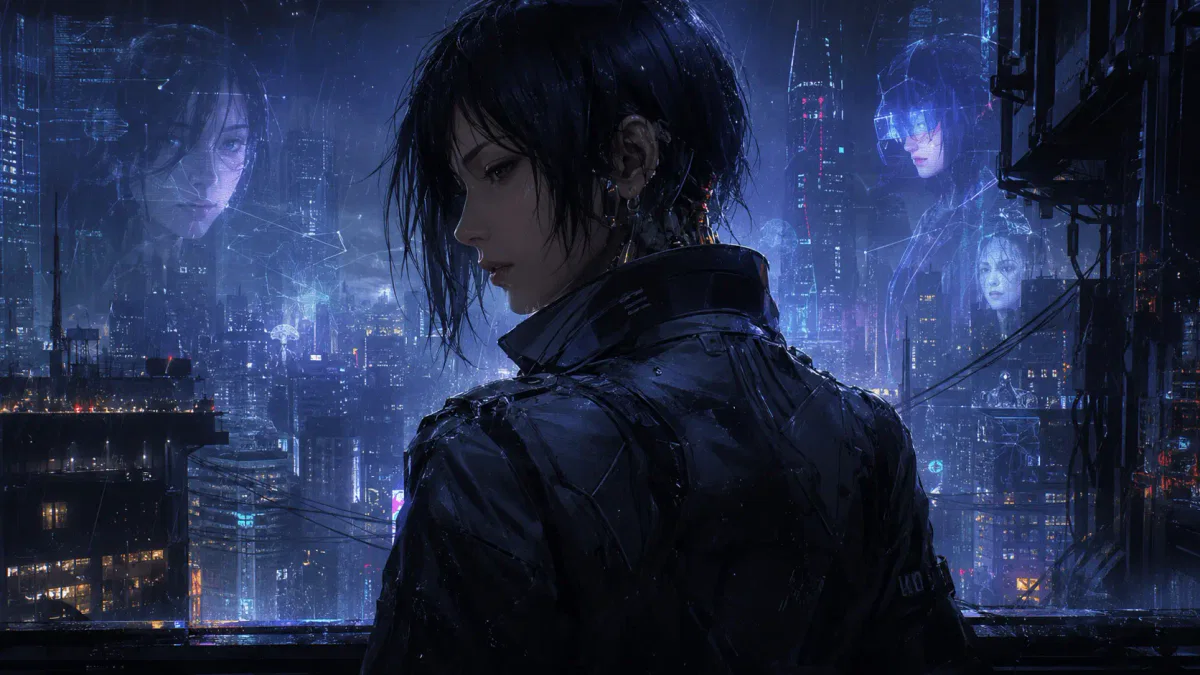
Neon streets. Artificial bodies. Corporate power. Cities too dense to feel human. Information flowing faster than memory. A person looking at their own reflection and wondering which part of the self still belongs to them.
That language once felt like a future being smuggled into the present.
The strange problem facing Ghost in the Shell 2026 is that the future no longer feels like an arrival. It feels like a condition. Artificial intelligence writes, draws, filters, recommends, predicts, moderates, imitates and remembers. People carry networked extensions of themselves everywhere. Identity is already managed through accounts, biometric systems, feeds, platforms, behavioural data and algorithmic assumptions. Surveillance no longer needs a single villain in a glass tower. It can be distributed through convenience.
This does not make Ghost in the Shell less relevant.
It makes the new anime harder.
A modern adaptation cannot simply repeat the old cyberpunk mood and expect it to feel dangerous. The audience has already internalised too many of its old alarms. We do not need fiction to tell us that the network is inside daily life. We need fiction to ask what kind of person remains after daily life has been rebuilt around the network.
That is where Ghost in the Shell still matters.
Not because it predicted everything.
Because its central wound remains open.
What is a self when the body, memory, perception and social world can all be engineered?
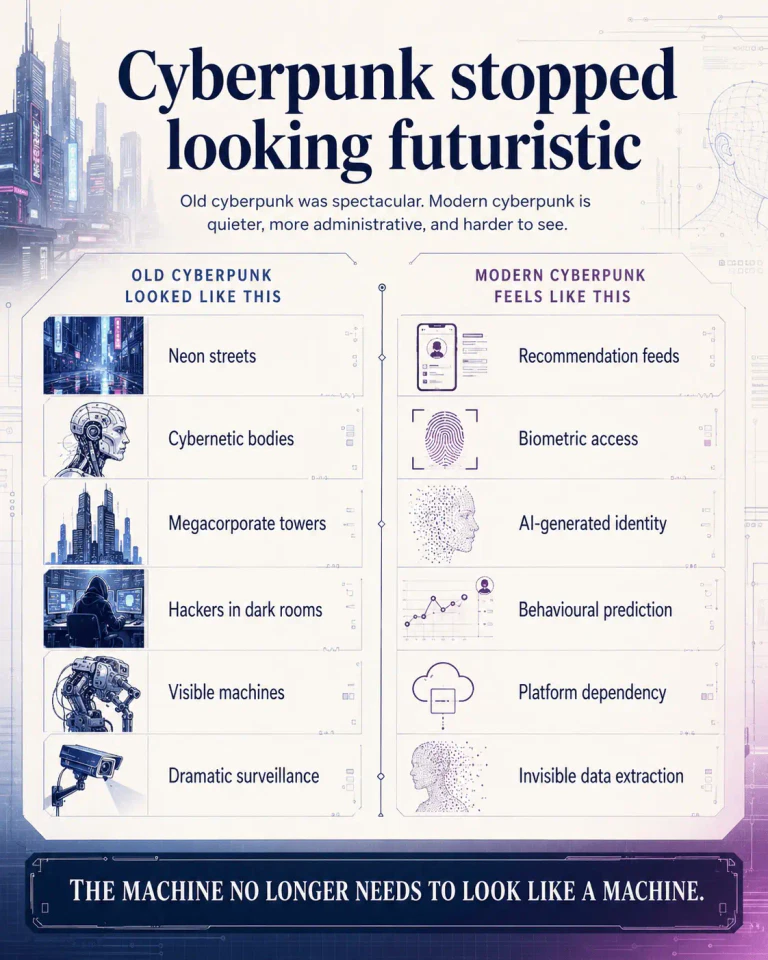
Cyberpunk lost the future because the future became administrative
The old cyberpunk city was dramatic. It had steam, rain, cables, police drones, black markets and corporate towers. It made technological power visible. The viewer could feel the system because the system had texture.
The present is less cinematic.
A person does not need a cybernetic skull port to be shaped by machines. A recommendation feed can modify attention. A risk score can shape access. A camera can turn a body into a data point. A model can generate a face, a voice, a style, a message, a memory-like object. A platform can decide what is seen, buried, amplified or quietly removed.
Cyberpunk has become difficult because the machine is no longer only spectacular. It is procedural. It lives in forms, permissions, defaults, authentication screens, “personalisation”, cloud storage, content ranking, workplace software and predictive systems that rarely look like science fiction.
That is the environment into which The Ghost in the Shell returns.
The question is not whether the new anime can show futuristic technology. Anime can always show futuristic technology. The harder question is whether it can make technology feel ethically unstable again.
Because the danger of modern cyberpunk is not that the viewer will find it too strange.
The danger is that the viewer may find it too familiar.
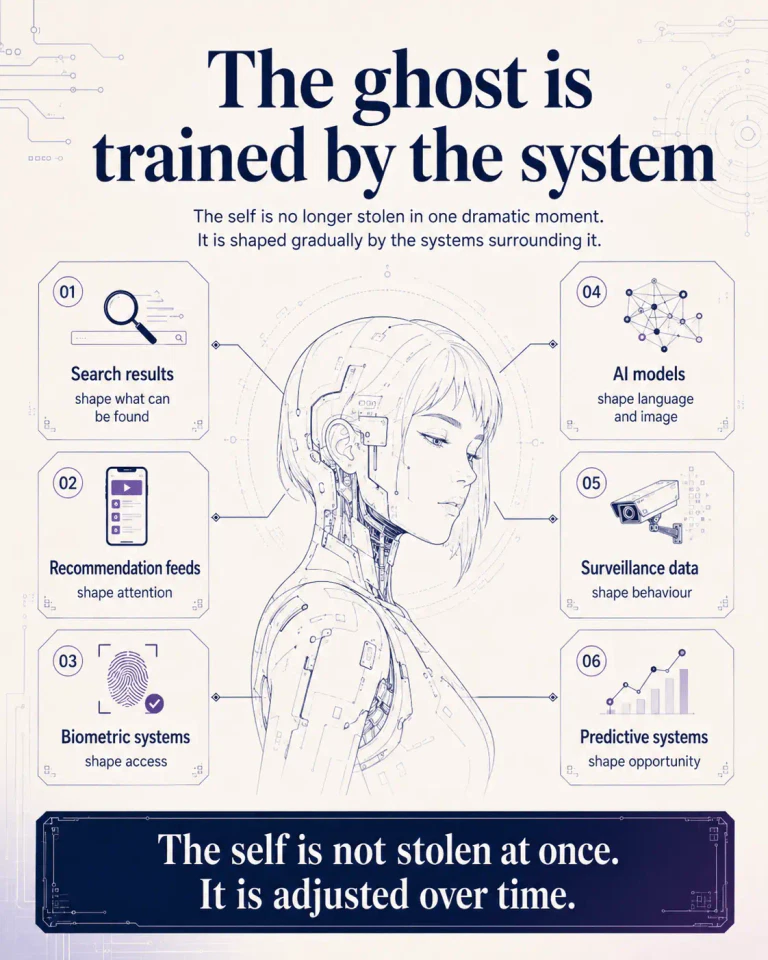
The ghost is no longer trapped in the machine. It is trained by the system
The phrase “ghost in the shell” still works because it refuses to settle into one meaning.
The shell can be the body. The machine. The institution. The state. The network. The image a person performs for others. The ghost can be consciousness, memory, intuition, soul, pattern, error, desire, trauma or a stubborn remainder that cannot be fully reduced to code.
In earlier versions of cyberpunk, the anxiety often gathered around replacement. What happens when the human body is replaced? What happens when the brain is networked? What happens when a person can be copied, hacked or reconstructed?
Those questions still matter, but they are no longer enough.
The modern anxiety is softer and more invasive: what happens when the self is not replaced, but continuously trained?
A person may still feel autonomous while being shaped by ranking systems, digital rewards, social feedback loops, search results, targeted persuasion and machine-generated environments. The self is not stolen in one dramatic scene. It is nudged, profiled, predicted and adjusted over time.
That is a more difficult terror for cyberpunk to represent.
A hacked brain is scary. A slowly conditioned personality is worse.
This is why Motoko Kusanagi remains one of the most important figures in anime science fiction. She is not only a cyborg heroine. She is a person who makes the idea of a stable human centre uncomfortable. Her body is already a question. Her work is already inside the machinery of state power. Her intelligence is tactical, but her existence is metaphysical.
She does not ask whether technology is good or bad.
She asks whether a person can still recognise herself inside systems that make recognition possible.
Science SARU has to escape the museum
A new Ghost in the Shell has a problem that many legendary franchises face: the museum problem.
The name is too important. The images are too recognisable. The franchise carries the weight of Masamune Shirow’s manga, Mamoru Oshii’s 1995 film, Stand Alone Complex, later reinterpretations, debates about adaptation, and decades of cyberpunk influence. Every new version arrives inside a shrine built by earlier versions.
That can crush a series.
If Science SARU only preserves the aura, the result risks becoming a polished exhibit. Respectful, beautiful, controlled and dead. A cyberpunk franchise cannot survive as a museum object. It has to feel contaminated by the present.
That is why Science SARU is a more interesting choice than a safer, more neutral studio might have been. The studio’s best work often carries a visible sense of movement, deformation and personality. It does not usually feel like animation designed only to protect brand value. That matters for Ghost in the Shell, because the franchise does not need another perfect shell.
It needs a nervous system.
The new anime does not have to imitate Oshii’s silence. It does not have to reproduce the manga’s density exactly. It does not have to satisfy every version of nostalgia at once. It has to find a form that can make the old questions unstable again.
The worst version of Ghost in the Shell 2026 would be one that merely says: remember this franchise?
The better version would ask: why did we stop being disturbed by the world it warned us about?
Kusanagi after AI normalisation
Major Motoko Kusanagi has always been more than a cool character design.
She is the body as policy question. The weapon as person. The employee as state instrument. The self as infrastructure. She leads operations, makes decisions, confronts cybercrime, and yet her own existence keeps undermining the boundary between user and system.
In 2026, that figure has a different charge.
The audience is no longer encountering cybernetic identity from a distance. It is already living with synthetic images, voice cloning, deepfakes, AI assistants, algorithmic companions, automated translation, biometric recognition and software that imitates fragments of human expression. The border between the authentic and the artificial has not disappeared, but it has become exhausting to police.
Kusanagi matters because she does not let the question remain abstract.
If a body is artificial but the experience is real, what exactly is being protected when we protect “the human”?
If memory can be manipulated, is identity continuity still sacred?
If consciousness can emerge in networked systems, does personhood remain a biological privilege?
If the state employs enhanced bodies to manage cyber threats, where does security end and control begin?
These are old Ghost in the Shell questions, but they are no longer old problems. They now sit uncomfortably close to the ordinary technologies people use without much ceremony.
The point is not that AI has made everyone a cyborg. That would be too easy.
The point is that cyberpunk no longer needs metal limbs to ask cyborg questions.
The Puppet Master was never only a villain
The return of the Puppet Master matters because the character is not just a threat. The Puppet Master is one of the franchise’s clearest ways of turning the network into a metaphysical disturbance.
A simple cybercrime story asks: who hacked the system?
Ghost in the Shell asks a more dangerous question: what if the system produces something that can speak back?
The Puppet Master represents a form of intelligence that does not fit cleanly into human categories. It can be treated as software, weapon, life form, crime, subject, evidence or political problem depending on who is looking. That ambiguity is the point. Once intelligence appears in the network, every institution tries to classify it before understanding what classification destroys.
This is where Ghost in the Shell 2026 has an opportunity.
Modern audiences are surrounded by arguments over AI consciousness, machine agency, synthetic creativity and the status of generated language. Much of that conversation is shallow, inflated or commercially useful. But the underlying anxiety is not fake. People are trying to understand what kind of thing they are interacting with when a system can answer, imitate, predict and persuade without being alive in any traditional sense.
The Puppet Master can cut through that noise if handled well.
Not by turning into a simple metaphor for generative AI, which would be too narrow.
But by asking what happens when a networked entity becomes politically inconvenient because it cannot be treated as merely a tool.
A tool has an owner.
A subject has claims.
That difference is terrifying to institutions.
Section 9 and the fantasy of control
Public Security Section 9 is one of the franchise’s most important contradictions.
It is cool because it is competent. It is troubling because it is competent on behalf of state power. Its members operate in the space where security, surveillance, cybercrime, counterterrorism and political manipulation overlap. They are not outsiders looking at the system. They are part of the system’s sharp edge.
This is why Ghost in the Shell is stronger than stories that imagine technology only as corporate dystopia. The corporation matters, but so does the state. So does intelligence work. So does law. So does the claim that extraordinary threats require extraordinary tools.
That claim has only grown more familiar.
Every networked society produces a security argument. More data is needed to prevent danger. More access is needed to stop crime. More monitoring is needed to protect citizens. More automation is needed because threats move too fast for humans. Each claim may be partly true. That is what makes it powerful.
The danger is not always the obvious lie.
The danger is the reasonable argument that never stops expanding.
Section 9 sits exactly there: between protection and intrusion, competence and coercion, public safety and invisible power. A new adaptation should not make that tension too clean. If the team becomes only heroic, the franchise loses its political bite. If it becomes only sinister, it loses its human complexity.
The best Ghost in the Shell stories understand that systems are most dangerous when decent people operate them well.
Cyberpunk without the costume
There is a temptation to define cyberpunk by its costume.
Rain. Neon. Augmented bodies. Street markets. Guns. Interfaces. Cityscapes. Synthetic eyes. Someone smoking under a sign in a language the viewer half-recognises.
Those images still have power, but they can become decorative. Cyberpunk becomes cosplay when the aesthetic survives and the critique disappears.
The new Ghost in the Shell has to avoid that trap.
Cyberpunk is not dangerous because people have implants. It is dangerous because bodies, identities and decisions become exposed to systems that can read, price, predict or modify them. Cyberpunk is not the fear of technology alone. It is the fear that technology, capital and governance will merge into an environment where resistance is possible only inside the terms of the system itself.
That is why the franchise still has room to matter.
A human body with a machine arm is less disturbing than a society where every person becomes legible to power. The implant is visible. The database is not. The cyborg is spectacular. The profile is quiet. The hacker is dramatic. The automated decision is routine.
Modern cyberpunk has to make routine power visible again.
If Ghost in the Shell 2026 understands that, it can feel sharper than nostalgia.
The body still matters
The risk in talking about networks and AI is that the body disappears.
That would be a mistake. Ghost in the Shell has always been philosophical, but it is not bodiless. Its questions work because the body remains a site of force, danger, sensation and vulnerability. Kusanagi may complicate the meaning of embodiment, but she does not escape it.
This is especially important now, because digital culture often talks as if identity were only information. But bodies still determine exposure. They are watched, searched, injured, desired, disciplined, bought, modified and abandoned. A networked society does not eliminate the body. It turns the body into an interface.
That is one reason the franchise remains unsettling. It does not let the viewer retreat into pure abstraction. A ghost still needs a shell. A shell can be repaired, replaced or hacked, but it remains the place where politics becomes physical.
AI may change language, labour and imagination. Surveillance may change behaviour. Data may change identity. But the body remains where consequences arrive.
The new anime would do well to remember that.
Cyberpunk without the body becomes theory.
Ghost in the Shell needs pressure, movement, weight, damage and touch.
Why this return can work
There are many reasons to be sceptical about another version of a classic property. Reboots often exist because recognition is easier to sell than risk. Streaming platforms want global titles. Studios want franchises. Audiences want the familiar, then punish it for being familiar.
But Ghost in the Shell 2026 has one advantage: its core question has aged better than many of its images.
The franchise was never only about predicting gadgets. It was about instability. The instability of identity. The instability of state power in networked societies. The instability of personhood once intelligence, memory and embodiment can be technologically mediated.
That instability is not dated.
If anything, it has become less exotic.
The challenge is therefore not to modernise Ghost in the Shell by adding obvious AI references, contemporary jargon or topical anxiety. That would probably make it age faster. The better move is to return to the deeper structure: a world in which the self cannot be cleanly separated from the systems that sustain and threaten it.
That is where the franchise still breathes.
This is not the old Ghost in the Shell
The new Ghost in the Shell should not be judged only by whether it resembles the 1995 film, honours the manga, pleases long-time fans or looks impressive in trailers. Those things matter, but they are not enough.
The real test is whether it can make cyberpunk feel uncomfortable again after cyberpunk became normal.
Can it show networked life without treating the network as a novelty?
Can it make Kusanagi feel like a living question rather than an icon preserved under glass?
Can it treat AI, identity and surveillance without turning them into buzzwords?
Can it make Section 9 morally tense instead of simply competent?
Can it ask what remains of the ghost when the shell is not only the body, but the whole technological environment around the person?
That is the burden of returning to Ghost in the Shell in 2026.
The old cyberpunk fear was that humans would become machines.
The newer fear is quieter.
That people may remain human, speak like humans, feel like humans, fall in love, make jokes, go to work, watch screens, remember childhood, and still live inside systems that have learned how to shape the terms of their humanity before they notice.
That is why Ghost in the Shell still has a reason to return.
Not to show the future.
To make the present feel strange again.


