
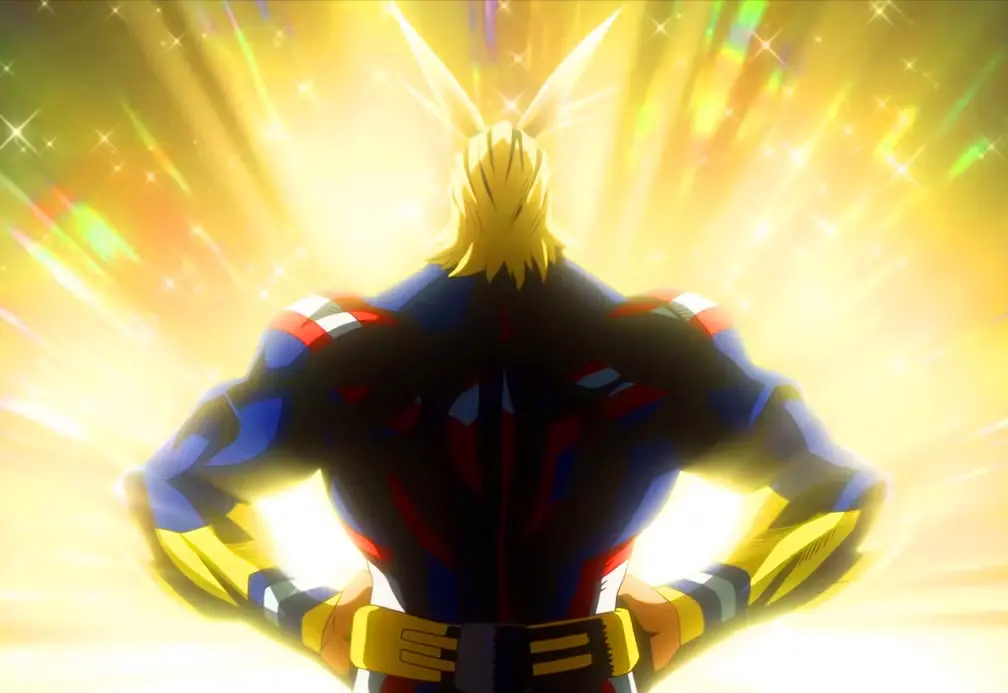
Key takeaways from the Symbol of Peace deconstruction
A critical analysis of superhuman society reveals that the beloved "Symbol of Peace" paradigm was built on profound hypocrisy and unsustainable methodologies, whereas the deeply flawed Endeavor presents a more realistic, operationally sound model of heroism:
- 1. All Might's systemic hypocrisy and manufactured divinity Despite preaching an egalitarian vision of heroism, All Might privately enforced rigid biological standards (initially rejecting a Quirkless Midoriya). He judged the powerless from a position of immense privilege, relying on a highly classified, inherited power (One For All) while presenting himself as a self-made, infallible god. This facade fostered extreme societal complacency and systemic negligence.
- 2. Endeavor's superior operational infrastructure While All Might relied on a reactionary, solo approach to crime-fighting, Endeavor built an industrialized, highly efficient agency capable of 24/7 monitoring and delegation. This systemic approach, combined with tactical combat mastery rather than inherited brute force, allowed Endeavor to achieve the official historical record for the highest number of resolved criminal cases.
- 3. Accountability over comfortable lies All Might lied to the public about his declining health, prioritizing the illusion of peace over preparing society for his absence. In stark contrast, despite committing unforgivable domestic atrocities, Endeavor's tenure as Number One is defined by extreme operational transparency. He accepts the totality of his guilt publicly and seeks difficult, grueling atonement without demanding forgiveness.
Within the hyper-reality of superhuman society, the concept of a singular, infallible entity responsible for maintaining global equilibrium has been historically celebrated as the pinnacle of civic achievement. For decades, Toshinori Yagi, known to the public as the hero All Might, served as this immovable foundation, adopting the moniker of the "Symbol of Peace". His presence was credited with single-handedly lowering national crime rates and acting as a supreme deterrent against villainy. However, a rigorous structural and philosophical examination of his tenure reveals a paradigm built on profound contradictions, unsustainable methodologies, and an inherent hypocrisy. The public perception of All Might was carefully curated to project absolute invulnerability; he famously smiled to hide his own fear, establishing an aesthetic of effortless victory that civilians and fellow heroes alike began to accept as the natural order. Yet, the foundation of this peace was deeply flawed. By presenting himself as an unassailable god-like figure, All Might engineered a societal architecture that was entirely dependent on a single load-bearing pillar. When the realities of human frailty, the hidden nature of his power, and the impossibility of his public ethos are critically analyzed, it becomes evident that All Might’s reign was characterized by fundamental dishonesty. Conversely, Enji Todoroki, operating as the hero Endeavor, emerges through the ashes of this collapsed system as a paradoxically truer manifestation of heroism. Despite possessing catastrophic personal flaws and a history of domestic cruelty, Endeavor’s eventual tenure as the top hero was defined by operational transparency, sustainable infrastructure, and a brutal honesty that All Might systematically avoided.
The hypocrisy of All Might
The central tenet of All Might’s public persona was the democratized ideal of heroism, promoting the notion that courage and righteousness were the only prerequisites for saving lives. This messaging created an entire generation of citizens who idolized him, believing in the omnipresent goodness of the hero system. Yet, the reality of his ideology was sharply exposed during his initial interaction with a young, powerless Izuku Midoriya. When directly confronted with the question of whether a Quirkless person could become a hero, All Might abruptly dismantled his own public ethos, stating unequivocally that one could not be a hero without a Quirk.
This dismissal exposes a profound layer of hypocrisy when contextualized against the origins of All Might's own power. Toshinori Yagi was himself born Quirkless, existing at the very bottom of the genetic hierarchy in a world dominated by superpowers. He did not ascend to the zenith of hero society through innate biological superiority or sheer willpower alone; rather, he was chosen to inherit One For All, a highly classified, artificially stockpiled superpower that defies the natural mechanics of Quirks. By actively concealing the transmissible nature of his power, All Might operated from a position of immense, inherited privilege while simultaneously invalidating the dreams of those who mirrored his own origin.
It was only when Midoriya demonstrated a suicidal degree of recklessness by charging an enemy without a plan that All Might reversed his stance and deemed the boy a worthy successor. The hypocrisy lies in the fact that All Might preached an egalitarian vision of heroism while privately enforcing a rigid, exclusionary biological standard. He judged the powerless from the lofty heights of a power he did not naturally earn, effectively acting as a gatekeeper to the very dream he ostensibly represented to the masses. The Symbol of Peace was, at its core, a manufactured deity sustained by an inherited, secret anomaly rather than the universal human spirit he claimed to champion.
Societal complacency and lies
The structural damage inflicted by All Might’s methodology extended far beyond philosophical contradictions; it severely compromised the operational integrity of the entire heroic infrastructure. By monopolizing the burden of national security, All Might established an unsustainable monopoly on public safety. Sociological analyses of this era describe the phenomenon as the "Yoda Problem," wherein an entire civilization relies so heavily on an apex protector that the foundational competence of the society atrophies. Because All Might was perceived as an omnipresent force capable of handling any crisis, both the public and his peers grew deeply complacent. Other heroes were no longer required to push their absolute limits because the ultimate safety net was always assumed to be present.
This complacency bred systemic negligence. The tragedy of Tenko Shimura, who would later become the apex villain Tomura Shigaraki, serves as the primary indictment of All Might’s era. A battered, orphaned child wandered the streets, and everyday civilians actively chose to ignore his suffering because they had been conditioned to believe that a hero would inevitably arrive to solve the problem. All Might’s insistence on projecting an image of total control meant he inadvertently fostered a society devoid of communal responsibility. By refusing to share the burden of peace, he prevented the development of a resilient societal fabric.
Furthermore, All Might was fundamentally a liar who deceived the public about his declining physical state and the severe injuries he sustained. He prioritized the illusion of the Symbol of Peace over the pragmatic necessity of preparing society for his inevitable absence. When his power finally waned and he was forced into retirement after the Kamino Ward incident, the vacuum he left behind triggered an immediate, catastrophic collapse of public order. Villains who had merely been suppressed, resurfaced with devastating momentum, exposing the extreme fragility of a peace built entirely on a single, aging man's shoulders and a foundation of systemic deception.
Endeavor and the ugly truth
In stark contrast to the mythological artifice of All Might stands Enji Todoroki, the hero Endeavor. Any objective analysis of Endeavor must confront the severe ethical and moral transgressions that defined his early life. Driven to madness by the impossible standard set by All Might, Endeavor engaged in eugenics, entering into a Quirk marriage specifically to engineer a child capable of surpassing the Symbol of Peace. This obsession resulted in the severe psychological and physical abuse of his family, the institutionalization of his wife, and the catastrophic psychological fragmentation of his eldest son, Toya, who would later emerge as the mass-murdering villain Dabi. If heroism is defined purely by moral purity, Endeavor fails spectacularly.
However, the narrative of modern superhuman society demands a shift from the static, morally infallible archetype to dynamic, accountable, and operationally effective figures. While the vast majority of the hero community accepted All Might's supremacy and settled into comfortable mediocrity, Endeavor was the singular figure who actively and obsessively attempted to bridge the unbridgeable gap. His operational approach to heroism was structurally far superior and infinitely more sustainable than All Might’s chaotic methodology.
Where All Might relied on a reactionary, solo approach to crime-fighting, Endeavor built an industrialized, highly efficient hero agency. The Endeavor Agency operated with dozens of specialized sidekicks, functioning continuously in an organized, corporate structure capable of handling multiple, simultaneous crises. This systematic delegation of duties allowed Endeavor to achieve a statistical milestone that completely shatters the myth of All Might’s practical supremacy: Endeavor holds the official historical record for the highest number of resolved criminal cases in history. Endeavor treated heroism not as a solitary messianic crusade, but as an essential public utility that required infrastructure, constant delegation, and rigorous systemic operation.
Operational efficiency metrics
To fully deconstruct the dichotomy between the Symbol of Peace and the pragmatic number two, one must analyze their comparative methodologies. The official organizational metrics provide a quantitative foundation that illustrates why Endeavor's approach was far more conducive to long-term societal stability than All Might's raw, unreplicable power.
| Metric of analysis | All Might | Endeavor |
| Systemic organization | Solo operator; highly disorganized; actively avoids administrative duties. | Massive agency; over 30 sidekicks; highly efficient 24/7 monitoring and delegation. |
| Incident resolution | High volume daily, but structurally limited by physical proximity. | Holds the ultimate record for the highest number of resolved criminal cases in history. |
| Combat methodology | Brute force; relying on changing air pressure and absorbing immense damage. | Tactical carbonization of targets; strategic heat manipulation; advanced martial arts. |
| Public transparency | Actively hid severe physical injuries and the true inherited nature of his Quirk. | Publicly acknowledged his limitations; broadcasted his human determination post-Kamino. |
This quantitative and qualitative comparison underscores a critical thesis: All Might's effectiveness was a biological anomaly of the One For All Quirk, whereas Endeavor's effectiveness was the result of relentless human optimization and institutional planning. Endeavor’s tactical intellect allowed him to swiftly deduce the biological mechanisms of engineered bio-weapons, such as the Nomu, realizing instantly that carbonizing their cells was the only method to bypass their regeneration. Furthermore, he utilized his flames for high-level mobility, heating the soles of his feet to adhere to building structures, showcasing a mastery of physics and combat mechanics that required years of grueling discipline. All Might, conversely, simply punched harder, relying on an inherited power that no average citizen or hero could ever emulate.
Atonement without forgiveness
What ultimately elevates Endeavor above the hypocrisy of All Might is the nature of his atonement and his relationship with the truth. Following All Might’s retirement, Endeavor is thrust into the Number One position. Instead of hiding behind a newly crafted facade or attempting to project an illusion of invulnerability, he undergoes a rigorous process of public and private accountability. Unlike traditional redemption arcs that hinge on the perpetrator receiving forgiveness as an ultimate reward, Endeavor’s trajectory completely discards the expectation of grace. He actively acknowledges that his past actions are abhorrent and irreversible. When confronted by the surviving members of his family, he does not demand their unity or force his status upon them; he respects their boundaries and focuses entirely on self-improvement through tangible, difficult action. He famously states that he does not want their forgiveness, but rather seeks to make amends by ensuring their future safety, an ethos driven by internal growth rather than external validation.
This philosophical pivot is crystallized during the Hero Billboard Chart announcements. When the flamboyant hero Hawks publicly challenges the stagnant, platitude-heavy speeches of the other top heroes, Endeavor steps to the microphone and issues a stark, pragmatic mandate: "Just watch me". He does not promise an era of flawless, magical peace. He does not smile to hide his fear. He offers only a commitment to bleed for the society that requires his strength. This moment signifies the death of the Symbol of Peace paradigm and the birth of a new, grounded heroism founded on visible, grueling effort rather than inherited divinity.
When the villain Dabi publicly broadcasted Endeavor’s history of domestic abuse and his own true identity as Toya Todoroki, it was a moment designed to completely destroy faith in the hero system. Yet, Endeavor does not retreat into the shadows or attempt to spin a web of lies to protect his image. He stands before the public and accepts the totality of his guilt. He acknowledges that the hero known as Endeavor is conceptually dead, but the man Enji Todoroki must continue to fight his own son to protect the nation. This level of extreme operational transparency stands in sharp rebuke to All Might’s methodology. All Might lied about his power, his health, and his capacity to protect, allowing society to sleep comfortably in a burning house. Endeavor admitted he was the one who started the fire, and then willingly stepped into the inferno to extinguish it.
The reality of true heroism
In synthesizing the vast array of societal, psychological, and operational data, a definitive conclusion emerges regarding the true nature of heroism within this ecosystem. The title of the Symbol of Peace was a poisoned chalice. It demanded a level of absolute perfection that could only be achieved through systemic deception and hypocrisy. All Might, despite his genuinely altruistic intentions, became the architect of a fragile, dependent society. By hoarding the responsibility of salvation and hiding the transferable, gifted nature of his strength, he inadvertently taught society that they were inherently powerless, gatekeeping the very concept of heroism.
Endeavor stands as the brutal antithesis to this sanitized, fictionalized narrative. He is a profoundly flawed individual whose desperation to achieve the impossible led to unforgivable domestic atrocities. Yet, in the crucible of societal collapse, it was his methodology, that provided the realistic blueprint for recovery. Endeavor proves that actual heroism is not the absence of fear, nor is it the possession of overwhelming, secret strength. It is the grueling, unglamorous process of facing one's own catastrophic failures, organizing a competent infrastructure to mitigate societal damage, and standing transparently before a broken world to do the necessary work. The genuine hero is not the one who descends from the sky to effortlessly crush evil with a smiling facade and a hidden truth, but the one who walks through the fire of their own making, bearing the scars of their sins, and continuously working to rebuild the structures that the false gods left in ruins.


