
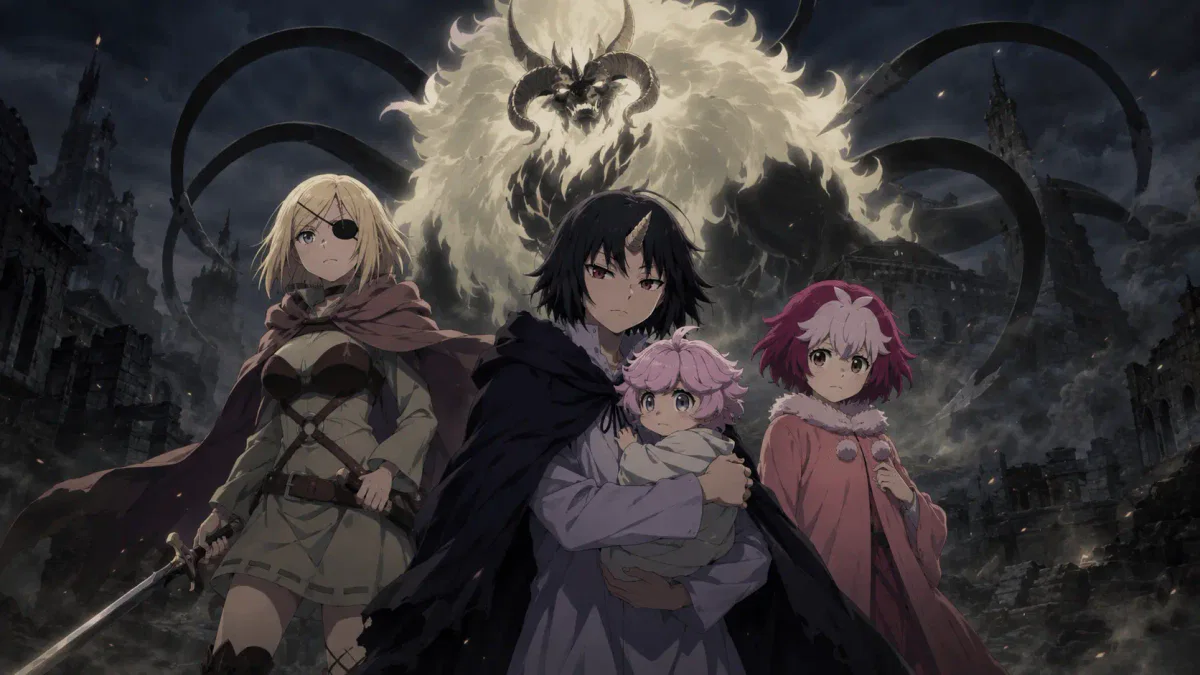
Key takeaways from Clevatess and the collapse of heroic certainty
Clevatess begins by destroying the familiar structure in which a kingdom identifies evil, appoints its heroes and treats victory as proof that its judgement was correct. What follows is a darker examination of how political authority creates heroic identities, how distance turns other beings into monsters, and why individual conduct matters more than the roles imposed on a person.
- 1. Alicia’s title does not guarantee that her mission is just Alicia’s courage and idealism are genuine, but the kingdom turns them into a military mission based on incomplete knowledge. After her death, she becomes a more convincing hero because she can no longer depend on royal authority, public recognition or a legendary weapon to validate her choices. Her actions must be judged by what she protects and challenges, rather than by the title she was given.
- 2. Humans and Dark Beasts use labels to avoid understanding one another The kingdom treats Clevatess as a monster because he stands beyond the human border and obstructs expansion. Clevatess responds by treating the actions of thirteen warriors as evidence against humanity as a whole. Both sides transform limited encounters into general verdicts, showing how categories such as “hero”, “monster” and “enemy” can make violence appear morally simple.
- 3. Luna exposes the ordinary labour hidden beneath political symbolism Luna may represent royal succession and the future of humanity, but the child survives through feeding, cleaning, carrying and constant attention. These tasks cannot be completed through heroic strength or political authority. Through Alicia, Clen and Nelluru, the anime shows that grand historical narratives depend on forms of care that are physically demanding, socially undervalued and often performed by people with the least power.
Most fantasy anime spend an entire season persuading us that their protagonist deserves to be called a hero. Clevatess hands the title out in its opening minutes and then destroys almost everyone who carries it. Alicia and twelve other warriors receive royal weapons, cross into the territory of a Dark Beast King and discover that the legend guiding their mission has told them almost nothing useful about the enemy waiting there. Their defeat is not the end of a long campaign. It is the point at which the actual story begins. By the close of the first episode, the heroes are dead, their kingdom has suffered Clevatess’s retaliation, and Alicia continues to exist only because the creature she was sent to kill has decided that an undead human might help him look after a newborn child.
The speed of this collapse is important. There is no time for the thirteen heroes to become a surrogate family, reveal their hidden depths or justify the confidence placed in them. The audience receives just enough information to recognise the outline of a conventional adventure before the anime removes it. What disappears along with the party is the moral certainty attached to that outline. A king has identified a threat, chosen his champions and given them weapons, but none of those actions proves that the campaign is wise or just. The title of hero turns out to be an administrative decision supported by an old story.
From that point onward, Clevatess becomes unusually interested in the distance between a name and the person forced to carry it. Alicia remains a hero after her kingdom is gone, although she no longer has a ceremony, an audience or even a living body to confirm the role. Clevatess remains a monster despite displaying more curiosity and restraint than many of the human authorities he encounters. Luna is a royal heir, a possible political instrument and a child associated with the future of humanity, but most of the time he is simply a baby who needs food, warmth and attention. These descriptions are not necessarily false. The problem is that every one of them becomes dangerous when treated as complete.
Who gets to appoint a hero?
Alicia’s childhood dream is not presented as ridiculous. She admires her father, trains seriously and wants to do something that matters beyond the boundaries of ordinary life. There is no indication that she joins the expedition because she enjoys violence or wants the social advantages of fame. Her idealism is genuine, which makes the failure of the mission more revealing. The kingdom does not invent her courage, but it gives that courage a target and assumes that official approval settles the moral question.
This is a familiar mechanism in heroic fantasy. The ruler’s command provides narrative legitimacy, while the weapon bestowed on the protagonist confirms that the world itself has recognised the mission. Clevatess separates those elements. Alicia has real ability, and the weapons used by the heroes are genuinely exceptional, yet the institution that brings them together understands neither Clevatess nor the wider structure of the world. The expedition is based on inherited confidence rather than reliable knowledge. Its members know that the Dark Beast Kings prevent humanity from travelling beyond its known territory, but that fact is immediately interpreted as proof that the creatures must be defeated. Little attention is given to why the border exists or what might lie beyond it.
The anime therefore does not argue that heroism is fraudulent. It asks whether heroism can safely be defined by the state. The difference becomes clearer after Alicia’s death. Once resurrected, she has lost nearly everything that once made her identity legible to other people. Her former allies are gone, her political position is compromised, and her body is sustained by the power of her former enemy. She is no longer acting inside a public story that promises recognition at the end. When she protects someone, challenges Clevatess or enters a fight, the action has to stand on its own.
That does not make her new situation liberating. Alicia has been revived by the being who killed her, and the relationship between them is founded on an enormous imbalance of power. She cannot simply treat the journey as a second chance voluntarily chosen. The series is at its best when it allows her renewed purpose to coexist with this lack of freedom. Her courage after death means more precisely because it does not turn her circumstances into something acceptable. She continues to exercise judgement within conditions she did not create, and her disagreements with Clevatess prevent his physical superiority from becoming the only authority in the story. The first season gradually shows her reassessing the heroic traditions she once accepted while trying to decide for herself what the title should require.
Alicia becomes a more convincing hero after the public machinery of heroism has failed her. That is not because suffering automatically makes her wiser, but because she can no longer rely on appointment as proof of righteousness. The kingdom gave her a weapon and a destination. It did not give her a reliable way to judge the world.

The map creates the monster
Humanity’s view of Clevatess is shaped by geography before it is shaped by encounter. The known human territories are surrounded by regions associated with the Dark Beast Kings. From within that political map, the creatures appear to be jailers blocking expansion and keeping civilisation confined. The fact that Clevatess has not invaded the kingdom does little to soften this judgement. His existence on the other side of the border is enough to make him an obstacle, and an obstacle powerful enough to resist humanity can easily be described as evil.
Clevatess initially thinks about humans in much the same way. The heroes arrive as representatives of their species, so their aggression becomes evidence of what humanity is. When he retaliates, he does not separate the ambitions of a king from the lives of the people living under that king. The kingdom attacked him; therefore, the kingdom can be destroyed. Both sides turn a limited encounter into a general conclusion because categories make violence easier to organise. “Monster” allows the humans to avoid asking what Clevatess protects or wants. “Humanity” allows Clevatess to ignore differences between rulers, soldiers and civilians.
His human disguise begins to disturb that symmetry. As Clen, he enters settlements, becomes subject to human assumptions and sees the effects of institutions from below rather than from the perspective of an almost invulnerable Beast King. He can still escape many situations through force, but he first has to notice how those situations work. He encounters people who are predatory without being powerful, people who cooperate because they have no better option, and people whose moral choices are constrained by poverty, fear or dependency. The experience does not immediately produce empathy, and the series wisely avoids turning Clen into a human personality hiding inside a monstrous body. He remains arrogant, impatient and willing to use violence with very little hesitation.
What changes is the quality of the information available to him. From outside human society, he can observe wars, borders and collective behaviour. Inside it, he encounters particular arrangements of power. He sees who is protected, who is expendable and how easily human beings learn to treat one another as resources. This makes his judgement harsher in some respects, but also less simple. Humanity no longer appears as one coherent actor. It becomes a collection of competing institutions and individuals, some of whom reproduce the cruelty directed at them while others resist it at considerable personal cost.
The device works because Clevatess is not an innocent visitor. Stories about outsiders often use a naïve character to expose customs that everyone else takes for granted. Clen does not have the innocence required for that role. He enters the human world after committing an atrocity of his own, and his observations are compromised by the ease with which he can dominate almost everyone around him. He may recognise hypocrisy accurately, but recognition does not make him morally neutral. His intelligence allows him to diagnose human failures while remaining capable of failures that are equally severe.
A baby is bad at being a symbol
Luna carries several meanings before he is old enough to understand any of them. He belongs to a royal family, represents a possible line of succession and becomes the subject of Clevatess’s experiment with humanity. Other characters can imagine the child as an heir, a bargaining tool, a source of legitimacy or proof that the destroyed kingdom still has a future. None of those interpretations helps when he is hungry.
The ordinary needs of the baby repeatedly interfere with the elevated language surrounding him. Luna cannot wait until the political situation becomes convenient. He needs to be fed during a journey, carried through dangerous territory and kept clean by adults who have little experience of childcare. This gives the series some of its comedy, but it also keeps the central conflict connected to physical work. The fate of humanity may be attached to Luna in symbolic terms, yet his survival depends on tasks that heroic stories normally leave outside the frame.
One of the clearest examples is the early scene in which Alicia and Clen struggle to change the baby’s nappy near a river. Director Kiyotaka Taguchi has explained that this material was expanded for the anime and drew on screenwriter Keigo Koyanagi’s recent experience of caring for his own child. The scene was designed to capture the relationship between Alicia and Clen by making him intensely serious about a problem for which neither of them is well prepared.
That production detail helps explain why the humour feels more specific than the usual joke about an intimidating man being unable to handle a baby. Clen’s strength is almost irrelevant. There is no enemy to intimidate and no object to destroy. The situation requires observation, patience and a willingness to let someone else’s bodily rhythm determine what happens next. The baby is not teaching Clevatess a sentimental lesson about innocence. Luna is forcing him to participate in maintenance.
Nelluru’s presence makes this aspect of the story more uncomfortable. For Clen and Alicia, childcare is unfamiliar work that interrupts the adventure. For Nelluru, the ability to provide care has already been treated as something other people can extract from her body. Her value within the bandit compound is tied to her role as a wet nurse, and the violence surrounding her makes it impossible to romanticise caregiving as a naturally rewarding expression of femininity.
The series does not explore the politics of care in a systematic way, but the material is there. Luna’s survival depends on work that the powerful are poorly equipped to perform and that vulnerable women have often been expected to provide. A child presented as the future of a kingdom is kept alive through feeding, cleaning, carrying and watching. Political history may eventually record who inherited the throne or won a battle. It is unlikely to record who woke when the child cried.
This gives Luna a useful role beyond softening the central monster. He exposes the gap between the importance societies attach to children in principle and the status they give to the people doing the daily work of keeping children alive. The royal baby is valuable to almost everyone. Care for the baby is valuable mainly when someone else performs it.
Bodies remember what power tries to repair
Resurrection in fantasy often functions as a reset. A dead character returns, the immediate grief is reversed and the body resumes its previous role with a new ability or altered costume. Clevatess is more interested in the wrongness of the process. Alicia can continue moving, speaking and fighting, but her body does not stop being a corpse simply because it is useful again. It can be damaged in ways that would be final for a living person, and its reconstruction is frequently grotesque rather than triumphant.
This matters because Clevatess has the power to restore function without restoring the conditions that existed before the violence. He can make a body stand up. He cannot make Alicia’s mission successful, return her companions or undo the fact that he killed her. Physical repair does not create consent, absolution or continuity. The body works, but its existence now belongs to a different moral situation.
The anime’s visual design reinforces this idea. Its creators deliberately pursued a look associated with cel animation, using pronounced linework, painterly backgrounds, film grain and slight image movement to prevent the digital production from appearing too clean. Taguchi also connected Alicia’s reanimation to his interest in zombie films, practical effects and scenes that combine physical disgust with humour.
The result is more than a retro surface. The visual texture gives bodies friction. Blood and dirt do not feel like temporary overlays placed on otherwise perfect character models, while Alicia’s movements can remain awkward enough to suggest that her body has not simply returned to normal. The grotesque comedy works because the anime does not separate physical vulnerability from its larger ideas about political and magical power. Kingdoms speak in abstractions; bodies suffer in detail.
This is also where Clevatess occasionally takes an easy route. The series presents slavery, sexual violence, mutilation and mass death with enough frequency that brutality can begin to function as a general marker of seriousness. Some antagonists are so uncomplicated in their cruelty that they provide little insight into the institutions enabling them. Their behaviour confirms that human society is terrible, but it does not always explain why cruelty becomes stable, profitable or socially tolerated. Nelluru’s history is especially vulnerable to this problem. Her suffering gives the story emotional and thematic weight, yet there are moments when the narrative seems more interested in establishing how bad her captors are than in giving her an interior life equal to the violence inflicted on her.
The body horror is therefore effective when it preserves consequences and less effective when it becomes proof that the series is darker than neighbouring fantasy anime. Gore can remove the protective distance of genre convention, but it can also become another convention. Clevatess does not always avoid that trap.

The show is not as impartial as Clevatess thinks he is
Clevatess often behaves like an observer conducting an investigation. He asks questions, identifies contradictions and treats emotional reactions as data about a species he has not yet decided to spare. Because he is more intelligent and less hypocritical than many of the humans he encounters, the series can make his assessments appear unusually objective. His contempt is frequently entertaining, particularly when it punctures the self-importance of political or military figures.
Yet his supposed impartiality deserves suspicion. Clevatess decides which human actions count as representative, and he does so from a position in which almost no human can impose meaningful consequences on him. He can study fear without sharing it, condemn weakness without having lived under the same constraints and withdraw from moral responsibility whenever human affairs become inconvenient. Even his decision to investigate humanity is possible because he has already granted himself the authority to decide whether the species should exist.
The anime’s central relationship works because Alicia refuses to accept that authority as self-evident. She cannot match Clevatess’s power, but she can object to the assumptions behind his conclusions. Her perspective is emotionally involved, partial and sometimes shaped by beliefs the story later complicates. That does not make it inferior. Clevatess can see patterns that Alicia misses, while Alicia understands that moral judgement requires more than accurate description. Knowing why someone behaves badly does not automatically determine what should happen to them. Seeing corruption in a kingdom does not make every person living there responsible for it.
Their arguments give the series a productive tension between analysis and commitment. Clevatess can ask whether humans deserve to survive because he imagines himself standing outside the answer. Alicia cannot stand outside it. She has attachments, memories and obligations that prevent her from treating humanity as an intellectual problem. The show never fully resolves which perspective is more reliable, and it should not. Detachment can reveal structures that loyalty conceals, but it can also disguise the privilege of someone who does not expect to become a victim of his own judgement.
There is a similar tension in the way the anime presents Clevatess himself. His intelligence, dry humour and overwhelming competence make him easy to enjoy, even when his actions are indefensible. The danger is that charisma can quietly turn domination into an attractive personality trait. Alicia’s magical dependence on him, for example, is sometimes used to facilitate comedy or action without receiving the moral attention it would demand in a less fantastical setting. The series is more compelling when it remembers that an entertaining monster remains a monster, rather than treating occasional protection as sufficient repayment for earlier violence.

What remains after the ceremony
The first season of Clevatess does not dismantle the categories of hero and monster in order to reveal that everyone is secretly the same. Alicia and Clevatess are not interchangeable moral figures. Her original mission may have been misguided, but she did not respond to that mistake by destroying a civilian population. Clevatess may become a guardian, but responsibility for Luna does not cancel what he has done or remove the coercive basis of his relationship with Alicia.
The categories still have meaning. They simply cannot do all the work people expect from them.
Calling Alicia a hero does not make her first mission just. Calling Clevatess a monster does not make every human action against him legitimate. Calling Luna an heir says nothing about whether the child is warm, fed or safe. Calling Nelluru a caretaker can conceal the conditions under which her body became useful to others. Words organise the world, but they also allow institutions to hide decisions inside roles that appear natural.
What the anime gradually substitutes for those roles is conduct. Alicia’s heroism becomes credible through the choices she makes when the title offers no prestige and may even place her in danger. Clevatess becomes more complicated through the responsibilities he continues to accept, although the series does not need to declare him redeemed. Nelluru’s kindness matters because it survives a social environment organised around exploitation, not because suffering has made her pure. Luna matters before he can perform any role at all.
This is why the destruction of the thirteen heroes is more than a violent opening hook. The scene clears away the reassuring structure in which a king identifies evil, a hero confronts it and victory proves that the original judgement was correct. Once that structure is gone, everyone has to act without the guarantee that history will use the right word for them.
Clevatess begins with a ceremony that names its heroes before they have done anything. It becomes a better story after the ceremony is over, when heroism has to be recognised in retrospect — through what someone protects, what they refuse to excuse and how they behave when no kingdom remains to applaud.


