

Key takeaways from the Chainsaw Man Reze Arc analysis
Chainsaw Man: Reze Arc is not devastating because Denji is simply naive or because Reze is only a manipulator. The arc hurts because it turns emotional deprivation into romance, and then shows how easily tenderness can become another way of using someone.
- 1. Denji is not foolish because he wants too much, but because he has been given too little His hunger for food, touch, praise and being wanted is not comic simplicity alone. It comes from a life where survival replaced emotional development. Reze reaches him because Denji has never had enough affection to calmly test whether warmth is safe, honest or attached to another form of use.
- 2. Reze is dangerous because she does not feel like control at first Makima’s power over Denji is vertical, distant and disciplinary. Reze feels closer, softer and more possible. She does not only offer desire. She offers the fantasy of escape: a small life outside missions, commands and being treated as a weapon. That makes her deception emotionally sharper than a simple betrayal.
- 3. The romance hurts because the lie borrows from something real Reze Arc would be easier to process if everything between Denji and Reze were fake. Instead, the warmth feels almost real: the rain, the conversations, the shared escape, the brief image of another life. Fujimoto’s cruelty lies there. The manipulation works because it touches a genuine human need before turning back into violence.
Denji does not fall in love like someone who has been allowed to grow normally.
He falls in love like someone reaching for proof.
Proof that he can be wanted without being bought. Proof that tenderness can arrive without a leash attached. Proof that a girl might look at him and see more than a weapon, more than a body, more than a useful idiot with a chainsaw inside his chest.
That is why Chainsaw Man Reze Arc hurts more than a simple betrayal story should. Reze is not devastating because she deceives Denji. Deception alone would be too ordinary for Tatsuki Fujimoto. She is devastating because the deception uses something Denji has never had enough of: ordinary affection.
A smile. A conversation. A shared secret. A little rain. A place that feels outside the machinery of Public Safety. The possibility of running away.
For most characters, those things would be small.
For Denji, they look like life.
This article is not another broad argument about the women who manipulate Denji. Chainsaw Man is full of asymmetric relationships, predatory attention, emotional hunger and power disguised as intimacy. But Reze Arc deserves its own reading because Reze is not simply another figure in that pattern. She is more dangerous than that.
She feels like an exit.
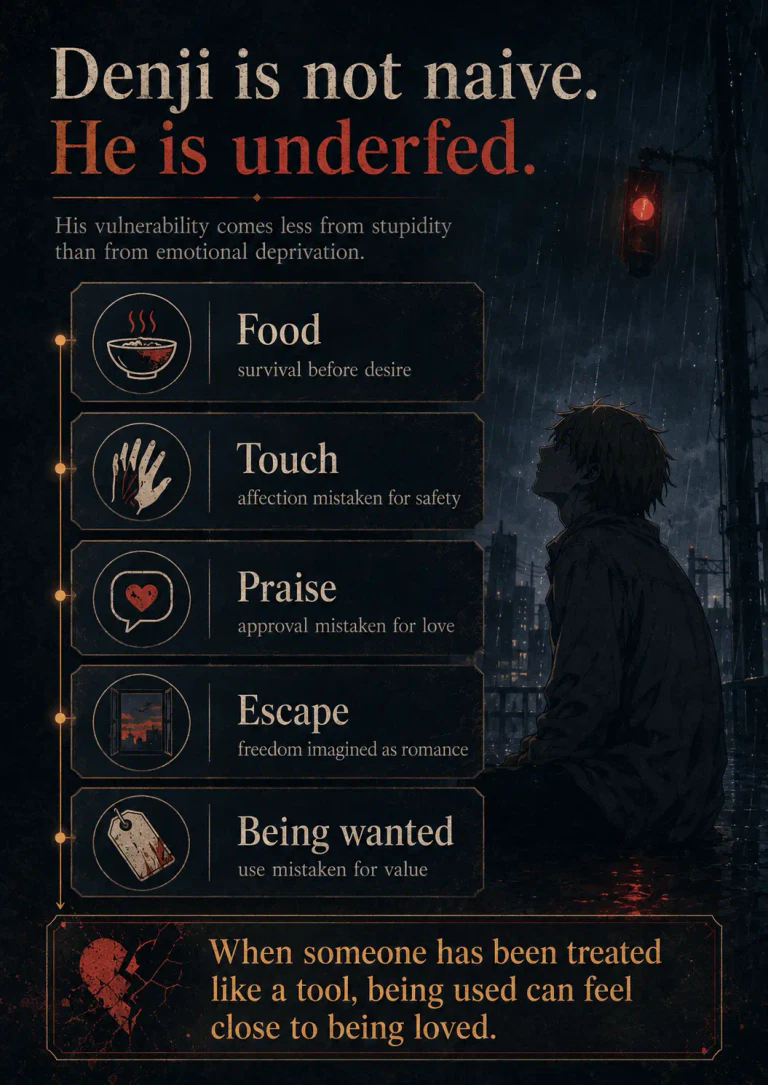
Denji is not stupid. He is underfed
The easiest mistake is to treat Denji’s desire as comedy.
He wants food. He wants touch. He wants a girlfriend. He wants sex. He wants comfort in the blunt, embarrassing, almost childish way that Chainsaw Man often puts on the surface. The series lets him be ridiculous. It lets his needs sound small, physical and crude.
But the joke is never only a joke.
Denji’s desires are primitive because his life has been primitive. He was not raised into emotional complexity. He was not given safety, education, steady affection, privacy, dignity or time to become sophisticated about his own needs. He learned hunger before he learned love. He learned debt before he learned trust. He learned usefulness before he learned selfhood.
That matters.
A person who has never been treated gently may not recognise gentleness as something that can be evaluated. He may only recognise it as relief. A person who has been used for labour, violence and survival may not immediately ask whether affection is authentic. He may ask whether it is finally happening.
Reze enters exactly there.
She does not need to convince Denji that she is perfect. She only needs to offer a version of attention that feels less controlled than Makima’s and less chaotic than his everyday life. She gives him a scene in which he can imagine himself not as a devil hunter, not as property, not as a dog, not as a tool, but as a boy with someone beside him.
That is not small.
For Denji, it is almost revolutionary.
Reze feels dangerous because she feels like an answer
Reze’s power is not only that she is charming. Many characters in Chainsaw Man are charming, monstrous or both. Her real danger is that she appears at the exact point where Denji’s emotional map is weakest.
Makima offers structure, desire and domination. She teaches Denji to want through hierarchy. Her affection is never free from control. Even when she smiles, the smile belongs to a system above him. Denji is pulled toward her because she gives shape to his longing, but that shape is vertical. She is above. He is below.
Reze feels different.
She seems closer to his level. She is not only an authority figure. She does not initially appear as a distant manager of his body and desires. She feels like someone who might meet him sideways, in the rain, in a shop, in the small spaces where normal romance might happen.
That is the trick.
Not that Reze is harmless.
That she feels like the kind of danger Denji can survive.
She gives him an alternative fantasy. Not the fantasy of being chosen by someone powerful, but the fantasy of escaping power altogether. With Reze, Denji can imagine a life outside commands. Outside missions. Outside being managed. Outside the humiliating economy of reward and obedience.
This is why the Reze Arc works as romance even when the audience knows it cannot be trusted.
It is not built on the question “is Reze good?”
It is built on the worse question:
What if the lie gives Denji something closer to truth than his real life does?
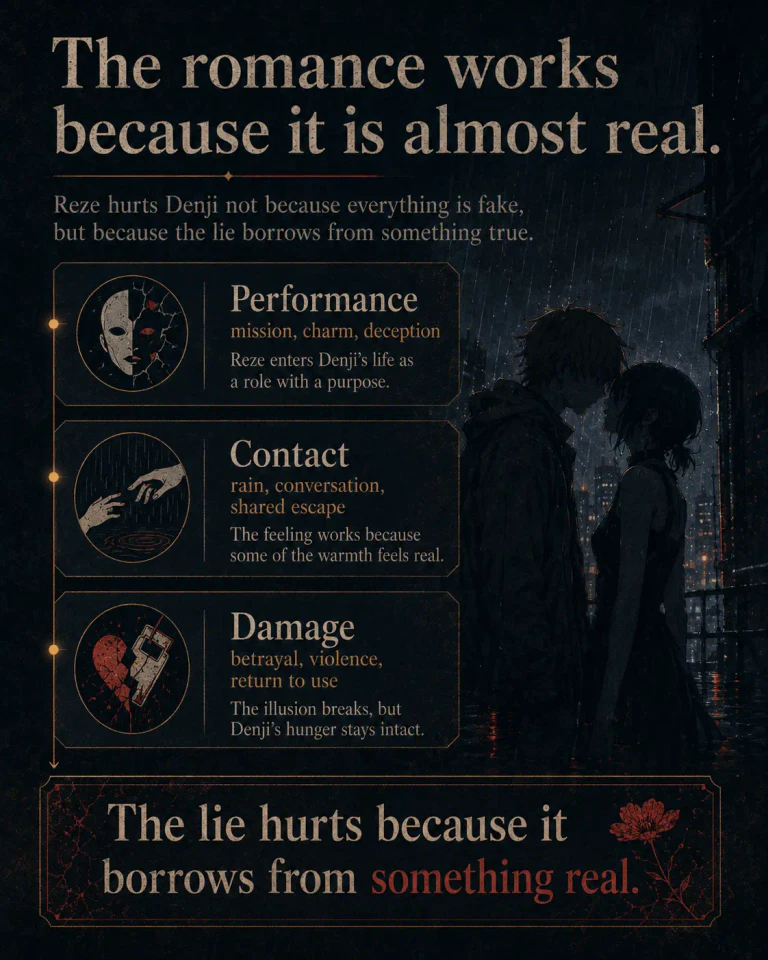
The romance works because it is almost real
If Reze were only acting, the story would be cleaner. Crueler in a simpler way, but cleaner.
She would be a spy. Denji would be a mark. The romance would be a tool. The betrayal would confirm what Chainsaw Man often says about power: tenderness is bait, and the hungry are easiest to catch.
But Reze Arc is stronger because it refuses that clean reading.
The best scenes between Denji and Reze carry the discomfort of something that might be both manipulation and contact. Reze plays a role, but the role is not empty. She may approach Denji with a mission, but the time they spend together does not feel mechanically fake. There is a looseness to it. A softness. A possibility that the performance begins to touch the performer.
That ambiguity is where Fujimoto does his damage.
He understands that the most painful manipulation is not always pure falsehood. Sometimes it works because it borrows from something real. A person can lie and still feel something. A person can use someone and still recognise their loneliness. A person can be an enemy and still glimpse the life they might have wanted if the world had not trained them otherwise.
This is why Reze is not interesting as a simple predator.
A simple predator consumes and moves on.
Reze leaves the impression of someone who may have found, too late and too briefly, a version of herself that did not have to be a weapon.
That does not absolve her. It makes the story worse.
Because Denji is not only being tricked by a lie.
He is being offered a truth that cannot survive its own context.
Fujimoto turns tenderness into a weapon without making it fake
Chainsaw Man is often violent in obvious ways: dismemberment, devils, blood, panic, grotesque bodies, sudden death. But Fujimoto’s sharper violence is emotional.
He repeatedly shows that tenderness can be real and still function as a weapon.
That is a more disturbing idea than simple cynicism. In a cynical story, affection is always fake. Everyone is using everyone. Love is just manipulation with softer lighting. Chainsaw Man does not quite believe that. It is darker and more generous at the same time.
Affection exists.
That is why it can hurt.
Denji’s problem is not that he believes in something completely imaginary. His problem is that he keeps encountering fragments of real human connection inside systems built to exploit him. A meal can be real and still be part of control. A touch can be real and still be transactional. A kiss can be real and still be humiliating. A romance can be real enough to matter and false enough to destroy him.
Reze embodies that contradiction.
She weaponises intimacy, but the weapon is not made of nothing. It is made of timing, need, possibility and the fact that Denji is desperate to be seen as a person before he is seen as Chainsaw Man.
That is the tragedy.
Not that Denji is fooled by a beautiful girl.
That he is fooled by the shape of a normal life.
Denji wants the ordinary more than the heroic
Many action stories pretend that ordinary life is what heroes leave behind.
Chainsaw Man inverts that desire.
Denji does not dream like a traditional hero. He does not begin with a noble mission, a kingdom to save, a grand revenge or a moral philosophy. His dreams are almost embarrassingly modest. Jam on bread. A place to sleep. A girl who likes him. A body that is not always in danger. A life that does not feel like punishment.
That makes Reze Arc cruel in a very specific way.
Reze does not tempt Denji with greatness. She tempts him with smallness.
The possibility of leaving. The possibility of not fighting. The possibility that love could be quiet and impractical and maybe even stupid. She offers him a dream that would look unambitious to almost anyone else. To Denji, it feels enormous.
This is where the arc becomes more than a tragic romance. It becomes a story about deprivation.
When someone has been denied ordinary life long enough, ordinariness becomes intoxicating. The fantasy is not power. It is not even sex, though Denji may think in those terms because his emotional vocabulary is damaged. The fantasy is being allowed to exist without being converted into use.
Reze’s betrayal hurts because it returns Denji to the old law of his world:
If someone wants you, check what they want you for.
Reze and Makima are not the same kind of danger
Because Denji is surrounded by women who manipulate him, it is tempting to flatten them into one category. That loses too much.
Makima and Reze both understand Denji’s hunger, but they use it differently.
Makima is structural control. She operates through hierarchy, reward, promise and ownership. Her intimacy is disciplinary. She does not simply attract Denji; she organises the world in which his attraction becomes a leash. Her power is cold because it makes Denji’s desires part of an administrative system.
Reze is more personal and more fleeting. Her danger is not the stable architecture of control, but the sudden possibility of escape. She is not frightening because she is above Denji in the same way Makima is. She is frightening because she can stand beside him and make the side door look real.
Makima trains obedience.
Reze awakens escape.
That difference matters because it changes Denji’s vulnerability. With Makima, he wants approval. With Reze, he wants an elsewhere. The first keeps him inside the system. The second makes him imagine leaving it.
This is why Reze Arc carries a strange tenderness even when it becomes violent. It briefly allows Denji to imagine that he could choose another life.
Then it makes that imagination unsafe.
The rain matters because it suspends the world
Reze Arc has an emotional weather.
Rain, night, shops, empty spaces, shared shelter — these are not just atmosphere. They create a temporary zone where Denji can believe the usual rules have softened. Public Safety feels farther away. Makima’s shadow feels less immediate. The violence of the larger plot waits outside the frame.
This is one of the reasons the arc feels romantic rather than merely seductive.
Romance often depends on the illusion of a pocket world. Two people step aside from ordinary life and behave as if the rest of the world has paused. For Denji and Reze, that pause is especially powerful because their ordinary world is not ordinary at all. It is made of devils, surveillance, missions, handlers and bodies turned into weapons.
The rain does not cleanse them.
It hides the machinery for a while.
That is enough for Denji. He does not need proof that the escape will last. He needs the feeling that it might. In a life built from immediate hunger, the temporary can feel as valuable as the permanent.
This is also why the arc’s beauty is dangerous. The audience can feel the lie and still want Denji to stay inside it a little longer.
That is the emotional trap.
We know better.
We still understand why he does not.
The betrayal is not the deepest wound
The obvious wound is betrayal.
Denji trusts, or almost trusts. Reze deceives him. Violence follows. The romance breaks. The story reveals its hidden mechanism.
But the deeper wound is not that Reze lied.
The deeper wound is that Denji’s longing remains intact.
He is not cured of wanting. He is not made wiser in a clean, empowering way. He does not emerge from the experience with a healthy suspicion that protects him from future harm. Chainsaw Man is not that kind of moral lesson.
Denji may learn something, but the need remains.
That is what makes him so vulnerable and so human. Trauma does not erase hunger. Betrayal does not automatically create emotional maturity. Being used does not stop a person from wanting to be loved. Sometimes it makes the wanting worse, because the brief illusion proved that another kind of life could be imagined.
This is the cruelest thing Reze gives him.
Not false love.
The image of a life in which love might have been possible.
Once Denji has seen that image, returning to his old reality is not the same. The world is not only violent now. It is deprived.
Reze is tragic because she also belongs to the machinery
Reze should not be read only as Denji’s wound.
She is also wounded by the structure that sends her toward him. Her role is not simply “girl who manipulates boy”. She is another person shaped into function. Another body placed inside a mission. Another young life trained to turn intimacy into technique.
That parallel is essential.
If Denji is a weapon being taught to want, Reze is a weapon being taught to perform want. Their meeting is not innocent, but it is also not merely one person preying on another from a position of uncomplicated freedom. Both are caught inside systems that use bodies, desire and violence for strategic ends.
This is what separates Chainsaw Man from simpler stories about seduction.
Reze is responsible for what she does, but she is not outside the machinery. She has her own damage, her own conditioning, her own impossible relation to freedom. The possibility that she might want to run away is not a sentimental excuse. It is a glimpse of how little space either of them has.
Two weapons meet and briefly imagine being teenagers.
That is the romance.
That is also why it cannot last.
The tragedy is that Denji would probably choose it again
The most painful reading of Reze Arc is not that Denji was too naive.
It is that, even knowing the danger, some part of him might still choose the moment again.
Not because he enjoys being used. Not because he fails to understand betrayal. But because the alternative is a life in which he never gets even the illusion of being wanted freely.
For a person with a secure life, illusion is cheap. For Denji, illusion can be shelter.
That does not make the manipulation acceptable. It makes the emotional economy of the story more brutal. Denji is not choosing between truth and lie in some clean philosophical sense. He is choosing between a harsh reality that repeatedly reduces him to function and a fragile falsehood that briefly lets him feel human.
Many people would choose badly under those conditions.
Chainsaw Man understands that. It does not mock him for it. It lets the audience feel the foolishness and the dignity of wanting more than survival.
That is why Denji remains one of the most strangely moving protagonists in modern shonen. His dreams are crude, but his deprivation is not. His stupidity is often the surface form of damage. His desire is comic until the story turns the light slightly and shows the wound underneath.
Reze Arc is one of the clearest examples of that method.
It makes Denji ridiculous, then breaks your heart for laughing too quickly.
Reze as the romance of manipulation
Chainsaw Man: Reze Arc should not be remembered only as a violent romance, a stylish movie arc or another case of Denji being manipulated by a dangerous woman.
Its real power lies in how precisely it understands emotional starvation.
Denji is not vulnerable because he is simply horny, foolish or immature. He is vulnerable because his life has taught him to confuse use with value. If someone needs him, he feels wanted. If someone touches him, he feels chosen. If someone offers escape, he cannot easily ask whether the door is real.
Reze enters that wound with terrible accuracy.
But the story is not powerful because she is a perfect deceiver. It is powerful because the deception almost becomes a life. For a few moments, the audience can understand why Denji believes in it, why Reze might hesitate inside it, and why the whole thing hurts more than a clean lie ever could.
That is Fujimoto’s gift and cruelty.
He does not simply say that love is fake.
He says that love can appear inside exploitation, and that this makes exploitation harder to survive.
The romance of Reze Arc is not tragic because it was never real.
It is tragic because it was real enough for Denji to need it.


