
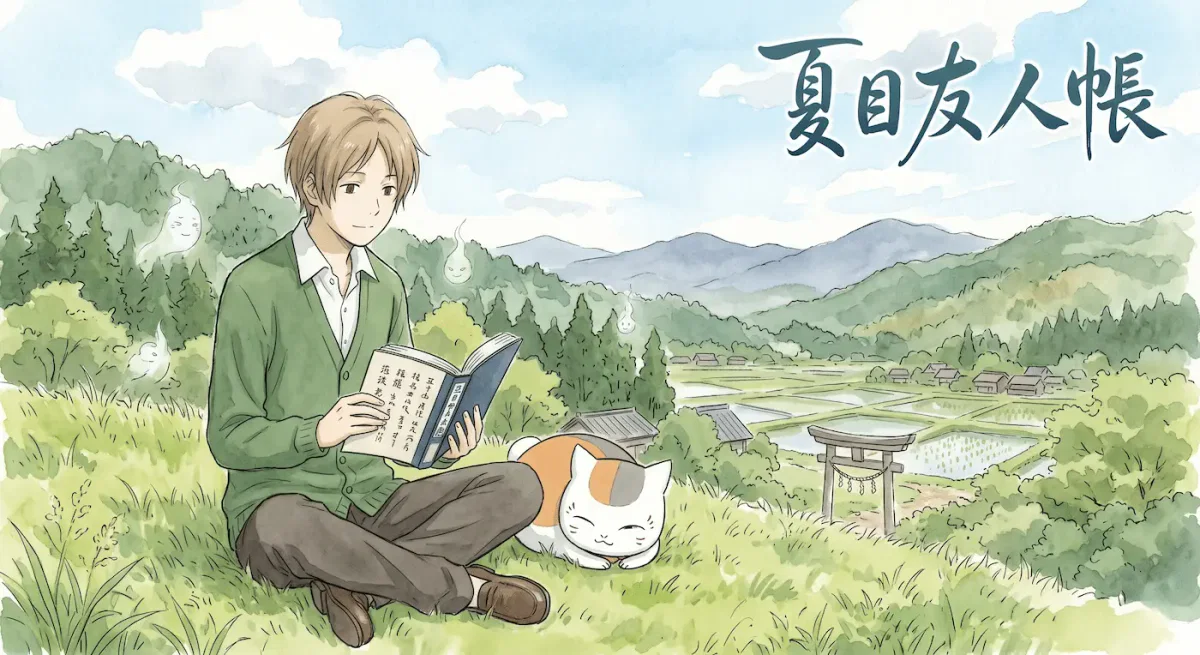
Key takeaways from the Natsume Yuujinchou analysis
"Natsume's Book of Friends" subverts traditional supernatural tropes by weaponizing empathy over violence. It utilizes Shinto folklore to create a profound exploration of childhood trauma, marginalized identities, and the exhausting but beautiful process of healing:
- 1. Yokai as metaphors for trauma and marginalization Natsume's spiritual sight serves as a powerful allegory for systemic childhood abuse and the exhausting performance of the closeted queer experience. The series refuses to romanticize this trauma, accurately portraying hyper-vigilance and dissociation while highlighting the absolute necessity of safe, unconditionally accepting communities.
- 2. Radical empathy and the iyashikei experience Unlike other series that isolate their protagonists, Natsume's journey bends toward emotional integration. Monsters are not slain but understood—revealed as beings lashing out from deep sorrow. Relinquishing power to return their stolen names becomes an act of mutual respect that actively heals the protagonist's own fractured soul.
- 3. A transcendent multimedia legacy Surviving over two decades, the franchise has successfully transitioned from episodic manga to anime, and now into interactive video games. Its muted watercolor aesthetics, haunting score, and melancholic atmosphere have deeply resonated with audiences, even revitalizing real-world locations like Hitoyoshi through dedicated fan pilgrimages.
Memory stands as a fragile construct, often fading long before we are ready to let it go. For those who walk a delicate line between the visible human realm and the invisible supernatural plane, this ephemeral nature of existence dictates every waking moment. The story of a boy who can see spirits captures this profound isolation with devastating clarity, completely avoiding the loud, violent tropes of typical supernatural fiction. As a definitive touchstone of modern animation, Natsume's Book of Friends offers a quiet meditation on loneliness and the slow, often agonizing process of learning to trust. The narrative breathes deliberately, allowing silence to carry the immense weight of unshed tears.
At the core of this narrative rests Takashi Natsume, an orphaned teenager burdened with a generational secret that brings him nothing but pain. Passed from one reluctant relative to another, he learned early in childhood that his reality was entirely unacceptable to the adult world. His visions of supernatural entities branded him a liar, painting him as a deeply unstable child seeking attention through elaborate and disturbing fabrications. Through his weary eyes, Natsume Yuujinchou explores the precise mechanics of childhood alienation and survival. He smiles constantly to placate his caregivers, hiding his terror behind empty, detached stares.
The absolute catalyst for his journey is a bizarre inherited heirloom left behind by his maternal grandmother, Reiko. This physical ledger contains the bound names of spirits she physically or magically defeated, granting the current holder absolute dominion over their existence. Yet, the protagonist of Natsume's Book of Friends flatly refuses to wield this power for personal gain. He embarks on an arduous mission to return every stolen name, an act that drains his physical stamina while slowly rebuilding his fractured soul. His monumental decision upends the traditional power fantasy, proving that authority can be relinquished in favor of mutual respect.
Serving as his bodyguard and cynical companion is Madara, an immensely powerful spirit trapped in the comical guise of a lucky cat. Nicknamed Nyanko-sensei, this ancient entity initially demands the ledger for himself, promising to simply wait around until the frail human dies. Their evolving dynamic forms the crucial emotional anchor of Natsume Yuujinchou, shifting away from a hostage situation into genuine camaraderie. What begins as a transactional pact softens into unspoken affection as the ancient beast learns the value of fleeting mortal lives. The isolated boy slowly learns that protection does not always come with painful conditions.
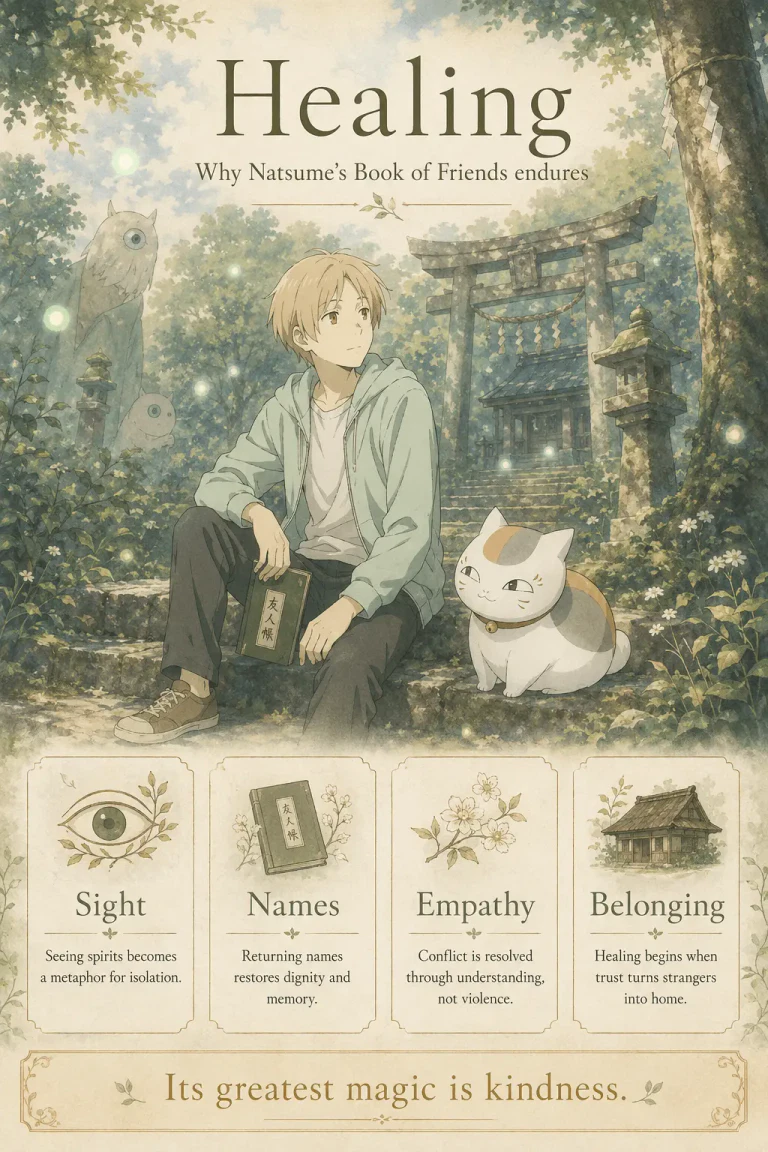
What makes Natsume's Book of Friends so special is its quiet rejection of typical supernatural tropes. Instead of defeating monsters with violence, Natsume resolves conflicts through understanding. The series reminds us that healing isn't always a dramatic breakthrough; often, it’s just the slow, quiet process of learning to trust people again after years of isolation.
Shinto roots and animated folklore
Spirituality in Japan relies heavily on an animistic understanding of the natural world. Shintoism dictates that sacred spirits, known as kami, reside within everyday objects, weather patterns, and geographic features. Within the universe of Natsume Yuujinchou, this polytheistic framework provides the foundational logic for every supernatural encounter the protagonist faces. The woods are never truly empty. The rain is never merely precipitation falling from the sky. There is a steady pulse beneath the surface of the mundane world, demanding constant acknowledgment and deep respect.
Unlike western monsters designed purely for horror, Japanese folklore presents entities with incredibly complex, human-like motivations. Ayakashi, a collective term often applied to spirits appearing above water surfaces, blur the lines between malicious demons and mischievous tricksters. The narrative structure of Natsume's Book of Friends leverages this historical ambiguity brilliantly. Creatures approach the boy not just to cause harm, but to seek favors, resolve ancient grudges, or simply cure their own crippling boredom. They are driven by petty jealousies and profound sorrows, mirroring the flaws of humanity.
Classification among these entities tightly dictates the power dynamics of the unseen realm. Greater spirits, formally known as daiyokai like Misuzu, command immense respect and wield destructive capabilities capable of leveling mountains. Yet, Natsume Yuujinchou frequently pulls the camera away from gods to focus on the lesser, drastically weaker beings. The vulnerable spirits hovering around abandoned shrines or hiding in teacups possess narratives just as compelling as the celestial deities. Their sheer fragility highlights the overarching theme of impermanence, proving that raw power does not equate to narrative worth.
Some entities completely blur the boundary between natural guardians and divine figures. A mysterious white owl with a ring on its leg might serve as a protector of a specific forest, operating on a moral axis entirely alien to human understanding. In Natsume's Book of Friends, the protagonist frequently stumbles into the strict jurisdiction of these territorial beings. He must navigate their rigid rules without fully comprehending their ancient, unspoken logic. Survival in these moments often depends on humility rather than brute force, because a misplaced step can invoke centuries of wrath.
| Entity Classification | Narrative Function | Example Characters |
|---|---|---|
| Kami (Gods) | Represent major natural forces, tied to geography | Tsuyukami |
| Daiyokai (Great Spirits) | Wield immense power, operate independently | Madara, Misuzu |
| Ayakashi / Lesser Yokai | Everyday spirits with specific grievances | Fox boy, Tsubame |
| Guardians | Protect specific domains or other spirits | The white owl |
To properly codify these interactions, the series maintains a strict adherence to traditional mythology while injecting highly modern emotional sensibilities. The spirits are treated as living beings rather than dusty cultural artifacts. In the vast context of Natsume Yuujinchou, they function as living memories of a Japan that is slowly paving over its shrines and forgetting its rural rituals. The true tragedy of the yokai is their creeping obsolescence. They are slowly fading from human memory, clinging desperately to the few individuals who still possess the sight to acknowledge their existence.
Metaphors for psychological trauma
Beneath the gorgeous supernatural veneer lies a devastatingly accurate portrayal of childhood abuse and systemic neglect. The protagonist's ability to perceive spirits functions as a highly detailed metaphor for mental illness, deeply isolating him from peers and caretakers alike. Watching Natsume's Book of Friends requires confronting the uncomfortable reality of how society systematically treats marginalized, troubled youth. Adults quickly brand him a habitual liar. Other children shun him for his sudden, inexplicable emotional outbursts. His environment is consistently hostile, forcing his nervous system into a state of perpetual hyper-vigilance.
The psychological scars physically manifest in recognizable patterns of post-traumatic stress. He suffers from recurring, violent nightmares, waking up in tears as the phantom voices of his past loudly accuse him of deceit. In the quiet, mundane moments of Natsume Yuujinchou, his friends notice his face suddenly tensing up, a distinct physical reaction to invisible triggers. He is terrified of becoming a burden to anyone. He assumes that any moment of peace is strictly temporary, and that the absolute slightest misstep will result in his immediate abandonment by those he loves.
Dissociation rapidly becomes his primary coping mechanism to survive the unexplainable. His current foster family observes him frequently acting detached and distant, his eyes empty as if his heart has completely left his physical body. The true brilliance of Natsume's Book of Friends lies in its absolute refusal to romanticize this trauma. His false smiles and eager-to-please demeanor are accurately recognized for what they are: desperate survival tactics learned in abusive homes. The show understands deeply that healing is never linear, and relapses into old fears happen regularly.
Manifestations of clinical despair
One particular episode introduces a horrifying spirit drawn exclusively to lonely hearts, treating human despair as a literal delicacy. This specific entity operates as a striking, terrifying personification of clinical depression. It physically forces the protagonist of Natsume Yuujinchou to verbalize his deepest self-loathing, whispering endlessly that he is fundamentally broken and entirely unworthy of love. The creature softly offers the release of oblivion. It is a chilling representation of suicidal ideation, weighing the certainty of nothingness against the frightening vulnerability of hoping for a better tomorrow.
Reiko Natsume, the enigmatic grandmother who started the ledger, represents the tragic alternative to recovery. Society viewed her entirely through a heavily gendered lens of mental illness, labeling her as "not right in the head" and judging her harshly for failing to fulfill traditional expectations like marriage. Within the history of Natsume's Book of Friends, she died young beneath a tree, completely forgotten by humans. She fully embraced the isolation that her grandson is actively trying to escape. She remains a haunting cautionary tale of untreated, festering trauma. Makoto Yoshimori’s soundtrack is what truly brings the show's atmosphere to life. Rather than sticking only to relaxing acoustic tunes, the music isn't afraid to use strange, discordant sounds when the yōkai appear. This contrast perfectly captures the show's core feeling: the spirit world is beautiful, but it can also be genuinely unnerving.
True recovery requires a highly stabilizing environment, provided here by the unconditionally loving Fujiwara family. They act as the total antithesis of his previous abusers. They cross rigid social boundaries to rescue him from neglect, demanding absolutely nothing in return. Their role in Natsume Yuujinchou cannot be overstated. They accept his awkward attempts at connection without forcing him to painfully disclose his secrets before he is completely ready. They accommodate his erratic behavior with profound patience, providing the quiet safety necessary for a nervous system to finally heal.
Subtext and queer relationships
The hidden world of yōkai can easily be read as a metaphor for the closeted queer experience. Natsume lives in two realities, constantly trying to figure out who is safe to confide in and masking his true self to fit in. The series beautifully captures the quiet, daily exhaustion of having to pretend you are someone else just to feel accepted.
This heavy subtext crystallizes beautifully through his relationship with Kaname Tanuma, the quiet son of a local priest. Tanuma possesses a faint sensitivity to the supernatural, able to see shifting shadows and sense magical disruptions without full visual clarity. Their shared existence in this delicate liminal space allows the protagonist of Natsume Yuujinchou to feel truly perceived for the very first time. Tanuma does not dismiss his reality. He actively seeks to understand it, slowly bridging the massive gap between the mundane human world and the isolating realm of spirits.
Their dynamic is defined by a highly delicate, complementary balance. Tanuma's calm, grounded demeanor successfully levels out the rash, impulsive decisions born from years of unhealed trauma. As they grow closer in Natsume's Book of Friends, they develop a fierce mutual reliance. The boy with the clear sight leans heavily on the boy with the vague sensitivity. They protect one another with a tunnel-vision devotion that entirely transcends traditional shounen camaraderie. It is a quiet, intense intimacy forged in the spaces where conventional society cannot intrude.
Visualizing the closet experience
Specific linguistic choices heavily elevate this bond far above mere friendship. While standard acquaintances are referred to with highly casual terminology, Tanuma is frequently designated as a "taisetsu na tomodachi," translating roughly to an important or precious friend. The visual framing of Natsume Yuujinchou amplifies this reverence dramatically. Their interactions are steeped in overwhelmingly atmospheric romance. They are constantly framed against breathtaking sunsets, standing side-by-side on verandas, or quietly watching the reflections of koi fish dance across a wooden ceiling. The direction deliberately lingers on their quiet proximity.
The absolute turning point of their relationship occurs when the heavy burden of the past is finally shared aloud. Confiding the complete truth about his grandmother and the ledger marks a monumental shift in emotional trust. According to the original author of Natsume's Book of Friends, this difficult confession was entirely necessary for the protagonist to begin processing his grief. Opening the closet door to someone who will definitely not run away is the ultimate act of vulnerability. It completely shatters the generational curse of isolation left behind by Reiko.
Parallel dynamics exist constantly on the periphery, adding rich texture to this thematic exploration. The tense, ideologically opposed relationship between the actors Shuuichi Natori and Matoba provides a much darker reflection of shared supernatural burdens. Unlike the gentle acceptance found elsewhere in Natsume Yuujinchou, the exorcist clans operate purely on control and violent subjugation. They perfectly represent the toxic elements of an insular, terrified community. They offer raw power and belonging, but demand the total sacrifice of empathy in exchange.
Adapting the original manga
The difficult transition from printed page to television screen required a careful, highly strategic restructuring of narrative flow. Yuki Midorikawa originally launched the manga in Hakusensha's LaLa DX magazine in 2003 as a strictly episodic serial. Each individual chapter was designed to be consumed entirely independently. When adapting Natsume's Book of Friends, the production committees faced the massive challenge of weaving these isolated vignettes into cohesive seasonal arcs. The result is an anime that deliberately shuffles the chronological order of the source material to maximize emotional impact.
Visual alterations were made very early in production to suit the demands of the animated medium. In the original manga pages, the protagonist possesses striking white hair and bright green eyes, giving him an inherently ethereal, almost ghostly appearance. However, the anime directors for Natsume Yuujinchou opted to visually ground him with sandy brown hair and muted eyes. This seemingly minor color change significantly alters his overall character design. It strips away the overt visual markers of the supernatural, making his internal, invisible alienation feel even more profound against an ordinary exterior.
The structural editing of television episodes frequently combines smaller, unrelated manga stories into robust narratives. The universally beloved arc featuring the little fox boy, for instance, does not actually exist as a single cohesive chapter in the manga. The brilliant anime staff of Natsume's Book of Friends meticulously stitched together a few short, disparate vignettes to create one of the most effective and tear-jerking episodes of the first season. This editorial liberty demonstrates a deep, intuitive understanding of pacing and emotional buildup, utilizing the unique strengths of television.

Studio shifts and staff continuity
Production duties surprisingly shifted over the franchise's extensive, multi-year lifespan. Brain's Base handled the foundational first four seasons, perfectly establishing the delicate aesthetic tone. From the highly anticipated fifth season onward, the newly formed studio Shuka took over the massive production of Natsume Yuujinchou. Despite the jarring change in animation houses, the visual transition was virtually imperceptible. The core creative staff, including chief director Takahiro Omori, remained entirely intact, ensuring the melancholic atmosphere and pastoral beauty survived the corporate restructuring.
| Season | Premiere Year | Animation Studio | Notable Episodes / Arcs |
|---|---|---|---|
| Season 1 | 2008 | Brain's Base | The Little Fox Boy, Tsubame |
| Season 2 (Zoku) | 2009 | Brain's Base | The Black Board, The Dew God |
| Season 3 (San) | 2011 | Brain's Base | Young Days, A Place to Go Home To |
| Season 4 (Shi) | 2012 | Brain's Base | The Mansion Fire, The East Forest |
| Season 5 (Go) | 2016 | Shuka | False Image, The Unchanging Form |
| Season 6 (Roku) | 2017 | Shuka | The Day the Tree Bears Fruit |
| Season 7 (Urushi) | 2024 | Shuka | The Fragment's Lament, Chobi's Treasure |
Fans waited seven arduous, agonizing years between the conclusion of the sixth and the premiere of the seventh seasons. When the fall 2024 release was finally announced, the global community response was overwhelmingly ecstatic. The seventh iteration of Natsume's Book of Friends proudly brought back director Hideki Ito and series composer Sadayuki Murai. Episodes like "The Fragment's Lament" and "Someday's Garden" quickly proved that the massive passage of time had not dulled the franchise's emotional blade. The pacing remained incredibly deliberate, refusing to accelerate into modern, fast-cut anime trends.
Because the source manga currently spans 33 volumes and remains happily ongoing, the anime still has ample material left to adapt. The sixth season officially left off around volumes 20 and 21, meaning the television series is still playing a long game of catch-up. Dedicated fans of Natsume Yuujinchou often debate the artistic merits of both mediums. The manga offers the raw, unfiltered vision of Midorikawa, while the anime provides the undeniable emotional weight of Makoto Yoshimori's score and the flawless, career-defining voice acting of Hiroshi Kamiya.
Defining the iyashikei experience
The current anime landscape is filled with hundreds of subgenres, but few are as deeply psychological as iyashikei, or "healing" anime. These specific shows are intricately designed to soothe the viewer, relying heavily on pastoral atmospheres and low-stakes conflicts. Yet, to categorize this specific series as merely relaxing is a severe disservice to its profound depth. The healing presented in Natsume's Book of Friends is hard-won and bloody. It is not the mere absence of pain, but the active, exhausting process of confronting it. The rustic charm serves only as a soft landing pad for heavy emotional falls.
Comparisons are frequently and loudly drawn between this series and another iyashikei masterpiece, Mushishi. Both feature highly episodic encounters with supernatural entities placed in rural Japanese settings. However, their fundamental approaches to human connection are diametrically opposed. In Mushishi, the traveling protagonist Ginko fully embraces a lifestyle of permanent, necessary isolation. In stark contrast, the core thematic drive of Natsume Yuujinchou is the desperate, terrifying yearning for community. The supernatural intrigue is merely the vehicle; the ultimate destination is always human empathy.
Contrasting paths in Mushishi
The permanence of loneliness clearly defines the critical difference between the two monumental works. Mushishi leaves its human characters forever altered, often permanently isolated by the bizarre phenomena they barely survived. The narrative trajectory of Natsume's Book of Friends bends inevitably and beautifully toward warmth. Every single season documents a slow, agonizing crawl out of the dark. The protagonist learns to rely on his foster parents, to banter lightly with school friends, and to trust the spirits. It is a story of total integration, rather than perpetual, lonely wandering.
This optimistic integration does not mean the endings are uniformly happy. The series excels marvelously at the bittersweet conclusion. Spirits operate on a vastly different temporal scale than humans, meaning every single relationship forged is inherently doomed by human mortality. The yokai of Natsume Yuujinchou watch their human companions wither and die in what feels like a mere blink of an eye. The show repeatedly asks the viewer how we survive the absolute inevitability of loss. The answer, whispered through falling cherry blossoms, is that the fleeting nature of the connection is precisely what makes it beautiful.
Watching these gentle episodes before bed has become a sacred ritual for many exhausted fans. The sylvan atmosphere, the gentle rustle of painted leaves, and the quiet murmurs of rural life create a strangely calming, hypnotic effect. It is the television equivalent of a deep, steadying breath. But Natsume's Book of Friends never lets the viewer forget the invisible threads binding broken people together. It demands reflection. It constantly leaves a residual ache in the chest, a profound reminder of the immense courage required to simply speak your truth.

Muted watercolors and environment
Yuki Midorikawa's unique art style is a masterclass in delicate restraint. Her original illustrations rely heavily on soft shading and watercolor techniques, creating a visual landscape that feels both deeply nostalgic and slightly unreal. When translating this complex aesthetic to the screen, the art directors for Natsume Yuujinchou utilized a highly muted palette of earthy hues and pastel tones. The greens of the forest are not vibrant and harsh; they are intentionally washed out, echoing the hazy, dreamlike quality of a distant summer memory.
The visual compositions frequently emphasize the sheer scale of the natural world compared to the fragility of the human form. Characters are rarely framed in tight, claustrophobic close-ups. Instead, the camera in Natsume's Book of Friends pulls way back, situating the small boy and the giant beast within vast, empty fields or beneath towering, ancient trees. This spatial awareness continuously reinforces the Shinto themes of the narrative. The environment is not a passive backdrop; it is an active participant in the story, humming loudly with unseen life.
Character designs intentionally and strictly avoid the exaggerated proportions common in mainstream anime. The protagonist is mild-mannered and soft-spoken, and his visual design perfectly reflects this gentle passivity. Even the formidable spirits in Natsume Yuujinchou are drawn with a keen eye toward cultural authenticity rather than grotesque horror. From the majestic, wolf-like true form of Madara to the bizarre, abstract shapes of the lesser forest dwellers, the creature designs draw heavily from historical Japanese scrolls and traditional folklore iconography.
Lighting plays an absolutely critical role in establishing profound emotional resonance. Sunsets are a massive recurring motif, bathing the rural landscape in a melancholic, bleeding orange glow. This twilight hour, traditionally known as the dangerous time when the boundary between worlds thins, serves as the stage for the most profound conversations in Natsume's Book of Friends. The dappled sunlight filtering through the leaves creates a deep sense of transient beauty. Every frame feels like a delicate painting that could wash away in the next heavy rain.
Auditory landscapes by Yoshimori
If the visuals flawlessly provide the atmosphere, the original soundtrack by Makoto Yoshimori provides the beating soul. His brilliant compositions are a study in wild contrast, swinging wildly between soothing acoustic melodies and deeply unsettling experimental noise. The emotional baseline of Natsume Yuujinchou is firmly established through tracks that evoke the sluggish warmth of a lazy summer day. Guitars and pianos interlock in slow, repetitive patterns that feel far less like structured songs and much more like the natural rhythm of breathing.
The iconic theme song, "Kimi ga Yobu Namae," perfectly encapsulates this elegant subtlety. It opens with a slow accordion melody that drifts lazily through the air, eventually giving way to a piano segment that is nothing short of soul-stirring. Yoshimori understands completely that the music of Natsume's Book of Friends must never overpower the fragile dialogue. It remains respectfully subdued, swelling only in the final moments of an episode to release the heavy tension that has been quietly building for twenty minutes.
Vocals are used very sparingly but to absolutely devastating effect. The haunting track "Atatakai Basho" features the voice actor Hiroshi Kamiya singing in a incredibly soft, restrained register. Because he is not a trained powerhouse vocalist, his performance feels incredibly vulnerable and deeply authentic. It grounds the auditory experience of Natsume Yuujinchou, offering a soothing, melancholic lullaby that speaks directly to the protagonist's desperate search for a warm place to belong. It leaves the listener with a profound sense of comfort.
Experimental supernatural tension
However, Yoshimori is entirely unafraid of the bizarre. To accurately represent the alien nature of the spirits, he frequently deploys highly experimental, discordant tracks. The piece "Natsu Mado Hirakettanashi" totally abandons traditional melody entirely, using electronic droning to literally imitate a massive swarm of mosquitoes. It is an abrasive, deeply irritating sound. Yet, in the terrifying context of Natsume's Book of Friends, it brilliantly projects the overwhelming, chaotic presence of the supernatural violently bleeding into the mundane world.
This auditory tension extends beautifully to tracks like "Oushi Za no Kaijin," which relies heavily on guttural moaning and growling sounds to create a genuinely off-putting atmosphere. When a massive gathering of spirits occurs, the score erupts into "Hyakkiyagyou," a cacophonous, discordant melody that mimics a terrifying ceremonial war dance. The musical direction of Natsume Yuujinchou demands that the viewer physically feel the danger. The spirits are not always friendly; sometimes, they are ancient, incomprehensible forces, and the music screams this truth when words fail.
Pilgrimage to rural Hitoyoshi
The pastoral beauty depicted on screen is not entirely fictional. Yuki Midorikawa based the setting heavily on her hometown of Hitoyoshi, located deep in the Kumamoto prefecture of Kyushu. Over the passing years, this quiet rural city has become a sacred pilgrimage site for dedicated fans. Enthusiasts of Natsume's Book of Friends travel from across the globe to engage in "seichi junrei," or holy land pilgrimage, seeking out the exact bridges, shrines, and train stations meticulously recreated in the anime's background art.
The physical locations offer a tangible connection to the story's emotional core. The Amemiya Shrine, heavily featured as the protagonist's childhood secret base and the home of the dew god, sits quietly amid towering trees. Fans reverently leave notes and drawings at these sites. The Kamishikimi Kumanoimasu Shrine, with its moss-covered stone steps winding up into the dark forest, looks as though a spirit could materialize at any second. For hardcore followers of Natsume Yuujinchou, standing in these spaces is a profoundly spiritual experience.
| Pilgrimage Location | Anime Significance | Status / Note |
|---|---|---|
| Amemiya Shrine | Natsume's childhood secret base | Intact, heavily visited |
| Kamishikimi Shrine | Forest atmosphere and spirit pathways | Iconic mossy steps |
| Tengu Bridge | Opening credits and transition scenes | Overlooks Kuma River |
| Setoishi Station | Model for Moriguchi Station (Episode 5) | Destroyed in 2020 |
Hitoyoshi has warmly welcomed fans of the series, even providing maps so visitors can find the exact bridges and shrines seen in the anime. It’s heartwarming to see how a story about finding community has quietly helped support the real-world town that inspired it.
Community resilience after floods
Tragedy struck the entire region in July 2020. Severe flooding of the Kuma River caused massive devastation to Hitoyoshi and the surrounding areas. The essential rail service was destroyed, and several key locations, including the Setoishi station building used as a model in the anime, were completely washed away. The global community surrounding Natsume Yuujinchou rallied impressively in the immediate aftermath. Fans organized massive donation drives and charity campaigns to assist in the recovery efforts, demonstrating the show's core message of unconditional empathy in real time.
The horrible damage altered the landscape forever, adding a thick layer of tragic irony to the pilgrimage. The series has always been deeply about the impermanence of existence and the slow fading of memory. Now, the physical locations that directly inspired Natsume's Book of Friends are themselves heavily subject to the cruel whims of nature. The rail line remains down, and certain vistas live on only in the animated frames. The anime has inadvertently become a historical archive, perfectly preserving the rustic charm of a town before the floodwaters rose.
Expanding into interactive media
As the franchise moves confidently into its third decade, the mechanisms for storytelling continue to expand rapidly. In a landmark announcement, Toydium and Bushiroad Games revealed the development of the very first video game adaptation, officially titled Hazuki no Shirushi. Slated for release on June 5, 2025, for the Nintendo Switch and PC via Steam, this massive project represents a monumental shift. Fans of Natsume Yuujinchou will finally be able to step out of the role of passive observer and actively participate in the emotional labor of the narrative.
The gameplay purposefully eschews traditional action mechanics in favor of a highly relaxing, emotional summer vacation simulation. Players step into the shoes of the protagonist during the brief break after his first school term. The core loop of the Natsume's Book of Friends game revolves around completing daily chores for the Fujiwara family, spending idle time with human friends like Tanuma and Nishimura, and offering careful counsel to troubled spirits. It is an interactive translation of the iyashikei genre, strictly prioritizing atmosphere over adrenaline.
Completing requests for the local yokai unravels highly specific narrative threads, ultimately leading to one of five possible endings. The developers have promised a deeply original story unique to the game, ensuring it is not merely a lazy rehash of old episodes. However, the game also functions beautifully as a nostalgia engine for long-time followers of Natsume Yuujinchou. Certain quests will trigger emotional callbacks to memorable scenes from the first seven seasons, allowing the player to reflect on the immense journey the boy has undertaken.
Merchandising and fan engagement
The pricing structure heavily reflects a targeted approach toward dedicated collectors. The standard digital edition retails for approximately $51 USD, but the limited first-print physical edition, priced around $83 USD, offers a massive trove of physical merchandise. Buyers receive a Nyanko-sensei pencil case, an A3 clear poster, original badges, and exclusive bromide cards. This brilliant merchandising strategy highlights the enduring commercial viability of Natsume's Book of Friends. The aesthetic of the show translates perfectly into physical goods that successfully evoke a sense of calm.
This interactive leap proves clearly that the intellectual property is far from stagnant. While the manga continues its slow, steady serialization and the anime releases seasons at a glacial pace, the video game completely opens a new avenue for deep immersion. It allows the world of Natsume Yuujinchou to be fully lived in, rather than just watched. By focusing on the quiet moments of a summer vacation, the developers understand perfectly that the true appeal of the franchise has always been the spaces between the supernatural events.
Emotional resonance in vignettes
To truly understand the cultural weight of the series, one must closely examine the specific episodes that cemented its legacy. The heartbreaking story of the little fox boy remains a touchstone for conditional love. After the protagonist rescues the kitsune from bullies, the young spirit develops an overwhelming attachment, eventually leaving the safety of his forest to desperately find the boy in the human world. This episode of Natsume's Book of Friends perfectly encapsulates the core thesis: a single act of small kindness is never wasted, rippling outward to change a life forever.
Equally devastating is the haunting tale of Tsuyukami, the tiny dew god. Shinto deities absolutely require human belief to sustain their physical existence. As the rural population heavily dwindles, Tsuyukami shrinks, tethered to the mortal plane by only one single elderly worshipper. When she passes away, he does not express anger, but profound gratitude for having been loved at all. Watching him fade into nothingness is a masterclass in emotional pacing. Natsume Yuujinchou handles the complex concept of death not as a violent end, but as a gentle, inevitable transition.
Bittersweet farewells to spirits
The franchise frequently uses mundane objects to magically anchor its emotional weight. In the OVA featuring the snow spirit Yuki Hana, a fleeting winter encounter sharply underscores the tragedy of vastly different lifespans. The spirit desperately searches for something lost in the snow, melting away painfully as spring approaches. Or consider the yokai couple making sake cups in the pale moonlight. These vignettes in Natsume's Book of Friends are not about saving the world. They are about honoring a promise made centuries ago. They are about the immense dignity of remembering those whom history has forgotten.
Narrative tension is occasionally ratcheted up to heavily test the protagonist's growth. The terrifying episode involving the mansion fire forces him to actively race against the clock, working closely alongside the exorcist Natori. Yet, even in high-stakes scenarios, the ultimate resolution of Natsume Yuujinchou rarely involves destroying the antagonist. The conflict usually ends with a quiet revelation of shared pain. The "monster" is almost always a creature lashing out from a place of deep, unhealed trauma. Radical forgiveness becomes the most powerful weapon in the narrative arsenal.
Perhaps the most deeply resonant scenes are those lacking dialogue entirely. Fans consistently point to the quiet moments: a gentle smile exchanged between human and spirit, or the melancholic gaze of a yokai watching cherry blossoms fall. The realization that the boy will eventually die, leaving his immortal friends behind, hangs terribly heavy over every interaction. Yet, as one character in Natsume's Book of Friends eloquently states, "We know the flower petals will fall someday, yet we are still entranced by them." The grief is the necessary price of the joy.
Enduring impact on animation
Surviving in the incredibly volatile anime industry for over two decades is a massive anomaly. The series debuted in print in 2003, seamlessly transitioned to television in 2008, and remains a foundational cornerstone of the medium in 2024. The massive staying power of Natsume Yuujinchou is not driven by viral marketing or spectacular battle choreography. It is sustained by an absolutely unwavering commitment to its core philosophy. It provides a quiet sanctuary for the weary. It offers a consistent, reliable warmth in an increasingly cynical, loud cultural landscape.
By beautifully utilizing the framework of Japanese folklore, the narrative translates profound human truths into easily digestible parables. The spirits are merely reflections of our own deep inadequacies, our crippling fears of abandonment, and our desperate need to be perceived accurately. Through the delicate lens of Natsume's Book of Friends, the viewer is forced to confront their own biases and traumas. The journey of the orphaned boy returning names is, ultimately, the deeply relatable journey of reclaiming one's own identity from the people who violently tried to rewrite it.
The flawless transition across entirely different mediums demonstrates the vast flexibility of the intellectual property. Whether you are reading the slow, deliberate panels of Midorikawa's art, listening to the swelling accordion of Yoshimori's score, or walking the physical streets of Hitoyoshi, the profound emotional result is identical. The universe of Natsume Yuujinchou demands that we slow down. It demands that we look incredibly closely at the shadows, not with fear, but with an open, bleeding heart.
As long as there are people who feel heavily alienated, who struggle to find their voice, or who carry the heavy weight of invisible scars, this profound story will remain entirely relevant. The brilliant legacy is totally secure. It is not just a beautifully animated show about ghosts. The enduring phenomenon of Natsume's Book of Friends is a continuous, quiet revolution of empathy, proving year after year that the sheer courage to speak your truth is the most extraordinary magic of all.


